Oilfield Casing Spools Market Size, Share & Industry Analysis, By Working Pressure (Below 3,000 PSI, 3,000 – 5,000 PSI, 5,000 – 10,000 PSI, 10,000 – 15,000 PSI, and Above 15,000 PSI), By Application (Onshore and Offshore), and Regional Forecast, 2026-2034
 Download Free Sample
Oilfield Casing Spools Market Size and Future Outlook
 Listen to Audio Version
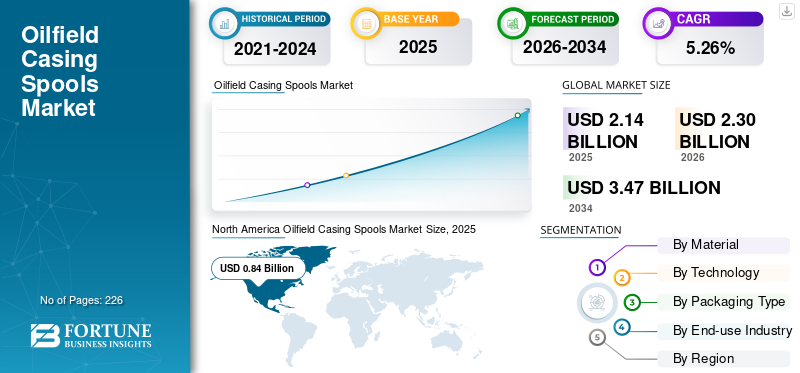
The global oilfield casing spools market size was valued at USD 2.14 billion in 2025. The market is projected to grow from USD 2.30 billion in 2026 to USD 3.47 billion by 2034, with a CAGR of 5.26% over the forecast period. North America dominated the oilfield casing spools market with a market share of 39.25% in 2025.
A casing spool is installed between casing strings to support and suspend casing pipes, seal the annular space, and provide outlets for pressure-monitoring and well-control equipment. The market for oilfield casing spools comprises manufactures and supplies casing spools, a key component of wellhead systems in oil and gas drilling operations. This component is designed to withstand high pressure and harsh operating conditions in both onshore and offshore wells. Global drilling activities, upstream oil and gas investments, and increasing development of deepwater and high-pressure wells drives the demand in the market. Demand for casing spools is closely linked to the number of wells drilled and the complexity of wellhead configurations required in modern drilling operations.
The growth of the market is primarily driven by rising global demand for oil and natural gas, which is encouraging exploration and production across onshore and offshore fields. Rising investments in deepwater and ultra-deepwater drilling projects are also boosting demand for high-pressure wellhead components, including casing spools. Additionally, the expansion of shale oil and gas drilling, particularly in North America, is increasing the number of wells drilled annually, directly supporting equipment demand. Technological advancements in High-Pressure, High-Temperature (HPHT) wellhead systems and the ongoing redevelopment of mature oilfields are further contributing to market growth.
Key players operating in the market include SLB, Baker Hughes, NOV Inc., TechnipFMC, and Weatherford International. These companies play a crucial role in designing, manufacturing, and supplying wellhead equipment, including casing spools. Their extensive global presence, engineering capabilities, and integrated oilfield service offerings enable them to supply casing spool systems for both onshore and offshore wells.
Download Free sample to learn more about this report.
OILFIELD CASING SPOOLS MARKET KEY TAKEAWAYS
 Global Market Size & Forecast
- 2025 Market Size: USD 2.14 billion
- 2026 Market Size: USD 2.30 billion
- 2034 Forecast Market Size: USD 3.47 billion
- CAGR: 5.26% from 2026-2034
 Market Share
- North America captured the largest oilfield casing spools market share of 39.25% in 2025.
- The 5,000–10,000 PSI segment captured nearly 36.75% of the market share.
- The above 15,000 PSI segment is anticipated to grow at a 7.70% CAGR over the forecast period.
 Key Regional Highlights
North America
North America held the largest oilfield casing spools market, reaching USD 0.84 billion in 2025 and representing 38.38% of the global market.
Europe
Europe accounted for USD 0.30 billion in 2025, representing approximately 13.93% of global revenues.
Asia Pacific
The Asia Pacific market reached USD 0.65 billion in 2025, contributing approximately 31.14% of global revenue.
U.S.
The U.S. market was valued at approximately USD 0.67 billion in 2025 and is projected to increase to USD 0.71 billion in 2026.
Japan
Rapid industrialization and population growth across the region continue to drive energy consumption, encouraging governments and national oil companies to expand exploration programs and field development projects
Read More

Oilfield Casing Spools Market Trends
Increasing Adoption of High-Pressure and Deepwater Wellhead Systems is a Key Market Trend
A major global trend in the market is growing demand for equipment designed for High-Pressure, High-Temperature (HPHT) and deepwater wells. As conventional onshore reserves mature, oil and gas companies are increasingly exploring deeper reservoirs and offshore basins where pressure and temperature conditions are significantly higher. In deepwater environments such as offshore Brazil and the Gulf of Mexico, wells often reach depths of over 6,000 meters, requiring casing spools capable of handling pressures above 10,000 PSI. These extreme conditions require stronger materials, advanced sealing technologies, and higher-pressure wellhead assemblies. As a result, equipment manufacturers are focusing on developing casing spools with enhanced durability and improved corrosion resistance. The global expansion of deepwater exploration and technically complex drilling projects is therefore shaping product innovation and driving demand for advanced casing spool systems.
MARKET DYNAMICS
Market Drivers
Download Free sample to learn more about this report.
Rising Global Oil and Gas Drilling Activities to Boost the Market Progress
One of the primary drivers of the global market is the steady increase in oil and gas drilling activity. Since casing spools are essential components of wellhead systems, demand for them grows directly with the number of wells drilled. Global oil demand remains strong due to industrial growth, transportation needs, and rising energy consumption in developing economies. According to international energy statistics, global oil demand exceeded 102 million barrels per day in 2024, reflecting continued reliance on hydrocarbons for energy supply. To maintain production levels, oil-producing countries and companies are investing in new exploration and field development projects. National oil companies in the Middle East, North America, and Asia are expanding drilling programs to sustain output and offset natural field decline. As new wells are drilled and existing fields are redeveloped, the need for wellhead equipment, such as casing spools, continues to increase globally.
Market Restraints
Global Energy Transition and Reduced Long-Term Fossil Fuel Dependence to Limit the Market Expansion
A key restraint for the market is the accelerating global transition toward cleaner energy sources and reduced dependence on fossil fuels. Governments from all over the globe are implementing policies to lower carbon emissions and promote renewable energy technologies such as solar, wind, and hydrogen. In recent years, global renewable energy capacity has expanded rapidly, with annual additions exceeding 500 gigawatts in 2023. Many countries have also adopted long-term strategies to achieve net-zero greenhouse gas emissions by 2050, which may gradually reduce future oil and gas exploration activities. As energy companies diversify their investments toward renewable energy projects and low-carbon technologies, some upstream oil and gas spending could slow in the long term. Since casing spools are directly linked to drilling operations, reduced exploration activity could moderate future growth in certain regions.
Market Opportunities
Development of New Offshore Oil Provinces to Create New Growth Avenues
The discovery and development of new offshore oil and gas provinces present a significant growth opportunity for the market. Recent discoveries in regions such as Guyana, Namibia, and offshore Suriname have attracted major investments from international oil companies. For example, Guyana's offshore oil production has increased rapidly since its first commercial output in 2019, with production expected to exceed 1 million barrels per day in the early 2030s as multiple new projects are developed. Each offshore project requires drilling numerous production and injection wells, each of which requires a wellhead assembly with a casing spool. Offshore wells often operate under higher pressures and harsher environmental conditions than onshore wells, increasing the demand for high-performance casing spool systems. As exploration continues in frontier basins and new offshore production hubs emerge globally, equipment suppliers have strong opportunities to expand their presence in the market during the forecast period.
Market Challenges
Fluctuations in Global Oil Prices and Upstream Investment to Limit Market Growth
A significant challenge affecting the global oilfield casing spools market growth is the volatility of oil prices, which directly influences exploration and production investment. Oil prices are affected by multiple factors, including geopolitical tensions, global economic conditions, and supply-demand imbalances. Sudden price declines can prompt oil companies to cut capital expenditures and delay drilling projects. For instance, during the global demand slowdown in 2020, oil prices briefly dropped below USD 20 per barrel, leading many companies to postpone exploration and development activities. Because casing spools are installed during drilling and completion, any reduction in drilling programs can significantly impact equipment demand. This cyclical nature of the oil and gas industry creates uncertainty for equipment manufacturers, requiring them to adjust production planning and supply chains in response to changing upstream investment patterns.
Segmentation Analysis
By Working Pressure
High Requirement in Deep Onshore Wells and Offshore Operations to Drive the Demand for 5,000–10,000 PSI
Based on working pressure, the market is segmented into below 3,000 PSI, 3,000 – 5,000 PSI, 5,000 – 10,000 PSI, 10,000 – 15,000 PSI, and above 15,000 PSI.
The 5,000–10,000 PSI segment accounted for approximately 36.75% of the market share. This pressure range is commonly used in modern oil and gas wells, including shale wells, deep onshore wells, and many offshore projects. Most contemporary wellhead systems are designed to operate within this pressure range because it provides the necessary strength to manage moderate-to-high formation pressures while maintaining cost efficiency. Regions with extensive drilling activity, such as North America, the Middle East, and Asia Pacific, rely heavily on this pressure category. Its versatility and compatibility with a wide range of well conditions makes it the dominant segment in the market.
The above 15,000 PSI segment is expected to grow at a CAGR of 7.70% during the forecast period.
To know how our report can help streamline your business, Speak to Analyst
By Application
Cost Effectiveness, Easy Access, and Higher Number of Well Drilled on Land Pushes the Dominance of Onshore Segment
Based on the application, the market is segmented into onshore and offshore.
The onshore segment held the largest share of the market, accounting for approximately 70.29% in 2025. This large share is primarily due to the significantly higher number of wells drilled on land than offshore. Onshore drilling is generally more cost-effective, easier to access, and supported by the presence of established infrastructure in major oil-producing regions such as North America, the Middle East, China, and Russia. Globally, around 65–70% of oil and gas wells are drilled onshore, reflecting the extensive development of conventional and unconventional resources such as shale oil and shale gas. Casing spools are installed in every wellhead assembly, hence, high volume of onshore drilling activity directly translates into strong demand for these components. Additionally, shorter drilling cycles and lower operational costs enable operators to drill more onshore wells annually, further strengthening the segment's share.
The offshore segment is expected to grow at a CAGR of 5.75% during the forecast period.
Oilfield Casing Spools Market Regional Outlook
By geography, the market has been studied across North America, Europe, Asia Pacific, Latin America, and the Middle East & Africa.
North America
North America Oilfield Casing Spools Market Size, 2025 (USD Billion)
To get more information on the regional analysis of this market, Download Free sample
North America holds the dominant oilfield casing spools market share, with USD 0.84 billion in 2025, accounting for approximately 38.38% of the global market. This dominance is primarily driven by extensive oil and gas drilling activity in the U.S. and Canada. The region benefits from advanced drilling technologies, including horizontal drilling and hydraulic fracturing, which have significantly increased well development. The U.S. alone produces more than 13 million barrels of crude oil per day, making it the world's largest oil producer and supporting continuous drilling activities. In addition, North America has a very large installed base of oil and gas wells, with more than 1.4 million active and inactive wells, which contributes to sustained demand for wellhead equipment such as casing spools during both new drilling and field redevelopment activities.
U.S. Oilfield Casing Spools Market
The U.S. market was es valued around USD 0.67 billion in 2025 and is set to reach USD 0.71 billion in 2026. Market growth is supported by extensive drilling activities across major shale basins, including the Permian, Bakken, and Eagle Ford. The country's large number of active wells and ongoing drilling programs creates a strong, consistent demand for casing spools and other wellhead components.
Asia Pacific
The Asia Pacific market was valued at USD 0.65 billion in 2025, accounting for approximately 31.14% of global market revenues. The region's growth is supported by rising energy demand, increased exploration activities, and national strategies to strengthen domestic oil and gas production. China, India, Indonesia, and Malaysia are investing heavily in both onshore and offshore drilling projects to reduce reliance on energy imports. The Asia Pacific region has recorded over 400 exploration and appraisal wells in recent years, indicating strong upstream activity. Rapid industrialization and population growth across the region continue to drive energy consumption, encouraging governments and national oil companies to expand exploration programs and field development projects, which, in turn, supports the demand for casing spools and other wellhead equipment.
China Oilfield Casing Spools Market
China remains the dominant contributor in the Asia Pacific, reaching USD 0.21 billion in 2025 and set to reach USD 0.23 billion in 2026. The country's growth is supported by large-scale domestic oil and gas production and ongoing drilling across major onshore basins. Expansion in unconventional resources and offshore exploration is further increasing the demand for the product in the country.
India Oilfield Casing Spools Market
India touched approximately USD 0.11 billion in 2025 and is expected to reach USD 0.13 billion in 2026. India's market is supported by ongoing exploration and production activities in both offshore and onshore basins. Government initiatives to increase domestic hydrocarbon production are also encouraging additional drilling activity, supporting demand for wellhead components.
Indonesia Oilfield Casing Spools Market
Indonesia was valued at USD 0.078 billion in 2025 and is likely to reach USD 0.085 billion in 2026. The market growth is driven by oil and gas production from both offshore and onshore fields. Continued exploration and redevelopment of mature oilfields across the country contribute to steady demand in the market.
Europe
Europe accounted for USD 0.30 billion in 2025, representing approximately 13.93% of global revenues. In Europe, the market is primarily supported by offshore drilling in the North Sea. The North Sea remains one of the most technologically advanced offshore production areas and continues to attract investments in enhanced oil recovery and redevelopment of mature fields. Norway and the U.K. are the major contributors to Europe's oil and gas production, with offshore fields accounting for a large share of regional output. While many of Europe's oilfields are mature, operators continue drilling new wells to maintain production levels. However, stricter environmental regulations and long-term energy transition policies across several European countries are propelling new exploration activity. As a result, the region maintains a stable but moderate share in the global market.
Germany Oilfield Casing Spools Market
Germany reached around USD 0.030 billion in 2025 and is expected to reach USD 0.032 billion in 2026. The country's demand for oilfield casing spools is driven by its relatively limited domestic oil and gas production. Most upstream activity is concentrated in onshore fields, where moderate drilling and field maintenance activities generate limited but stable demand.
U.K. Oilfield Casing Spools Market
The U.K. market was valued at USD 0.050 billion in 2025 and is projected to reach USD 0.053 billion in 2026. The U.K. market is driven mainly by offshore drilling operations in the North Sea. Ongoing redevelopment of mature offshore fields and continued investment in offshore production infrastructure support steady demand for casing spools.
Latin America
Latin America accounted for USD 0.14 billion in 2025, approximately 6.28% of global revenues. Brazil dominates the regional market due to its large deepwater and pre-salt oilfields, which require advanced wellhead equipment capable of operating under high pressure and extreme depths. The country produces more than 3 million barrels of oil per day, and its offshore fields require continuous drilling of production and injection wells. Mexico is another key contributor, with offshore drilling activity in the Gulf of Mexico supporting equipment demand. Additionally, Argentina's Vaca Muerta shale formation has significantly expanded onshore drilling activity. These developments, along with discoveries in the Guyana–Suriname basin, are strengthening Latin America's role in the global market.
Middle East & Africa
The Middle East and Africa accounted for USD 0.21 billion in 2025. In the region, the market is supported by some of the world's largest conventional oil reserves. Countries such as Saudi Arabia, the United Arab Emirates, Kuwait, and Iraq conduct extensive drilling programs to maintain or expand production capacity. Saudi Arabia alone produces around 10 million barrels of oil per day and continues to invest in upstream development projects. In Africa, offshore exploration activities in countries such as Angola, Nigeria, and Namibia are increasing drilling operations. The Middle East remains one of the most active regions for oilfield development, with more than 150 exploration wells drilled in recent years, highlighting its importance as a key global upstream investment hub. Strong investment by national oil companies and large hydrocarbon reserves continue to support demand for casing spools and other wellhead components across the MEA region.
GCC Oilfield Casing Spools Market
The GCC market was estimated at USD 0.13 billion in 2025 and is set to reach USD 0.15 billion in 2026. The GCC market benefits from large conventional oilfields and extensive upstream operations. Continuous drilling and reservoir management programs by national oil companies maintain strong demand in the regional market.
Competitive Landscape
KEY INDUSTRY PLAYERS
Extensive Product Portfolio Is Driving the Booming Market Share of Leading Companies
SLB, Baker Hughes, NOV Inc., TechnipFMC, and Weatherford International play a crucial role in advancing the oilfield casing spools industry through continuous technological innovation and integrated wellhead solutions. These companies develop high-pressure, high-temperature wellhead equipment for complex drilling environments, such as deepwater and unconventional reservoirs. Their investments in advanced materials, digital monitoring systems, and standardized wellhead designs help improve drilling safety, efficiency, and well integrity. In addition, their global manufacturing and service networks enable the large-scale deployment of casing spools across major oil and gas-producing regions, supporting the expansion of upstream exploration and production activities globally.
List of Key Oilfield Casing Spools Companies Profiled
- Baker Hughes (U.S.)
- SLB (U.S.)
- Weatherford International (U.S.)
- NOV Inc. (U.S.)
- TechnipFMC (U.K.)
- Forum Energy Technologies (U.S.)
- The Weir Group (U.K.)
- Worldwide Oilfield Machine (U.S.)
- Sentry Wellhead Systems (U.S.)
- UZTEL S.A. (Romania)
- Jereh Group (China)
- Jiangsu HongFei Petroleum Machinery Manufacturing (China)
- Shaanxi FYPE Rigid Machinery (China)
- Parveen Industries (India)
- Delta Corporation (India)
KEY INDUSTRY DEVELOPMENTS
- January 2026: SLB secured two five-year contracts from Petroleum Development Oman to supply low-pressure, high-pressure, and thermal wellheads along with artificial lift systems for the Block-6 concession, supporting improved oil recovery and production efficiency.
- January 2026: Baker Hughes completed the formation of a surface pressure control joint venture with Cactus, restructuring its wellhead and pressure-control equipment business to strengthen global market reach and operational efficiency.
- September 2025: TechnipFMC was awarded a substantial subsea production systems contract by ExxonMobil for the Hammerhead project in Guyana, covering the engineering and manufacturing of subsea equipment for offshore well development.
- November 2024: Baker Hughes inaugurated a Surface Pressure Control Solutions Center in Abu Dhabi, expanding manufacturing and service capacity for wellheads and pressure-control equipment in the Middle East.
- July 2024: Baker Hughes agreed to acquire Chart Industries in a USD 13.6 billion deal, expanding its industrial and energy technology portfolio and strengthening equipment capabilities across LNG and energy infrastructure markets.
REPORT COVERAGE
The oilfield casing spools market report provides a comprehensive analysis of the market, focusing on key aspects such as leading companies, product processes, and Porter's Five Forces. Additionally, the report provides valuable insights into market trends and highlights key industry developments. In addition to the factors mentioned above, the report also encompasses several factors that contributed to the market's growth in recent years.
Request for Customization to gain extensive market insights.
REPORT SCOPE & SEGMENTATION
| ATTRIBUTE | DETAILS |
| Study Period | 2021-2034 |
| Base Year | 2025 |
| Estimated Year | 2026 |
| Forecast Period | 2026-2034 |
| Historical Period | 2021-2024 |
| Growth Rate | CAGR of 5.26% from 2026 to 2034 |
| Unit | Value (USD Billion) |
|
Segmentation |
By Working Pressure
|
|
By Application
|
|
|
By Region
|
Frequently Asked Questions
According to Fortune Business Insights, the global market value stood at USD 2.14 billion in 2025 and is projected to reach USD 3.47 billion by 2034.
In 2025, the North America market value stood at USD 0.84 billion.
The market is expected to grow at a CAGR of 5.26% over the forecast period.
By working pressure, the 5,000–10,000 PSI segment led the market.
Rising global oil and gas drilling activity is a key factor driving the market.
SLB, Baker Hughes, NOV Inc., TechnipFMC, and Weatherford International are the major players in the global market.
North America dominated the market in 2025 with the largest share.



- 2021-2034
- 2025
- 2021-2024
- 226
Get 30-60 hrs Free Customization
Expand Regional and Country Coverage, Segments Analysis, Company Profiles, Competitive Benchmarking, and End-user Insights.













Related Reports
-
US +1 833 909 2966 ( Toll Free )
-
Get In Touch With Us