 Download Free Sample



Get a Quote
Receive a tailored pricing based on your needs.
- Choose license type
- Multiple user options
- Custom scope & coverage
- Fast turnaround
"Designing Growth Strategies is in our DNA"
 Listen to Audio Version
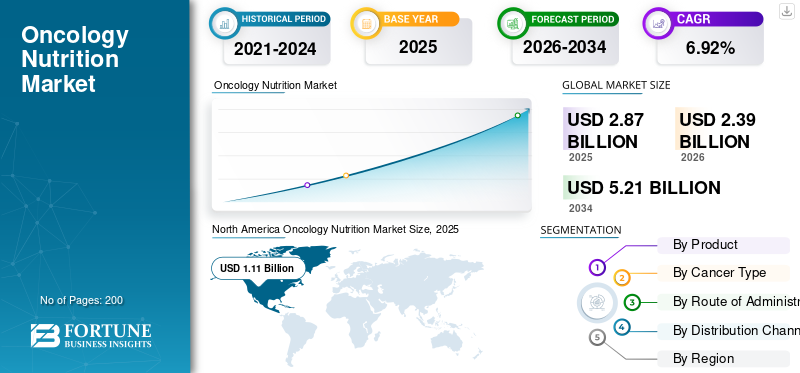
The global oncology nutrition market size was valued at USD 2.87 billion in 2025. The market is projected to grow from USD 3.05 billion in 2026 to USD 5.21 billion by 2034, exhibiting a CAGR of 6.92% during the forecast period. North America dominated the global oncology nutrition market with a market share of 38.68% in 2025.
Oncology nutrition is a significant part of cancer treatments and plays a crucial role in nourishing patients and helping them stay stronger throughout treatment. Proper nutrition plays a critical role in minimizing side effects from treatments such as chemotherapy, immunotherapy, hormonal medications, transplants, and surgery. These advanced therapies adversely impact the appetite and may lead to cancer cachexia, i.e., severe weight and muscle loss. With the rising incidence and prevalence of cancer worldwide, the global oncology nutrition is also anticipated to grow.
For instance, in 2022, the International Agency for Research on Cancer reported an incidence of 19,976,499 cancer cases. Such a high incidence drives the market demand.
The market is dominated by various key operating players, including Abbott, Nestlé Health Science, Nutricia, and Fresenius Kabi AG, which direct their resources toward strategic mergers and acquisitions and new product launches to diversify their product offerings.
Download Free sample to learn more about this report.
 Market Size & Forecast
 Market Share
 Key Regional Highlights
North America
North America maintained its leading position with a market value of USD 1.11 billion in 2025.
Europe
Europe is projected to reach USD 0.84 billion by 2026, growing at a CAGR of 6.47%.
Asia Pacific
Asia Pacific is expected to reach USD 0.73 billion by 2026, making it the third-largest regional market.
U.S.
The oncology nutrition market is estimated to reach USD 1.10 billion.
Japan
Rising cancer prevalence and increasing adoption of specialized nutritional support are driving market growth.
Read More

Rising Disease Burden of Cancer to Drive Market Growth
One of the principal factors contributing to the growth of the market is the rising cancer burden, increasing the demand for patients who need oncology nutrition care. An ageing population, particularly in developed markets, is further boosting demand, as older cancer patients are more at risk of malnutrition. Growing research and clinical evidence suggest that early nutrition intervention shortens the duration of hospital stays. The expansion of outpatient and home-based cancer care is also expanding demand for oncology nutritional supplements. These factors are driving higher uptake of oncology-focused nutrition products.
High Cost of Specialized Oncology Nutrition Products Limits Market Growth
The high cost associated with specialized oncology nutrition products acts as a key restraint for the adoption of these oncology nutrition products. In many regions, oncology nutritional products are not fully reimbursed, resulting in out-of-pocket expenditure, leading to underuse or early discontinuation. Hospitals and cancer centers with tight budgets often prioritize core drugs and procedures over premium nutrition products. As a result, clinical guidelines recommending early nutritional support are not consistently implemented. These factors emerge as barriers and slow market penetration.
Rising Investment by Key Companies to Offer Lucrative Growth Opportunities in the Market
One of the prominent factors driving the growth of the market is the rising investment by major players operating in the global market to expand their oncology nutrition portfolios. This increasing investment is creating strong growth opportunities, with increasing R&D to develop therapy-specific formulas and immunonutrition blends, tailored for different cancer stages. This broader portfolio addresses more clinical use cases for different cancer indications. Additionally, higher investment supports clinical trials, strengthening scientific backing.
New Product Launches for Cancer Patients Is a Prominent Market Trend Observed
A global oncology nutrition market trend observed is the increasing number of new product launches to cater to the increasing demand. With increasing research and development, these new product offerings are tailored in accordance with cancer patients undergoing different therapies. These factors have encouraged key players to focus on better palatability, texture, and improving adherence in patients with poor appetite. Novel product launches, along with digital support apps and monitoring tools, aim to strengthen clinical integration, thereby reinforcing oncology nutrition market growth.
Regulatory Complexity Related to Medical Foods, Clinical Nutrition, And Therapeutic Claims to Pose a Significant Market Challenge
Regulatory complexity around medical foods and clinical nutrition is a major challenge for market growth as companies in this space operate at the intersection of food and drug regulations. These oncology nutrition products must meet strict safety, labelling, and composition standards, and yet cannot make therapeutic claims such as a drug. Regulatory guidelines differ considerably by region, requiring companies to create multiple formulations, labels, and dossiers for the same product. These factors raise development costs and delay launches, posing a significant challenge for the market.
Download Free sample to learn more about this report.
New Product Launches Boosted Immunonutrition Segment Growth
Based on product, the global oncology nutrition market is segmented into immunonutrition, EPA-enriched/cachexia nutrition, high-protein/high-calorie formulas, and others. In 2025, the immunonutrition segment captured the dominant oncology nutrition market share. The dominance of the segment is attributed to better clinical outcomes in treatment protocols. Additionally, these immunonutrition products, aimed at enhancing immunity, contain formulas enriched with arginine, omega-3 fatty acids, nucleotides, and specific micronutrients known to reduce postoperative infections, support immune function, and shorten hospital stay in cancer. These factors encourage key players to invest in developing new products and launching them in the market.
For instance, in August 2024, GN Corporation launched Nichi BRITE Beta-glucan for enhancing immunity and reducing biomarkers of pancreatic cancer and its recurrence in patients undergoing surgical resection of malignant pancreatic tumors.
To know how our report can help streamline your business, Speak to Analyst
The others segment is expected to grow at a CAGR of 8.74% during the forecast period.
Rising Awareness Programs Encouraged the Stomach and Gastrointestinal Cancer Segment Growth
On the basis of cancer type, the market is classified into head and neck cancer, stomach and gastrointestinal cancer, colorectal cancer, lung cancer, hematologic cancer, breast cancer, and others.
The stomach and gastrointestinal cancer segment accounted for the largest share of the market in 2025. In 2026, the segment is anticipated to dominate with a 24.29% share. Stomach and gastrointestinal cancers have a direct impact on eating and nutrient absorption. Tumors, surgeries, and treatments in this area result in severe side effects such as severe dysphagia, vomiting, and diarrhea, which rapidly drive malnutrition and weight loss. This results in higher consumption of oncology nutrition by stomach and gastrointestinal cancer. As nutritional status strongly influences surgical outcomes in the cancer type, tolerance to chemo/radiotherapy is shown to improve significantly.
Additionally, the rising number of awareness programs highlighting these advantages for stomach cancer is anticipated to support the growth of the segment.
For instance, in November 2021, Taiho Oncology, Inc. raised awareness to improve nutritional education for patients impacted by stomach cancer.
The colorectal cancer segment is expected to grow at a CAGR of 8.28% over the forecast period.
Ease of Administration of Oral Segment Fueled Segmental Growth
Based on route of administration, the market is segmented into oral, enteral, and parenteral.
The oral segment accounted for the largest share of the market in 2025 and is anticipated to dominate with a 68.63% share in 2026. The dominance of the segment is due to oral drugs being the least invasive way to deliver this medical nutrition to cancer patients. Many clinical guidelines recommend starting with dietary advice and oral nutritional supplements (ONS) for oncology patients at risk of malnutrition. These oral formulas offer greater ease of administration. Additionally, robust product offering through new product launches by key companies with multiple flavors and high-protein, immunonutrition variants, supports them to capture the largest share of revenue within oncology nutrition.
The enteral segment is expected to grow at a CAGR of 9.07% over the forecast period.
Strategic Collaborations with Hospital Pharmacies Propelled Segmental Growth
Based on distribution channel, the market is categorized into hospital pharmacies, drug stores & retail pharmacies, online pharmacies, and others.
The hospital pharmacies segment dominated the market in 2025. In 2026, the segment is anticipated to dominate with a 46.36% share, as most cancer diagnoses, along with active treatment consultation, occur in hospital-based cancer centers. These centers offer oncology nutrition as part of the care pathway. Additionally, manufacturers prioritize hospital contracts and tenders to secure bulk sales. These factors reinforce hospital pharmacies as the primary and most influential distribution channel for oncology nutrition products. Additionally, collaborations and key partnerships among key operating players in the market promote the adoption of these oncology drugs through strategic activities.
The online pharmacies segment is expected to grow at a CAGR of 10.92% over the forecast period.
By geography, the market is categorized into Europe, North America, Asia Pacific, Latin America, and the Middle East & Africa.
North America captured the dominant share in 2024, valued at USD 1.04 billion, and also maintained its leading share in 2025, with USD 1.11 billion. The high market share in the region is attributed to a large and mature market driven by robust clinical adoption. Additionally, the region witnessed increasing research and development initiatives for new product launches and various nutraceutical products in clinical trials.
North America Oncology Nutrition Market Size, 2025 (USD Billion)
To get more information on the regional analysis of this market, Download Free sample
In the U.S., high cancer prevalence and favorable reimbursement for enteral nutrition drive market growth and supporting the country’s dominance in the region. In 2026, the U.S. market is estimated to reach USD 1.10 billion.
The Asia Pacific and Europe are poised to witness notable growth in the coming years. During the forecast period, the region is projected to record a growth rate of 6.47%, the second-highest among all regions, and reach a valuation of USD 0.84 billion by 2026. The growth in Europe is due to strong demand for oncology nutrition products along with robust cancer care infrastructure and government-driven nutrition protocols. Backed by these factors, countries including the U.K. are likely to record the valuation of USD 0.18 billion, Germany to record USD 0.20 billion, and France to record USD 0.13 billion in 2026. The market in Asia Pacific is estimated to reach USD 0.73 billion in 2026 and secure the position of the third-largest region in the market. In the region, India and China are both estimated to reach USD 0.24 billion and USD 0.09 billion each in 2026.
The Latin America and Middle East & Africa regions are expected to witness moderate growth during the forecast period. The Latin America market in 2026 is set to reach a valuation of USD 0.17 billion and is witnessing moderate growth. The region is experiencing an improvement in the adoption of oncology nutritional products. In the Middle East & Africa, the GCC is set to reach a value of USD 0.07 billion by 2026.
New Product Launches by Key Players supported their Leading Position
The global oncology nutrition market exhibits a semi-consolidated structure, with a few companies actively operating worldwide. These players are actively involved in numerous strategic activities such as capacity expansion, innovative product launches, and strategic acquisitions. They actively invest in technology advancement and offer a wide array of product offerings for innovative products.
Abbott, Nestlé Health Science, Nutricia, and Fresenius Kabi AG are some of the significant players in the market. These companies offer a wide range of product offerings and focus on enhancing research and development. They participate in strategic acquisitions to strengthen market positions.
Other notable players in the market include Baxter, B. Braun SE, Hormel Foods Corporation, Danone, and others. These companies are undertaking various strategic initiatives, such as investments to expand their product offering.
The global oncology nutrition market analysis provides a detailed study of market size & forecast by all segments included in the report. It includes details on the market dynamics and market trends expected to drive the market during the forecast period. It also provides overviews of technological advancements, product development, key industry developments, mergers & acquisitions, and strategic insights into market growth. The global market research report also includes a detailed competitive landscape, providing information on market share and profiles of key operating players.
Request for Customization to gain extensive market insights.
| ATTRIBUTE | DETAILS |
| Study Period | 2021-2034 |
| Base Year | 2025 |
| Forecast Period | 2026-2034 |
| Historical Period | 2021-2024 |
| Growth Rate | CAGR of 6.92% from 2026-2034 |
| Unit | Value (USD Billion) |
| Segmentation |
By Product
By Cancer Type
By Route of Administration
By Distribution Channel
By Geography
|
Fortune Business Insights says that the global market value stood at USD 2.87 billion in 2025 and is projected to reach USD 5.21 billion by 2034.
In 2025, the market value stood at USD 1.11 billion.
The market is expected to exhibit a CAGR of 6.92% during the forecast period (2026-2034).
The immunonutrition segment is expected to lead the market in terms of product.
The increasing prevalence of various forms of cancer is the key factor driving market growth.
Abbott, Nestlé Health Science, Nutricia, and Fresenius Kabi AG are among the prominent players in the market.
North America dominated the market in 2025.

Get 30-60 hrs Free Customization
Expand Regional and Country Coverage, Segments Analysis, Company Profiles, Competitive Benchmarking, and End-user Insights.













.webp)






Related Reports
Get In Touch With Us
US +1 833 909 2966 ( Toll Free )
Receive a tailored pricing based on your needs.
Discuss your questions with our industry experts.
Have questions? Get quick answers before you purchase.

