 Download Free Sample



Get a Quote
Receive a tailored pricing based on your needs.
- Choose license type
- Multiple user options
- Custom scope & coverage
- Fast turnaround
"Designing Growth Strategies is in our DNA"
 Listen to Audio Version
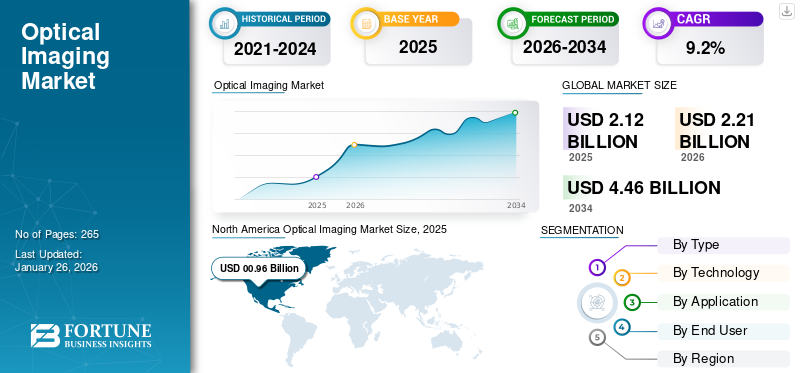
The global optical imaging market size was valued at USD 2.12 billion in 2025 and is projected to grow from USD 2.21 billion in 2026 to USD 4.46 billion by 2034, exhibiting a CAGR of 9.2% during the forecast period. North America dominated the optical imaging market with a market share of 45.1% in 2025.
Optical imaging is a non-invasive research and diagnostic technique that uses light to obtain images of internal body structures, molecules, and cells for detecting anomalies within body tissues. The growing prevalence of chronic conditions, including diabetes, cancer, and others, is resulting in an increasing number of patient admissions in clinical settings. The expanding patient pool and the benefits associated with this technology, such as being radiation-free, are further augmenting the demand for diagnostic tests, thereby contributing to the adoption of optical imaging systems in the market.
Furthermore, the growing geriatric population is also a major factor contributing to the increasing number of test volumes in the market. This, coupled with increasing technological advancements such as digital cameras and advanced sensors, is driving the focus of key players, including Abbott, Koninklijke Philips N.V., and others, and is expected to support the growth of the global optical imaging market.
Download Free sample to learn more about this report.
 Market Size & Forecast
 Market Share
 Key Regional Highlights
North America
North America generated USD 0.96 billion in revenue and accounted for 45.10% of the global market in 2025.
Europe
Europe held a 26.60% market share and reached USD 0.57 billion in 2025.
Asia Pacific
Asia Pacific accounted for 21.00% of global demand with a market value of USD 0.45 billion in 2025.
U.S.
The optical imaging market was valued at USD 0.88 billion in 2025, supported by rising diagnostic testing volumes and product innovation.
Japan
The market is driven by increasing adoption of advanced diagnostic imaging technologies and growing healthcare investments.
Read More

Increasing Prevalence of Chronic Disorders to Fuel Market Growth
The rising prevalence of chronic disorders, including cancer, cardiovascular diseases, ocular diseases, and others, is supporting the increasing demand for diagnostic tests and treatment monitoring among the patient population, consequently boosting the adoption rate of these products in the market.
Additionally, the increasing geriatric population is a crucial factor contributing to the increasing prevalence of chronic disorders among patients, further fueling the demand for these products worldwide. Optical imaging is a non-invasive technique that offers several benefits, including cost-effectiveness and high resolution. Therefore, the factors mentioned above, coupled with the increasing focus of prominent players on R&D activities to launch innovative products, are anticipated to fuel the adoption rate, thereby supporting the global optical imaging market growth.
High Cost Associated with Advanced Products and Software to Limit Market Growth
There is an increasing demand for these products owing to their distinct benefits, such as being non-invasive. However, the high cost associated with technologically advanced products and software is expected to limit the adoption rate for these products, especially in emerging countries such as Brazil, China, India, and others.
The high ownership cost and total cost of capital investment represent a huge expenditure, especially for resource-limited healthcare settings. Moreover, the additional costs associated with this technology, such as software upgrades, periodic maintenance, or calibration of devices, further add to the financial burden.
Furthermore, modern optical coherence tomography (OCT) systems generate large amounts of imaging information, which requires robust infrastructure and standardized protocols, including image management systems, servers, and other components, all of which demand additional technical expertise and investment.
Therefore, limited healthcare infrastructure, high upfront costs, software and maintenance expenses, coupled with financial sustainability, are anticipated to limit the penetration rate of this technology in the market.
Technological Advancements in These Systems to Create Market Opportunities
There is an increasing focus on integrating technological advancements into these systems in the market. Innovations, such as handheld and point-of-care devices, are expanding access and increasing utilization volumes for disease diagnosis and treatment monitoring among patients.
These technologically advanced devices enable imaging in mobile screening vans, remote clinics, and other settings, further driving the demand for these products in the market. This, coupled with the growing focus of key players on research and development activities to integrate artificial intelligence and image analytics into these products, is anticipated to boost their adoption in the market.
Limited Diagnosis in Emerging Countries to Limit Market Growth
There is a growing focus on initiatives among national organizations to raise awareness about early diagnosis of chronic disorders among the patient population. However, there is a growing prevalence of delayed detection of chronic conditions owing to distinct factors, including limited professional expertise and awareness, delayed referrals of patients with chronic diseases, and inadequate reimbursement policies, especially in emerging nations.
The limited number of healthcare settings and the availability of specialized imaging rooms, among other factors, contribute to the delayed detection of chronic disorders, ultimately leading to the postponement of diagnosis among patients, particularly in emerging countries such as Mexico and Brazil.
Shifting Preference Toward Non-Invasive Techniques to Boost Product Demand
There is an increasing trend toward non-invasive techniques and real-time modalities that can be incorporated into surgical, diagnostic, and interventional workflows. Prominent players are emphasizing technologies that provide safety and accurate visualization without exposing patients to radiation.
This shift is augmenting the demand for these imaging systems, such as optical coherence tomography (OCT) systems, photoacoustic imaging systems, and others across various clinical applications. These advancements are streamlining workflows by reducing the need for post-operative imaging checks and improving patient outcomes. Moreover, the integration of advanced analytics and hardware miniaturization is further anticipated to fuel the adoption of optical imaging technology in clinical settings worldwide.
Download Free sample to learn more about this report.
Increasing Product Launches Encouraged Hardware Segment Growth
Based on type, the market is classified into hardware and software. Hardware is further divided into imaging systems, cameras, illumination systems, and others.
To know how our report can help streamline your business, Speak to Analyst
The hardware segment led the market, accounting for 85.97% market share in 2026. The growth is owing to the increasing prevalence of chronic disorders such as ophthalmologic disorders and other related conditions, resulting in a growing number of diagnostic test volumes globally. Additionally, the increasing focus of major players on research and development initiatives to launch novel products is further expected to contribute to the segment’s growth.
Increasing Number of Optical Coherence Tomography (OCT) Examinations Led to the Dominance of the Segment
Based on technology, the market is categorized into optical coherence tomography (OCT), near-infrared spectroscopy, hyperspectral imaging, and photoacoustic tomography.
The optical coherence tomography (OCT) segment is projected to dominate the market with a share of 57.92% in 2026. The dominant share is attributed to the increasing number of OCT examinations, which has led to a growing demand for advanced products integrated with this technology. This, coupled with the growing focus among prominent players on R&D activities to launch advanced optical imaging products, is likely to support the segment’s growth in the market.
The photoacoustic tomography segment is expected to grow at a CAGR of 8.4% over the forecast period.
Increasing Prevalence of Cancer Led to the Dominance of the Oncology Segment
On the basis of application, the market is segmented into oncology, ophthalmology, cardiology, neurology, and others.
The oncology segment is expected to lead the market, contributing 40.72% globally in 2026. The growth is primarily due to the increasing prevalence of various forms of cancer, including lung cancer and bowel cancer, among others, resulting in increasing demand for innovative devices such as hyperspectral imaging systems and others in the market.
The ophthalmology segment is set to flourish with a growth rate of 7.3% during the forecast period.
Increasing Number of Hospitals & ASCs Led to the Segment’s Dominance
Based on end user, the market is segmented into hospitals & ASCs, specialty clinics, diagnostic imaging centers, and others.
The hospitals and ASCs segment will account for 57.92% market share in 2026. The growing prevalence of chronic diseases, the increasing number of diagnostic and treatment monitoring tests, and the rising number of hospitals & ASCs are some of the vital factors supporting the growth of the segment in the market.
In addition, the specialty clinics segment is projected to grow at a CAGR of 7.3% during the study period.
Based on region, the market has been studied across North America, Europe, Asia Pacific, Latin America, and the Middle East & Africa.
North America Optical Imaging Market Size, 2025 (USD Billion) To get more information on the regional analysis of this market, Download Free sample
The market in North America reached USD 0.96 billion in 2025, representing 45.10% of total market revenue, and is projected to reach USD 1 billion in 2026. The dominance of the region is attributed to several factors, including the rising prevalence of chronic diseases, increasing diagnostic test volumes, robust healthcare infrastructure, strategic government initiatives, growing product launches among key players, and the widespread adoption of advanced diagnostic systems. In 2025, the U.S. market is estimated to reach USD 0.88 billion. The country's growth is due to a growing number of diagnostic tests among patients, which is driving increased R&D focus among key players to launch technologically advanced products in the market.
The Europe market contributed approximately USD 0.57 billion to the global market in 2025, accounting for a 26.60% share, and is expected to reach USD 0.59 billion in 2026. The region is expected to witness considerable growth during the forecast period, supported by the increasing number of healthcare settings, the rising prevalence of chronic diseases, and the growing focus of governmental organizations on funding medical research and development activities. The U.K. is expected to reach a valuation of USD 0.1 billion in 2026, Germany is expected to reach USD 0.13 billion in 2026, and France is expected to reach USD 0.09 billion in 2025.
The Asia Pacific market stood at USD 0.45 billion in 2025, representing 21.00% of global demand, and is projected to grow to USD 0.46 billion in 2026. This growth is due to the increasing number of healthcare settings, the rising prevalence of chronic diseases, and the growing focus of governmental organizations on funding medical research and development activities in the region. After Europe, the market in Asia Pacific is estimated to reach USD 0.46 billion in 2026 and secure the position of the third-largest region in the market. In the region, India is estimated to reach USD 0.06 billion while China is estimated to reach USD 0.17 billion in 2026.
Over the forecast period, the Latin America region is expected to witness moderate growth in this market. The Latin America market accounted for USD 0.09 billion in 2025, representing 4.20% of the global industry, and is expected to reach USD 0.09 billion in 2026. The increasing prevalence of chronic disorders, improvement in healthcare infrastructure, and demand for innovative products and software are expected to boost product adoption in the region.
Over the forecast period, the Middle East & Africa region is expected to witness moderate growth in this market. The region maintained a presence in the global market, reaching USD 0.07 billion in 2025, accounting for a 3.10% share, and is expected to reach USD 0.07 billion in 2026. The increasing prevalence of chronic disorders, improvement in healthcare infrastructure, and demand for innovative products and software are expected to boost product adoption in the region. In the Middle East & Africa, GCC is set to attain a value of USD 0.04 billion in 2025.
Growing Number of Product Launches Among the Major Players to Support Their Market Dominance
A robust and diversified product portfolio of advanced devices and software, along with a significant global presence, is one of the key factors supporting the dominance of leading companies in the market. Abbott, CANON MEDICAL SYSTEMS CORPORATION, and Topcon Corporation were among the major players in the market in 2024. Furthermore, the growing focus of key players on receiving regulatory approval for their innovative products is likely to aid the global optical imaging market share.
For instance, in August 2021, Abbott received U.S. FDA approval for its optical coherence tomography (OCT) imaging platform driven by the company's Ultreon Software. This innovative imaging software combines OCT with artificial intelligence (AI) to provide physicians with a more comprehensive view of coronary blood flow and blockages, thereby enhancing clinical decision-making.
Other key players, including Carl Zeiss AG and others, are also growing in the market, primarily due to their increasing focus on collaborations among the other players to strengthen their brand presence in the market.
The market report provides a detailed global optical imaging market analysis, focusing on key aspects such as leading companies, types, technologies, applications, and end-users. Besides this, the global report offers insights into the market growth trends and highlights key industry developments. In addition to the aforementioned factors, the report encompasses several factors that have contributed to the growth and advancement of the market over recent years.
Request for Customization to gain extensive market insights.
|
ATTRIBUTE |
DETAILS |
|
Study Period |
2021-2034 |
|
Base Year |
2025 |
|
Estimated Year |
2026 |
|
Forecast Period |
2026-2034 |
|
Historical Period |
2021-2024 |
|
Growth Rate |
CAGR of 9.2% from 2026-2034 |
|
Unit |
Value (USD Billion) |
|
Segmentation |
By Type, Technology, Application, End User, and Region |
|
By Type |
· Hardware o Imaging Systems o Cameras o Illumination Systems o Others · Software |
|
By Technology |
· Optical Coherence Tomography (OCT) · Near Infrared Spectroscopy · Hyperspectral Imaging · Photoacoustic Tomography · Others |
|
By Application |
· Oncology · Ophthalmology · Cardiology · Neurology · Others |
|
By End User |
· Hospitals & ASCs · Specialty Clinics · Diagnostic Imaging Centers · Others |
|
By Region |
· North America (By Type, By Technology, By Application, By End User, and by Country) o U.S. (By Technology) o Canada (By Technology) · Europe (By Type, By Technology, By Application, By End User, and by Country/Sub-region) o U.K. (By Technology) o Germany (By Technology) o France (By Technology) o Italy (By Technology) o Spain (By Technology) o Scandinavia (By Technology) o Rest of Europe (By Technology) · Asia Pacific (By Type, By Technology, By Application, By End User, and by Country/Sub-region) o China (By Technology) o Japan (By Technology) o India (By Technology) o Australia (By Technology) o Southeast Asia (By Technology) o Rest of Asia Pacific (By Technology) · Latin America (By Type, By Technology, By Application, By End User, and by Country/Sub-region) o Brazil (By Technology) o Mexico (By Technology) o Rest of Latin America (By Technology) · Middle East & Africa (By Type, By Technology, By Application, By End User, and by Country/Sub-region) o GCC (By Technology) o South Africa (By Technology) o Rest of the Middle East & Africa (By Technology) |
Fortune Business Insights says that the global market size was valued at USD 2.12 billion in 2025 and is projected to reach USD 4.46 billion by 2034.
In 2025, the North America regional market value stood at USD 0.96 billion.
Growing at a CAGR of 9.2%, the market will exhibit steady growth over the forecast period (2026-2034).
By type, the hardware segment led the market in 2026.
Technological advancements are the major factor driving the market's growth.
Abbott and CANON MEDICAL SYSTEMS CORPORATION are the major players in the global market.
North America dominated the market share in 2026.
The growing prevalence of chronic disorders and the increasing number of product launches are anticipated to fuel the adoption of these products worldwide.

Get 30-60 hrs Free Customization
Expand Regional and Country Coverage, Segments Analysis, Company Profiles, Competitive Benchmarking, and End-user Insights.













.webp)






Related Reports
Get In Touch With Us
US +1 833 909 2966 ( Toll Free )
Receive a tailored pricing based on your needs.
Discuss your questions with our industry experts.
Have questions? Get quick answers before you purchase.

