Organic Rice Protein Market Size, Share & Industry Analysis, By Type (Organic Rice Protein Isolate, Organic Rice Protein Concentrate, and Organic Rice Protein Hydrolysate), By Form (Powder and Liquid), By Application (Food & Beverages, Dietary Supplements & Sports Nutrition, Cosmetics & Personal Care, Infant Nutrition, and Others), and Regional Forecast, 2026-2034
 Download Free Sample
(Offer valid till 30th Sep 2026)

Organic Rice Protein Market Size and Future Outlook
 Listen to Audio Version
The global organic rice protein market size was valued at USD 211.20 million in 2025 and is projected to grow from USD 225.21 million in 2026 to USD 379.34 million by 2034, exhibiting a CAGR of 6.73% during the forecast period. North America dominated the organic rice protein market with a market share of 36.94% in 2025.
Organic rice protein is a plant-sourced protein extracted from brown organic rice via enzymatic/mechanical processing methods that adhere to organic certification standards. This ingredient offers 60–90% protein and has a neutral to mild taste. Chemically, it comprises naturally occurring minerals, essential amino acids, and peptides. The primary end users of this component are sports nutrition brands, food and beverage producers, cosmetics firms, and supplement manufacturers. Regarding consumption, the highest intake of rice protein is observed in Europe and North America, owing to the popularity of vegan diets and their hypoallergenic profile.
Companies such as Axiom Foods Inc., Organic Way, and Laybio are prominent players in the market. New product launches are a pivotal strategy adopted by key players to improve their position.
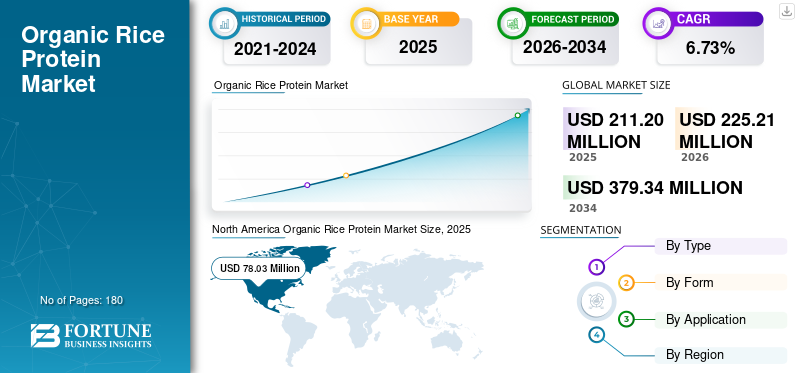
Download Free sample to learn more about this report.
ORGANIC RICE PROTEIN MARKET KEY TAKEAWAYS
 Global Market Size & Forecast
- 2025 Market Size: USD 211.20 million
- 2026 Market Size: USD 225.21 million
- 2034 Forecast Market Size: USD 379.34 million
- CAGR: 6.73% from 2026–2034
 Market Share
- North America dominated the market with a 36.94% share in 2025.
- Organic rice protein isolate led the market in 2025.
- Powder held the largest market share in 2025.
 Key Regional Highlights
North America
North America led with USD 78.03 million in 2025.
Europe
Europe reached USD 55.13 million in 2025.
Asia Pacific
Asia Pacific recorded USD 54.05 million in 2025.
U.S.
`The U.S. market reached USD 63.54 million in 2025.
Japan
The Japan market reached USD 6.11 million in 2025.
Read More

ORGANIC RICE PROTEIN MARKET TRENDS
Surging Use of Rice Protein in Cosmetics Industry is a Prominent Trend
The global market is witnessing an evolving and phenomenal trend toward rice protein in the cosmetics sector. Today, beauty product formulators are increasingly utilizing plant-centric proteins in haircare and skincare items to fulfill consumer demands for sustainable, clean, and natural components. In the beauty products space, organic rice protein is valued for its high amino acid content, which enhances skin elasticity. Moreover, it aids in retaining moisture and minimizes oxidative stress. Additionally, this ingredient is effective in lowering inflammation and redness due to its allantoin content. Seeing these advantages, global market producers are aiming to reformulate or launch new rice-protein-infused cosmetics.
MARKET DYNAMICS
MARKET DRIVERS
Download Free sample to learn more about this report.
Rising Popularity of Sports Nutrition-based Products Bolsters Use of Rice Protein
The surging popularity of sports nutrition food/supplements is a pivotal driver fueling the use of rice protein. As most individuals switch toward an active lifestyle and concentrate on fitness, there is a spike in demand for proteinaceous items that support physical performance, muscle recovery, and endurance. Ready-to-drink nutritional drinks, protein powders, and meal-replacement shakes have become an integral part of wellness and fitness routines, especially among gym enthusiasts and athletes. Organic proteins extracted from rice are widely used in these end products, as they provide a plant-centric alternative to conventional animal-derived proteins, such as casein and whey. Moreover, the flourishing trend toward vegan/dairy-free supplements is another factor that fuels its adoption.
MARKET RESTRAINTS
Limited Availability of Organic Raw Components and Tough Competition from Alternatives Inhibits Market's Growth
One of the key hurdles in the global industry is the restricted availability of organic materials. Globally, as compared to conventional rice production, organic rice cultivation holds a minimal share as farmers need to undergo a multi-year transition to convert traditional land into organic fields. During this period, most farmers face higher manufacturing costs and lower crop yields owing to the absence of chemical crop protection inputs and artificial fertilizers. Moreover, strict traceability and certification requirements make organic rice sourcing more challenging. As a result, these factors can result in an irregular supply of raw materials, further hindering the global organic rice protein market share. Another major obstacle in the market is tough competition from plant-centric proteins. The rice protein sector faces stiff competition from fava bean protein, pea protein, and soy protein isolate, which is putting pressure on the market's growing momentum.
MARKET OPPORTUNITIES
Technological Advancements in Protein Industry Create Growth Possibilities
The use of advanced technologies in the protein sector unlocks numerous growth opportunities. To strengthen the purity, producers are adopting advanced enzymatic extraction technologies. Along with improved purity, this approach also enhances the functionality and digestibility of components. Solubility and texture enhancement technologies are also gaining traction in the market as companies adopt them to produce more soluble, smoother rice protein. Moreover, technological advancement in membrane filtration technologies (microfiltration and ultrafiltration) allows businesses to develop proteins with improved consistency. Additionally, as the majority of consumers show interest in plant based nutrition/clean-label ingredients, companies are trying to invest in processing technologies that lower the use of artificial additives.
Segmentation Analysis
By Type
Organic Rice Protein Isolate Segment Dominated Market Due to Its Higher Protein Efficiency
Based on type, the market is segmented into organic rice protein isolate, organic rice protein concentrate, and organic rice protein hydrolysate.
The organic rice protein isolate segment dominated the market in 2025. In comparison to other types, it is widely used in gourmet products, which are mostly positioned as premium offerings. These ingredients contain higher amounts of protein, and producers can easily attain the desired levels with smaller volumes. Moreover, it has a long shelf life and superior protein purity, which fuels the segment's potential.
The organic rice protein hydrolysate is projected to grow at a high CAGR of 12.20% over the forecast period.
To know how our report can help streamline your business, Speak to Analyst
By Form
Powder Segment Led Owing to Storage Stability and Extended Shelf Life
Based on form, the market is divided into powder and liquid.
In 2025, the powder segment led the global industry. Powdered rice protein primarily has an extended shelf life owing to low moisture levels. Moreover, it is cost-effective and easier to transport than liquid forms. Additionally, powders have improved compatibility with blended formulations and have the advantage of flexible handling and packaging. Additionally, the dry form has minimal risk of microbial contamination and enhanced stability during food processing, thereby augmenting the global organic rice protein market growth.
The liquid segment is projected to grow at a high CAGR of 10.50% over the forecast period.
By Application
Food & Beverages Segment Led Market Owing to High Use of Protein in Edible Items
Based on application, the market is distributed into food & beverages, dietary supplements & sports nutrition, infant nutrition, cosmetics & personal care, and others.
Food & beverages segment led the global industry in 2025. Compared to dietary supplements and cosmetics, rice protein is widely used in food and beverage products such as RTD protein drinks, vegan milk, snack bars, and yogurts. Moreover, it imparts a mild and neutral taste that doesn't affect flavors, fueling its usage. Additionally, the rising inclination toward allergen-free items and the ability of rice protein to strengthen the nutritional value of food items further propel the segment's growth.
The cosmetics & personal care segment is projected to grow at a high CAGR of 10.54% over the forecast period.
Organic Rice Protein Market Regional Outlook
By geography, the market is categorized into Europe, North America, Asia Pacific, South America, and the Middle East & Africa.
North America
North America Organic Rice Protein Market Size, 2025 (USD Million)
To get more information on the regional analysis of this market, Download Free sample
The North America region dominates the market and reached a valuation of USD 78.03 million in 2025. The market is expected to grow due to surging demand for dairy alternatives and adoption of ricebran technologies. Moreover, the increasing consumer demand for plant based proteins and the surging awareness of rice protein concentrates/rice protein isolate are driving regional growth.
U.S. Organic Rice Protein Market
Based on North America's strong contribution and the U.S. dominance within the region, the U.S. market was valued at around USD 63.54 million in 2025, accounting for roughly 30.09% of global sales.
Europe
Europe reached USD 55.13 million in 2025, recording a growth rate of 5.73% in the coming years, and secured the second position. The evolving animal nutrition sector and high inclination toward functional cosmetics are propelling the region's potential.
Germany Organic Rice Protein Market
The Germany market was valued at around USD 14.07 million in 2025, representing roughly 6.66% of the global market revenues.
U.K. Organic Rice Protein Market
The U.K. market reached approximately USD 11.96 million in 2025, equivalent to around 5.66% of the global market sales.
Asia Pacific
The Asia Pacific region reached a valuation of USD 54.05 million in 2025 and held the third position. The growing infant population and strong consumer awareness for sports nutrition-based supplements are key factors boosting the region's potential.
India Organic Rice Protein Market
The Indian market was valued at around USD 11.91 million in 2025, accounting for roughly 5.64% of the global market revenues. The growing use of protein ingredients in gourmet products and the increased awareness of clean-label cosmetics are driving factors in the market.
China Organic Rice Protein Market
China's market is projected to be one of the largest globally, with revenues valued at around USD 20.28 million in 2025, accounting for roughly 9.60% of global market sales.
Japan Organic Rice Protein Market
The Japan market is estimated at around USD 6.11 million in 2025, accounting for approximately 2.89% of the global revenues.
South America and Middle East & Africa
The South America and Middle East & Africa regions are expected to witness moderate growth in this market during the forecast period. The South America market reached a valuation of USD 13.51 million in 2025. The growing demand for plant based proteins in pet food and specialty uses is expected to drive demand. The Middle East & Africa market reached USD 10.49 million in 2025.
South Africa Organic Rice Protein Market
The South African market reached around USD 3.84 million in 2025, representing roughly 1.82% of global revenues.
COMPETITIVE LANDSCAPE
Key Industry Players
New Product Launches Help Firms to Improve their Market Position
The organic rice protein market is moderately fragmented, comprising a mix of regional ingredient distributors and prominent plant-centric protein producers. All companies operating in the market are primarily focusing on new product innovation to enhance their market position. Moreover, the firms should aim to expand capacity and build partnerships to boost their sales.
LIST OF KEY ORGANIC RICE PROTEIN COMPANIES PROFILED IN REPORT
- Axiom Foods Inc. (U.S.)
- Bioway (Xi'an) Organic Ingredients Co., Ltd. (China)
- The Green Labs LLC (U.S.)
- Northland Organic Foods Corporation (U.S.)
- Lundberg Family Farms (U.S.)
- GluCorp (U.S.)
- A&B Ingredients (U.S.)
- Pioneer Industries Private Limited (India)
- Laybio (China)
- Organic Way (China)
KEY INDUSTRY DEVELOPMENTS
- March 2025: Axiom Foods, an American plant-centric ingredients producer, introduced a rice protein, "Oryzatein 2.0," available in both organic and isolate forms.
- January 2024: Suja Organic, an organic juice company in the U.S., unveiled Suja Organic Protein Shakes, which provide 16 grams of hemp, pea, and rice protein. This drink can be purchased from retailers for USD 4.99 per ounce.
- October 2020: Actus Nutrition, a U.S.-based components company, introduced PROriz, a brown rice protein manufactured using hexane-free processing. This product is available in organic format and can be utilized in ready-to-mix protein shakes.
REPORT COVERAGE
The global organic rice protein market provides an in-depth study of the market size & forecast by all the market segments included in the market reports. The global market forecast analysis includes details on the market dynamics and global market trends expected to drive the market during the forecast period. The global market analysis offers information on the technological advancements, new product launches, key industry developments, and details on partnerships, mergers & acquisitions. The industry forecast also encompasses a detailed competitive landscape with information on the market segmentation, market share, and profiles of key operating players.
Request for Customization to gain extensive market insights.
Report Scope & Segmentation
| ATTRIBUTE | DETAILS |
| Study Period | 2021-2034 |
| Base Year | 2025 |
| Estimated Year | 2026 |
| Forecast Period | 2026-2034 |
| Historical Period | 2021-2024 |
| Growth Rate | CAGR of 6.73% from 2026-2034 |
| Unit | Value (USD Million) |
| Segmentation | By Type, Form, Application, and Region |
| By Type |
|
| By Form |
|
| By Application |
|
| By Region |
|
Frequently Asked Questions
Fortune Business Insights says that the global market value stood at USD 211.20 million in 2025 and is projected to reach USD 379.34 million by 2034.
In 2025, North Americas market value stood at USD 78.03 million.
The market is expected to exhibit a CAGR of 6.73% during the forecast period of 2026-2034.
By form, the powder segment led the global market in 2025.
Rising popularity of sports nutrition-based products bolsters the use of rice protein.
Axiom Foods Inc., Organic Way, and Laybio are among the top players in the market.
North America held the largest market share in 2025.
Surging use of rice protein in skincare products is the prominent trend.



- 2021-2034
- 2025
- 2021-2024
- 180
-
(Offer valid till 30th Sep 2026)
Get 30-60 hrs Free Customization
Expand Regional and Country Coverage, Segments Analysis, Company Profiles, Competitive Benchmarking, and End-user Insights.




















Related Reports
-
US +1 833 909 2966 ( Toll Free )
-
Get In Touch With Us