Organic Soy Protein Market Size, Share & Industry Analysis, By Product Type (Soy Protein Concentrate, Soy Protein Isolate, and Soy Flour), By Form (Dry and Liquid), By Application (Food Applications [Meat Alternatives, Dairy Alternatives, Bakery & Confectionery, Functional Foods, Infant Nutrition, Nutraceuticals & Dietary Supplements, and Others] and Feed Applications [Livestock Feed, Aquaculture Feed, and Pet Food]), and Regional Forecast, 2026-2034
 Download Free Sample
(Offer valid till 30th Sep 2026)

Organic Soy Protein Market Size and Future Outlook
 Listen to Audio Version
The global organic soy protein market size was valued at USD 713.87 million in 2025. The market is projected to grow from USD 753.84 million in 2026 to USD 1,181.87 million by 2034, exhibiting a CAGR of 5.78% during the forecast period. North America dominated the organic soy protein market with a market share of 38.77% in 2025.
Organic soy protein refers to protein ingredients derived from organically cultivated soybeans without the use of synthetic pesticides, fertilizers, or Genetically Modified Organisms (GMOs). These ingredients include soy protein isolate, soy protein concentrate, soy flour, and textured soy proteins that are widely used in food processing, dietary supplements, and animal feed formulations. Organic soy products are valued for their high protein content, balanced amino acid profile, and functional properties such as emulsification, water binding, and texture enhancement.
The market is positioned at the intersection of the plant-based protein industry, functional food ingredients, and organic food markets. Growing consumer demand for clean-label, non-GMO, and plant-based protein sources is driving increased adoption of such protein in meat alternatives, dairy alternatives, bakery products, and nutritional supplements.
Major companies operating in the industry, such as ADM, Cargill, Bunge Limited, Fuji Oil Holdings Inc., and DuPont Nutrition & Biosciences (IFF), are expanding organic ingredient portfolios and investing in sustainable soybean sourcing, protein processing technologies, and plant-based product innovation.
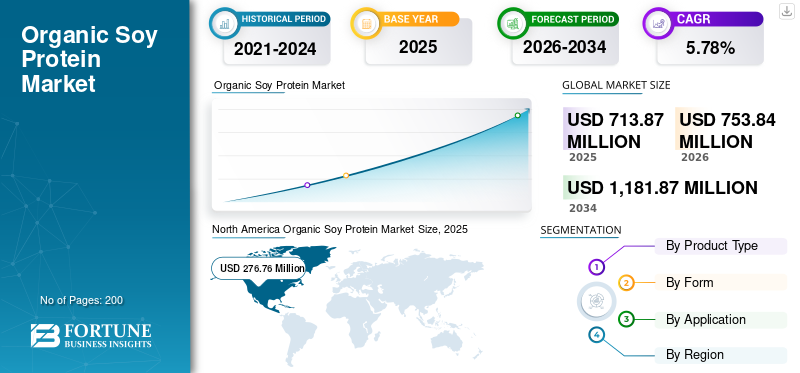
Download Free sample to learn more about this report.
Organic Soy Protein Market Key Takeaways
 Global Market Size & Forecast
- 2025 Market Size: USD 713.87 million
- 2026 Market Size: USD 753.84 million
- 2034 Forecast Market Size: USD 1,181.87 million
- CAGR: 5.78% from 2026–2034
 Market Share
- North America dominated the organic soy protein market with a 38.77% share in 2025.
- The liquid segment is projected to grow at the fastest CAGR of 8.22% during 2026–2034.
- The soy protein isolate segment is projected to grow at the fastest CAGR of 6.48% during the forecast period.
 Key Regional Highlights
North America
North America led the global market with revenue of USD 276.76 million in 2025 and is projected to grow at a CAGR of 4.31% through 2034.
Europe
Europe generated approximately USD 247.44 million in 2025 and is expected to grow at a CAGR of 5.20% during 2026–2034.
Asia Pacific
Asia Pacific accounted for approximately USD 140.91 million in 2025 and is projected to register the fastest CAGR of 8.56% through 2034.
U.S.
The market reached approximately USD 232.69 million in 2025, leading the North American region.
Japan
Demand is supported by growing consumer preference for plant-based and organic protein products.
Read More

Organic Soy Protein Market Trends
Rising Demand for Sustainable and Environmentally Friendly Protein Sources to Fuel Industry Growth
Environmental sustainability is becoming a major factor influencing consumer awareness and food choices. Plant-based proteins, such as soy, require significantly fewer natural resources compared with animal protein production. The market for such protein, in particular, is gaining traction as it aligns with sustainability goals, including reduced pesticide usage and environmentally responsible agricultural practices. These sustainability advantages are encouraging food manufacturers to increase the demand for plant-based protein ingredients such as organic soy protein.
- According to the Good Food Institute report 2024, plant-based meat generally produces 71% lower GHG emissions than chicken and requires 95% less water on average compared to conventional meat production.
MARKET DYNAMICS
Market Drivers
Download Free sample to learn more about this report.
Rising Adoption of Plant-Based Proteins in Food Applications to Transform Market Demand
The global food industry is undergoing a structural shift toward plant-based protein ingredients, driven by health awareness, environmental concerns, and increasing demand for sustainable food systems. Organic soy protein has emerged as one of the most widely used plant proteins due to its high protein concentration and favorable functional characteristics in food processing.
Food manufacturers are increasingly incorporating such protein in meat alternatives, dairy substitutes, protein-enriched bakery products, and functional foods to improve nutritional value while meeting clean-label requirements. The rapid expansion of plant-based food brands and alternative protein product launches is reinforcing demand for soy-derived protein ingredients.
- According to the Food and Agriculture Organization (FAO), agricultural production data, global soybean production in 2023 was 371.18 million tons, with major producers including Brazil, the U.S., and Argentina. Soybeans contain roughly 36–40% protein, making them the most concentrated and widely utilized plant protein source in food processing.
Market Restraints
Supply Constraints and Organic Certification Costs to Restrain Market Expansion
Despite strong demand growth, the industry faces challenges related to the limited availability of certified organic soybeans and higher production costs. Organic soybean cultivation requires compliance with strict agricultural standards, including the avoidance of synthetic pesticides and genetically modified seeds. Certification and compliance requirements across different regulatory jurisdictions increase operational complexity for ingredient manufacturers. Moreover, organic farming practices typically result in lower crop yields compared with conventional soybean production, which can increase raw material costs and limit supply availability.
- According to the Center for Farm Financial Management report 2020-21, organic soybean production requires USD 106–USD 125 higher costs per acre (USD 6.62–USD 7.81 per bushel) than conventional methods, primarily due to higher, labor-intensive input costs.
Market Opportunities
Expansion of Plant-Based Meat and Functional Nutrition Products to Unlock Market Opportunities
The rapid expansion of plant-based meat alternatives, protein-enriched functional foods, and dietary supplements is creating new organic soy protein market growth opportunities for such ingredients. Soy protein isolate and textured soy protein are widely used in plant-based burgers, sausages, and nuggets due to their ability to mimic meat texture and deliver high protein content.
At the same time, the growing demand for sports nutrition products, meal replacements, and nutraceutical formulations is supporting increased use of soy protein isolates and concentrates as cost-effective protein sources.
Technological advancements in protein extraction, fermentation, and functional ingredient processing are also improving product quality, taste, and digestibility, enabling wider adoption across food and beverage applications.
SEGMENTATION ANALYSIS
By Product Type
Soy Protein Isolate Segment Dominated Due to High Protein Content and Wide Use in Functional Food Applications
By product type, the market segmentation includes soy protein concentrate, soy protein isolate, and soy flour.
The soy protein isolate segment dominated the global market in 2025, reaching approximately USD 296.99 million, supported by its high protein concentration of more than 90% and its widespread use in functional foods, nutritional supplements, and plant-based meat alternatives. Soy protein isolate is commonly incorporated into protein beverages, dairy alternatives, and sports nutrition products due to its superior digestibility, neutral flavor profile, and excellent emulsification properties, which allow manufacturers to enhance protein content without affecting product taste and texture.
The soy protein isolate segment is also projected to grow at the fastest CAGR of 6.48% during the global organic soy protein market forecast period. The growth is driven by the increasing global demand for high-protein diets, sports nutrition products, and plant-based food innovations.
To know how our report can help streamline your business, Speak to Analyst
By Form
Dry Segment Dominated Due to Longer Shelf Life and Ease of Processing
By form, the market is segmented into dry and liquid.
The dry segment dominated the global market in 2025, reaching approximately USD 627.93 million, accounting for the majority of total market demand. Dry soy protein ingredients, including powders and granules, are widely preferred in food manufacturing as they offer longer shelf life, easier storage and transportation, and compatibility with a wide range of food processing applications such as meat alternatives, bakery products, and nutritional supplements.
The liquid segment is projected to grow at the fastest CAGR of 8.22% during 2026–2034. Moreover, the growth is supported by the increasing demand for ready-to-drink protein beverages, functional drinks, and liquid nutritional formulations.
By Application
Food Applications Segment Dominated Due to Rising Demand for Plant-Based Foods
By application, the global market is segmented into food applications and feed applications.
The food applications segment dominated the global organic soy protein market share in 2025, reaching approximately USD 659.16 million. The growth is supported by increasing consumer demand for plant-based foods, protein-enriched products, and clean-label products. Within this category, meat alternatives represented the largest application segment, valued at approximately USD 155.39 million in 2025, driven by the rapid expansion of plant-based meat products across retail and foodservice industries.
The feed applications segment is projected to grow at the fastest CAGR of 8.11% during 2026–2034. The growth is supported by increasing use of plant-based protein ingredients in livestock feed, aquaculture nutrition, and premium pet food formulations.
Organic Soy Protein Market Regional Outlook
Regionally, the report covers the global market analysis across North America, Europe, Asia Pacific, South America, and the Middle East & Africa.
North America
North America Organic Soy Protein Market Size, 2025 (USD Million)
To get more information on the regional analysis of this market, Download Free sample
North America accounted for approximately USD 276.76 million in 2025, dominating the global market and is projected to grow at a CAGR of 4.31% during 2026–2034. The growth is supported by strong consumer demand for organic food products and plant-based protein ingredients.
U.S. Organic Soy Protein Market
The U.S. dominated the North American market, reaching approximately USD 232.69 million in 2025. The country maintains a well-developed organic food sector and large-scale soybean production capacity, which supports domestic protein ingredient manufacturing.
Europe
Europe reached approximately USD 247.44 million in 2025 and is projected to grow at a CAGR of 5.20% during 2026–2034. The growth is supported by increasing plant-based food consumption and strict regulations encouraging sustainable and organic food production.
Germany Organic Soy Protein Market
Germany accounted for approximately USD 69.47 million in 2025, supported by strong consumer demand for plant-based foods and the expansion of vegetarian and vegan product categories.
U.K. Organic Soy Protein Market
The U.K. market reached approximately USD 29.69 million in 2025, driven by rapid growth in plant-based food startups and increasing adoption of alternative protein ingredients.
Asia Pacific
Asia Pacific accounted for approximately USD 140.91 million in 2025 and is projected to grow at the fastest CAGR of 8.56% during 2026–2034. The growth is driven by rising protein consumption, expanding food processing industries, and increasing adoption of plant-based diets.
China Organic Soy Protein Market
China dominated the Asia Pacific market with approximately USD 56.90 million in 2025. The country has a long-established soybean processing industry and continues to expand its plant-based food manufacturing capacity.
India Organic Soy Protein Market
India accounted for a market value of USD 19.08 million in 2025, supported by the rapid expansion of vegetarian diets and increasing use of soy-based protein ingredients in food processing.
South America and the Middle East & Africa
South America accounted for approximately USD 29.30 million in 2025 and is projected to grow at a CAGR of 7.60% during 2026–2034. However, the growth is supported by strong soybean cultivation and growing export-oriented soy ingredient production.
The Middle East & Africa market reached approximately USD 19.46 million in 2025 and is projected to grow at a CAGR of 6.95% during the forecast period, driven by rising demand for plant-based foods and increasing imports of soy protein ingredients.
Brazil Organic Soy Protein Market
Brazil dominated the regional market with approximately USD 19.56 million in 2025, supported by its position as one of the world's largest soybean producers and exporters.
COMPETITIVE LANDSCAPE
Key Industry Players
Key Companies are Expanding Organic Ingredient Portfolios and Plant-Based Protein Solutions
Leading companies in the global market are focusing on expanding organic soybean sourcing, investing in protein extraction technologies, and developing plant-based ingredient solutions to strengthen their competitive positions. Companies are also investing in sustainable agriculture practices and traceable supply chains to meet increasing demand for certified organic food ingredients.
Key Players in the Organic Soy Protein Market
|
Rank |
Company Name |
|
1 |
Archer Daniels Midland Company |
|
2 |
Cargill, Incorporated |
|
3 |
Bunge Limited |
|
4 |
Fuji Oil Holdings Inc. |
|
5 |
International Flavors & Fragrances Inc. |
List of Key Organic Soy Protein Companies Profiled
- Archer Daniels Midland Company (U.S.)
- Cargill, Incorporated (U.S.)
- Bunge Limited (U.S.)
- Fuji Oil Holdings Inc. (Japan)
- International Flavors & Fragrances Inc. (U.S.)
- Wilmar International Limited (Singapore)
- Shandong Yuwang Industrial Co., Ltd. (China)
- The Scoular Company (U.S.)
- Crown Soya Protein Group (China)
- Devansoy Inc. (U.S.)
KEY INDUSTRY DEVELOPMENTS
- March 2026: Bunge announced the completion of its acquisition of International Flavors & Fragrances (IFF)'s soy protein concentrate, lecithin, and soy crush businesses. This transaction bolsters Bunge's ingredients portfolio by integrating IFF's established brands, Response, Alpha, Procon, and Solec, which provide textured, functional, and powdered soy protein concentrates.
- September 2025: Astarta, a major Ukrainian agribusiness player in dairy and plant-based proteins, has announced a USD 46.54 million investment to build a soy protein concentrate plant operational by 2026.
- June 2025: Nexnoa introduced Flow-Textured Plants (FTP), a novel, single-ingredient plant-based protein made from 100% non-GMO soy flour. Developed in Germany using advanced, multidimensional extrusion technology, this product provides a fibrous, meat-like texture and superior flavor absorption without additives. It is designed for high sustainability and versatility.
- December 2022: Bunge invested approximately USD 550 million in a new Soy Protein Concentrate (SPC) and Textured Soy Protein Concentrate (TSPC) facility in Morristown, Indiana, U.S. The plant, integrated with Bunge's existing soybean processing site, aims to process an additional 4.5 million bushels of soybeans annually to meet demand for plant-based foods, processed meats, pet food, and feed.
REPORT COVERAGE
The global industry report analyzes the market in depth and highlights crucial aspects such as global market trends, market dynamics, market research, prominent companies, investment in research and development, and end-use. Besides this, the report also provides insights into the global organic soy protein market analysis and highlights significant industry developments.
Request for Customization to gain extensive market insights.
Report Scope & Segmentation
| ATTRIBUTE | DETAILS |
| Study Period | 2021-2034 |
| Base Year | 2025 |
| Estimated Year | 2026 |
| Forecast Period | 2026-2034 |
| Historical Period | 2021-2024 |
| Growth Rate | CAGR of 5.78% from 2026 to 2034 |
| Unit | Value (USD Million) |
|
Segmentation |
By Product Type
|
|
By Form
|
|
|
By Application
|
|
|
By Region
|
Frequently Asked Questions
Fortune Business Insights says that the global market was valued at USD 713.87 million in 2025 and is anticipated to reach USD 1,181.87 million by 2034.
At a CAGR of 5.78%, the global market will exhibit steady growth over the forecast period.
By form, the dry segment led the market.
North America held the largest market share in 2025.
The rising adoption of plant-based proteins in food applications is transforming market demand.
ADM, Cargill, Bunge Limited, Fuji Oil Holdings Inc., and DuPont Nutrition & Biosciences (IFF) are the leading companies in the market.
The rising demand for sustainable and environmentally friendly protein sources to reshape market demand.



- 2021-2034
- 2025
- 2021-2024
- 200
-
(Offer valid till 30th Sep 2026)
Get 30-60 hrs Free Customization
Expand Regional and Country Coverage, Segments Analysis, Company Profiles, Competitive Benchmarking, and End-user Insights.




















Related Reports
-
US +1 833 909 2966 ( Toll Free )
-
Get In Touch With Us