Outdoor Air Quality Monitoring System Market Size, Share & Industry Analysis, By Pollutant (Chemical, Physical, and Biological), By End-User (Commercial & Residential, Public Infrastructure, Power Generation Plants, Pharmaceutical Industry, and Others), and Regional Forecast, 2026-2034
 Download Free Sample
KEY MARKET INSIGHTS
 Listen to Audio Version
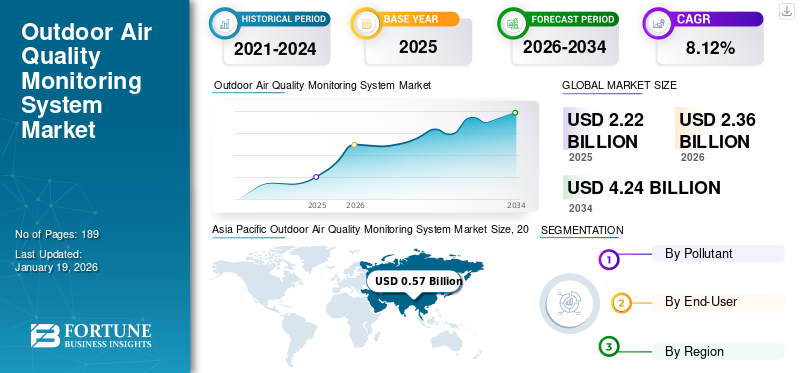
The global outdoor air quality monitoring system market size was valued at USD 2.22 billion in 2025. The market is projected to grow from USD 2.36 billion in 2026 to USD 4.24 billion by 2034, exhibiting a CAGR of 8.12% during the forecast period. Asia Pacific dominated the global market with a share of 25.89% in 2025.
An outdoor air quality monitoring system is a network of sensors and devices used to measure and analyze the levels of various pollutants in the atmosphere. These systems provide real-time data on factors including particulate matter (PM2.5, PM10), gases (CO, SO2, NOx, ozone), and other harmful substances, helping to assess and manage air quality. The data collected is often used to inform the public, support research, and guide strategies for improving air quality.
Aeroqual provides integrated monitoring and software systems for indoor and outdoor applications. The company offers a range of products for perimeter air monitoring, handheld air monitoring, and related software and services. Aeroqual’s offerings are well-suited for industrial operations, urban air pollution monitoring, and vehicle pollution monitoring, and are also used by environmental consultants and for research purposes.
Download Free sample to learn more about this report.
Outdoor Air Quality Monitoring System Market Key Takeaways
 Global Market Size & Forecast
- 2025 Market Size: USD 2.22 billion
- 2026 Market Size: USD 2.36 billion
- 2034 Forecast Market Size: USD 4.24 billion
- CAGR: 8.12% from 2026–2034
 Market Share
- Asia Pacific dominated the market with a 25.89% share in 2025.
- The chemical segment accounted for the largest market share.
- The physical pollutants segment is expected to witness significant growth.
 Key Regional Highlights
Asia Pacific
Asia Pacific accounted for USD 0.57 billion and 25.89% of the market in 2025.
North America
North America reached USD 0.53 billion, representing 23.99% of the market in 2025.
Europe
Europe generated USD 0.41 billion, accounting for 18.59% of the global market in 2025.
U.S
The market is driven by strong EPA regulations and nationwide air quality monitoring programs.
Japan
The market is supported by government initiatives to improve outdoor air quality.
Read More

MARKET DYNAMICS
MARKET DRIVERS
Growing Emphasis on Enhancing Air Quality Monitoring in Various Industries to Support Market Growth
Industries are focusing on air quality monitoring to enhance workplace safety and minimize health hazards linked to air pollution exposure. In fields such as mining, chemical production, and construction, air quality monitoring systems assist in mitigating risks associated with particulate matter, volatile organic compounds (VOCs), and harmful gases, in turn fueling the outdoor air quality monitoring system market growth. Improved air quality leads to safer work environments, lowering the chance of accidents and reducing long-term health complications for employees. Additionally, with an increased focus on occupational health standards, companies are seeing the advantages of offering cleaner air, which complies with workplace safety regulations and industry best practices. This movement also builds goodwill and strengthens employer reputation, attracting workers who prioritize healthy and secure work environments.
MARKET RESTRAINTS
Cost Associated with Purchasing, Installation, and Maintenance of Systems to Hinder Market Expansion
One major challenge is the significant expense involved in acquiring, setting up, and maintaining Air Quality Monitoring Systems (AQMS). The upfront cost for sophisticated monitoring equipment can be high, often reaching the thousands. This financial challenge can restrict availability for smaller entities or municipalities, especially in low- and middle-income nations where budget limitations are more evident. Additionally, the recurring expenses associated with the upkeep and calibration of these systems put further pressure on resources, hindering some areas from implementing sufficient air quality monitoring (AQM) stations.
Moreover, issues related to data accuracy and standardization present major challenges. The absence of consistent data gathering and reporting methods can result in discrepancies in air quality information, making it difficult to compare findings across various areas or systems.
MARKET OPPORTUNITIES
Technological Advancements to Encourage Market Growth
The growth of advanced technologies such as Internet of Things (IoT) systems, Wireless Sensor Networks (WSN), cloud computing, gas sensing technologies, and others is anticipated to propel market expansion in the future. Systems based on IoT and cloud computing efficiently assess aerosol levels, Volatile Organic Compounds (VOCs), carbon monoxide, carbon dioxide, and temperature-humidity, transmitting data to a web server in real-time through LTE. This functionality enables authorized personnel to monitor air quality from any location and at any time. These devices include pollutant detection sensors, a microcontroller, and an LTE modem.
OUTDOOR AIR QUALITY MONITORING SYSTEM MARKET TRENDS
Increasing Awareness of Health Risks Due to Air Pollution is Among Many Significant Market Trends
Air pollution is increasingly recognized as a critical global challenge, with detrimental effects on health and the environment. Extended exposure to contaminated air, such as smog, can greatly affect health, contributing to illnesses such as asthma, respiratory conditions, allergies, and Others. Thus, it has highlighted the need for an air quality monitoring system.
Monitoring air quality provides a transparent and immediate insight into the air. These systems assess various pollutants, becoming essential for governments, researchers, and the general public. By delivering actionable information, they facilitate policy reforms, encourage scientific progress, and empower individuals to make knowledgeable decisions about their lifestyles.
Download Free sample to learn more about this report.
Segmentation Analysis
By Pollutant
Chemical Segment to Dominate Market Due to Rising Need for Systems to Identify and Quantify Various Harmful Chemicals
Based on the pollutant, the market is classified into chemical, physical, and biological.
The chemical segment is anticipated to dominate the outdoor air quality monitoring system market share. The growth of the segment can be linked to the rising need for systems that can identify and quantify various harmful chemicals present in the air. These pollutants can lead to significant health problems. Government and environmental organizations enforce stringent regulations to oversee and manage air quality. This regulatory pressure and heightened public awareness regarding the health risks associated with air pollution are encouraging both public and private entities to invest in sophisticated air quality monitoring systems to detect chemical pollutants.
Physical pollutants, mainly Particulate Matter (PM), specifically PM2.5 and PM10, are minuscule particles or droplets that can be breathed in and result in significant health problems, including respiratory infections, heart disease, and lung cancer. The growth of urbanization and industrial activities has resulted in elevated levels of these pollutants, particularly in heavily populated cities. As a result, there is an increased need for air quality monitoring systems that can detect and quantify the presence of particulate matter.
By End-User
Growing Importance of Air Quality Monitoring Systems in Public Infrastructure to Boost Segment Growth
Based on end-user, the market is divided into commercial & residential, public infrastructure, power generation plants, pharmaceutical industry, and others.
Public infrastructure will be the fastest-growing segment in the coming years. The growing importance of air quality monitoring systems in public infrastructure is anticipated to boost segment growth. An outdoor air quality monitoring system integrated with public infrastructure can significantly improve environmental management and public health in urban areas. Large public events, including religious celebrations, concerts, or corporate gatherings, may present health hazards if ventilation is inadequate. Implementing air monitoring systems allows organizers to track CO₂ levels in real-time, promoting a safer atmosphere for participants. Additionally, it offers immediate alerts and notifications through SMS or email when CO₂ levels surpass safe limits, empowering organizers to respond promptly with necessary corrective measures.
Outdoor Air Quality Monitoring System Market Regional Outlook
By geography, the market is categorized into North America, Europe, Asia Pacific, Latin America, and Middle East & Africa.
Asia Pacific
Asia Pacific Outdoor Air Quality Monitoring System Market Size, 2025 (USD Billion)
To get more information on the regional analysis of this market, Download Free sample
In 2025, Asia Pacific held 25.89% of the global market, reaching a valuation of USD 0.57 billion, and is projected to grow to USD 0.62 billion in 2026. Asia Pacific dominates the market, due to increasing air pollution and government initiatives to improve the outdoor air quality for public health. The Asia Pacific region is expected to register the highest CAGR in the global outdoor air quality monitoring system market. This growth can be attributed to factors such as increasing air pollution and government initiatives aimed at improving outdoor air quality to protect public health. Initiatives such as the Asia Pacific Regional Action Programme on Air Pollution (RAPAP) and the Asia Pacific Clean Air Partnership (ACAP) are driving efforts to improve air quality through regional cooperation and implementing cost-effective measures.
North America
North America accounted for USD 0.53 billion in 2025, representing 23.99% of the global market share, and is projected to reach USD 0.58 billion in 2026. The North American outdoor air quality monitoring system market is primarily driven by the rapid adoption of advanced technologies and stringent government policies for effective pollution control and monitoring. North America utilizes robust outdoor air quality monitoring programs and policies, primarily driven by the U.S. Environmental Protection Agency (EPA) and the Clean Air Act. The EPA sets National Ambient Air Quality Standards (NAAQS) for criteria pollutants, including particulate matter, ozone, and others, and these standards are regularly reviewed and updated.
U.S.
The U.S. dominates the North American market due to increasing government initiatives and findings for environment monitoring programs in the country. Moreover, national and local monitoring networks are in place to assess compliance with standards and track pollution trends.
Europe
The Europe market was valued at USD 0.41 billion in 2025, capturing 18.59% of global revenue, and is estimated to reach USD 0.44 billion in 2026. The market for outdoor air quality monitoring systems in Europe is projected to experience considerable growth during the forecast period, driven by increasing government regulations focused on reducing air pollution levels. Key aspects include setting legally binding limits for pollutants by 2030, enhancing monitoring and measuring provisions, and ensuring public access to information and justice for those affected by air pollution. The European Parliament has adopted a revised Ambient Air Quality Directive (AAQD) that aligns with WHO guidelines and includes provisions for potential compensation to citizens whose health has been damaged by air pollution.
Latin America
The Latin America region captured 15.31% of the global market in 2025, generating USD 0.34 billion in revenue, and is projected to reach USD 0.35 billion in 2026. Outdoor air quality monitoring systems in Latin America are experiencing significant growth due to increased awareness of air pollution and government efforts to improve air quality. The market is expected to grow, driven by government initiatives, public awareness campaigns, and the demand for real-time data to inform public health decisions and environmental policies.
Middle East & Africa
Middle East & Africa contributed approximately USD 0.36 billion to the global market in 2025, accounting for 16.23% share, and is expected to reach USD 0.37 billion in 2026. Outdoor air quality monitoring systems in the Middle East are driven by various factors, including rising air pollution levels, increasing industrialization, and supportive government initiatives. For instance, the Abu Dhabi Air Quality Monitoring Network, managed by the Environment Agency – Abu Dhabi (EAD), is among the most sophisticated air quality monitoring systems globally. This network includes 20 stationary and two mobile monitoring stations. It tracks various air pollutants, such as particulate matter (PM), ozone (O3), nitrogen dioxide (NO2), sulfur dioxide (SO2), and carbon monoxide (CO).
COMPETITIVE LANDSCAPE
Key Industry Players
Awareness Programs and Initiatives to Highlight Need for Air Quality Monitoring Systems
The rising demand for air quality monitoring systems can be attributed to awareness programs and initiatives to highlight the need for air quality monitoring systems. For example, IQAir, a Swiss air quality technology company, introduced Schools4Earth, a new initiative that enables schools to monitor real-time air quality. By allowing schools to use affordable air monitors, Schools4Earth equips educators, students, parents, and communities with essential air quality information to safeguard student health and diminish exposure to air pollution.
LIST OF KEY OUTDOOR AIR QUALITY MONITORING SYSTEM COMPANIES PROFILED
- Thermo Fisher Scientific (U.S.)
- Emerson Electric (U.S.)
- 3M Company (U.S.)
- Horiba, Ltd. (Japan)
- Siemens AG (Germany)
- RXI Instruments (U.S.)
- Tisch Environmental (U.S.)
- Innovaer Technologies (U.S.)
- Chemtrols (India)
- Honeywell (U.S.)
- Aeroqual (New Zealand)
- TSI Incorporated (U.S.)
KEY INDUSTRY DEVELOPMENTS
- June 2024: India’s Ministry of Electronics and Information Technology introduced the Indigenous Air Quality Monitoring System (AQ-AIMS) and launched the Air-Pravah App. This system tracks environmental pollutants, measuring parameters such as PM 1.0, PM 2.5, PM 10, SO2, NO2, O3, CO, CO2, temperature, humidity, and more, for ongoing air quality assessment.
- February 2024: The EPA revealed nearly USD 81 million in non-competitive, direct award funding from the Inflation Reduction Act of 2022 (IRA) for qualified state, local, Tribal, and territorial air agencies to create new air monitoring locations and to sustain, run, or enhance current ambient air monitoring systems.
- April 2023: TEMPO, a NASA instrument, was launched on Intelsat 40e to monitor air quality over North America. The main goal of TEMPO is to enhance the understanding of air quality and its effects. By offering near-real-time data and detailed measurements of atmospheric composition, TEMPO contributes to the advancement of knowledge about the Earth system and the research and prediction of air quality. Additionally, it assists in assessing the influence of air quality on vegetation, agriculture, and human health.
- April 2023: Attune, a real-time data solutions provider, unveiled the Outdoor Air Quality (OAQ) Kit, a sensor-based platform designed for monitoring air quality. The OAQ Kit offers comprehensive data on various outdoor air threats.
- March 2023: The BERNARD Gruppe purchased the product range from Hawa Dawa, enhancing its existing sectors in energy, industry, infrastructure, and mobility. It has enabled BERNARD Gruppe's offerings in noise, vibration, and air quality solutions.
REPORT COVERAGE
The global outdoor air quality monitoring system market report delivers a detailed insight into the market. It focuses on key aspects, such as leading companies in the global market. Besides, it offers insights into the market trends & technology and highlights key industry developments. In addition to the factors above, it encompasses several factors and challenges that contributed to the growth and downfall of the market in recent years.
Request for Customization to gain extensive market insights.
Report Scope & Segmentation
|
ATTRIBUTE |
DETAILS |
|
Study Period |
2021-2034 |
|
Base Year |
2025 |
|
Estimated Year |
2026 |
|
Forecast Period |
2026-2034 |
|
Historical Period |
2021-2024 |
|
Growth Rate |
CAGR of 8.12% from 2026-2034 |
|
Unit |
Value (USD Billion) |
|
Segmentation |
By Pollutant
|
|
By End-User
|
|
|
By Region
|
Frequently Asked Questions
The global outdoor air quality monitoring system market size is projected to grow from $2.36 billion in 2026 to $4.24 billion by 2034, exhibiting a CAGR of 8.12%
In 2025, the Asia Pacific market value stood at USD 0.57 billion.
The market is expected to exhibit a CAGR of 8.12% during the forecast period.
By pollutant, the chemical segment is anticipated to dominate the market during the forecast period.
Rising demand in various industries is expected to support the global outdoor air quality monitoring market growth.
Thermo Fisher Scientific, Emerson Electric, and Honeywell are some of the key players in the market.
Asia Pacific holds the largest share of the market.
Technological advancements are expected to encourage the global outdoor air quality monitoring market growth.



- 2021-2034
- 2025
- 2021-2024
- 189
Get 30-60 hrs Free Customization
Expand Regional and Country Coverage, Segments Analysis, Company Profiles, Competitive Benchmarking, and End-user Insights.



















Related Reports
-
US +1 833 909 2966 ( Toll Free )
-
Get In Touch With Us