Outdoor Toys Market Size, Share & Industry Analysis, By Product (Rid-on Toys, Water & Sand Toys, Trampolines & Bounce Toys, Inflatable & Soft Outdoor Toys, Creative & Activity Toys, and Others), By Material (Plastic, Wood, Metal, and Others), By Age Group (0–2 years (toddlers), 3-5 Years, 6-8 Years, and Above 8 Years), By End-user (Household, Schools & Educational Institutions, Parks & Recreation Areas, and Others), By Distribution Channel (Specialty Stores, Supermarket/Hypermarket, E-commerce, and Others), and Regional Forecast, 2026-2034
 Download Free Sample
(Offer valid till 15th Oct 2026)

Outdoor Toys Market Size and Industry Overview
 Listen to Audio Version
The global outdoor toys market size was valued at USD 22.72 billion in 2025. The market is projected to grow from USD 23.42 billion in 2026 to USD 33.70 billion by 2034, exhibiting a CAGR of 4.65% during the forecast period. Asia Pacific dominated the global outdoor toys market with a market share of 39.44% in 2025.
Outdoor games help keep children active and engaged and are a key part of their growth and development. The market is experiencing a significant transformation due to a shift in consumer lifestyle, sustainability preferences, advancements in materials of sports and outdoor toys, and expanding number of commercial users. The market is anticipated to grow in the coming years due to strong economic indicators, increasing urbanization, and rising outdoor living culture. Additionally, rising residential construction, increased outdoor spending, and expansion of commercial areas in hospitality are expected to drive the global market. For instance, according to the U.S. Census Bureau, outside home renovation spending increased roughly by 11-14% between 2020 and 2023, driving the demand for loungers, dining sets, and patio seats.
The global market includes the large players specializing in various outdoor toy products, and regional brands focus on specific categories such as ride-on, swings, and others. The global market is characterized by key players including Hasbro, Inc., Walt Disney company, LEGO Group, Mattel, Inc., Spin Master, MGA Entertainment, and others. These companies invest significantly in R&D activities to develop innovative products.
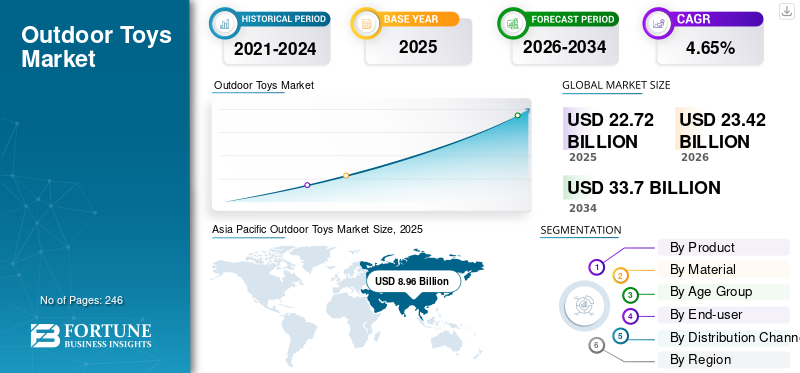
Download Free sample to learn more about this report.
Outdoor Toys Market Key Takeaways
 Market Size & Forecast
- 2025 Market Size: USD 22.72 billion
- 2026 Market Size: USD 23.42 billion
- 2034 Forecast Market Size: USD 33.70 billion
- CAGR: 4.65% from 2026–2034
 Market Share
- Asia Pacific dominated the outdoor toys market with a 39.45% share in 2025.
- Plastic material segment held a leading 42.23% market share in 2025.
- Ride-on toys segment accounted for the largest share due to broad adoption across multiple age groups.
 Key Regional Highlights
Asia Pacific
Asia Pacific accounted for 39.45% of the global market and reached USD 8.96 billion in 2025.
Europe
Europe held the second-largest market share in 2025, supported by strong demand for premium and safety-certified toys.
North America
North America is expected to witness significant growth through 2034 due to high demand for durable and feature-rich outdoor toys.
U.S.
Strong household spending and widespread availability of outdoor play spaces support market growth.
Japan
Demand is driven by a large child population base and increasing focus on outdoor physical development activities.
Read More

MARKET DYNAMICS
MARKET DRIVERS
Increasing Focus on Outdoor Play for Child Development to Drive Market Progress
Outdoor play is considered one of the important parts for children’s development, increasing the demand for outdoor toys such as slides, swings, playhouses, trampolines, climbing frames, and others. Governments, educational and health institutes, and parents focus on outdoor activities due to their significant benefits for children’s physical, emotional, and social growth. This increased awareness is expected to drive the demand for outdoor toy products globally. For instance, according to the World Health Organization (WHO), children aged between 3 to 5 years should be engaged in outdoor activities for at least 18 minutes on a daily basis. This helps with higher physical active levels and better emotional regulation.
Additionally, owing to the rising digital exposure, most parents are worried about prolonged screen times and their disadvantages on the child’s brain development. This factor is increasingly forcing today’s parent to focus on outdoor games. According to the UNICEF (United Nations Children's Fund), the screen time of children has increased by over 50% from 2019–2022.
MARKET RESTRAINTS
Safety Concerns and Stringent Regulations to Restrain Market Growth
Safety concerns and strict regulations are major challenges for the global market. Outdoor toys such as trampolines, slides, ride-ons, inflatables, climbing frames, and scooters can lead to a higher risk of physical injury due to active play. For instance, according to the U.S. Consumer Product Safety Commission (CPSC) reports that around 230,000 emergency visits related to playground and outdoor toys occur annually in the U.S. alone. Additionally, regulatory bodies enforce strict compliance requirements, which raise manufacturing costs, delay product launches, and increase recall frequency.
MARKET OPPORTUNITIES
Increasing Adoption of Sustainable and Eco-Friendly Outdoor Toys to Augment Market Growth
Rising concerns about environmental sustainability, non-toxic materials, and product durability have significantly increased the demand for sustainable outdoor toys. Various outdoor toys are affected by harsh climatic conditions such as humidity, UV rays, and rain. To protect the toys from these conditions, manufacturers prefer whether resistant materials and recyclable plastic.
Moreover, most of the parents and educational institutes prefer toys manufactured from recycled plastic, wood, and biodegradable materials with low-toxic ingredients. Therefore, due to their increasing demand, it creates better opportunities for manufacturers to develop eco-friendly products.
MARKET CHALLENGES
Increased Logistics and Raw Materials cost to Challenge Key Players’ Business Revenue Growth
Outdoor toys are specifically made from plastic resins, wood, metal frames, and other materials that are bulky, heavy, and intensive. Fluctuations in the prices of these raw materials may hugely impact the manufacturing cost and profit margins. These cost-related issues may affect the entire value chain of the business, impacting the revenue and growth of the major players.
OUTDOOR TOYS MARKET TRENDS
Integration of Technology in Smart Outdoor Toys to Favor Growth
Technological implementation in outdoor toys is a major trend shaping the global outdoor toys market growth. Now-a-days, children are more exposed to digital devices; therefore, parents are looking for ways to combine physical activity with the development of technological learning skills, making smart outdoor toys a preferred product.
The smart outdoor toys have transformed traditional toys with data-driven experiences supporting both entertainment and development.
Download Free sample to learn more about this report.
Segmentation Analysis
By Product
Wider Adoption of Ride-on Toys among Diverse Age Groups Governed the Primary Position of Ride-On Toys Segement
By product, the market is segmented into rid-on toys, water & sand toys, trampolines & bounce toys, inflatable & soft outdoor toys, creative & activity toys, and others.
The ride-on toys segment is expected to hold the majority share in the global outdoor toys market, owing to the broader consumer base that is from infants to pre-teens. However, the other product categories, such as slides, playhouses, or sand toys, are restricted until a certain age (typically 1-5 years). Therefore, the adoption and demand for ride-on toys is much greater than the other product categories.
Additionally, water and sand toys such as sandboxes, buckets, shovels, sand play sets, water tables, sprinklers, inflatable pools, water guns, and beach toys are some of the most popular outdoor toys around the world. Due to their low cost, developmental benefits, frequent use, and their appeal to a wide range of age groups, have led to secure their second largest market share.
To know how our report can help streamline your business, Speak to Analyst
By Material
Light-weight and Weather Resistant Feature led to the Dominance of Plastic Segment
By material, the market is segmented into plastic, wood, metal, and others.
The plastic segment exhibited a leading global market share of 42.23% in 2025. The segment is projected to grow at the fastest rate from 2026 to 2034. The segment’s leading share is attributed to the high consumer preference for plastic outdoor toys, owing to its lightweight and weather-resistant features. Moreover, the affordability and mass-market consumers have lead to an increase in the demand for plastic toys from health & educational institutes and household users.
Furthermore, the wood toys are expected to hold the second position in the global outdoor toys market during the forecasted period 2026-2034. These toys give a premium and natural aesthetic look and are preferred for large backyard structures. For instance, in May 2024, Fisher-Price, a pioneer in developing high-quality educational toys for young children, announced an all-new Fisher-Price wooden toy line for children ages 6 months to 5 years. Therefore, the expansion of the wooden toys segment by various key players led to an increase the demand during the forecast period.
By Age Group
Frequent Outdoor Games Played by the Age Group of 3-5 Years Leads to Its Dominance in the Market
Based on the age group, the market is segmented into 0–2 years (toddlers), 3-5 years, 6-8 years, and above 8 years.
The age group 3-5 years is expected to hold the majority share as children of this age group play outdoor games very frequently and independently. Furthermore, the parents of these age groups invest actively in toys that promote both physical fitness and creative outdoor time.
By End-user
Household Segment Leads Owing to Parents’ Focus on Children’s Physical Development
Based on end-user, the market is segmented into household, schools & educational institutions, parks & recreation areas, and others.
The household segment dominates the global outdoor toys industry, owing to the parents' focus on children’s physical development, and outdoor play increases the purchase frequency by parents for the age group of 0-12. Additionally, the strong influence of gifting toys on birthdays and other occasions leads to high consumption of toys by household users.
By Distribution Channel
Rising Adoption of Online Shopping Led the E-Commerce Segment to Grow at Fastest Growth Rate
Based on distribution channels, the market is segmented into specialty stores, supermarket/hypermarket, e-commerce, and others.
The e-commerce is expected to be the fastest-growing segment during the forecast period 2026-2034. Rising preference for online shopping, availability of a wider variety of products, and customer reviews influencing purchase decisions from Amazon, Walmart, Alibaba, and Flipkart is expected to drive the demand for outdoor toys during the forecasted period.
Outdoor Toys Market Regional Outlook
By geography, the market is categorized into North America, Europe, Asia Pacific, South america and the middle east and africa.
Asia Pacific
Asia Pacific Outdoor Toys Market Size, 2025 (USD Billion) To get more information on the regional analysis of this market, Download Free sample
The Asia Pacific region exhibited a leading global outdoor toys market share of 39.45% in 2025. The region’s market size reached USD 8.96 billion in 2025. The increasing population of children aged 0-14 across the region is creating the greatest demand for the market in countries such as India, China, Japan, and others. For instance, according to the World Bank 2024 report, about 18% of the population in East Asia falls under the age group of 0-14. Additionally, rapid urbanization and huge land allocation by the government for urban community parks, playgrounds, play zones, and others are expected to increase the demand for outdoor toys.
The China market size reached USD 3.07 billion in 2025. Rising awareness of child development many Chinese parents prefer outdoor toys that support physical activity, motor development, and learning. Various e-commerce platforms and social media have made toys more accessible in urban and semi-urban areas in China. Furthermore, China is considered to be the production hub for the market, which makes the toys cheaper for the customers. This cost-effective factor increases the demand for outdoor toys, especially in China.
Europe
The European region held a second-leading global market share in 2025, owing to the strong spending power on premium and safety-certified toys. European parents prefer trusting brands that meet safety standards. Additionally, various countries in the region invest annually in new public playground infrastructure for the proper development of children’s physically and socially development. These factors are positively contributing to market growth in the region.
North America
The North America region is expected to grow at a significant pace owing to the high-quality, durable, and feature-rich products. The countries such as the U.S. and Canada have homes with dedicated outdoor spaces, which drives the purchase of outdoor toys.
South America and Middle East & Africa
Over the global market forecast period, the market in the South America and Middle East & Africa regions is expected to witness a moderate growth rate from 2026 to 2034. The increasing urbanization and growing number of middle-income households in Brazil, Argentina, and Colombia are primarily driving the growth of the Latin America market.
The high per-capita spending, rapid urban development, and strong government focus on parks, recreation, and child wellness in South Africa, the UAE, and Saudi Arabia are mainly driving the growth of the Middle East & African market.
COMPETITIVE LANDSCAPE
Key Industry Players
Consistent Focus on Eco-friendly and Sustainable Products to Help Key Players Build Market Positions
The global outdoor toys market is moderately fragmented, with a large number of local and global players. The leading players including LEGO Group, Hasbro Inc., Mattel Inc., Little Tikes, Smoby Toys, and others. Product innovation, safety standards, pricing strategies, and distribution network across retail and e-commerce channels mainly drive the competition amongst these companies.
LIST OF KEY OUTDOOR TOYS COMPANIES PROFILED
- Hasbro Inc. (U.S.)
- Mattel Inc. (U.S.)
- Little Tikes (U.S.)
- Step2 Company (U.S.)
- Smoby Toys (France)
- Simba Dickie Group (Germany)
- BIG Spielwarenfabrik (Germany)
- Spin Master (Canada)
- Radio Flyer (U.S.)
- LEGO Group (Denmark)
KEY INDUSTRY DEVELOPMENTS
- September 2025: British toy retailer The Entertainer has partnered with British Garden Centers, the U.K.'s largest family garden center group, to launch branded toy stores in stores across the country.
- March 2025: Just Play has expanded into board games and outdoor toys with new licensing partnerships with Hasbro and Sony Pictures TV. This partnership has been approached for quality, value, and speed to enter into the market.
- October 2023: BMS Brands introduced Kazaang with a range of outdoor toys focusing on enhancing play time.
- March 2023: WowWee has announced an expanded partnership to bring more classic Hasbro play products to outdoor playgrounds and introduce new Nerf Super Soaker products.
- June 2020: Hasbro, Inc. is expanding its industry-leading toy and game recycling program in the UK by partnering with TerraCycle, a leader in hard-to-recycle waste, to offer a free nationwide recycling program for all Hasbro toys and games.
REPORT COVERAGE
Request for Customization to gain extensive market insights.
Report Scope & Segmentation
|
ATTRIBUTE |
DETAILS |
|
Study Period |
2021-2034 |
|
Base Year |
2025 |
|
Estimated Year |
2026 |
|
Forecast Period |
2026-2034 |
|
Historical Period |
2021-2024 |
|
Growth Rate |
CAGR of 4.65% from 2026-2034 |
|
Unit |
Value (USD Billion) |
|
Segmentation |
By Product, Material, Age Group, End-user, Distribution Channel, and Region |
|
By Product |
· Rid-on Toys · Water & Sand Toys · Trampolines & Bounce Toys · Inflatable & Soft Outdoor Toys · Creative & Activity Toys · Others |
|
By Material |
· Plastic · Wood · Metal · Others |
|
By Age Group |
· 0–2 years (toddlers) · 3-5 Years · 6-8 Years · Above 8 Years |
|
By End-user |
· Household · Schools & Educational Institutions · Parks & Recreation Areas · Others |
|
By Distribution Channel |
· Specialty Stores · Supermarket/Hypermarket · E-commerce · Others |
|
By Region |
· North America (By Product, Material, Age Group, End-user, Distribution Channel, and Country) o U.S. (By Product) o Canada (By Product) o Mexico (By Product) · Europe (By Product, Material, Age Group, End-user, Distribution Channel, and Country) o Germany (By Product) o France (By Product) o Italy (By Product) o Spain (By Product) o U.K. (By Product) o Russia (By Product) o Rest of Europe (By Product) · Asia Pacific (By Product, Material, Age Group, End-user, Distribution Channel, and Country) o China (By Product) o India (By Product) o Japan (By Product) o Australia (By Product) o Rest of Asia Pacific (By Product) · South America (By Product, Material, Age Group, End-user, Distribution Channel, and Country) o Brazil (By Product) o Argentina (By Product) o Rest of South America (By Product) · Middle East & Africa (By Product, Material, Age Group, End-user, Distribution Channel, and Country) o South Africa (By Product) o UAE (By Product) o Rest of the Middle East & Africa (By Product) |
Frequently Asked Questions
Fortune Business Insights says that the global market value stood at USD 22.72 billion in 2025 and is projected to reach USD 33.70 billion by 2034.
In 2025, the market value stood at USD 8.96 billion.
At a CAGR of 4.65%, the global market forecasted to growth during the forecast period.
By Product, the ride-on toys segment exhibited a leading global market share throughout the forecast period.
Increasing focus on outdoor play for child development to drive the global market.
LEGO Group, Hasbro Inc., Mattel Inc., Little Tikes, Smoby Toys, and others are among the prominent players in the market.
Asia Pacific dominated the market in 2025.
The increasing urbanization and rising disposable income is expected to favor the adoption rate of these products.



- 2021-2034
- 2025
- 2021-2024
- 246
-
(Offer valid till 15th Oct 2026)
Get 30-60 hrs Free Customization
Expand Regional and Country Coverage, Segments Analysis, Company Profiles, Competitive Benchmarking, and End-user Insights.



















Related Reports
-
US +1 833 909 2966 ( Toll Free )
-
Get In Touch With Us