Oxygen Therapy Equipment Market Size, Share & Industry Analysis, By Product Type (Oxygen Concentrators, Liquid Oxygen Devices, Oxygen Cylinders, Oxygen Delivery Devices, Accessories, and Others), By Portability (Stationary and Portable), By Application (COPD, Asthma, Sleep Apnea, Pneumonia, and Others), By End-user (Hospitals & ASCs, Homecare Settings, Emergency Care, and Others), and Regional Forecast, 2026-2034
 Download Free Sample
Oxygen Therapy Equipment Market Size and Future Outlook
 Listen to Audio Version
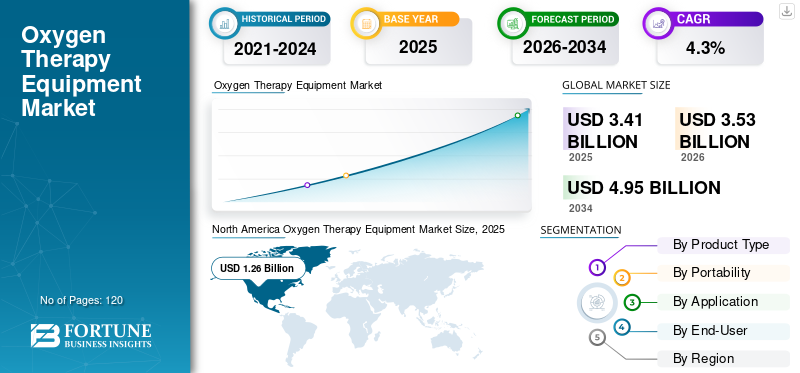
The global oxygen therapy equipment market size was valued at USD 3.41 billion in 2025. The market is projected to grow from USD 3.53 billion in 2026 to USD 4.95 billion by 2034, exhibiting a CAGR of 4.3% during the forecast period. North America dominated the oxygen therapy equipment market with a market share of 36.95% in 2025.
Oxygen therapy equipment includes devices which are used to deliver oxygen to patients who have difficulty breathing or low oxygen levels. These products mainly include oxygen concentrators, cylinders, liquid oxygen systems, masks, and related accessories. The market growth is attributed to the rising number of respiratory diseases such as COPD, asthma, and other lung conditions. The demand also increased significantly after COVID-19, which highlighted the importance of oxygen support in both hospitals and homecare settings. In addition, many patients now continue oxygen therapy at home, which is further boosting demand for user-friendly and reliable devices. In addition, the aging population and increasing pollution levels are contributing to higher respiratory issues globally.
- For instance, according to data published by the Centers of Disease Control and Prevention (CDC), an estimated 14.2 million population in the U.S. was suffering from COPD in 2021.
Furthermore, many key industry players are focusing on developing various innovative technologies to offer better products with improved accuracy and efficiency. Such companies operating in the market include CAIRE Inc., Inogen, Inc., Koninklijke Philips N.V., Invacare International Holdings Corp., and React Health.
Download Free sample to learn more about this report.
Oxygen Therapy Equipment Market Key Takeaways
 Global Market Size & Forecast
- 2025 Market Size: USD 3.41 billion
- 2026 Market Size: USD 3.53 billion
- 2034 Forecast Market Size: USD 4.95 billion
- CAGR: 4.3% from 2026–2034
 Market Share
- North America dominated the oxygen therapy equipment market with a 36.95% share in 2025.
- The oxygen concentrators segment accounted for the largest market share in 2025.
- The homecare settings segment is projected to hold a 37.0% share in 2026.
 Key Regional Highlights
North America
North America generated USD 1.26 billion in 2025, accounting for 36.95% of the global market.
Europe
Europe is projected to reach USD 0.99 billion in 2026, supported by rising respiratory disease prevalence and product innovation.
Asia Pacific
Asia Pacific is expected to reach USD 0.87 billion in 2026, emerging as the fastest-growing regional market.
U.S
The U.S. market is estimated to reach USD 1.11 billion in 2026, representing approximately 31.4% of global sales.
Japan
Japan’s market is projected to reach USD 0.15 billion in 2026, accounting for approximately 4.3% of global revenue.
Read More

OXYGEN THERAPY EQUIPMENT MARKET TRENDS
Shift Toward Portable and User-Friendly Devices is One of the Important Trends Observed in the Market
The market is witnessing a considerable shift of preference toward portable and easy-to-use oxygen therapy devices. Patients today prefer lightweight and compact equipment that allows them to move freely and maintain a normal lifestyle. Moreover, companies are also introducing portable oxygen concentrators that are quieter, battery-operated, and travel-friendly. This trend is especially strong in homecare and outpatient settings. Along with portability, there is also a focus on improving device design, noise levels, and usability.
- For instance, in May 2022, Caire Inc., expanded its operations and portfolio in Brazil. Through this expansion and approval of ANVISA, the company got an opportunity to expand its customer reach for portable oxygen concentrators in the country.
MARKET DYNAMICS
MARKET DRIVERS
Download Free sample to learn more about this report.
Substantial Prevalence of Respiratory Conditions is Projected to Boost Market Growth
The growing prevalence of respiratory conditions across the globe is one of the prominent market drivers. Diseases such as COPD, asthma, and chronic bronchitis require long-term oxygen support in many cases. Also, as pollution levels rise and the global population ages, more people are developing breathing-related problems. This directly increases the need for oxygen therapy devices. Hospitals and homecare providers are both witnessing higher demand for these products.
MARKET RESTRAINTS
Dependence on Power and Infrastructure to Deter Market Growth
In regions with unstable power supply, using oxygen concentrators can be challenging. Even in homecare settings, patients need reliable electricity to operate these devices safely. Backup options such as cylinders’ increase cost and complexity. In addition, maintenance and servicing requirements can limit usage in remote or low-resource settings. Due to these limitations, adoption may be slower in certain developing regions where infrastructure support is not consistent, which impacts overall global oxygen therapy equipment market growth.
MARKET OPPORTUNITIES
Expansion of Home Healthcare to Offer Lucrative Market Growth Opportunities
A major opportunity in this market is the rapid growth of home healthcare. More patients prefer receiving treatment at home instead of staying in hospitals, especially for long-term conditions. Oxygen therapy fits well into this trend as many patients need continuous support but not intensive hospital care. Companies are focusing on making devices smaller, quieter, and easier to use at home. This creates strong demand for portable and user-friendly equipment. As healthcare systems aim to reduce hospital burden and costs, home-based oxygen therapy is expected to grow significantly, creating long-term market opportunities.
- For instance, in June 2025, Inogen, Inc. announced the launch of its new Voxi, a new-generation oxygen concentrator, especially for homecare use.
MARKET CHALLENGES
High Cost and Patient Affordability to Pose a Critical Challenge to Market Growth
One of the major challenges in the market is affordability. Advanced devices, especially portable oxygen concentrators, can be expensive for many patients. Long-term oxygen therapy also involves ongoing costs such as maintenance, electricity, and accessories. In many regions, insurance coverage for home oxygen therapy is limited, which increases the financial burden on patients. This can restrict adoption, especially in low- and middle-income countries. Even though demand is rising, affordability remains a key barrier that companies and healthcare systems need to address for wider market penetration.
Segmentation Analysis
By Product Type
High Adoption of Oxygen Concentrators in Healthcare Facilities to Boost Oxygen Concentrators Segment Growth
Based on the product type, the market is divided into oxygen concentrators, liquid oxygen devices, oxygen cylinders, oxygen delivery devices, accessories, and others.
The oxygen concentrators segment is anticipated to account for the largest oxygen therapy equipment market share. The segment growth is attributed to repetitive purchase, technological advancements, and new product introductions. Unlike cylinders, concentrators provide a continuous oxygen supply without the need for refilling, making them more convenient and cost-effective over time. In addition, a growing number of product launches are also estimated to boost segment growth.
- For instance, in April 2024, Dynarex Corporation announced the launch of its new product line of portable oxygen concentrators.
The oxygen delivery devices segment is anticipated to rise with a CAGR of 4.4% over the forecast period.
To know how our report can help streamline your business, Speak to Analyst
By Portability
Considerable Convenience Offered by Stationary Systems to Accelerate Segment Growth
Based on portability, the market is segmented into stationary and portable.
In 2025, the stationary segment dominated the global market as it is commonly used in homes and hospitals where continuous oxygen supply is required. Moreover, these systems are more powerful and can deliver higher oxygen flow compared to portable devices. They are ideal for patients who spend most of their time at home and need stable oxygen support. Stationary units are also generally more affordable than portable options, which increases their adoption.
Additionally, the portable segment is estimated to grow at a CAGR of 5.0% during the forecast period.
By Application
Considerable Prevalence of COPD Conditions to Boost Segment Growth
Based on application, the market is segmented into COPD, asthma, sleep apnea, pneumonia, and others.
In 2025, the COPD segment dominated the global market. Patients with COPD often experience low oxygen levels and need continuous support to maintain normal breathing. As the number of COPD cases increases globally, the demand for oxygen therapy equipment also rises. This condition typically requires long-term treatment, which creates steady demand for devices. Due to its high prevalence and ongoing treatment needs, COPD remains the leading application segment in the market.
In addition, the pneumonia segment is projected to grow at a CAGR of 4.1% during the forecast period.
By End-User
Shift of Preference for Home Stays by Patients to Accelerate Homecare Settings Segment Growth
Based on end-user, the market is segmented into hospitals & ASCs, homecare settings, emergency care, and others.
In 2025, homecare settings held the highest market share as many patients prefer receiving oxygen therapy at home rather than staying in hospitals. Long-term oxygen therapy is more convenient and cost-effective when managed at home. Advances in device design have made it easier for patients and caregivers to operate oxygen equipment without professional supervision. This shift toward home-based care has significantly increased demand for home-use devices. Furthermore, the segment is set to hold 37.0% share in 2026.
In addition, the hospitals & ASCs segment is projected to grow at a CAGR of 4.3% during the forecast period.
Oxygen Therapy Equipment Market Regional Outlook
By region, the market is categorized into Europe, North America, Asia Pacific, Latin America, and the Middle East & Africa.
North America
North America Oxygen Therapy Equipment Market Size, 2025 (USD Billion)
To get more information on the regional analysis of this market, Download Free sample
North America held the dominant share in 2024, valuing at USD 1.22 billion, and also maintained the leading share in 2025, with USD 1.26 billion. The market in North America is expected to increase due to technological advancements in oxygen therapy, and growing number of product launches.
U.S. Oxygen Therapy Equipment Market
Based on North America’s strong contribution and the U.S. dominance within the region, the U.S. market can be analytically approximated at around USD 1.11 billion in 2026, accounting for roughly 31.4% of global sales.
Europe
Europe is projected to record a growth rate of 6.3% in the coming years, which is the second highest among all regions, and reach a valuation of USD 0.99 billion by 2026. The region is estimated to witness considerable market growth due to rising investments for new product development, and growing prevalence of respiratory conditions.
U.K. Oxygen Therapy Equipment Market
The U.K. market in 2026 is estimated at around USD 0.16 billion, representing roughly 4.6% of global revenues.
Germany Oxygen Therapy Equipment Market
Germany’s market is projected to reach approximately USD 0.22 billion in 2026, equivalent to around 6.3% of global sales.
Asia Pacific
Asia Pacific is estimated to reach USD 0.87 billion in 2026 and secure the position of the third-largest region in the market. Asia Pacific is expected to be the fastest-growing region as it combines a very large respiratory disease burden with improving access to diagnosis, treatment, and respiratory care infrastructure. As healthcare systems mature and homecare penetration rises, this creates strong room for growth in concentrators, delivery devices, and oxygen accessories from a relatively underpenetrated base.
Japan Oxygen Therapy Equipment Market
The Japan market in 2026 is estimated at around USD 0.15 billion, accounting for roughly 4.3% of global revenues.
China Oxygen Therapy Equipment Market
China’s market is projected to be one of the largest worldwide, with 2026 revenues estimated at around USD 0.29 billion, representing roughly 8.3% of global sales.
India Oxygen Therapy Equipment Market
The India market in 2026 is estimated at around USD 0.20 billion, accounting for roughly 5.5% of global revenues.
Latin America and Middle East & Africa
Latin America and the Middle East & Africa regions are expected to witness moderate growth in this market space during the forecast period. The Latin America market is set to reach a valuation of USD 0.22 billion in 2026. Growth in Latin America is being supported by a persistent burden of chronic respiratory diseases, improving recognition of pulmonary rehabilitation and respiratory care needs, and gradual strengthening of oxygen-use protocols across health systems.
In the Middle East & Africa, the GCC is set to reach a value of USD 0.05 billion in 2026. However, growth in the Middle East & Africa region is being driven by rising respiratory disease risk factors, especially air pollution and indoor pollution exposure, alongside gradual expansion of healthcare infrastructure and oxygen access.
South Africa Oxygen Therapy Equipment Market
The South Africa market is projected to reach around USD 0.02 billion in 2026, representing roughly 0.64% of global revenues.
COMPETITIVE LANDSCAPE
Key Industry Players
Strong Focus on Product Launches and Rising Number of Collaborations by Key Players to Boost Market Competition
The global oxygen therapy equipment market features a moderately concentrated landscape. However, leading organizations in the market include CAIRE Inc., Inogen, Inc., Koninklijke Philips N.V., Invacare International Holdings Corp., and React Health. The significant global market share of these companies is due to numerous strategic activities, including new product launches and rising number of collaborations.
- For instance, in January 2025, Inogen Inc. and Yuwell Medical announced a long-term strategic partnership and investment aimed at bolstering their global respiratory care positions, particularly in respiratory therapy, diabetes management, and homecare
Furthermore, additional contributors globally include Plexus Corp., Celestica HealthTech, West Pharmaceutical Services, Phillips-Medisize, and Nextern. Moving forward, these firms are anticipated to prioritize collaborations to increase their global market share during the forecast period.
LIST OF KEY OXYGEN THERAPY EQUIPMENT COMPANIES PROFILED
- CAIRE Inc. (U.S.)
- Inogen, Inc. (U.S.)
- Koninklijke Philips N.V. (Netherlands)
- Invacare International Holdings Corp. (U.S.)
- React Health (U.S.)
- Fisher & Paykel Healthcare (New Zealand)
- ResMed (U.S.)
- Nidek Medical Products, Inc. (U.S.)
- Oxymed (India)
- Drive DeVilbiss Healthcare (U.S.)
KEY INDUSTRY DEVELOPMENTS
- April 2026: VARON announced delivery of advanced and portable oxygen concentrators in Europe with an aim to cater increasing demand for oxygen therapies.
- May 2025: Raydiant Oximetry and GE HealthCare announced boosting the pace of their collaborative innovation on fetal oxygen saturation technology.
- May 2021: Daikin Industries, Ltd. announced the donation of 200 oxygen concentrators in various healthcare facilities in India.
- April 2021: Steel Authority of India Limited (SAIL) announced its plan to expand production of liquid medical oxygen from its plants.
- March 2021: Belluscura PLC and Separation Design Group received FDA approval for its X-plo2r portable oxygen concentrator. The new system delivers 95% pure oxygen.
REPORT COVERAGE
The global oxygen therapy equipment market analysis includes a comprehensive study of the market size & forecast by all the market segments included in the report. It includes details on the market dynamics and market trends expected to drive the market over the forecast period. It provides information on key aspects, including an overview of technological advancements, the regulatory environment, and product launches. Additionally, it details partnerships, mergers & acquisitions, as well as key industry developments and investments by key regions. The global market research report also provides a depth competitive landscape with information on the market share and profiles of key operating players.
Request for Customization to gain extensive market insights.
Report Scope & Segmentation
| ATTRIBUTE | DETAILS |
| Study Period | 2021-2034 |
| Base Year | 2025 |
| Estimated Year | 2026 |
| Forecast Period | 2026-2034 |
| Historical Period | 2021-2024 |
| Growth Rate | CAGR of 4.3% from 2026-2034 |
| Unit | Value (USD Billion) |
| Segmentation | By Product Type, Portability, Application, End-User, and Region |
| By Product Type |
|
| By Portability |
|
| By Application |
|
| By End-User |
|
| By Region |
|
Frequently Asked Questions
According to Fortune Business Insights, the global market value stood at USD 3.41 billion in 2025 and is projected to reach USD 4.95 billion by 2034.
In 2025, the market value stood at USD 1.26 billion.
The market is expected to exhibit a CAGR of 4.3% during the forecast period.
By product type, the oxygen concentrator segment is expected to lead the market.
The rising prevalence of respiratory diseases coupled with technological advancements in oxygen therapy devices are driving the market expansion.
CAIRE Inc., Inogen, Inc., Koninklijke Philips N.V., Invacare International Holdings Corp., and React Health are the major players in the global market.
North America dominated the market in 2025.



- 2021-2034
- 2025
- 2021-2024
- 120
Get 30-60 hrs Free Customization
Expand Regional and Country Coverage, Segments Analysis, Company Profiles, Competitive Benchmarking, and End-user Insights.













.webp)






Related Reports
-
US +1 833 909 2966 ( Toll Free )
-
Get In Touch With Us