Fiber Reinforced Polymer (FRP) Composites Market Size, Share & Industry Analysis, By Type (Glass Fiber-reinforced Polymer, Carbon Fiber-reinforced Polymer, and Others), By Application (Transportation, Construction, Electronics, Sports & Leisure, and Others), and Regional Forecast, 2026-2034
 Download Free Sample
KEY MARKET INSIGHTS
 Listen to Audio Version
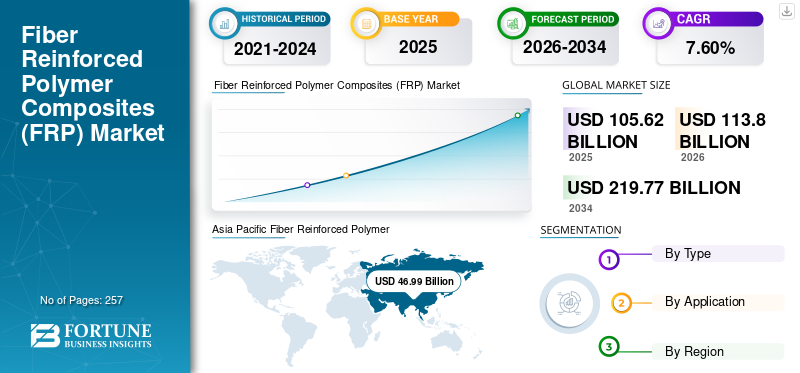
The global Fiber Reinforced Polymer (FRP) composites market size was valued at USD 102.61 billion in 2025. The market is projected to grow from USD 113.80 billion in 2026 to USD 219.77 billion by 2034 at a CAGR of 7.60% during 2026-2034. Asia Pacificdominated the Fiber Reinforced Polymer (FRP) composites market market with a market share of 45.79% in 2025.
Fiber reinforced polymer composites are materials made by combining a polymer matrix with a fibrous reinforcing dispersed phase. The polymer matrix, which is typically a type of plastic, binds the fibers together and helps distribute loads and stresses between them. The fibers, which are usually made from materials such as glass, carbon, aramid, or basalt, provide strength and stiffness to the composite. This combination yields a material that is lightweight, strong, and durable, making FRP composites popular for use in various applications, including aerospace, automotive, marine, and construction industries.
The market is experiencing rapid growth, characterized by the incorporation of fibers such as glass, carbon, or aramid embedded in a polymer matrix to create a lightweight and strong material. FRP composites are widely used in various industries, including aerospace, automotive, construction, and sports equipment, due to their high strength-to-weight ratio, corrosion resistance, and durability. The market is expected to grow in the coming years due to increased demand for lightweight and high-performance materials. SGL Carbon, Avient Corporation, Hexcel Corporation, Arvind Composites, Owens Corning are the key players operating in the market.
Download Free sample to learn more about this report.
Fiber Reinforced Polymer Composites Market Key Takeaways
 Global Market Size & Forecast
- 2025 Market Size: USD 102.61 billion
- 2026 Market Size: USD 113.80 billion
- 2034 Forecast Market Size: USD 219.77 billion
- CAGR: 7.60% from 2026–2034
 Market Share
- Asia Pacific dominated the Fiber Reinforced Polymer (FRP) composites market with a 45.79% share in 2025.
- The glass fiber-reinforced polymer segment is expected to account for a 76.69% share in 2026.
- The transportation segment is projected to capture a 39.87% share in 2026.
 Key Regional Highlights
North America
North America was valued at USD 26.20 billion in 2025 and is projected to reach USD 28.01 billion in 2026.
Asia Pacific
Asia Pacific accounted for USD 46.99 billion in 2025 and is projected to reach USD 51.14 billion in 2026.
Europe
Europe reached USD 23.47 billion in 2025 and is expected to grow to USD 25.18 billion in 2026.
U.S.
The U.S. Fiber Reinforced Polymer (FRP) composites market is projected to reach USD 23.13 billion in 2026.
Japan
The Japan Fiber Reinforced Polymer (FRP) composites market is projected to reach USD 3.82 billion in 2026.
Read More

Fiber Reinforced Polymer (FRP) Composites Market Trends
Shift toward Lightweight, Sustainable, and High-Performance Composite Solutions
A key trending factor in the global FRP composites market is the accelerating shift toward lightweight and high-performance materials that also meet the evolving sustainability expectations. Across transportation, construction, and industrial applications, manufacturers and end users are increasingly prioritizing materials that reduce energy consumption during use, improve durability, and lower lifecycle costs. FRP composites, particularly those reinforced with glass fiber and carbon fiber, are gaining traction as they enable weight reduction without compromising structural integrity, thereby supporting efficiency and performance goals.
Download Free sample to learn more about this report.
Market Dynamics
Market Drivers
Increasing Demand for GFRP Composites in Transportation to Drive Market Growth
The market for glass fiber-reinforced polymer (GFRP) composites is experiencing growth due to the increasing demand in the construction and transportation sectors. The lightweight and high-strength properties of GFRP composites make them a popular choice for applications in the automotive, aerospace, and marine industries. This results in fuel efficiency and reduced emissions, making it an attractive option for environmentally conscious consumers.
The demand for GFRP composites has been increasing in recent years due to their superior properties compared to traditional materials. These composites are lightweight, exhibit high strength, and demonstrate excellent corrosion resistance. This makes them an ideal choice for a transportation application. As the benefits of GFRP composites become increasingly recognized, the demand for these materials is expected to continue growing in the years ahead, propelling fiber reinforced polymer (FRP) composites market growth.
Market Restraints
High Cost of Raw Material May Restrain the Market Development
The market is facing a significant challenge due to the high cost of raw materials. This challenge is limiting the growth of the market, as manufacturers struggle to maintain competitive pricing while ensuring profitability. Despite the many advantages of FRP composites, such as their high strength and durability, the cost issue emerges as a major obstacle for the industry. As a result, companies are exploring various options to reduce costs and improve efficiency, including the use of alternative raw materials and the adoption of new manufacturing processes. Thus, higher prices of raw materials will restrain the market's growth during the forecast period.
Market Opportunities
Rising Adoption of Electric Vehicles to Propel FRP Composites Market Growth
The switch to electric vehicles is driving the demand for FRP composites. These composites are lightweight, durable, and offer a high strength-to-weight ratio, making them a perfect fit for the automotive industry. As the world moves toward more sustainable and eco-friendly means of transportation, the demand for electric vehicles is increasing, driving the demand for FRP composites. According to a study conducted by the IEA, the electric car sales in 2022 exceeded 10 million, with the share of electric cars increasing from 4% in 2020 to 14% in 2022. Such growth is also anticipated for FRP composites in the coming years.
Market Challenges
High Cost and Complex Processing of FRP Composites to Create Challenges
One of the primary challenges restraining the global FRP composites market is the high cost of raw materials combined with complex and capital-intensive manufacturing processes. Key inputs such as glass fibers, carbon fibers, specialty resins, and performance additives are energy-intensive to produce and are subject to fluctuations in petrochemical feedstock prices and energy costs. These cost pressures are particularly pronounced for carbon fiber–reinforced polymers, where high precursor and processing costs significantly limit adoption beyond aerospace, defense, and premium transportation segments.
Segmentation Analysis
By Type
Glass Fiber-reinforced Polymer Segment Holds a Dominant Share with High Demand from a Variety of Applications
Based on type, the market is segmented into glass fiber-reinforced polymer, carbon fiber-reinforced polymer, and others.
The glass fiber-reinforced polymer segment is expected to dominate the FRP composites market, capturing a share of 76.69% in 2026. with high demand for GFRP products across various industries such as aerospace, automotive, and construction. GFRP composites offer numerous benefits, including high design flexibility, high strength-to-weight ratio, and corrosion resistance. These advantages have led to a surge in the demand for GFRP composites, which is expected to continue in the coming years.
The Carbon Fiber-Reinforced Polymer (CFRP) segment is experiencing significant growth is set to register a CAGR of 7.2% during the forecast period. With its exceptional strength, stiffness, and lightweight properties, CFRP is increasingly being utilized in a wide range of applications, spanning aerospace, automotive, and construction. The impressive performance of CFRP has made it an attractive alternative to traditional materials such as steel and aluminum, which are not as strong or lightweight.
Furthermore, the growing demand for fuel-efficient vehicles and increasing environmental regulations have resulted in a surge in the adoption of CFRP in the automotive industry. The use of Carbon Fiber-reinforced Polymer (CFRP) in vehicles reduces weight, which in turn improves fuel efficiency and reduces emissions. This has prompted automotive manufacturers to invest heavily in CFRP technology, further driving the market's growth.
By Application
To know how our report can help streamline your business, Speak to Analyst
Transportation Segment Secures the Major Share Owing to Growing Consumption across Automotive Industry
Based on application, the market is fragmented into transportation, construction, electronics, sports & leisure, and others.
The transportation segment is expected to account for the major share of the Fiber Reinforced Polymer (FRP) composites market, contributing 39.87% globally in 2026. These lightweight and durable materials are utilized in various applications, including structural components, underbody shields, and body panels, thereby contributing to improved fuel efficiency, reduced emissions, and enhanced safety in the automotive sector. Moreover, the demand for FRP composites in the automotive industry is expected to grow in the coming years, driven by the need to meet stringent regulations and the growing trend toward electric vehicles. Manufacturers are investing heavily in R&D activities to develop innovative solutions that offer higher performance at a lower cost. Due to the increasing benefits of these materials, the automotive sector is expected to continue dominating the FRP market.
The construction industry is rapidly adopting fiber reinforced polymer composites due to their exceptional strength, durability, and lightweight characteristics. These materials are utilized in various applications, including reinforcing concrete, enhancing seismic resistance, and serving as cladding materials for buildings. The use of FRP composites in construction offers numerous advantages, including reduced maintenance costs, enhanced safety, and extended lifespan of structures. Moreover, the construction segment in the FRP market is expected to experience significant growth in the coming years, driven by an increasing demand for sustainable and cost-effective solutions. As a result, manufacturers are investing in research and development (R&D) to create new products that cater to the specific needs of the construction industry. With the growing awareness of the benefits of FRP composites, the construction segment is experiencing rapid growth and is estimated to grow at a CAGR of 8.7% during the study period.
Similarly, the FRP composites market is experiencing positive growth in certain industries, such as electronics and sports. In the electronics industry, FRP composites are used to manufacture printed circuit boards. In contrast, in the sports industry, they are used to manufacture equipment such as hockey sticks, tennis rackets, and other sports-related items. With the constant need for innovation and improvement, an increasing number of companies are turning to fiber reinforced polymer composites to gain a competitive edge.
FIBER REINFORCED POLYMER (FRP) MARKET REGIONAL OUTLOOK
Based on geography, the market is divided into Latin America, Asia Pacific, North America, the Middle East & Africa, and Europe.
Asia Pacific
Asia Pacific Fiber Reinforced Polymer (FRP) Composites Market Size, 2025 (USD Billion) To get more information on the regional analysis of this market, Download Free sample
Asia Pacific dominated the market with a valuation of USD 46.99 billion in 2025 and is projected to reach USD 51.14 billion in 2026. Asia Pacific is a significant contributor to the FRP composites market, holding a major share on account of the growing demand for lightweight and fuel-efficient vehicles coupled with rapid infrastructure development in the region. With the rise in population and economic growth, the region is experiencing a surge in construction activities, resulting in a greater demand for fiber reinforced polymer composites in building and construction applications. Moreover, the increasing industrialization and urbanization are expected to drive the demand for FRP composites in various sectors, including aerospace, defense, and transportation. The Japan fiber reinforced polymer composites market is projected to reach USD 3.82 billion by 2026 and the India fiber reinforced polymer composites market is projected to reach USD 6.76 billion by 2026.
China Fiber Reinforced Polymer (FRP) Composites Market
The China market is projected to be one of the largest markets worldwide, with 2024 revenues estimated at around USD 21.12 billion, representing roughly 22.1% of global sales. The China fiber reinforced polymer composites market is projected to reach USD 26.55 billion by 2026,
North America
North America contributed 24.80% to the global market in 2025, with a valuation of USD 26.2 billion, and is projected to reach USD 28.01 billion in 2026. The market in North America is expected to witness significant growth in the coming years. The U.S. is a major contributor to the North America market, accounting for a considerable share of the regional market. This is due to the increasing adoption of FRP composites in various end-use industries such as automotive, construction, and aerospace. The benefits of FRP composites, including their lightweight nature, high strength, and durability, make them an ideal choice for various applications. Furthermore, the region has a well-established infrastructure for the manufacturing and distribution of FRP composites, which further supports the market growth. As the product demand continues to rise, manufacturers are investing in research and development to introduce new products and improve existing ones. This is a positive sign for the future of the FRP composites market in North America.
U.S. Fiber Reinforced Polymer (FRP) Composites Market
In 2024, the U.S. represents USD 19.28 billion market in North America for FRP composites, primarily driven by strong demand from the residential and commercial construction sectors. The U.S. is expected to account for roughly 20.2% of the global market sales in 2024. The U.S. fiber reinforced polymer composites market is projected to reach USD 23.13 billion by 2026.
Europe
Europe accounted for USD 23.47 billion in 2025, representing 22.20% of the global market share, and is projected to reach USD 25.18 billion in 2026. FRP composites are also experiencing a growing demand in Europe. Moreover, the stringent regulations related to carbon emissions in Europe are driving the demand for lightweight materials, which in turn is further boosting the product demand. The region, with well-established automotive and aerospace industries, is a significant consumer of fiber reinforced polymer composites. Manufacturers are focusing on developing new products to cater to the growing demand and provide cost-effective solutions to their customers. With the increasing demand and innovation in the FRP composites market, Europe is expected to witness significant growth in the years to come. The UK fiber reinforced polymer composites market is projected to reach USD 2.5 billion by 2026, while the Germany fiber reinforced polymer composites market is projected to reach USD 6.21 billion by 2026.
Germany Fiber Reinforced Polymer (FRP) Composites Market
In 2025, the Germany market is estimated to reach around USD 5.53 billion, representing roughly 5.8% of the global market revenue.
Latin America
In 2025, the Latin America market stood at USD 3.35 billion, representing 3.20% of global demand, and is projected to grow to USD 3.56 billion in 2026. The FRP composites market in Latin America is witnessing positive growth, driven by the increasing demand from the construction and infrastructure sectors. The rising adoption of fiber reinforced polymer (FRP) composites is supported by their advantages, such as high strength, durability, and strong resistance to corrosion, making them highly suitable for modern construction applications.
Middle East & Africa
The market in Middle East & Africa reached USD 5.61 billion in 2025, representing 5.30% of total market revenue, and is projected to reach USD 5.9 billion in 2026. The FRP composites market in the Middle East & Africa is also experiencing steady growth, supported by expanding construction and infrastructure activities across the region. The use of FRP materials is increasing due to their durability, corrosion resistance, and suitability for harsh environmental conditions, making them a preferred choice for various industrial and construction applications.
COMPETITIVE LANDSCAPE
Key Industry Players
Key Players Focus on Acquisition and Expansion Strategies to Increase their Market Share
The market's competitive landscape reflects consolidation and intense competition. Leading players across the globe have made substantial investments in research and development to enhance technological advancements and improve product output. The growth strategies employed by market leaders include prioritizing superior operational efficiency and pioneering technology development. Moreover, major players are actively engaged in acquisition and expansion strategies to augment their market share.
LIST OF KEY FIBER REINFORCED POLYMER (FRP) COMPOSITES COMPANIES PROFILED
- SGL Carbon (Germany)
- Avient Corporation (U.S.)
- Hexcel Corporation (U.S.)
- Arvind Composites (India)
- Owens Corning (U.S.)
- Mitsubishi Chemical Carbon Fiber and Composites Inc. (U.S.)
- Park Aerospace Corp. (U.S.)
- NIPPON STEEL Chemical & Material Co., Ltd. (Japan)
- TORAY Industries, Inc. (Japan)
- TEIJIN Limited (Japan)
KEY INDUSTRY DEVELOPMENTS
- October 2025 – Avient Corporation announced a successful collaboration with ReForm Composites Engineering LLC, a company that designs and manufactures continuous-fiber-reinforced thermoplastic solutions for concrete infrastructure. ReForm utilizes its patented Continuous Forming Machine (CFM), an advanced thermoplastic pultrusion technology that enables the creation of curved and complex profiles, unlike conventional pultrusion, which is limited to straight profiles.
- August 2025 – SGL Carbon launched natural fiber–based prepregs for motorsports, supplying flax fiber composite materials for the Toyota Hilux body competing in the Asia Cross Country Rally. Produced in Germany, the new prepreg offers lightweight performance, high moisture resistance, and a CO₂ footprint that is up to 85% lower than that of conventional carbon fiber components.
- May 2023 – Avient Corporation expanded its production line for OnForce and Complēt long fiber reinforced thermoplastic composites in the Asia Pacific region. This new line would enable the company to meet the increasing demand for composite materials.
- May 2022 – Avient Corporation launched Bio-Based polymer solutions for medical applications, aiming to capture more market share in the composite market.
- May 2022 – Hexcel Corporation launched a new product, namely, the HexPly Nature Range. This newly launched product is made with bio-derived resin content with natural fiber reinforcements. This product addresses demand across automotive, marine, wind energy, and winter sports applications.
REPORT COVERAGE
The market report provides a comprehensive analysis of the market, focusing on key aspects such as leading companies, product types, and major end-use industries. Besides this, the report offers insights into the market trends and highlights key industry developments. In addition to the aforementioned factors, the report encompasses several other factors that have contributed to the market's growth over recent years.
Request for Customization to gain extensive market insights.
Report Scope & Segmentation
|
ATTRIBUTE |
DETAILS |
|
Study Period |
2021-2034 |
|
Base Year |
2025 |
|
Estimated Year |
2026 |
|
Forecast Period |
2026-2034 |
|
Historical Period |
2021-2024 |
|
Growth Rate |
CAGR of 7.60% during 2026-2034 |
|
Unit |
Value (USD Billion) and Volume (Kiloton) |
|
Segmentation |
By Type, Application, and Region |
|
By Type |
· Glass Fiber-reinforced Polymer · Carbon Fiber-reinforced Polymer · Others |
|
By Application |
· Transportation · Construction · Electronics · Sports & Leisure · Others |
|
By Region |
· North America (By Type, Application, and Country) o U.S. (By Application) o Canada (By Application) · Europe (By Type, Application, and Country) o Germany (By Application) o France (By Application) o Italy (By Application) o U.K. (By Application) o Rest of Europe (By Application) · Asia Pacific (By Type, Application, and Country) o China (By Application) o India (By Application) o Japan (By Application) o Rest of Asia Pacific (By Application) · Latin America (By Type, Application, and Country) o Brazil (By Application) o Mexico (By Application) · Middle East & Africa (By Type, Application, and Country) o UAE (By Application) o South Africa (By Application) o Rest of the Middle East & Africa (By Application) |
Frequently Asked Questions
According to Fortune Business Insights, the global market size was USD 102.61 billion in 2025 and is projected to reach USD 219.77 billion by 2034.
The market will exhibit steady growth at a CAGR of 7.60% during the forecast period (2026-2034).
The transportation segment is the leading application segment in the market.
The increasing demand for GFRP composites in the transportation industry is a key factor driving the market.
SGL Carbon, Avient Corporation, Hexcel Corporation, Owens Corning, Mitsubishi Chemical Group Corporation, Park Aerospace Corp., NIPPON STEEL Chemical & Material Co., Ltd., TORAY Industries, Inc., and TEIJIN Limited are the top players in the market.
Asia Pacific holds the largest market share.
The rising demand from the transportation and construction industries supports the adoption of this product.



- 2021-2034
- 2025
- 2021-2024
- 257
Get 30-60 hrs Free Customization
Expand Regional and Country Coverage, Segments Analysis, Company Profiles, Competitive Benchmarking, and End-user Insights.


















Related Reports
-
US +1 833 909 2966 ( Toll Free )
-
Get In Touch With Us