Bubble Tea Market Size, Share & Industry Analysis, By Type (Black Tea, Green Tea, Oolong Tea, and White Tea), By Flavor (Original, Fruit, Chocolate, Coffee, and Others), and Regional Forecast, 2026 - 2034
 Download Free Sample
 KEY MARKET INSIGHTS
 Listen to Audio Version
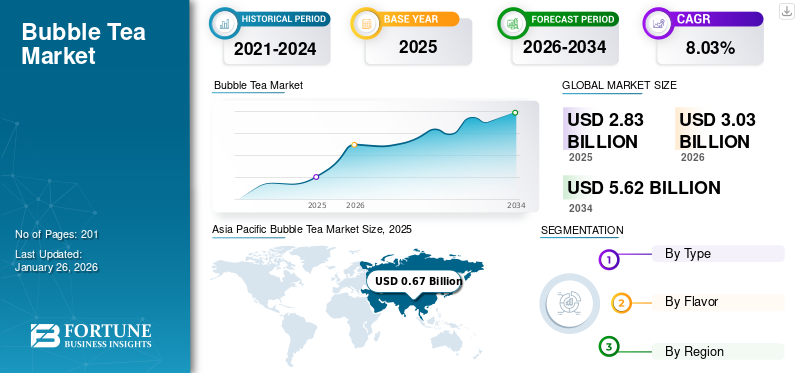
The global bubble tea market size was valued at USD 2.83 billion in 2025. The market is projected to grow from USD 3.03
billion in 2026 to USD 5.62 billion by 2034, exhibiting a CAGR of 8.03% during the forecast period. Asia Pacific dominated the bubble tea market with a market share of 44.06% in 2025.
The bubble tea trend has continued to soar in its originating region, later gaining traction in other western countries, such as Canada and the U.K. The beverage is now considered a mainstay due to its unique formulation. This popular sweetened tea is made up of high-quality milk and sweetener liquid tapioca pearls along with creamer, fruit powder, and sweeteners. Bubble tea has emerged as a cultural icon for the world and symbolizes Taiwan’s food innovation to promote its existence amidst the food service industry. For instance, Nextrends Asia 2021 displayed a 330% surge in Taiwan’s exports of pearl milk tea’s base ingredients (raw materials, packaging and machinery, and others) compared to 2018. In addition, the growing gastronomic tourism, rising number of health-conscious individuals, and increased social media influences further paved the way toward growing potential.
The outbreak of COVID-19 forced government bodies to impose strict closure of restaurants, farms, and factories to maintain safety measures and implement social distancing. This has led to transportation delays and the functioning of both supplies (tea estates) and demand for consumption points to a standstill due to a shortage of manpower and reduced visits of customers to coffee shops amidst the lockdown. According to the Indian Tea Association 2020, tea price has risen by 25%-40% on average due to lockdown in the tea growing regions, leading to a drop in crop size along with disruptions in transportation and logistics.
Furthermore, a decline in the growth of product consumption is witnessed due to strong restrictions on import and export facilities. For instance, the base ingredients required for the preparation of black or green tea are exported from India, but due to the imposed regulations, companies were unable to process the demands of the manufacturers.
Download Free sample to learn more about this report.
Bubble Tea Industry Landscape Overview
Market Size & Forecast:
- 2025 Market Size: USD 3.03 billion
- 2026 Market Size: USD 5.62 billion
- 2034 Forecast Market Size: USD 5.62 billion
- CAGR: 8.03% from 2026–2034
Market Share:
- Asia Pacific dominated the bubble tea market with a 44.06% share in 2025, driven by its origin and widespread regional acceptance.
- The black tea segment is projected to grow at a significant CAGR due to its antioxidant and anti-aging benefits.
- Fruit flavor dominated in 2024 due to high nutritional value and consumer preference for fruity beverages.
Key Country Highlights:
- U.S.: The bubble tea market is projected to reach USD 875.56 million by 2032, supported by growing popularity among younger demographics.
- Indonesia: Ranked first in Southeast Asia for bubble milk tea market demand.
- Vietnam & Taiwan: Leading countries in Asia Pacific for bubble tea sales.
- Canada & U.K.: Witnessed rapid adoption of bubble tea driven by younger demographics and premium tea chains.
- Italy: Frankly, Italy’s first bubble tea chain, grew 148% year-over-year in 2022 due to crowdfunding expansion.
- UAE: Brands like Koi The Co and Moge Tee opened new outlets to tap into rising demand.
- Brazil & Argentina: Experiencing growing experimentation with bubble tea despite coffee dominance.
Bubble Tea Market Trends
Market to Boom As Consumers Seek Versatile Teas with Innovative Bold Flavors
Boba tea is creating a buzz among individuals worldwide, owing to its growing appeal and novelty. The growing interest of consumers in innovative beverages with bold flavors and their willingness to experiment with various flavors is captivating the consumer’s attention, which contributes to fuel market growth. Bubble tea has emerged as one of Gen Z’s trademarks as its consumption is highly witnessed by the young generation as compared to any other age group. For instance, in August 2021, according to a study by the Business Times Newspaper, Southeast Asia spent around USD 3.7 billion on launching milk tea and such similar drinks, owing to the ever-growing demand from youth. Moreover, based on the study by the finance-based startup, Momentum Works and payment startup, Qlub, Indonesia’s bubble milk tea market ranked first among all the Southeast Asian countries. Besides this, due to its various attributes, such as low-fat and low-calorie content and other several health benefits, including high antioxidant value, it also boosts the consumption of boba tea across the domestic and international markets.
To know how our report can help streamline your business, Speak to Analyst
Bubble Tea Market Growth Factors
Expanding Range of Products to Target Younger Individuals to Boost Growth
In this era, the growing consumer preferences for products depend on various factors such as choice of taste, price, brand, and location accessibility. All these aspects necessitate the manufacturers to develop premium quality teas by keeping the consumer demands in mind. Bubble milk tea’s surge in popularity is mainly attributed to taste, affordability, and the rising reinvention of the basic tea recipe. Bubble tea has a strong market potential as it offers various types and flavors of boba teas, such as fruit flavored, black tea-based milk tea, and green jasmine, across the globe. For instance, in April 2022, U.S.-based start-up Bubluv Inc. launched tapioca starch and konjac-based boba tea in three flavors, black milk tea with tapioca pearls, matcha soy latte with tapioca pearls, and oolong guava with tapioca pearls.
In addition, the companies are focusing on the growing incidences of lactose intolerance, and thus are working toward introducing lactose-free bubble milk tea options for individuals. Furthermore, the shift of millennials toward such products owing to their demand for superior quality tea varieties with unique flavor offerings has encouraged industry players to expand their business activities. Companies are focusing on expanding their geographical presence, technology development, and product innovation by investing or raising funds from the public. For instance, in January 2024, Guming Holdings, a Chinese bubble tea company, was looking to raise USD 300 million in its upcoming Hong Kong IPO. The company would utilize the funds to expand its stores and technology development to enhance operational efficiency. The focus of industry players on raising funds to expand their business operations is likely to push the global bubble tea market growth.
Consumer Shift toward Healthy Alternatives to Favor Growth
The prevalence of lifestyle disorders such as obesity and diabetes associated with the hectic lifestyle of consumers has nudged them to shift toward healthy drinks, such as ginger tea and boba teas, due to their easy customization. The specialty of milk tea is growing due to its ease of customization with various tea bases and toppings such as jellies, fruit bits, syrups, and tapioca balls. Studies showed that green tea-based milk tea is proven to be beneficial for lowering blood pressure and the risk of cancer. The consumption of bubble tea also improves the balance of vitamins and minerals in the human body due to the presence of various inclusions such as yogurt, cream, fruit bits, and others. According to a study published in the National Library of Medicine, in 2022, chewing tapioca pearls can increase salivary C-protein (CRP) and calcium (Ca) levels. Furthermore, the increasing working class population in developing countries paired with rising shopper health consciousness is supporting the market growth. Apart from the U.S. and Asian countries, the trend of milk tea is also extensively growing amongst individuals residing in the Middle East and Africa. Since the acceptance of milk tea and boba tea has been increasing in the Middle Eastern countries, several companies are engaging in establishing their presence in the market to capture potential opportunities. For instance, in September 2021, Dubai witnessed the opening of various new tea outlets serving boba tea across the country. Brands, such as Koi The Co, Moge Tee, and M.A.D. Modern Asian Desserts expanded its business in the country by introducing various boba milk tea outlets.
RESTRAINING FACTORS
Availability of Alternative Caffeinated Drinks to Impede Growth
Despite the burgeoning demand for such innovative tea beverages, the wide availability of other caffeinated and conventional drinks, such as coffee and chocolate, coupled with the prominent coffee consumption trends in Western countries, poses a threat to market growth. Coffee and tea are the most consumed as well as socially accepted nootropic beverages across the world, and many consumers are highly dependent on such caffeinated drinks before starting their day. Moreover, the availability of suitable alternatives, such as unsweetened tea, coconut water, fruit-infused teas, and others, offering similar benefits, hamper the global market growth. Also, due to the strong dependency on Asian countries to source raw materials, such as tapioca balls from Taiwan, hinders the production process and impacts their overall operations. Such challenges cumulatively hamper the growth potential of the global market.
Bubble Tea Market Segmentation Analysis
By Type Analysis
Shift of Consumers toward Black Tea Due to its Health-Imparting Properties Boosts Market's Performance
The black tea segment is projected to dominate the market with a share of 42.24% in 2026, owing to its increased preference by health-conscious consumers across every region. The consumption of black tea is highly promoted due to its strong antioxidant, anti-aging, and anti-diabetic properties. Consumers are shifting toward natural and organic food and beverage products, which is one of the major factors that would help in the growth of this segment in the market.
Followed by black tea, the green tea segment is expected to hold a major percentage of the market share. According to NCBI, healthy and natural ingredients such as green tea help in preventing weight gain and also in inducing weight loss when consumed regularly. Green tea has shown long-term energy inducing properties and has a positive effect on the regulation of body weight.
To know how our report can help streamline your business, Speak to Analyst
By Flavor Analysis
Fruit Flavor Segment is Dominating Backed by High Consumer Preference
By flavor, the market is classified into coffee, fruit, chocolate, original, and others. Among various flavors, the fruit flavor segment is expected to account for 33.66% of the market share in 2026. It includes flavor variants such as lychee, mango, passion fruit, peach, plum, strawberry, avocado, banana, grape, kiwi, lemon, and others. This segment is expected to grow significantly throughout the forecast period due to its high nutritional value as compared to other flavors, the high popularity of tea-based fruity beverages, and high consumer preference.
The chocolate segment is projected to have the fastest growth in the coming years due to increasing demand for chocolate-based drinks from every age group. Chocolate-flavored milk tea is tremendously popular in which chocolate powder is blended with milk to strengthen its flavor. Apart from this, coffee flavor is also anticipated to hold a strong market share in the forecast period owing to the escalated demand for coffee as a healthy beverage.
REGIONAL INSIGHTS
Asia Pacific Bubble Tea Market Size, 2025 (USD Billion)
To get more information on the regional analysis of this market, Download Free sample
Asia Pacific
The Asia Pacific market held the largest share and was valued at USD 1.14 billion in 2024. Countries such as Vietnam and Taiwan are projected to have the largest sales. The manufacturers or entrepreneurs in the boba tea industry are venturing into the launch of their own restaurants/cafes to attract consumers and fortify their market presence. For instance, in September 2020, Chen Shucheng started a new bubble milk tea franchise in Singapore called Meme Xpress. The Japan market is projected to reach USD 0.1 billion by 2026, the China market is projected to reach USD 0.13 billion by 2026, and the India market is projected to reach USD 0.08 billion by 2026. The Asia Pacific market accounted for USD 1.24 billion in 2025, representing 44.06% of the global industry, and is expected to reach USD 1.36 billion in 2026.
North America
Followed by Asia Pacific, the North America bubble tea market share emerged to be the second-largest and is likely to maintain its position throughout the forecast period. Countries in North America are gradually increasing the consumption of this tea owing to the growing popularity of tea-based drinks. Furthermore, there has been an increase in boba stores in the U.S. and Canada, owing to the shift in consumer preferences toward no and low-alcohol beverages, which has further contributed to the market growth. The U.S. market is projected to reach USD 0.57 billion by 2026. North America maintained a strong presence in the global market, reaching USD 0.67 billion in 2025, accounting for 23.61% share, and is expected to reach USD 0,.71 billion in 2026.
Europe
Europe also witnessed growth in the pearl milk tea market around the same time as other Asian countries. Brands such as CHATIME and Bubbolitas established their first production units of boba drinks in 2009, and since then, the market has witnessed a growth trajectory. For instance, in June 2022, Frankly, the first Italian bubble tea chain, witnessed a massive increment of around 148% compared to the previous years via a crowdfunding campaign. The campaign will be extended due to the tremendous profit achieved, which motivates the company to broaden its product offerings and brand position. Such initiatives further support the immense growth opportunities for the companies.The UK market is projected to reach USD 0.08 billion by 2026, while the Germany market is projected to reach USD 0.05 billion by 2026. In 2025, Europe generated USD 0.48 billion, contributing 16.88% to global market revenue, and is projected to grow to USD 0.51 billion in 2026.
Moreover, European and other Scandinavian countries are prominent followers of tea and coffee cultures, and thus are keenly interested in experimenting with new types of fruity flavors, herbal, and bubble teas. In addition, as Europe is not highly indulged in tea production and mostly relies on other regions for the supply of tea, it somehow limits the market growth.
South America is anticipated to grow in terms of sales volume of the products in the coming years. With globalization, new trends have started striking the food service market, thereby influencing the young generation to try new beverages. However, the consumption of tea is not as prominent as the popularity of coffee in South American countries such as Argentina and Brazil. Nevertheless, manufacturers are trying to introduce new beverage options, such as bubble milk tea, in the market.
Middle East & Africa
In 2025, Middle East & Africa represented USD 0.14 billion, accounting for 5.00% of the worldwide market, and is projected to grow to USD 0.15 billion in 2026.
The Middle East & Africa showcases a slower growth as pearl milk tea is consumed as a social drink or as a gesture of hospitality. The region is witnessing a cross-cultural food consumption trend, and the growing health and wellness approach is also expected to boost the growth. Using new techniques such as molecular nitrogenation also adds innovation to the traditional recipe, thus further opening numerous opportunities for market growth.
Latin America
Latin America contributed 10.45% to the global market in 2025, with a valuation of USD 0.3 billion, and is projected to reach USD 0.31 billion in 2026.
To know how our report can help streamline your business, Speak to Analyst
Key Industry Players
Companies in the Industry are Aggressively Expanding their Franchisees to Cater to the Growing Demand
Manufacturers are capitalizing on improving the functionality of boba drinks ingredients to cater to the rising demand from consumers. Companies, such as Lollicup U.S.A. Inc., Gong Cha, Chatime, and others, have invested in research and development activities to offer new variants of tea for a growing market. Other players operating in the market are Boba Box Limited, Fokus Inc., Sumos Sdn Bhd, Troika J.C. (Qbubble), and Boba Tea Company. The key players in the industry receiving high levels of popularity and response from customers are franchising their businesses into different locations.
List of Top Bubble Tea Companies:
- Chatime Group (China)
- Gong Cha (Taiwan)
- Coco Fresh Tea & Juice (Taiwan)
- Quickly (U.S.)
- Xing Fu Tang (Taiwan)
- Lollicup USA, Inc. (U.S.)
- TIGER SUGAR (China)
- Yummy Town (Cayman) Holdings Corporation (Happy Lemon) (Taiwan)
- K.O.I. The Co, LTD. (Taiwan)
KEY INDUSTRY DEVELOPMENTS:
- February 2024: Gong Cha, one of the leading boba tea chains, extended its partnership with European franchisee Mad Vision Group to open 15 new stores in the North African country.
- January 2024: MIXUE Group, a Chinese bubble tea and beverage company, shared plans to raise nearly USD 1 billion from its upcoming Hong Kong IPO to enhance its business operations.
- April 2022: BUBLUV, a New York-based startup, introduced a better-for-you boba alternative across the country. The drink is keto-friendly and gluten-free in nature and is available in three different varieties, Black Milk Tea with Tapioca Pearls, Passionfruit Oolong Guava with Tapioca Pearls, and Matcha Soy Latte with Tapioca Pearls.
- May 2022: Barroco by Café De Bangkok serves approximately 21 flavors of boba tea, such as Cotton Candy, Japanese Sweet Potato, and others, to cater to the demand from consumers. The café also offers an exciting Thai Bubble Tea, which is served with cream cheese.
- March 2022: The pearl milk tea trend is gaining the utmost market prominence across the world, due to which various Indian cities such as Thiruvananthapuram and others have also started offering this Taiwanese drink on their menu.
REPORT COVERAGE
The market research report includes quantitative and qualitative insights into the market. It also offers a detailed bubble tea market analysis with market size and growth rate for all possible segments. Various key insights presented in the report are an overview of related markets, competitive landscape, recent industry developments such as mergers & acquisitions, regulatory scenario in critical countries, and key bubble tea industry trends.
Request for Customization to gain extensive market insights.
REPORT SCOPE & SEGMENTATION
|
ATTRIBUTE |
DETAILS |
|
Study Period |
2021–2034 |
|
Base Year |
2025 |
|
Estimated Year |
2026 |
|
Forecast Period |
2026-2034 |
|
Historical Period |
2021–2024 |
|
Growth Rate |
|
|
Unit |
Value (USD Billion) |
|
Segmentation |
By Type
|
|
By Flavor
|
|
|
By Geography
|
Frequently Asked Questions
Fortune Business Insights says that the global market size was USD 2.63 billion in 2025 and is projected to reach USD 4.78 billion by 2034.
The market is expected to grow at a CAGR of 8.03% during the forecast period.
The black tea segment is expected to be the leading segment in the global market.
Health-beneficial attributes such as low-fat, low-calorie content, and the presence of anti-inflammatory properties are the key driving factors of the market.
Chatime, Gong Cha, Coco Fresh Tea & Juice, and Lollicup USA, Inc. are the leading players in the market.
Asia Pacific is expected to dominate the market during the forecast period.
Strong dependency on Asian countries to source raw materials acts as one of the major restraints in the market.



- 2021-2034
- 2025
- 2021-2024
- 201
-

(Offer valid till 15th Jun 2026)
Get 20% Free Customization
Expand Regional and Country Coverage, Segments Analysis, Company Profiles, Competitive Benchmarking, and End-user Insights.




















-
US +1 833 909 2966 ( Toll Free )
-
Get In Touch With Us