 Download Free Sample



Get a Quote
Receive a tailored pricing based on your needs.
- Choose license type
- Multiple user options
- Custom scope & coverage
- Fast turnaround
"Designing Growth Strategies is in our DNA"
 Listen to Audio Version
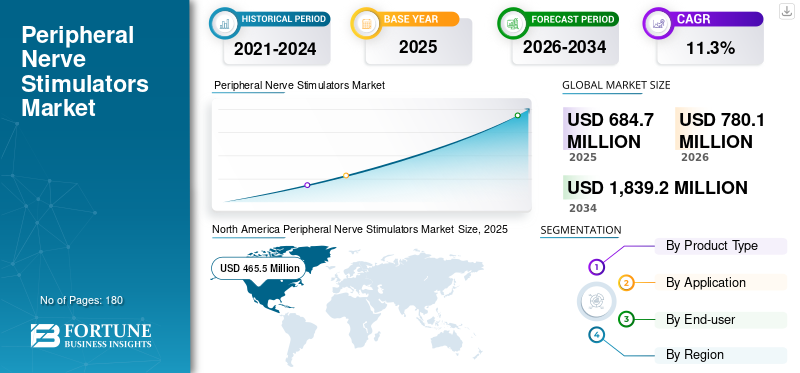
The global peripheral nerve stimulators market size was valued at USD 684.7 million in 2025 and is projected to grow from USD 780.1 million in 2026 to USD 1,839.2 million by 2034, exhibiting a CAGR of 11.3% during the forecast period. North America dominated the peripheral nerve stimulators market with a market share of 67.98% in 2025.
The global market is growing as healthcare providers look for more targeted and less drug-dependent ways to manage pain and nerve-related disorders. Peripheral Nerve Stimulators (PNS) deliver controlled electrical impulses to specific nerves outside the brain and spinal cord to help reduce pain signals or improve nerve function. These devices are used in chronic pain management, post-surgical pain, post-traumatic pain, and selected neurological or functional disorders. The product demand is rising due to the high burden of chronic pain, growing concerns around long-term opioid use, and the increasing adoption of minimally invasive neuromodulation therapies. The market is also benefiting from improvements in wearable and implantable device designs, better battery performance, wireless control, and expanding use in outpatient settings.
Furthermore, SPR Therapeutics, Inc., Boston Scientific Corporation, Curonix LLC, and Medtronic plc held the largest market share in 2025, driven by the limited market presence of other players and market consolidation.
Download Free sample to learn more about this report.
 Global Market Size & Forecast
 Market Share
 Key Regional Highlights
North America
North America generated USD 465.5 million in revenue in 2025, maintaining its position as the leading regional market.
Europe
Europe is expected to record the second-highest growth globally, reaching USD 111.7 million by 2026 with a 10.4% CAGR over the forecast period.
Asia Pacific
Asia Pacific is projected to reach USD 106.8 million in 2026, making it the third-largest regional market.
U.S.
U.S. The market is estimated to reach USD 488.5 million by 2026.
Japan
Japan The market is projected to generate approximately USD 25.0 million in revenue by 2026.
Read More

Shift toward Outpatient, Wireless, and Patient-friendly PNS Platforms is Reshaping Product Adoption
The market is increasingly moving toward outpatient and patient-friendly treatment models. Earlier neuromodulation systems were often associated with hospital-based implantation and long-term device management. Still, newer PNS technologies are being designed for simpler placement, remote control, and improved patient comfort. External or wearable stimulators, wireless power transfer, app-based programming, and smaller implanted components are becoming important product differentiators. These innovations are helping physicians use PNS in a wider range of care settings, including ambulatory surgery centers and specialty pain clinics.
The market is also seeing a greater emphasis on temporary treatment models, where patients receive stimulation for a defined period rather than committing immediately to a permanent implant. This is especially relevant for post-operative pain, post-traumatic pain, and selected chronic pain cases. In parallel, manufacturers are focusing on better ergonomics, discreet wearable designs, rechargeable or battery-free systems, and simplified programming interfaces. These trends are improving patient acceptance and physician confidence, while also supporting faster adoption among pain specialists looking for alternatives that fit outpatient workflows.
Download Free sample to learn more about this report.
Rising Chronic Pain Burden to Increase the Need for Targeted Neuromodulation Therapies
The surging number of patients suffering from chronic pain is one of the strongest drivers for the peripheral nerve stimulators market growth. Chronic pain is often difficult to manage with conventional therapies alone, especially when patients do not respond adequately to medications, physical therapy, injections, or radiofrequency procedures. In many countries, physicians are also trying to reduce dependence on long-term opioid therapy due to the risks of addiction, tolerance, side effects, and regulatory scrutiny. This has created a stronger demand for targeted device-based pain management options such as peripheral nerve stimulation. PNS offers a focused approach given that it stimulates the affected peripheral nerve rather than broadly affecting the central nervous system or the whole body. The therapy is increasingly used for conditions such as neuropathic pain, post-amputation pain, shoulder pain, knee pain, lower back-related peripheral nerve pain, and other refractory pain conditions.
The product adoption is further supported by the growth of interventional pain practices, the number of neuromodulation-trained physicians, and ambulatory procedure settings. As more clinicians become familiar with temporary, wearable, and implantable PNS systems, the market is expected to expand steadily across developed and emerging healthcare systems.
High Device Cost and Uneven Reimbursement May Limit Wider Patient Access
Despite strong clinical interest, restraints affecting the market expansion are related to cost, reimbursement, and access. Implantable and advanced wearable PNS systems can be expensive, particularly when the total cost includes leads, stimulators, controllers, programming accessories, and procedure-related consumables. In countries where reimbursement is limited or inconsistent, hospitals and clinics may be cautious in adopting these systems, especially if payers require strong evidence of long-term clinical benefit before approving coverage. Even in developed markets, reimbursement policies may differ by indication, product type, care setting, and payer, creating uncertainty for physicians and patients. This is particularly important for newer PNS technologies, where commercial adoption may move faster than payer policy updates. The out-of-pocket costs can also limit patient uptake, especially in emerging markets and private-pay settings.
In addition, some healthcare providers may continue using established alternatives such as medications, nerve blocks, radiofrequency ablation, physical therapy, or spinal cord stimulation, depending on local protocols and reimbursement support. These factors can slow market penetration, particularly outside the U.S. and select European countries.
Expansion of Minimally Invasive and Wearable PNS Systems Can Broaden the Treatable Patient Base
A major market opportunity lies in the growing use of minimally invasive, external, or wearable peripheral nerve stimulation systems. Traditional implantable neuromodulation therapies often require more complex procedures, which can limit use among patients who are not ready for permanent implants or who need short-term pain control. Newer PNS systems are addressing this gap by offering temporary, percutaneous, externally powered, or wearable configurations that can be used in outpatient settings. This expands the potential patient base to include post-surgical pain patients, post-traumatic pain patients, and chronic pain patients who may benefit from a less invasive option before moving to permanent therapy. These systems can also support faster procedure workflows in ambulatory surgery centers and specialty pain clinics.
Emerging markets offer another important opportunity as private hospitals and specialty clinics invest in advanced pain management technologies. Asia Pacific, Latin America, and the Middle East are expected to see gradual adoption as awareness improves, physician training expands, and device manufacturers strengthen their distribution networks. Companies that can offer clinically validated, cost-effective, easy-to-use PNS platforms are likely to benefit from this shift.
Evidence Gaps, Physician Training Needs, and Competition from Established Pain Therapies Remain Key Barriers
The market still faces practical challenges that could affect the pace of adoption. One of the main challenges is the need for stronger clinical and real-world evidence across different indications, anatomical targets, and patient groups. While PNS has gained traction in chronic pain and selected post-surgical applications, payers and hospital committees often require clear evidence on the durability of pain relief, functional improvement, reduced medication use, and cost-effectiveness.
Another challenge is physician training. Successful PNS placement depends on proper patient selection, nerve targeting, device programming, and follow-up, which means adoption may remain concentrated among experienced interventional pain physicians and neuromodulation specialists.
The market also competes with several established treatment options, including nerve blocks, steroid injections, radiofrequency ablation, physical therapy, pharmacologic therapies, and spinal cord stimulation. In some cases, physicians may prefer familiar procedures with established reimbursement pathways. Patient adherence and device comfort may also affect outcomes, especially for wearable or externally powered systems. To overcome these barriers, companies will need to invest in clinical education, payer engagement, outcome studies, and simpler product designs.
Longer Therapy Duration to Support Implantable PNS Segment Growth
Based on product type, the market is segmented into implantable peripheral nerve stimulators and external/wearable peripheral nerve stimulators.
To know how our report can help streamline your business, Speak to Analyst
The implantable peripheral nerve stimulators segment accounted for a dominant market share in 2025 due to their stronger revenue contribution, longer therapy duration, and use in chronic or refractory pain patients. These systems typically carry higher average selling prices than external or wearable systems as they include implantable leads, pulse generators or microstimulators, controllers, and programming components. They are often used when patients require sustained therapy and have not achieved adequate relief from conservative treatments.
Additionally, the external/wearable peripheral nerve stimulators segment is projected to grow at a CAGR of 13.7% during the forecast period.
Large Population with Chronic Pain Pushed the Dominance of the Chronic Pain Management Segment
By application, the market is classified into chronic pain management, acute post-surgical & post-traumatic pain, neurological & functional disorders, and others.
The chronic pain management segment held the highest market share in 2025 given that it represents the largest and most commercially established use case for peripheral nerve stimulation. Many patients with chronic neuropathic or peripheral nerve pain remain undertreated despite medications, injections, physical therapy, and other interventions. PNS provides a targeted option for patients who need longer-term relief without relying heavily on systemic drugs. Moreover, the segment is projected to hold a 70.1% share in 2026.
Additionally, the neurological & functional disorders segment is estimated to grow at a CAGR of 13.6% during the forecast period.
Procedural Volume and Specialists’ Availability Keep the Hospitals & ASCs Segment in the Lead
On the basis of end-user, the market is classified into hospitals and ASCs, specialty clinics, and others.
The hospitals and ASCs segment captured the highest peripheral nerve stimulators market share in 2025 as most PNS placements involve a clinical procedure, imaging, or anatomical guidance, sterile placement conditions, and trained specialists. Hospitals have established pain management, neurology, orthopedic, and surgical departments that support patient referrals and device implantation. Furthermore, the segment is set to hold a 59.7% share in 2026.
In addition, the specialty clinics segment is projected to grow at a CAGR of 12.7% during the forecast period.
Based on geography, the market is classified into North America, Europe, Asia Pacific, Latin America, and the Middle East & Africa.
North America Peripheral Nerve Stimulators Market Size, 2025 (USD Million)
To get more information on the regional analysis of this market, Download Free sample
North America held the largest revenue in 2024, with a value of USD 406.9 million, and reached USD 465.5 million in 2025. North America is expected to remain the leading region in the market due to the strong adoption of advanced pain management technologies, favorable availability of trained interventional pain specialists, and higher awareness of neuromodulation therapies. The U.S. accounts for major share, supported by a large chronic pain patient population, rising preference for non-opioid pain management, and the faster commercialization of implantable and external/wearable PNS systems.
In 2026, the U.S. market is estimated to touch a value of USD 488.5 million, capturing 62.6% of the total global revenue.
The Europe market is expected to depict a CAGR of 10.4% over the forecast period, the second-highest globally, reaching USD 111.7 million by 2026. Europe is projected to witness steady growth due to the increasing adoption of neuromodulation therapies across major countries such as Germany, the U.K., France, Italy, Spain, and Scandinavian countries. The regional market growth is driven by the rising prevalence of chronic pain conditions, expanding use of outpatient pain management procedures, and growing clinical interest in alternatives to long-term medication-based pain treatment. Germany and the U.K. are expected to remain important revenue contributors due to stronger specialist infrastructure and the greater adoption of advanced medical devices.
The U.K. market is projected to reach USD 20.2 million by 2026, accounting for 2.6% of the global market revenue.
The Germany market is estimated to reach about USD 25.6 million by 2026, representing roughly 3.3% of global revenue.
In 2026, the Asia Pacific market is predicted to be valued at USD 106.8 million, ranking as the third-largest globally. Asia Pacific is expected to be the fastest-growing region, mainly due to its large patient base, rising chronic pain prevalence, improving access to advanced medical technologies, and expanding private healthcare infrastructure. Countries such as China, Japan, India, South Korea, and Australia are seeing a growing demand for specialized pain management solutions as the awareness of neuromodulation increases.
The Japan market is projected to generate approximately USD 25.0 million in revenue by 2026, contributing nearly 3.2% to the global market.
The China market is poised to reach approximately USD 28.3 million by 2026, contributing about 3.6% to global revenues.
The India market is slated to contribute approximately USD 8.9 million to the market by 2026, corresponding to about 1.1% of global revenues.
Both Latin America and the Middle East & Africa are anticipated to witness moderate market growth, with Latin America expected to reach around USD 20.5 million by 2026. The Latin America market is likely to grow gradually, led by Brazil and Mexico, where private hospitals and specialty clinics are increasingly adopting advanced pain management technologies. The region has a growing burden of chronic pain, musculoskeletal disorders, diabetes-related neuropathy, and post-surgical pain, which supports the stimulator demand. The Middle East and Africa market is expected to grow from a smaller base, with adoption mainly concentrated in GCC countries, South Africa, and premium private hospitals. The market growth is supported by rising investment in advanced healthcare infrastructure, increasing medical tourism in the Gulf region, and the growing demand for modern pain management solutions.
By 2026, the GCC market is expected to generate approximately USD 7.1 million in the market, accounting for nearly 0.9% of global revenues.
Robust Product Innovation to Reinforce the Market Position of Prominent Players
The global peripheral nerve stimulators market is moderately consolidated, with a few specialized PNS-focused companies leading adoption. In contrast, large players operating in the market compete through broader pain management portfolios. Companies such as SPR Therapeutics, Inc., Boston Scientific Corporation, Curonix LLC, and Medtronic plc are among the key participants shaping the market.
The market competition is primarily driven by clinical evidence, product design, ease of placement, reimbursement access, physician training, and commercial reach. Pure-play PNS companies compete by offering targeted systems for chronic and post-surgical pain, while larger medtech companies benefit from established hospital relationships, neuromodulation sales teams, and broader procedural infrastructure. The market is seeing a clear shift toward minimally invasive, temporary, wireless, and wearable PNS platforms, which is helping companies expand use beyond traditional implantable systems.
Moreover, other key players, such as Abbott Laboratories, Bioventus Inc., BlueWind Medical Ltd., and Valencia Technologies Corporation, compete through ongoing technological advancements and the development of products via clinical trials.
The report provides an in-depth analysis of all market segments, highlighting key drivers, opportunities, restraints, and challenges. It also provides insights into technological advancements, company market share analysis, and profiles of leading companies. Besides this, the global report offers insights into the market growth trends and highlights key industry developments. In addition to the aforementioned factors, the report encompasses several factors that have contributed to the growth and advancement of the market over recent years.
Request for Customization to gain extensive market insights.
| ATTRIBUTE | DETAILS |
| Study Period | 2021-2034 |
| Base Year | 2025 |
| Estimated Year | 2026 |
| Forecast Period | 2026-2034 |
| Historical Period | 2021-2024 |
| Growth Rate | CAGR of 11.3% from 2026-2034 |
| Unit | Value (USD Million) |
| Segmentation | By Product Type, Application, End-user, and Region |
| By Product Type |
|
| By Application |
|
| By End-user |
|
| By Region |
|
Fortune Business Insights says that the global market value stood at USD 684.7 million in 2025 and is projected to reach USD 1,839.2 million by 2034.
In 2025, the North America market value stood at USD 465.5 million.
The market is expected to exhibit a CAGR of 11.3% during the forecast period of 2026-2034.
The implantable peripheral nerve stimulators segment led the market by product type in 2025.
The key factors driving the market are the rising chronic pain burden and the need for targeted neuromodulation therapies.
SPR Therapeutics, Inc., Boston Scientific Corporation, Curonix LLC, and Medtronic plc are the major players in the market.
North America dominates the market in terms of share.

Get 30-60 hrs Free Customization
Expand Regional and Country Coverage, Segments Analysis, Company Profiles, Competitive Benchmarking, and End-user Insights.













.webp)






Related Reports
Get In Touch With Us
US +1 833 909 2966 ( Toll Free )
Receive a tailored pricing based on your needs.
Discuss your questions with our industry experts.
Have questions? Get quick answers before you purchase.

