Photocatalysts Market Size, Share & Industry Analysis, By Type (Titanium Dioxide (TiO₂), Zinc Oxide (ZnO), Tungsten Oxide (WO₃), Graphitic Carbon Nitride (g-C₃N₄), and Others), By Application (Self-Cleaning Surfaces & Coatings, Air Purification, Water & Wastewater Treatment, Anti-Fogging / Anti-Soiling Coatings, Energy, and Others), and Regional Forecast, 2026-2034
 Download Free Sample
Photocatalysts Market Size and Future Outlook
 Listen to Audio Version
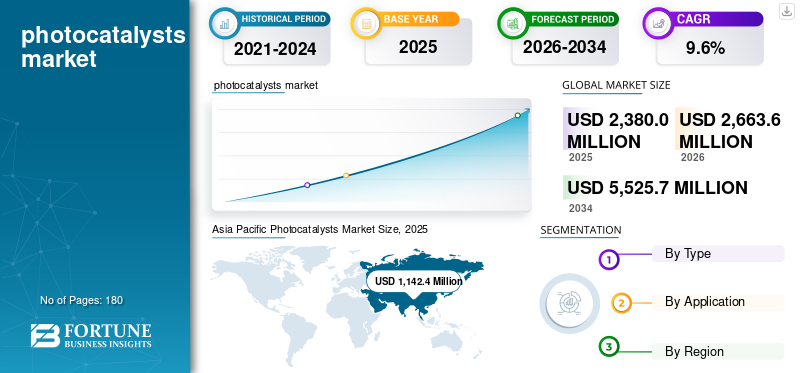
The global photocatalysts market size was valued at USD 2,380.0 million in 2025. The market is projected to grow from USD 2,663.6 million in 2026 to USD 5,525.7 million by 2034, exhibiting a CAGR of 9.6% during the forecast period. Asia Pacific dominated the photocatalysts market with a market share of 47.9% in 2025.
Photocatalysts are materials, often based on titanium dioxide, that use light to accelerate reactions that break down pollutants and organic compounds. Demand is mainly driven by their use in air and water purification, self-cleaning and antimicrobial coatings, and odor or VOC control in buildings, industrial sites, and public infrastructure. Adoption increases when low chemical consumption, long service life, and easier maintenance deliver clear value. Globally, the market typically grows at a steady pace, supported by environmental regulations and sustainability targets, but expansion is mostly application-led as end users scale up proven systems.
The market is dominated by a small group of established materials and chemical producers with scalable manufacturing assets and proprietary photocatalyst formulations. Major players such as TOTO LTD., NIPPON SODA CO., LTD., Kronos Worldwide, Inc., ISHIHARA SANGYO KAISHA, LTD., and The Chemours Company, along with regional specialists, focus on catalyst performance under real-world light conditions, consistent quality, and application support for coatings, construction materials, and environmental systems. This results in a moderately consolidated market characterized by steady demand, qualification-led adoption, and strong customer reliance on validated grades and long-term supply consistency.
Download Free sample to learn more about this report.
Photocatalysts Market Key Takeaways
 Market Size & Forecast
- 2025 Market Size: USD 2,380.0 Million
- 2026 Market Size: USD 2,663.6 Million
- 2034 Forecast Market Size: USD 5,525.7 Million
- CAGR: 9.6% from 2026–2034
 Market Share
- Asia Pacific dominated the photocatalysts market with a 47.9% share in 2025.
- The Zinc Oxide (ZnO) segment is projected to grow at a CAGR of 10.0% during the forecast period.
- The air purification segment is projected to grow at a CAGR of 10.1% during the forecast period.
 Key Regional Highlights
Asia Pacific
Asia Pacific generated USD 1,142.4 million in 2025 and is projected to reach USD 1,294.6 million in 2026.
North America
North America generated USD 428.4 million in 2025.
Europe
Europe generated USD 523.6 million in 2025.
U.S.
The photocatalysts market generated USD 382.1 million in 2025.
Japan
Strong demand for photocatalysts in functional coatings, environmental applications, and advanced construction materials continues to support market growth.
Read More

PHOTOCATALYSTS MARKET TRENDS
Shift Toward Visible-Light-Active and More Consistent Photocatalyst Grades Is Reshaping Market
A key trend in the market is the shift from UV-driven materials to visible-light-active photocatalysts, as many end uses operate under indoor or low-light conditions. Suppliers are increasingly using modified TiO₂, doped materials, and composites to improve efficiency and maintain performance when photocatalysts are built into paints, coatings, tiles, membranes, and filters. At the same time, buyers are asking for more consistent, test-validated performance, which is pushing producers to offer tighter specifications and clearer proof of results under real-world conditions.
- According to the U.S. Environmental Protection Agency (EPA), Americans spend approximately 90% of their time indoors, underscoring the market shift toward visible-light-active photocatalysts designed to operate under typical indoor lighting conditions.
MARKET DYNAMICS
MARKET DRIVERS
Download Free sample to learn more about this report.
Rising Demand for Air & Water Purification and Self-Cleaning Surfaces Sustains Consumption
Photocatalyst market growth is primarily driven by rising adoption of air and water purification solutions and functional surfaces across buildings, public infrastructure, industrial facilities, and consumer environments. Photocatalytic coatings and additives are increasingly used to enhance self-cleaning, stain resistance, and antimicrobial performance on construction materials, tiles, glass, and paints. In contrast, photocatalytic systems are applied for VOC and odor reduction and for breaking down organic contaminants in water. This end-use expansion creates a direct demand-side pull for photocatalysts, as wider deployment of these coatings and treatment systems increases consumption of validated product grades.
- According to the U.S. Environmental Protection Agency (EPA), concentrations of many Volatile Organic Compounds (VOCs) are consistently higher indoors—up to 10× higher than outdoors, supporting demand for photocatalyst-based VOC and odor control solutions in indoor environments.
MARKET RESTRAINTS
Performance Variability and Qualification Requirements Slow Product Adoption
The product demand is constrained by the fact that performance can vary widely across real-world conditions, especially due to differences in light intensity, humidity, airflow, and the type of pollutants present. In many applications, photocatalysts must be validated within specific coatings, building materials, or purification systems, and this qualification process can be time-consuming and costly for manufacturers and end users. If field performance does not match lab results, buyers may delay scale-up or revert to established alternatives such as activated carbon, conventional filtration, or chemical disinfectants. As a result, demand is often project-led and slower to ramp, particularly in regulated or high-reliability environments.
MARKET OPPORTUNITIES
Stricter Indoor Air Quality and Green-Building Requirements are Creating Growth Opportunities for Market
Photocatalyst demand is well positioned to grow as Indoor Air Quality (IAQ) rules and green-building standards are adopted more widely across commercial buildings and public infrastructure. These requirements are encouraging the use of low-emission, easy-maintenance materials and air-cleaning solutions, where photocatalysts can add value through VOC and odor breakdown and self-cleaning surface performance. As more hospitals, schools, offices, and transport hubs move from pilot projects to routine specification and retrofit upgrades, photocatalysts can shift from niche use to broader deployment. This standards- and procurement-led shift is creating clear growth opportunities for photocatalyst-enabled coatings, construction materials, and purification systems.
- According to the U.S. Department of Energy (DOE), buildings consume 75% of U.S. electricity and 40% of total energy use, supporting policy-led demand for indoor-environment improvements such as photocatalyst-enabled materials.
MARKET CHALLENGES
Ensuring Long-Term Durability and Reliable Performance in Real Products Remains a Key Challenge
The product suppliers face a major challenge in maintaining stable performance over long-term use, especially when photocatalysts are incorporated into paints, coatings, tiles, membranes, and purification systems. In real conditions, surface fouling, abrasion, moisture, and weathering can reduce activity over time. Performance can also drop if the product does not disperse well in the formulation or reacts with other additives, limiting the active surface area. For customers, this raises concerns about maintenance, batch consistency, and warranty risk. As a result, suppliers often need stronger quality control and longer field validation, which slows scale-up.
Segmentation Analysis
By Type
Proven Performance and Scale Fueled Dominance of Titanium Dioxide (TiO₂) in Market
Based on type, the market is segmented into titanium dioxide (TiO₂), zinc oxide (ZnO), tungsten oxide (WO₃), graphitic carbon nitride (g-C₃N₄), and others.
The titanium dioxide (TiO₂) segment accounted for the largest photocatalysts market share in 2025. TiO₂ leads consumption as it offers a strong balance of photocatalytic activity, stability, availability, and cost, making it the preferred choice for large-volume applications such as self-cleaning coatings, construction materials, air-purification surfaces, and water-treatment applications. Its long track record and broad supplier base also reduce qualification risk for end users, especially where consistent performance and durability are required. As adoption of TiO₂ in building materials and environmental applications expands, TiO₂ remains the most structurally anchored and widely specified photocatalyst.
Zinc Oxide (ZnO) is expected to grow at a steady CAGR of around 10.0% over the study period, driven by rising use in antimicrobial and UV-protective coatings and broader adoption in surface treatment applications.
To know how our report can help streamline your business, Speak to Analyst
By Application
Wide Adoption in Functional Coatings Positioned Self-Cleaning Surfaces & Coatings as Primary Demand Anchor
By application, the market is segmented into self-cleaning surfaces & coatings, air purification, water & wastewater treatment, anti-fogging/anti-soiling coatings, energy, and others.
The self-cleaning surfaces & coatings application dominated the market in 2025. This application drives demand for photocatalysts as they can be easily integrated into paints, tiles, glass, cementitious surfaces, and facade materials to deliver stain breakdown, odor reduction, and reduced surface maintenance under light exposure. For building owners and infrastructure operators, the value proposition is clear: improved surface cleanliness, reduced cleaning frequency, and longer aesthetic life with minimal chemical use. As adoption expands in commercial buildings and public infrastructure where maintenance costs and durability matter, self-cleaning coatings remain the most stable and specification-driven demand base for photocatalysts.
The air purification segment is expected to grow at a 10.1% CAGR over the forecast period.
Photocatalysts Market Regional Outlook
By geography, the market is categorized into North America, Europe, Asia Pacific, Latin America, and the Middle East & Africa.
Asia Pacific
Asia Pacific Photocatalysts Market Size, 2025 (USD Million)
To get more information on the regional analysis of this market, Download Free sample
Asia Pacific held the dominant position in 2025, valued at USD 1,142.4 million, and is expected to retain its leading role in 2026, reaching USD 1,294.6 million. The region’s leadership is supported by its large manufacturing base for construction materials and coatings, strong urban infrastructure development, and rising deployment of air and water treatment solutions. High demand for self-cleaning and functional coatings, indoor air purification, industrial wastewater treatment, and environmentally focused building materials sustains product consumption, particularly in high-volume, cost-sensitive applications where durability and proven performance matter.
China Photocatalysts Market
Based on Asia Pacific’s strong contribution and China’s large manufacturing footprint, the China market was valued at USD 594.0 million in 2025, accounting for around 52.0% of global revenues. Demand is supported by high-volume use in self-cleaning coatings and construction materials, as well as growing adoption in air purification and industrial wastewater treatment, backed by a scale-oriented supplier and manufacturing ecosystem.
India Photocatalysts Market
India’s market was valued at USD 148.5 million in 2025. Growth is supported by expanding construction industry, higher use of functional paints and coatings, and rising focus on indoor air quality. Increasing water and wastewater projects also boost demand for self-cleaning surfaces.
North America
North America remains a significant market, valued at USD 428.4 million in 2025. Demand is supported by functional coatings and building materials, as well as by adoption in indoor air purification and industrial or municipal water treatment. The region benefits from strong environmental compliance needs, advanced product qualification practices, and mature coatings and filtration industries. However, growth stays moderate due to market maturity and longer validation cycles.
U.S. Photocatalysts Market
The U.S. market was valued at USD 382.1 million in 2025, representing approximately 89.2% of global revenues. Consumption is driven by use in self-cleaning and functional coatings for buildings and infrastructure, by growing adoption in indoor air purification for commercial and public spaces, and by selective use in water and wastewater treatment, where oxidation of organic contaminants and odor control are priorities.
Europe
Europe is projected to record modest market growth over the forecast period, valued at USD 523.6 million in 2025. Strict environmental and indoor air quality requirements, along with strong sustainability standards for buildings and materials, shape the region. Despite slower adoption cycles, steady demand from functional coatings, construction products, air purification systems, and selective water treatment applications supports ongoing product consumption across key industries.
Germany Photocatalysts Market
Germany’s market reached a valuation of about USD 94.2 million in 2025, equal to around 18.0% of global revenues. Advanced coatings and building materials, strong sustainability focus, and selective use in industrial air purification and water treatment applications support demand.
U.K. Photocatalysts Market
The U.K. market was valued at USD 62.8 million in 2025, accounting for roughly 12.0% of global revenues. Consumption is concentrated in functional paints and coatings and building materials that support self-cleaning and anti-soiling performance, along with growing adoption in indoor air purification for commercial and public environments and in selective water treatment applications.
Latin America and the Middle East & Africa
Latin America and the Middle East & Africa are expected to witness moderate growth during the forecast period. The Latin America market reached a valuation of USD 119.0 million in 2025, supported by higher construction and refurbishment activity, rising use of functional paints and coatings, and gradual adoption of air and water purification solutions in major cities. In the Middle East & Africa, demand is driven by infrastructure build-out, preference for low-maintenance, anti-soiling building surfaces, and selective uptake in industrial air treatment and wastewater projects. The market reached a valuation of USD 166.6 million in 2025 as standards tighten and demonstration projects prove reliability.
GCC Photocatalysts Market
The GCC market accounted for around USD 66.6 million in 2025, representing about 40.0% of regional revenues. Demand is supported by construction and infrastructure projects, functional facade coatings for harsh climates, and selective adoption in indoor air quality and water treatment applications.
COMPETITIVE LANDSCAPE
Key Industry Players
High Capital Intensity and Strategic Asset Management Shape Competition in Market
The photocatalysts market is relatively consolidated and technology-intensive, as advanced material formulations, stringent quality control, and performance validation requirements create significant barriers to entry. These factors limit new participation and concentrate supply among a small group of global materials and specialty chemical producers with integrated operations and established R&D and application expertise.
Key players such as TOTO LTD., NIPPON SODA CO., LTD., Kronos Worldwide, Inc., ISHIHARA SANGYO KAISHA, LTD., and The Chemours Company focus primarily on optimizing existing product grades and strengthening application support rather than pursuing aggressive volume expansion. Recent activities across these companies highlight a strategic emphasis on consistent performance, durability, and the gradual development of visible-light-active, application-specific photocatalyst materials to support long-term market positioning.
LIST OF KEY PHOTOCATALYSTS COMPANIES PROFILED IN REPORT
- TOTO LTD. (Japan)
- Tronox Holdings Plc. (U.S.)
- NIPPON SODA CO., LTD. (Japan)
- Kronos Worldwide, Inc. (U.S.)
- Evonik Industries AG (Germany)
- ISHIHARA SANGYO KAISHA, LTD. (Japan)
- Toshiba Materials Co., Ltd. (Japan)
- The Chemours Company (U.S.)
- Sharp Corporation (Japan)
- Solvay S.A. (Belgium)
KEY INDUSTRY DEVELOPMENTS
- May 2020: Tronox Holdings Plc. signed a definitive agreement to acquire Eramet’s TiZir Titanium and Iron (TTI) business, aiming to strengthen titanium feedstock integration for TiO₂ production.
REPORT COVERAGE
The global photocatalysts market analysis provides an in-depth study of market size & forecast by all the market segments included in the report. It contains details on the market dynamics and market trends expected to drive the market during the forecast period. It offers information on technological advancements, new product launches, key industry developments, and partnerships, mergers & acquisitions. The market research report also encompasses a detailed competitive landscape, including market share and profiles of key operating players.
Request for Customization to gain extensive market insights.
Report Scope & Segmentation
| ATTRIBUTE | DETAILS |
| Study Period | 2021-2034 |
| Base Year | 2025 |
| Estimated Year | 2026 |
| Forecast Period | 2026-2034 |
| Historical Period | 2021-2024 |
| Growth Rate | CAGR of 9.6% from 2026-2034 |
| Unit | Value (USD Million) |
| Segmentation | By Type, Application, and Region |
| By Type |
|
| By Application |
|
| By Region |
|
Frequently Asked Questions
Fortune Business Insights says that the global market size was valued at USD 2,380.0 million in 2025 and is projected to reach USD 5,525.7 million by 2034.
Recording a CAGR of 9.6%, the market is slated to exhibit steady growth during the forecast period of 2026-2034.
The self-cleaning surfaces & coatings segment led the market in 2025.
Asia Pacific held the highest share in the market.
Rising demand for air & water purification and self-cleaning coatings to drive product adoption.



- 2021-2034
- 2025
- 2021-2024
- 180
Get 30-60 hrs Free Customization
Expand Regional and Country Coverage, Segments Analysis, Company Profiles, Competitive Benchmarking, and End-user Insights.


















Related Reports
-
US +1 833 909 2966 ( Toll Free )
-
Get In Touch With Us