Physiotherapy Equipment Market Size, Share & Industry Analysis, By Product (Instruments [Electrotherapy Equipment, Exercise & Mobility Therapy Equipment, Heat & Cold Therapy Equipment, and Others] and Accessories), By Modality (Hydrotherapy, Laser Light Therapy, Inferential Current Therapy, and Others), By Application (Musculoskeletal Disorders, Neurological Disorders, Cardiovascular Disorders, and Others), By End User (Hospitals, Physiotherapy & Rehabilitation Clinics, Homecare Settings, and Others), and Regional Forecast, 2026-2034
 Download Free Sample
Physiotherapy Equipment Market Size and Future Outlook
 Listen to Audio Version
The global physiotherapy equipment market size was valued at USD 22.27 billion in 2025 and is projected to grow from USD 23.84 billion in 2026 to USD 39.97 billion by 2034, exhibiting a CAGR of 6.7% during the forecast period. North America dominated the global physiotherapy equipment market with a market share of 39.11% in 2025.
Physiotherapy equipment refers to medical devices used to treat and restore the mobility, physical function, and strength in patients with acute or chronic disorders. The increasing prevalence of acute and chronic conditions such as among the population is resulting in a growing demand for physiotherapy procedures globally. The growing number of procedures, along with rising technological advancements in the equipment, are further boosting the adoption of physiotherapy equipment, further supporting their demand across the globe.
- For instance, according to the 2022 statistics published by the World Health Organization (WHO), approximately 1.71 billion people globally.
Additionally, the growing geriatric population is also a supporting factor for the increasing demand for these devices in the market. This, along with the prominent companies such as HMS Medical Systems, Zimmer MedizinSysteme GmbH, and others, is expected to support the global market growth.
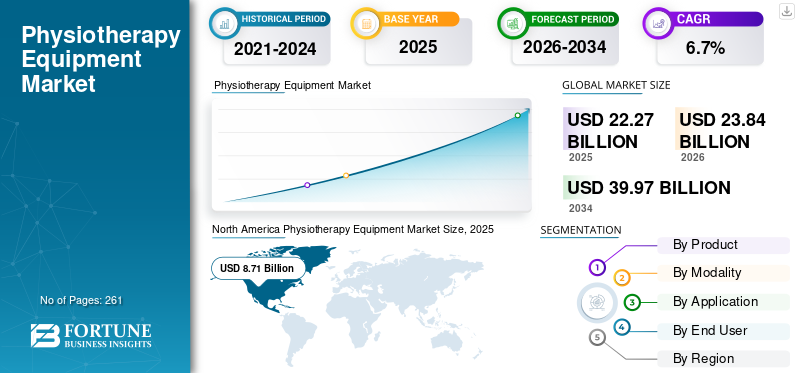
Download Free sample to learn more about this report.
PHYSIOTHERAPY EQUIPMENT MARKET KEY TAKEAWAYS
 Market Size & Forecast
- 2025 Market Size: USD 22.27 billion
- 2026 Market Size: USD 23.84 billion
- 2034 Forecast Market Size: USD 39.97 billion
- CAGR: 6.7% from 2026–2034
 Market Share
- North America dominated the physiotherapy equipment market with a 39.11% share in 2025.
- The others segment is projected to hold 57.8% of the market in 2026.
- The musculoskeletal disorders segment led by application with a 59.1% share in 2025.
 Key Regional Highlights
North America
North America reached USD 8.71 billion in 2025, driven by advanced healthcare infrastructure and high therapy adoption.
Europe
Europe was valued at USD 6.31 billion in 2025, supported by rehabilitation investments and an aging population.
Asia Pacific
Asia Pacific reached USD 5.27 billion in 2025, fueled by rising healthcare spending and expanding rehab facilities.
U.S.
The market was estimated at USD 7.08 billion in 2025, supported by strong demand for physiotherapy services.
Japan
The market is witnessing steady growth due to increasing elderly population and rising rehabilitation needs.
Read More

Market Dynamics:
Market Drivers
Increasing Prevalence of Acute and Chronic Conditions Driving to Fuel Market Growth
There is an increasing prevalence of acute and chronic conditions among the patient population, further resulting in the growing demand for physiotherapy procedures globally. This, along with increasing participation in sport activities and sedentary lifestyles such as poor ergonomics, among others, further contribute to musculoskeletal strain and risk of injury.
Moreover, the increasing geriatric population is an additional factor contributing to the growing prevalence of disorders such as musculoskeletal conditions, which further boosts the adoption rate of these products in the market. This, along with the increasing number of equipment launches among the key players, is expected to fuel the adoption rate, thereby contributing to the global market size.
- For instance, according to 2023 data published by the Global Alliance for Musculoskeletal Health, about 203 million are affected by neck pain globally.
Other Prominent Drivers
- Growing adoption of home‑based rehabilitation and portable physiotherapy devices.
- Expansion of outpatient care facilities and rehabilitation centers worldwide.
Market Restraints
High Cost Associated with Advanced Equipment to Limit Market Growth
There is an increasing demand for physiotherapy procedures, resulting in the growing adoption of devices globally. However, the high cost associated with these advanced rehabilitation technologies is anticipated to hamper the adoption rate for these products, especially in emerging nations, including Brazil, India, and others.
The advanced devices, such as shockwave therapy units, high-intensity laser therapy devices, and innovative electrotherapy systems, require high capital investment, which makes it challenging for standalone practices and small physiotherapy clinics. Additionally, software upgrades, ongoing maintenance costs, among others, are some of the other factors that further add to the financial burden, thereby hampering the adoption of these products in the market.
- For instance, according to 2025 data published by News Medical Lifesciences, it was reported that shockwave therapy systems generally cost in the range of USD 1,000 to USD 4,000.
Market Opportunities
Expansion in Emerging Nations to Create Market Opportunities
There is a growing prevalence of chronic conditions such as musculoskeletal conditions, neurological conditions, and others, rapid development of healthcare infrastructure, and growing awareness of rehabilitation services, especially in emerging nations such as Brazil, India, and others.
Additionally, rising government initiatives toward raising healthcare spending and boosting private sector participation have further enabled the adoption of rehabilitation therapy services. Therefore, as these countries are transitioning toward high technology and quality care, they represent a robust pipeline for growth among physiotherapy product manufacturers.
- According to 2025 data published by the International Trade Administration (ITA), it was reported that the healthcare expenditure is around USD 135.0 billion in Brazil.
Market Challenges
Limited Reimbursement Policies to Hinder Market Growth
There is a growing awareness and demand for physiotherapy services and equipment for various applications among the patient population. However, despite growing demand for this equipment, there is limited coverage for physiotherapy services, requiring patients to pay out-of-pocket for repeated sessions that may extend over a few months.
Additionally, stringent medical necessity criteria and capped yearly allowances directly impact clinic sales, which further reduces their investment in advanced equipment. Therefore, inadequate reimbursement policies, limited skilled professionals, among others, are resulting in limited penetration of these devices, thereby hampering the physiotherapy equipment market growth.
- For instance, according to 2025 data published by the MDPI, it was reported that the share of out-of-pocket health expenditure can exceed 40% of total health spending in Sub-Saharan Africa.
Other Prominent Challenges:
- Requirement for strong clinical evidence and ROI justification for hospitals and clinics.
Physiotherapy Equipment Market Trends
Shift toward Smart & Connected Physiotherapy Devices to Fuel Market Demand
The growing adoption of digital tools to improve treatment effectiveness and personalize treatment plans for patients is resulting in a growing demand for these products in the market. The integration of wearable sensors, mobile app connectivity, and artificial intelligence is improving the patient’s adherence to exercises and enabling continuous tracking of patient motion.
Moreover, growing preference toward treatment in home care settings is also boosting the demand for these advanced products. The smart devices, such as app-connected electrotherapy devices, digital goniometers, offer improved results and data-driven insights, making rehabilitation more efficient and outcome-focused.
- According to 2025 statistics published by Netguru, it was reported that 83% of patients reduced their pain without requiring surgery with the help of a digital physiotherapy
platform.
Other Prominent Trends:
- Increasing adoption of compact, portable devices (TENS units, portable ultrasound, electrotherapy systems).
- Rapid emergence of soft exosuits, robotic gait trainers, and advanced rehabilitation robotics.
- Shift toward evidence‑based physiotherapy and demand for outcome‑driven analytics.
- Consolidation through mergers and acquisitions of specialized rehabilitation device companies.
Download Free sample to learn more about this report.
SEGMENTATION ANALYSIS
By Product
Increasing Number of Instruments Launches to Drive Segmental Dominance
Based on the product, the market is classified into instruments and accessories.
The instruments segment held the largest market share in 2025. The growth is attributed to the increasing prevalence of chronic diseases, leading to a rising adoption of advanced instruments globally. This, coupled with the increasing focus of key players toward R&D activities to develop and launch novel products, is further anticipated to boost the segmental growth.
- In October 2025, NIMS Hyderabad inaugurated three advanced physiotherapy devices, including Dynamometry, Foot Pressure Analysis System, and Shortwave Diathermy for the treatment of diabetic foot care, sports injuries, arthritis, rehabilitation needs, and chronic conditions.
The accessories segment is expected to grow at a CAGR of 6.9% over the forecast period.
To know how our report can help streamline your business, Speak to Analyst
By Modality
Increasing Product Launches Led to Dominance of Others Segment
Based on technology, the market is divided into hydrotherapy, laser light therapy, inferential current therapy, and others.
The others segment dominated the market in 2025. In 2026, the segment is anticipated to dominate with a 57.8% share. Others segment includes ultrasound therapy systems, and others. The advantages of these devices, such as reduced swelling, improved circulation, and others, are resulting in a rising number of product launches, further supporting the dominance in the market.
- In January 2025, Resolve360 launched AI-augmented reality technology for online active physiotherapy, aiming to cater to the growing demand among patients.
The laser light therapy segment is expected to grow at a CAGR of 7.6% in the market during the forecast period.
By Application
Increasing Prevalence of Musculoskeletal Disorders Led to Dominance of Segment
Based on application, the market is segmented into musculoskeletal disorders, neurological disorders, cardiovascular disorders, and others.
The musculoskeletal disorders segment dominated the global market in 2025. By application, the musculoskeletal disorders segment held the share of 59.1% in 2025. The growth is primarily driven by the increasing prevalence of musculoskeletal conditions, including arthritis, back pain, and others, further resulting in a growing adoption of innovative devices in the market.
- For instance, according to the 2024 data published by the National Health Service (NHS), it was reported that over 20 million people have a musculoskeletal condition such as arthritis or back pain in the U.K.
The segment of neurological disorders is set to flourish with a growth rate of 7.6% across the forecast period.
By End User
Increasing Number of Physiotherapy Clinics Led to the Physiotherapy & Rehabilitation Clinics Segment Dominance
Based on end user, the market is divided into hospitals, physiotherapy & rehabilitation clinics, homecare settings, and others.
The physiotherapy & rehabilitation clinics segment dominated the market in 2025. The growing prevalence of chronic conditions, increasing patient admissions among physical therapy clinics, and others are some of the key factors supporting the growth of the market segment. Furthermore, the segment is set to hold a 45.6% share in 2026.
- For instance, according to 2025 statistics published by Cross River Therapy, there are currently 38,800 physical therapy clinics in the U.S.
In addition, homecare settings’ end users are projected to grow at a CAGR of 8.2% during the study period.
Physiotherapy Equipment Market Regional Outlook
Based on region, the global market has been studied across North America, Europe, Asia Pacific, Latin America, and the Middle East & Africa.
North America Physiotherapy Equipment Market Size, 2025 (USD Billion)
To get more information on the regional analysis of this market, Download Free sample
North America:
North America dominated the physiotherapy equipment market in 2024, valued at USD 8.21 billion, and also took the leading share in 2025 with USD 8.71 billion. The dominance of the region is due to distinct factors, including strong healthcare infrastructure, rapid adoption of advanced physiotherapy devices, a growing number of therapy sessions, and others. In 2025, the U.S. market is estimated to reach USD 7.08 billion.
- For instance, according to 2025 statistics published by Cross River Therapy, it was reported that about 300 million therapy sessions are conducted annually in the U.S.
Europe and Asia Pacific
Europe and Asia Pacific markets are expected to witness significant growth in the forecast period. During the study period, the European region is projected to record a growth rate of 5.5% and reach a valuation of USD 6.31 billion in 2025. This is driven by an aging population, rising rehabilitation investments, and strong medical device innovation. Moreover, rising healthcare spending and the expansion of rehab facilities are some of the other factors supporting the market growth. Backed by these factors, countries such as the U.K. are expected to record the valuation of USD 1.17 billion, Germany to record USD 1.41 billion, and France to record USD 0.94 billion in 2025. After Europe, the market in the Asia Pacific is estimated to reach USD 5.27 billion in 2025 and secure the position of the third-largest region in the market. In the region, India is estimated to reach USD 1.03 billion while China is estimated to reach USD 1.82 billion in 2025.
Latin America and Middle East & Africa
Over the forecast period, Latin America and the Middle East & Africa regions are expected to witness moderate growth in this market. The Latin America market in 2025 is set to record USD 1.09 billion as its valuation. The growing demand for affordable physiotherapy devices, with slower adoption of advanced technologies, and others are some of the factors expected to drive product adoption in these regions. In the Middle East & Africa, GCC is set to attain the value of USD 0.51 billion in 2026.
Competitive Landscape
Key Industry Players
Growing Acquisitions and Collaborations Among Key Companies to Led Their Market Dominance
A robust and diversified devices portfolio, along with a significant geographical presence to strengthen its presence, is one of the crucial factors contributing to the dominance of these companies in the market. HMS Medical Systems, Enovis Corporation, and Zimmer MedizinSysteme GmbH are major companies in the market in 2025. Furthermore, the growing focus of key companies on product launches to strengthen their product portfolio is expected to support the global physiotherapy equipment market share.
- For instance, in February 2024, Enovis Corporation launched Intelect Legend 2 and Intelect Transport 2, the latest additions to Enovis Recovery Sciences’ Chattanooga electrotherapy portfolio and the company’s extensive line of rehabilitation products.
Other key players, including EMS Physio, and others, are also growing in the market, primarily due to their increasing focus on acquisitions and mergers among other players to increase their brand presence in the market.
List of Key Physiotherapy Equipment Companies Profiled:
- Enovis Corporation (U.S.)
- HMS Medical Systems (India)
- EMS Physio (U.K.)
- Zimmer MedizinSysteme GmbH (Germany)
- BTL Group of Companies (Switzerland)
- Dynatronics Corporation (U.S.)
- Mettler Electronics Corp. (U.S.)
- Meden-Inmed (Poland)
- ITO Physiotherapy & Rehabilitation (Japan)
- COMPASS HEALTH BRANDS CORP. (U.S.)
KEY INDUSTRY DEVELOPMENTS:
- November 2025: PhysioTech is developing wearable devices that track a patient’s physical parameters in real-time with integrated apps that provide personalized exercise programs, making it easier for patients to adhere to their rehabilitation protocols.
- September 2024: Jims, owned by the supermarket chain, launched a physiotherapy arm named Prime Physio with an aim to strengthen its product portfolio.
- May 2023: JK Physio and Rehab Clinic launched an exoskeletal neuro device that will aid fully and partially paralyzed patients, including those who have suffered spinal cord injury and stroke, in the recovery process.
- April 2021: Enovis Corporation acquired MedShape, Inc., a privately held orthopedic medical device company, with an aim to strengthen its presence.
- August 2019: Zimmer MedizinSysteme GmbH released a new Z Wave, a reengineered acoustic shockwave device that revolutionizes Radial Pulse Technology.
REPORT COVERAGE
The market report provides a detailed global physiotherapy equipment market analysis and focuses on key aspects such as leading companies, product, modality, application, and end user. Besides this, the global report offers insights into the market growth trends and highlights key industry developments. In addition to the aforementioned factors, the report encompasses several factors that have contributed to the growth and advancement of the market over recent years.
Request for Customization to gain extensive market insights.
Report Scope & Segmentation
|
ATTRIBUTE |
DETAILS |
|
Study Period |
2021-2034 |
|
Base Year |
2025 |
|
Forecast Period |
2026-2034 |
|
Historical Period |
2021-2024 |
|
Growth Rate |
CAGR of 6.7% from 2026-2034 |
|
Unit |
Value (USD Billion) |
|
Segmentation |
By Product
By Modality
By Application
By End User
By Region North America (By Product, By Modality, By Application, By End User, and by Country)
Europe (By Product, By Modality, By Application, By End User, and by Country/Sub-region)
Asia Pacific (By Product, By Modality, By Application, By End User, and by Country/Sub-region)
Latin America (By Product, By Modality, By Application, By End User, and by Country/Sub-region)
Middle East & Africa (By Product, By Modality, By Application, By End User, and by Country/Sub-region)
Rest of the Middle East & Africa (By Application) |
Frequently Asked Questions
Fortune Business Insights says that the global market size was USD 22.27 billion in 2025 and is projected to reach USD 39.97 billion by 2034.
In 2025, the North America regional market value stood at USD 8.71 billion.
Growing at a CAGR of 6.7%, the market will exhibit steady growth over the forecast period.
By product, the instruments segment is the leading segment in this market.
The introduction of novel physiotherapy equipment is one of the key factors driving the market's growth.
Enovis Corporation and HMS Medical Systems are the major players in the global market.
North America dominated the market share in 2025.
The growing prevalence of chronic conditions, the growing number of product launches, among others, are some of the crucial factors anticipated to boost the adoption of these products worldwide.



- 2021-2034
- 2025
- 2021-2024
- 261
Get 30-60 hrs Free Customization
Expand Regional and Country Coverage, Segments Analysis, Company Profiles, Competitive Benchmarking, and End-user Insights.













.webp)






-
US +1 833 909 2966 ( Toll Free )
-
Get In Touch With Us