Pick and Place Robots Market Size, Share & Industry Analysis, By Robot Type (Delta Robots, SCARA Robots, Articulated Robots, and Cartesian (Gantry) Robots), By Payload Capacity (Up to 2 kg, 2–5 kg, 5–10 kg, and Above 10 kg), By Technology (Vision-Guided Systems and Non-Vision Systems), and By End-Use Industry (Food & Beverage, Electronics & Semiconductor, Healthcare, Consumer Goods, E-commerce & Logistics, and Automotive), and Regional Forecast, 2026 – 2034
 Download Free Sample
Pick and Place Robots Market Size and Future Outlook
 Listen to Audio Version
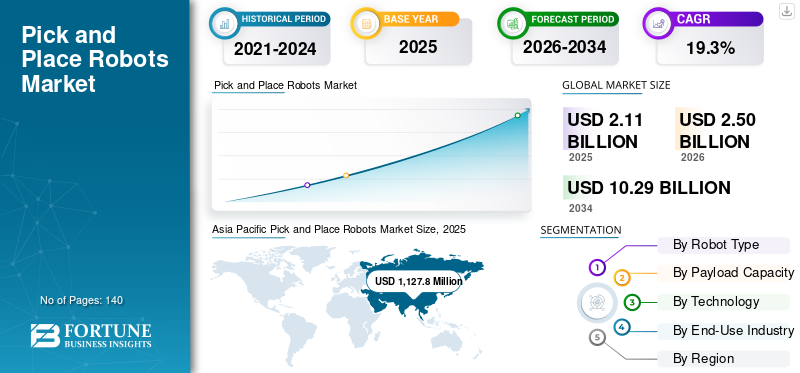
The global pick and place robots market size was valued at USD 2,110.5 million in 2025. The market is projected to grow from USD 2,501.7 million in 2026 to USD 10,298.3 million by 2034, exhibiting a CAGR of 19.3% during the forecast period. Asia Pacific dominated the pick and place robots market with a market share of 6.05% in 2025.
Pick-and-place robots comprise advanced industrial automation systems designed to pick objects from one location and place them in another with high precision, speed, and repeatability, enabling efficient material handling, assembly, sorting, and packaging operations across manufacturing and logistics environments. As industries increasingly shift toward automation-driven production models, the pick-and-place robots market is witnessing robust growth driven by rising demand for high-throughput manufacturing, labor shortages, and the need to reduce labor costs across key regions, including Asia Pacific and Middle East & Africa. These systems are widely deployed across electronics manufacturing lines, food and beverage industry, pharmaceutical packaging units, and e-commerce fulfillment centers to ensure efficient handling of products in high-volume and time-sensitive operations. They play a critical role in enhancing production, minimizing human error, reducing dependency on human workers, lowering workplace injuries, and supporting flexible manufacturing systems capable of handling diverse product types and repetitive tasks. Current market trends indicate increasing adoption of high-speed delta and SCARA robots integrated with advanced vision-guided systems and artificial intelligence, along with AI and machine learning capabilities, enabling accurate picking in unstructured environments and dynamic production lines. The growing integration of machine vision, sensor technologies, and real time data processing further enhances system adaptability, as it enables robots to operate efficiently across complex workflows while improving decision-making and operational performance.
- For instance, in February 2026, ABB Ltd. announced the launch of a next-generation vision-guided pick-and-place robotic system designed for high-speed packaging applications, integrating AI-based object recognition to improve picking accuracy and throughput in food and consumer goods manufacturing environments.
ABB Ltd., FANUC Corporation, Yaskawa Electric Corporation, KUKA AG, Mitsubishi Electric Corporation, DENSO Corporation, Omron Corporation, Epson Robots (Seiko Epson Corporation), and Kawasaki Heavy Industries, Ltd. are among the key players holding a significant share of the market. Their competitive positioning is strengthened by strong expertise in industrial robotics and motion control technologies, the ability to deliver application-specific and high-performance pick-and-place solutions, extensive global distribution and integration networks, and continuous innovation in vision-guided automation, collaborative robotics, and high-speed robotic systems to support the evolving landscape of smart manufacturing and industrial automation.
Download Free sample to learn more about this report.
Pick and Place Robots Market Key Takeaways
 Global Market Size & Forecast
- 2025 Market Size: USD 2,110.5 million
- 2026 Market Size: USD 2,501.7 million
- 2034 Forecast Market Size: USD 10,298.3 million
- CAGR: 19.3% from 2026–2034
 Market Share
- Asia Pacific dominated the market with a 6.05% share in 2025.
- Articulated Robots segment held the largest market share.
- Food & Beverage segment held the largest market share.
 Key Regional Highlights
North America
The market reached USD 387.0 million in 2025, driven by industrial automation and e-commerce growth.
Asia Pacific
The market reached USD 1,127.8 million in 2025, led by strong manufacturing and automation adoption.
Europe
The market witnessed strong growth, supported by industrial automation and advanced manufacturing technologies.
U.S.
The market is projected to reach USD 352.7 million by 2026, driven by automation investments.
Japan
The market is projected to reach USD 146.1 million by 2026, supported by manufacturing automation.
Read More

PICK AND PLACE ROBOTS MARKET TRENDS
Shift toward High-Speed, Vision-Guided, and Flexible Automation Systems is Reshaping Market Demand
Demand for pick-and-place robots is increasingly being influenced by the growing need for high-speed automation, operational flexibility, and the ability to handle diverse product types across dynamic production environments. With the rapid expansion of industries such as food and beverage, pharmaceuticals, electronics, and e-commerce, manufacturers are focusing on deploying robotic systems capable of adapting to varying product sizes, shapes, and orientations without compromising speed or accuracy. This is driving the adoption of advanced delta and SCARA robots integrated with vision-guided technologies, enabling precise object detection, orientation correction, and real-time decision-making in high-throughput operations. Unlike traditional fixed automation systems, there is a growing emphasis on intelligent robotic solutions that support flexible manufacturing, including rapid changeovers, multi-product handling, and seamless integration with digital production systems. The increasing use of machine vision, AI-based object recognition, and sensor-driven feedback systems is enhancing robotic capabilities, allowing efficient operation in unstructured environments such as mixed-item packaging lines and e-commerce fulfillment centers.
- For instance, in January 2026, FANUC Corporation introduced an advanced vision-guided delta robot system designed for high-speed packaging applications, enabling improved picking accuracy and flexible handling of mixed-product lines in food and consumer goods manufacturing environments.
MARKET DYNAMICS
MARKET DRIVERS
Download Free sample to learn more about this report.
Expansion of High-Throughput Manufacturing and E-commerce Fulfilment Driving Automation Demand
The pick-and-place robots market growth is increasingly being shaped by the rapid expansion of high-throughput manufacturing environments and the growing scale of e-commerce fulfillment operations. Unlike traditional manufacturing setups, modern production and distribution systems require the ability to handle large volumes of products at high speed with consistent accuracy, making automated pick-and-place systems a critical component of operational efficiency. Industries such as food and beverage, pharmaceuticals, electronics, and consumer goods are witnessing rising pressure to increase output while maintaining product quality and reducing dependency on manual labor. This shift is driving demand for advanced robotic systems capable of performing repetitive picking, sorting, and placement tasks with minimal error and high repeatability.
- For instance, in March 2024, ABB Ltd. announced the expansion of its robotic solutions portfolio for logistics and e-commerce applications, highlighting the deployment of AI-enabled robotic picking systems designed to improve order fulfillment speed and accuracy in warehouse operations.
MARKET RESTRAINTS
Thermodynamic Efficiency Limits and Energy Penalty of Liquefaction Constrain Commercial Viability
The growth of the market is significantly constrained by the inherent thermodynamic challenges associated with liquefying hydrogen, which requires extremely low temperatures and results in substantial energy consumption. Unlike other industrial gases, hydrogen has a low boiling point and high specific energy requirements for liquefaction, leading to an energy penalty that can account for a significant portion of the overall hydrogen production cost. This high energy intensity not only increases operational expenditure but also raises concerns regarding the overall efficiency and sustainability of hydrogen supply chains, particularly when electricity is sourced from non-renewable energy systems. Furthermore, achieving high liquefaction efficiency requires complex multi-stage refrigeration cycles and advanced cryogenic engineering, which increases system complexity and capital costs. Any inefficiencies in process design or operational performance can lead to boil-off losses and reduced system reliability, impacting the economic feasibility of large-scale projects. In addition, the lack of standardized liquefaction technologies across regions creates challenges in scaling and replicating projects efficiently, leading to longer development timelines and higher project risks. These technical and economic constraints continue to limit the widespread adoption of pick and place robots, particularly in cost-sensitive markets and early-stage hydrogen economies.
MARKET OPPORTUNITIES
Expansion of AI-Enabled Robotic Picking and Smart Warehouse Automation Creating New Growth Avenues
An emerging opportunity in the market lies in the rapid advancement of AI-enabled robotic picking systems and the expansion of smart warehouse automation across global supply chains. As industries increasingly move toward digitalized and data-driven operations, the demand for intelligent robotic systems capable of handling complex, unstructured picking tasks is rising significantly. Unlike traditional fixed pick-and-place applications, modern logistics and fulfillment environments require robots that can identify, sort, and handle mixed-item inventories with minimal human intervention, creating strong demand for vision-guided and AI-integrated robotic solutions.
- For instance, in March 2024, Amazon Robotics announced the deployment of AI-powered robotic systems in its fulfillment centers, designed to improve item picking efficiency and support high-volume order processing across its global e-commerce network.
MARKET CHALLENGES
Handling Variability and Complexity in Unstructured Environments Limiting System Performance
A key challenge in the market is the ability to efficiently handle product variability and operate in unstructured environments where objects differ in shape, size, texture, and orientation. Unlike controlled manufacturing settings, applications such as e-commerce fulfillment, mixed-product packaging, and food processing often involve irregular and randomly placed items, making it difficult for conventional robotic systems to achieve consistent performance. This complexity requires advanced vision systems, sophisticated algorithms, and precise end-of-arm tooling, which can increase system cost and integration complexity. Even with the integration of machine vision and AI-based object recognition, challenges such as occlusion, reflective surfaces, deformable materials, and inconsistent lighting conditions can impact picking accuracy and cycle time. In addition, handling fragile or soft products without causing damage requires specialized grippers and adaptive control systems, further increasing technical requirements. These limitations can lead to reduced system efficiency, higher error rates, and increased reliance on human intervention in certain applications.
Segmentation Analysis
By Robot Type
Articulated Robots Segment Led as it Represents Most Versatile and Widely Deployed Automation Solution across Industrial Applications
By robot type, the market is segmented into delta robots, SCARA robots, articulated robots, and cartesian (gantry) robots.
Articulated robots held the largest pick and place robots market share as they represent the most versatile and widely adopted robotic systems for pick-and-place applications across diverse industrial environments. These robots offer multi-axis flexibility, enabling them to handle a wide range of tasks including material handling, assembly, packaging, and product transfer with high precision and adaptability. Their ability to operate in complex and dynamic production settings makes them particularly suitable for industries such as automotive, consumer goods, food processing, and logistics, where product variability and operational flexibility are critical.
- For instance, in February 2026, Yaskawa Electric Corporation announced the expansion of its MOTOMAN industrial robot series, introducing new articulated robot models optimized for high-speed material handling and pick-and-place operations, with enhanced motion control and integration capabilities for packaging and logistics applications.
Cartesian (Gantry) robots are the fastest-growing segment and are projected to expand at a CAGR of 21.2% over the forecast period. The growth of this segment is driven by the increasing demand for cost-effective, easy-to-integrate, and scalable automation solutions, particularly in small and medium-sized manufacturing environments. These robots are widely used in packaging, palletizing, and basic material handling applications where linear motion and repeatable positioning are sufficient to meet operational requirements.
To know how our report can help streamline your business, Speak to Analyst
By Payload Capacity
2–5 kg Segment Led as it Represents Most Widely Utilized Payload Range across High-Speed and Precision Pick-and-Place Applications
By payload capacity, the market is segmented into up to 2 kg, 2–5 kg, 5–10 kg, and above 10 kg.
The 2–5 kg segment held the largest market share as it represents the most widely utilized payload range across a broad spectrum of pick-and-place applications in industries such as food and beverage, consumer goods, pharmaceuticals, and electronics. This payload range offers an optimal balance between speed, flexibility, and load-handling capability, making it highly suitable for high-throughput operations involving medium-weight products such as packaged goods, cartons, bottles, and assembled components.
The above 10 kg segment is the fastest-growing and is projected to expand at a CAGR of 20.3% over the forecast period. The growth of this segment is driven by the increasing need for handling heavier products, multi-item picking, and bulk material transfer across industries such as logistics, automotive components, industrial manufacturing, and large-format packaging. Unlike traditional lightweight pick-and-place applications, modern production and warehouse environments are increasingly requiring robots capable of managing larger payloads, including crates, multi-pack units, and industrial components. This shift is particularly evident in e-commerce fulfillment centers and palletizing operations, where handling efficiency and throughput optimization are critical.
By Technology
Vision-Guided Systems Segment Led as It Represents the Most Advanced and Widely Adopted Technology across Flexible and High-Precision Pick-and-Place Applications
By technology, the market is segmented into vision-guided systems and non-vision systems.
Vision-guided systems held the largest market share as they represent the most advanced and widely adopted technology for pick-and-place operations requiring high precision, flexibility, and adaptability across dynamic production environments. These systems integrate machine vision, cameras, and advanced image-processing algorithms to enable real-time object detection, orientation correction, and positional accuracy, making them highly suitable for applications involving random product placement and mixed-item handling.
Non-vision systems are projected to grow at a significant CAGR of 15.5% over the forecast period, driven by their continued relevance in structured and high-speed pick-and-place applications where product positioning remains fixed and predictable. These systems operate without the need for complex vision integration, relying instead on pre-defined coordinates and controlled environments to achieve consistent performance.
By End-Use Industry
Food & Beverage Segment Led as It Represents Largest Adoption Base for High-Speed and Hygienic Pick-and-Place Automation
By end-use industry, the market is segmented into food & beverage, electronics & semiconductor, healthcare, consumer goods, e-commerce & logistics, and automotive.
The food & beverage segment held the largest market share as it represents one of the most automation-intensive industries for pick-and-place applications, driven by the need for high-speed processing, hygiene compliance, and consistent product handling. Pick-and-place robots are extensively deployed in packaging, sorting, filling, and end-of-line operations, where maintaining throughput efficiency and product integrity is critical. The increasing demand for packaged and processed food, along with stringent food safety regulations, is accelerating the adoption of robotic systems capable of operating in hygienic and wash-down environments.
The e-commerce & logistics segment is the fastest-growing and is projected to expand at a CAGR of 24.4% over the forecast period. The growth of this segment is driven by the rapid expansion of online retail, increasing order volumes, and the need for fast and accurate order fulfillment across distribution centers and warehouses. Unlike traditional industrial applications, e-commerce operations require robotic systems capable of handling a wide variety of products with different shapes, sizes, and packaging formats in highly dynamic environments.
Pick and Place Robots Market Regional Outlook
By geography, the market is categorized into Europe, North America, Asia Pacific, South America, and the Middle East & Africa.
North America
Asia Pacific Pick and Place Robots Market Size, 2025 (USD Million)
To get more information on the regional analysis of this market, Download Free sample
The North America market accounted for over USD 387.0 million in revenue in 2025, supported by increasing investments in industrial automation, rapid expansion of e-commerce fulfillment infrastructure, and rising adoption of robotics across manufacturing and logistics sectors in the U.S., Canada, and Mexico. Regional demand is closely linked to labor shortages, the need for high-throughput operations, and the growing emphasis on improving operational efficiency across industries such as food & beverage, pharmaceuticals, and consumer goods. Manufacturers and logistics operators are increasingly deploying advanced pick-and-place robots to enhance productivity, reduce manual intervention, and improve handling accuracy, particularly in applications such as packaging, sorting, assembly, and warehouse order fulfillment.
U.S. Pick and Place Robots Market
The U.S. is expected to dominate the market with an estimated revenue of about USD 352.7 million in 2026, driven by its highly developed automation ecosystem, strong presence of leading robotics manufacturers, and continuous investments in advanced manufacturing and logistics infrastructure. Unlike many regions, U.S.-based companies are focusing on scaling automation capabilities to address labor constraints, increase production efficiency, and support high-volume operations in sectors such as e-commerce, food processing, and healthcare.
Europe
The European market is driven by a strong focus on industrial automation, high adoption of advanced manufacturing technologies, and increasing demand for precision handling systems across key economies such as Germany, the U.K., France, Italy, and the Netherlands. Demand for pick-and-place robots is closely linked to the region’s well-established food processing, pharmaceutical, and packaging industries, where high-speed, hygienic, and accurate product handling is critical. Manufacturers and system integrators are prioritizing robotic solutions that offer flexibility, energy efficiency, and compliance with stringent regulatory standards, particularly in sectors requiring cleanroom operations and contamination-free handling.
U.K. Pick and Place Robots Market
The U.K. market is estimated at around USD 54.4 million in 2026, representing roughly 2.2% of global sales.
Germany Pick and Place Robots Market
Germany’s market is projected to reach approximately USD 117.0 million in 2026, equivalent to around 4.7% of global sales.
Asia Pacific
Asia Pacific continues to dominate the pick-and-place robots market, with revenues valued at USD 1,127.8 million in 2025 globally. The growth is driven by rapid industrialization, strong manufacturing expansion, and large-scale adoption of automation technologies across key economies such as China, India, Japan, South Korea, and Southeast Asian countries. The region’s growth is primarily supported by its position as a global manufacturing hub, particularly in industries such as electronics & semiconductor, consumer goods, food processing, and automotive components. China, Japan, and South Korea are leading adopters of high-speed and precision robotic systems, especially SCARA and delta robots, driven by the need for efficient assembly, packaging, and material handling operations.
China Pick and Place Robots Market
China’s market is projected to remain the dominant in the Asia Pacific region, with 2026 revenues estimated at around USD 603.5 million, representing roughly 24.1% of global sales.
Japan Pick and Place Robots Market
The Japanese market is estimated at around USD 146.1 million in 2026, accounting for roughly 5.8% of the global sales.
India Pick and Place Robots Market
The Indian market is estimated at around USD 205.7 million in 2026, accounting for roughly 8.2% of global sales.
Middle East & Africa
The Middle East & Africa market is driven by increasing investments in industrial automation, expansion of logistics and distribution infrastructure, and growing focus on economic diversification across GCC countries, South Africa, Israel, and North Africa. Demand for pick-and-place robots is closely linked to the region’s shift toward developing modern manufacturing capabilities and enhancing supply chain efficiency, supported by government-led industrialization initiatives and infrastructure development programs.
GCC Pick and Place Robots Market
The GCC market is projected to reach around USD 40.6 million in 2026, representing roughly 1.6% of the global sales.
South America
The South America market is driven by increasing investments in industrial automation, expansion of food processing and consumer goods manufacturing, and the growing need to improve operational efficiency across key economies such as Brazil, Argentina, and Chile. Demand for pick-and-place robots is closely linked to the region’s gradual shift toward automated production systems, particularly in industries where high-volume processing, packaging, and material handling are critical. Countries in the region are actively focusing on enhancing manufacturing productivity and reducing dependency on manual labor, which is driving the adoption of robotic automation solutions. Brazil, being the largest industrial economy in the region, is witnessing strong demand from food & beverage, packaging, and automotive component manufacturing sectors. Argentina and Chile are also experiencing increasing adoption of automation technologies, particularly in food processing, agriculture-related industries, and consumer goods production.
Brazil Pick and Place Robots Market
The Brazil market is projected to reach around USD 44.6 million in 2026, representing roughly 1.8% of the global sales.
COMPETITIVE LANDSCAPE
Key Industry Players
Competitive Advantage is Driven by Advanced Robotics Engineering, Vision Integration, and High-Speed Automation Capabilities
The pick-and-place robots market is moderately consolidated, with competitive positioning driven by advanced robotics engineering capabilities, high-speed automation performance, and the ability to deliver flexible and application-specific robotic solutions across diverse industrial environments. Leading players such as ABB Ltd., FANUC Corporation, Yaskawa Electric Corporation, KUKA AG, and Mitsubishi Electric Corporation maintain strong market positions by offering high-performance robotic systems designed to improve operational efficiency, enhance precision, and support high-throughput manufacturing and logistics applications.
Competitive differentiation is increasingly shaped by the ability to develop intelligent robotic systems integrated with machine vision, AI-based control platforms, and advanced motion technologies. As manufacturers and logistics operators focus on improving productivity and handling complex, variable product environments, market players are investing in next-generation solutions such as vision-guided picking systems, collaborative robots (cobots), and modular automation platforms that enable flexible deployment across packaging, assembly, and warehouse operations.
- For instance, in March 2026, KUKA AG announced the expansion of its digital robotics portfolio with enhanced integration of AI-based vision systems and real-time control software, aimed at improving picking accuracy and operational flexibility in packaging, logistics, and industrial automation applications.
LIST OF KEY PICK AND PLACE ROBOTS COMPANIES PROFILED IN REPORT
- ABB Ltd. (Switzerland)
- FANUC Corporation (Japan)
- Yaskawa Electric Corporation (Japan)
- KUKA AG (Germany)
- Mitsubishi Electric Corporation (Japan)
- DENSO Corporation (Japan)
- Omron Corporation (Japan)
- Seiko Epson Corporation (Japan)
- Kawasaki Heavy Industries, Ltd. (Japan)
- Universal Robots A/S (Denmark)
KEY INDUSTRY DEVELOPMENTS
- June 2025: Seiko Epson Corporation (Epson Robots) introduced a new series of compact SCARA robots designed for high-speed assembly and pick-and-place operations, focusing on space efficiency and ease of integration in small-scale manufacturing environments.
- April 2025: Omron Corporation announced the development of advanced vision-guided robotic systems for precision picking applications, enabling enhanced object recognition and positioning accuracy in electronics and consumer goods manufacturing.
- March 2025: ABB Ltd. announced the launch of a new generation of high-speed delta robots designed for food packaging and pharmaceutical applications, focusing on enhanced hygiene compliance and improved cycle times for high-throughput production environments.
- February 2025: KUKA AG introduced an upgraded portfolio of automated pick-and-place robotic solutions integrated with intelligent software platforms, aimed at improving flexibility and efficiency in logistics and industrial packaging operations.
- January 2025: Yaskawa Electric Corporation expanded its MOTOMAN robot series with new models optimized for material handling and pick-and-place applications, offering improved motion control and energy efficiency for manufacturing industries.
REPORT COVERAGE
The global pick and place robots market analysis includes a comprehensive study of the market size & forecast by all the market segments included in the report. It includes details on the market dynamics and market trends expected to drive the market over the forecast period. It provides information on key aspects, including an overview of technological advancements, the regulatory environment, and product launches. Additionally, it details partnerships, mergers & acquisitions, key industry developments, and prevalence by key regions. The global market research report also provides a depth competitive landscape with information on the market share and profiles of key operating players.
Request for Customization to gain extensive market insights.
Report Scope & Segmentation
| ATTRIBUTE | DETAILS |
| Study Period | 2021-2034 |
| Base Year | 2025 |
| Estimated Year | 2026 |
| Forecast Period | 2026-2034 |
| Historical Period | 2021-2024 |
| Growth Rate | CAGR of 19.3% from 2026-2034 |
| Unit | Value (USD Million) |
| Segmentation | By Robot Type, Payload Capacity, Technology, End-Use Industry, and Region |
| By Robot Type |
|
| By Payload Capacity |
|
| By Technology |
|
| By End-Use Industry |
|
| By Region |
|
Frequently Asked Questions
According to Fortune Business Insights, the global market value is expected to reach USD 2,501.7 million in 2026 and USD 10,298.3 million by 2034.
In 2025, the Asia Pacific’s market value stood at USD 1,127.8 million.
The market is expected to exhibit a CAGR of 19.3% during the forecast period (2026-2034).
By end-use industry, the food & beverage segment leads the market.
Rising automation demand, e-commerce expansion, labor shortages, precision manufacturing needs, and adoption of vision-guided robotics drive growth.
ABB, FANUC, Yaskawa, KUKA, Mitsubishi Electric, DENSO, Omron, Epson Robots, and Kawasaki are the top players in the market.
Asia Pacific held the largest market share in 2025.



- 2021-2034
- 2025
- 2021-2024
- 140
Get 30-60 hrs Free Customization
Expand Regional and Country Coverage, Segments Analysis, Company Profiles, Competitive Benchmarking, and End-user Insights.















-
US +1 833 909 2966 ( Toll Free )
-
Get In Touch With Us