Pitch-based Carbon Fiber Market Size, Share & Industry Analysis, By Modulus Type (Standard, Intermediate, and High), By Application (Aerospace & Defense, Automotive, Wind Energy, Sports & Leisure, Construction, and Others), and Regional Forecast, 2026-2034
 Download Free Sample
KEY MARKET INSIGHTS
 Listen to Audio Version
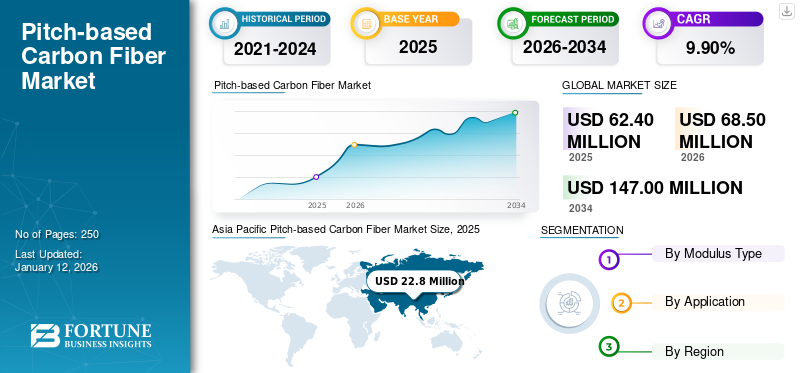
The global pitch-based carbon fiber market size was valued at USD 62.4 million in 2025. The market is projected to grow from USD 68.5 million in 2026 to USD 147 million by 2034, exhibiting a CAGR of 9.90% during the forecast period. Asia Pacific dominated the pitch-based carbon fiber market with a market share of 37.00% in 2025.
Pitch-based carbon fiber is a type of carbon fiber produced from pitch, a viscoelastic material derived from the distillation of carbon-based substances such as coal, crude oil, and plant matter. Pitch was one of the first options considered for carbon fiber precursors due to its high carbon yield of 85%. A key benefit of using pitch as a precursor is that it produces ultra-high modulus carbon fibers due to the significantly larger size of the graphite crystallites. These carbon fibers are known for their high modulus and thermal conductivity, which is particularly suitable for applications requiring high strength-to-weight ratios, such as in aerospace and automotive industries.
The market is mainly projected to grow due to rising demand for lightweight structural materials that can be used in high-performance application areas such as aviation and electric mobility. Employing lightweight structural components in electric vehicle aircraft increases the performance and improves fuel efficiency. In addition, pitch-based carbon fibers generally offer higher modulus and thermal conductivity compared to PAN-based fibers, making them an ideal choice in performance-demanding application areas set to drive market growth during the forecast period.
- In March 2025, GE Aerospace planned to invest around USD 1 billion in its U.S. factories and supply chain to enhance its manufacturing capabilities and to meet the increasing demand for new innovative parts and materials needed for the future of flight.
Download Free sample to learn more about this report.
Pitch-based Carbon Fiber Market KEY TAKEAWAYS
 Global Market Size & Forecast
- 2025 Market Size: USD 62.4 million
- 2026 Market Size: USD 68.5 million
- 2034 Forecast Market Size: USD 147 million
- CAGR: 9.90% from 2026–2034
 Market Share
- Asia Pacific dominated the pitch-based carbon fiber market with a 37.00% share in 2025.
- The high modulus segment held the largest market share.
- The aerospace & defense segment accounted for the largest application share.
 Key Regional Highlights
Asia Pacific
Asia Pacific generated USD 20.2 million in 2025, driven by strong demand from aerospace, EVs, and wind energy.
North America
North America reached USD 21.9 million in 2025, supported by major investments in satellites and aerospace technologies.
Europe
Europe generated USD 15.5 million in 2025, fueled by its strong aerospace manufacturing industry.
U.S.
The U.S. leads regional growth through significant investments in satellite programs and advanced aerospace applications.
Japan
Japan supports regional growth with advanced manufacturing capabilities and increasing demand for high-performance carbon fiber in aerospace and electronics.
Read More

MARKET DYNAMICS
MARKET DRIVERS
Surging Product Demand from Aerospace & Defense to Fuel Market Growth
The global market is witnessing significant expansion, propelled by its distinctive properties essential for aerospace and defense applications. Carbon fiber is extensively utilized in aerospace and defense settings due to its excellent strength-to-weight ratio, durability, and resistance to fatigue and corrosion. This makes it perfectly suited for applications requiring minimizing weight and maintaining structural integrity, including aircraft structures, defense vehicles, and weapon systems. In aircraft, it finds use in the fuselage, wings, and tails to cut down weight, resulting in fuel efficiency and reduced emissions. Furthermore, it improves the performance and longevity of drones and various UAVs. Consequently, the demand for this product is surging in the aerospace and defense sectors, which will drive the global pitch-based carbon fiber market growth throughout the forecast period.
- According to the Civil Aviation Ministry, as the global drone industry grows, the Indian drone industry is expected to reach USD 1.9 billion by 2026.
MARKET RESTRAINTS
Rising Recycling and Environmental Concerns May Hamper Market Growth
Pitch-based carbon fiber production raises environmental concerns due to its energy-intensive process, reliance on fossil fuels, and significant waste generation. Specifically, the precursor spinning stage, high energy consumption during carbonization, and difficulty in recycling contribute to its environmental impact. The production process generates significant waste, including fiber scraps and chemical by-products. In addition, carbon fiber, being a non-biodegradable product, makes it difficult to manage waste from manufacturing and end-of-life products. Recycling pitch-based fibers can be difficult due to the challenge of separating them from the resin matrix and the potential for degradation during the recycling process. Traditional methods, including grinding, can degrade the fibers, reducing their quality and strength. However, research is ongoing to develop more efficient and sustainable recycling methods. Hence, the aforementioned recycling and environmental impacts may hamper the adoption of the product in the short term.
Moreover, the cost-intensive nature of processing mesophase pitch into carbon fiber, coupled with complex pyrolysis and graphitization steps, results in high product prices, limiting its usage in mass-market applications. Also, new entrants face high R&D costs, technical know-how requirements, and proprietary process barriers, making the market capital-intensive and consolidated. Such factors may restrict its adoption and mass-scale production for the short term, creating more challenges for the market to flourish.
MARKET OPPORTUNITIES
Surge in Electric Vehicle Adoption to Create Lucrative Opportunities in Market
In recent times, carbon fiber has transformed automotive manufacturing. Pitch-based carbon fiber is both exceptionally strong and lightweight. Carbon fiber components are widely utilized in making high-performance sports cars, luxury vehicles, and electric cars. Its incredible strength, reduced weight, and heat resistance make it a perfect choice for high-performance applications, including electric automotive production. A key factor is its lightweight characteristic; carbon fiber is up to five times lighter than steel, offering similar strength, making it an excellent material for electric vehicle manufacturers. By using this composite material in traditional vehicle structural components, manufacturers can greatly decrease a car's overall weight, enhancing fuel efficiency and performance. Furthermore, its application in electric cars can enhance their range and efficiency, positioning them as a more eco-friendly alternative to conventional gasoline-powered vehicles. Therefore, the surge in EV adoption is set to create lucrative opportunities in the market.
- According to the International Energy Agency, in 2023, around 14 million new electric vehicles were registered globally.
PITCH-BASED CARBON FIBER MARKET TRENDS
Rising Momentum Toward Wind Energy to Propel Market Growth
The global transition to renewable energy, particularly wind power, is significantly driving the growth of the pitch-based carbon fiber market. Pitch-based fibers are known for their high strength and stiffness, which makes them a crucial raw material for wind energy applications, particularly wind turbine blades. They enhance the structural integrity and durability of blades, leading to larger and more efficient wind turbines. Carbon fibers, including pitch-based ones, are crucial for stiffening the blade's spar caps, which are critical structural components. Such exceptional properties prevent blade deformation and ensure the blades can withstand the forces of wind and fatigue. Therefore, the growing global momentum of wind energy will propel the market growth over the forecast period.
- According to the U.S. Department of Energy, wind is the largest source of renewable energy in the U.S., making up about 10% of U.S. energy production.
Download Free sample to learn more about this report.
Segmentation Analysis
By Modulus Type
High Segment Held Dominant Share Due to Its Balanced Properties
Based on modulus type, the market is segmented into standard, intermediate, and high.
The high segment held the largest global pitch-based carbon fiber market share in 2024. High-modulus pitch-based carbon fibers are in high demand due to their exceptional strength, stiffness, and thermal conductivity, making them ideal for demanding applications such as aerospace, sports equipment, and electronics. Their high modulus, strength, and thermal stability make them ideal for use in aircraft wings, fuselages, and engine parts, contributing to weight reduction, fuel efficiency, and safety. As a result, demand for high modulus pitch-based fibers is set to maintain its dominance throughout the forecast period.
Intermediate modulus pitch-based carbon fibers are in demand due to their unique properties that make them suitable for a wide range of applications, particularly in the aerospace and automotive industries. These fibers offer a good balance of strength, stiffness, and weight, making them a cost-effective option for many applications where high-performance materials are needed. In addition to its exceptional properties, its efficacy in standing against high temperatures will drive its demand significantly during the forecast period.
By Application
Aerospace & Defense Segment Dominated Market Due to Carbon Fibers’ High Utilization
Based on application, the market is segmented into aerospace & defense, automotive, wind energy, sports & leisure, construction, and others.
The aerospace & defense segment held the largest global market share in 2024. Pitch-based carbon fibers are used in aerospace and defense due to their exceptional strength, high thermal conductivity, and ability to withstand high temperatures and mechanical stress. Such properties make them ideal for critical applications such as thermal protection systems, rocket nozzles, and satellite construction, where lightweight, high-performance composites are needed. Therefore, the aerospace & defense segment is poised to remain a major application segment for the product over the forecast period.
Wind energy is identified as the fastest-growing segment in the global market, particularly driven by pitch-based carbon fiber’s unique combination of exceptional properties such as high strength, stiffness, and low density. Its unique set of properties allows the creation of long, lightweight blades that capture more wind energy without compromising structural integrity. Therefore, the growing demand for more energy power will naturally fuel the drive of the wind energy application segment in the coming years.
Pitch-based Carbon Fiber Market Regional Outlook
By region, the market is categorized into North America, Europe, Asia Pacific, Latin America, and Middle East & Africa.
Asia Pacific
Asia Pacific Pitch-based Carbon Fiber Market Size, 2025 (USD Million)
To get more information on the regional analysis of this market, Download Free sample
Asia Pacific held the largest global pitch-based carbon fiber market share in 2024, generating market revenue worth USD 20.2 million. Asia Pacific dominates the market due to the presence of massive industrialization, significant investment in advanced manufacturing, and increasing demand from key industries such as automotive and aerospace. In Asia Pacific, China dominates the regional market due to the country’s massive investment in the aerospace & defense sector and continuously expanding EV sector, which is driving the product demand. In addition, China is also the world’s largest wind energy market, boosting demand for pitch-based fibers. North America maintained a strong presence in the global market, reaching USD 21.9 million in 2025, accounting for 35.00% share, and is expected to reach USD 23.8 million in 2026.
- According to the Global Energy Monitor, in 2023, wind and solar energy accounted for around 37% of the total power capacity in the country.
North America
North America is identified as the second-largest region in the market. The U.S. is a leading investor in the global satellite market, with a significant focus on both commercial and national security applications. The U.S. has a substantial number of operational satellites, significantly outnumbering any other country. The product demand in North America is projected to surge, driven by massive investment plans in the region.
- SoftBank Group Corp has planned to invest around 1 billion in OneWeb Ltd, which is building a constellation of satellites to improve global broadband access.
Europe
The European aerospace sector designs and produces both civilian and military aircraft, helicopters, drones, aero-engines, and various systems and equipment. It also encompasses firms that offer support services, including maintenance and training. The civil sector of the industry serves as the foundation of the European aerospace and defense ecosystem, accounting for 50% of its yearly revenue while creating highly skilled employment and fostering innovation. Owing to such widespread production, the European market is anticipated to grow moderately during the forecast period. In 2025, Europe generated USD 15.5 million, contributing 25.00% to global market revenue, and is projected to grow to USD 16.7 million in 2026.
- According to the European Commission, Civil aeronautics provides 405,000 jobs, generates USD 147 billion in revenues, and plays a leading role in exports.
Latin America
The Latin America market is expected to grow gradually, owing to its focused investments in expanding satellite internet, communication, and data services. The market is expected to grow significantly, driven by factors such as increasing demand for broadband connectivity, especially in rural areas, and the use of satellite technology for emergency relief and government communications. As carbon fibers are highly utilized for thermal management applications in satellites hence the regional market is set to grow during the forecast period. Latin America contributed 2.30% to the global market in 2025, with a valuation of USD 1.4 million, and is projected to reach USD 1.6 million in 2026.
Middle East & Africa
The demand for products in the Middle East & Africa is expected to grow on an upward trajectory, fueled by the expanding aerospace, automotive, and sporting goods industries, as well as the broader push for sustainable technologies. Mega initiatives, including Saudi Arabia Vision 2030 and Dubai 2040 - Urban Master Plan & Sustainable Development, are set to create a progressive environment for market growth. In 2025, Middle East & Africa represented USD 0.7 million, accounting for 1.00% of the worldwide market, and is projected to grow to USD 0.7 million in 2026.
COMPETITIVE LANDSCAPE
Key Industry Players
Capacity Expansion and Product Innovation to Remain a Key Strategy in Market
The global market is partially concentrated with companies such as Mitsubishi Chemical Carbon Fiber and Composites, Inc., Nippon Graphite Fiber Co., Ltd., Toray, and Teijin Limited accounting for a significant market share. The top firms are well-positioned to achieve substantial revenue growth due to the increasing need for lightweight materials in the aerospace and defense, automotive, and energy sectors, especially wind energy. Major players in the industry are concentrating on enlarging their production capabilities and investing in research and development to satisfy the escalating demand for these products.
LIST OF KEY PITCH-BASED CARBON FIBER COMPANIES PROFILED
- Hexcel Corporation (U.S.)
- Kureha Corporation (Japan)
- Mitsubishi Chemical Carbon Fiber and Composites, Inc. (Japan)
- Nippon Graphite Fiber Co., Ltd. (Japan)
- Syensqo (Belgium)
- Tasuns Composite Technology Co., Ltd. (China)
- TEIJIN LIMITED (Japan)
- Toray Industries, Inc. (Japan)
- Wanhoo Composite (China)
- Zhengzhou Alfa Chemical Co., Ltd. (China)
KEY INDUSTRY DEVELOPMENTS
- March 2024: Jindal Advanced Materials (JAM), a composite material producer, collaborated with Italy's MAE S.p.A. and planned to invest around USD 316 million to set up a carbon fiber plant with a capacity to produce 3,500 tons annually.
- October 2023: Toray Industries Inc. expanded its high modulus and regular tow* medium carbon fibers production facilities at French subsidiary Toray Carbon Fibers Europe S.A. This move is due to the increasing demand for carbon fiber in Europe, bolstered by the move toward a net-zero society.
- December 2022: Hyosung Advanced Materials revealed that it had achieved the successful development of ultra-high-tensile carbon fiber, bringing it closer to independently producing aeronautic materials.
- March 2022: Hyosung Advanced Materials announced that it will invest USD 38.5 million to expand carbon fiber production at the company’s JeonJu, South Korea, plant facility.
- July 2021: Hexcel Corporation announced that it signed an agreement with Dassault to supply carbon fiber prepreg for the Falcon 10X program. The move is anticipated to strengthen the existing partnership between the two aerospace leaders.
REPORT COVERAGE
Request for Customization to gain extensive market insights.
Report Scope & Segmentation
|
ATTRIBUTE |
DETAILS |
|
Study Period |
2021-2034 |
|
Base Year |
2025 |
|
Estimated Year |
2026 |
|
Forecast Period |
2026-2034 |
|
Historical Period |
2021-2024 |
|
Unit |
Value (USD Million) & Volume (Kiloton) |
|
Growth Rate |
CAGR of 9.90% during 2026-2034 |
|
Segmentation |
By Modulus Type
|
|
By Application
|
|
|
By Region
|
Frequently Asked Questions
Fortune Business Insights says that the global market value stood at USD 62.4 million in 2025 and is projected to reach USD 147 million by 2034.
In 2025, the Asia Pacific market value stood at USD 22.8 million.
The market is expected to exhibit a CAGR of 9.90% during the forecast period of 2026-2034.
The aerospace & defense segment led the market by application.
Surging product demand from aerospace & defense to fuel market growth.
Mitsubishi Chemical Carbon Fiber and Composites, Inc., Nippon Graphite Fiber Co., Ltd., Toray, and Teijin Limited are the top players in the market.
Asia Pacific dominated the market in 2025.



- 2021-2034
- 2025
- 2021-2024
- 250
Get 30-60 hrs Free Customization
Expand Regional and Country Coverage, Segments Analysis, Company Profiles, Competitive Benchmarking, and End-user Insights.


















Related Reports
-
US +1 833 909 2966 ( Toll Free )
-
Get In Touch With Us