Plant-based Beverages Market Size, Share & Industry Analysis, By Source Type (Soy, Almond, Oat, Coconut, and Others), By Packaging (Cartons, Bottles, and Others), By Flavor (Plain/Unflavored and Flavored), By Distribution Channel (Supermarkets/Hypermarkets, Convenience Stores, Specialty Stores, and Online Retail), and Regional Forecast, 2026-2034
 Download Free Sample
(Offer valid till 30th Sep 2026)

Plant-based Beverages Market Size and Future Outlook
 Listen to Audio Version
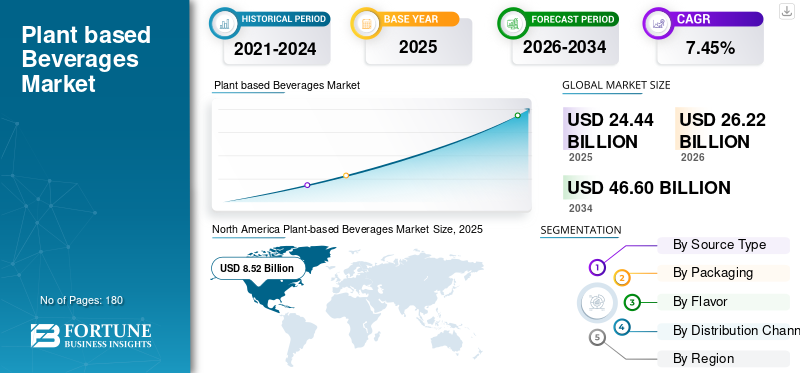
The plant-based beverages market size was valued at USD 24.44 billion in 2025 and is projected to grow from USD 26.22 billion in 2026 to USD 46.60 billion by 2034, exhibiting a CAGR of 7.45% during the forecast period. North America dominated the plant-based beverages market with a market share of 34.86% in 2025.
Plant-based beverages are dairy-free drinks produced by extracting useful nutrients from plant materials such as coconut, cereals, and legumes. They are commonly used as smoothie bases, standalone drinks, coffee whiteners, or culinary components. Plant-centric drinks are usually produced through cleaning, extraction, hydration, homogenization, and heat treatment. A few popular types of beverages include coconut, soy, oat, and blended drinks. Regarding target end-users, it caters to flexitarians, lactose-intolerant consumers, and individuals with specific dairy-avoidance/dairy allergies. Geographically, North America and Europe are key consumers in the global market. The rising awareness of ethical considerations and growing health & wellness trends are key factors driving the market’s potential.
Companies such as Danone S.A., Nestle S.A., and Oatly AB are prominent players in the market. New product offerings are a pivotal strategy adopted by key players to improve their position.
Download Free sample to learn more about this report.
PLANT-BASED BEVERAGES MARKET KEY TAKEAWAYS
 Global Market Size & Forecast
- 2025 Market Size: USD 24.44 billion
- 2026 Market Size: USD 26.22 billion
- 2034 Forecast Market Size: USD 46.60 billion
- CAGR: 7.45% from 2026–2034
 Market Share
- North America dominated the market with a 34.86% share in 2025.
- The Soy segment held the largest market share in 2025.
- The Cartons segment held the largest market share in 2025.
 Key Regional Highlights
North America
Reached USD 8.52 billion in 2025, driven by rising demand for plant-based drinks and increasing health-conscious consumers.
Europe
Reached USD 6.76 billion in 2025, supported by growing lactose intolerance awareness and rising adoption of plant-based diets.
Asia Pacific
Reached USD 6.56 billion in 2025, driven by increasing preference for vegan diets and growing health awareness.
U.S.
Reached USD 6.77 billion in 2025, accounting for 27.70% of global market revenue.
Japan
Reached USD 1.04 billion in 2025, accounting for 4.27% of global market revenue.
Read More

PLANT-BASED BEVERAGES MARKET TRENDS
Surging Inclination Toward Barista-Grade Plant-based Beverages is the Current Trend
Barista-grade plant drinks are gaining huge visibility in the global space as the majority of consumer’s first try and incorporate them in their daily coffee consumption. Regular plant-sourced drinks fit well in smoothies and cereals, but coffee reveals various formulation challenges, such as poor foam stability, separation, and curdling, that mask espresso notes. To overcome such obstacles, barista formulations are widely utilized in both coffee and non-coffee applications. This trend is also supported by rising foodservice adoption. Quick service restaurants, coffee chains, and hotels are extensively providing plant based milk drinks, which fuels the popularity of barista-grade beverages. Moreover, a few prominent coffee chains are eliminating/minimizing the extra charges of plant-centric milk, which further reinforces this trend.
MARKET DYNAMICS
MARKET DRIVERS
Download Free sample to learn more about this report.
Rising Dairy Sensitivities Boost the Consumption of Plant-based Beverages
The surging prevalence of dairy sensitivities is a key driver boosting the use of plant-based beverages. Currently, lactose intolerance is at its peak, and mostly occurs when the body faces difficulty in digesting milk sugar and lactose, owing to insufficient lactase enzyme. Common symptoms include stomach discomfort, diarrhea, and bloating after consuming beverages/foods that contain lactase. To overcome this issue, consumers are opting for plant-based drinks rather than avoiding milk-type beverages entirely. Individuals are increasingly incorporating almond, rice, pea, and cashew milk for preparing smoothies, coffee, or for direct consumption. Moreover, this condition further supports product innovation. Majority of the population who are avoiding dairy items often seek alternatives that are lactose-free, yet full of essential nutrients. This encourages producers to launch plant-sourced drinks fortified with iodine, calcium, vitamin B12, and vitamin D.
MARKET RESTRAINTS
Higher Retail Prices Compared to Dairy-based Drinks Slowdown Mass Market Adoption
One of the key obstacles in the market is premium pricing. Rice, oat, pea, almond, and other blended plant-based drinks are mostly priced higher than cow’s milk and ready-to-drink beverages as their supply chains are still less standardized and mature. Raw materials majorly need additional processing steps, including homogenization, enzyme treatment, and aseptic packaging, all of which fuel commercialization and manufacturing costs. In most of the markets, dairy gains an advantage from large-scale procurement and mature cold-chain infrastructure, and in a few countries, government assistance and traditional consumption habits. For budget-sensitive households, plant-based drinks are widely perceived as an occasional purchase rather than a daily staple. As a result, this scenario restricts repeat purchase, specifically in emerging countries.
MARKET OPPORTUNITIES
Usage of Modern Technologies in the Drinks Market Unlocks Growth Opportunities
The integration of innovative technologies in the plant-based drinks sector builds numerous growth possibilities. To strengthen natural sweetness and texture, the producers are adopting advanced enzyme treatment (controlled enzymatic hydrolysis). High-pressure processing technology is another modern method used for preserving nutrients, fresh flavor, and minimizing microbial load.
Moreover, membrane filtration technologies (ultrafiltration/microfiltration) are being explored by businesses to remove undesirable particles and enhance clarity. Additionally, manufacturers are utilizing fortification systems to correct nutritional imbalances compared to dairy milk. Besides this, companies are focusing on hydrocolloid blends and new emulsifier systems to upgrade shelf life while minimizing the requirement for synthetic additives.
Segmentation Analysis
By Source Type
Soy Category Led the Market Owing to Higher Protein Content
Based on source type, the market is divided into soy, almond, oat, coconut, and others.
The soy category dominated the market in 2025. Soy-based drinks offer major benefits with respect to protein content as compared to coconut and almond beverages. These drinks are economical in nature, primarily because of efficient processing and established supply chains. Moreover, it has a stronger presence in mass and emerging markets and better consumer familiarity. Additionally, soy milk has minimal dependence on heavy processing and is widely utilized in foodservice and institutional segments.
The oat segment is projected to grow at a high CAGR of 9.69% over the forecast period.
By Packaging
Cartons Segment Dominated the Market Due to Ease of Storage
Depending on the packaging, the market is distributed into cartons, bottles, and others.
In 2025, the cartons held the largest plant-based beverages market share. Compared to bottles, cartons are cost-effective in nature, making them the preferred choice by producers. These aseptic cartons optimize space utilization and are lightweight, which minimizes overall handling and logistics costs. Moreover, they are highly compatible with large pack sizes, which are mostly utilized for household consumption. Additionally, improved product protection from contaminants, air, and light further fuels the segment growth.
The bottles segment is projected to grow at a CAGR of 9.61% over the forecast period.
To know how our report can help streamline your business, Speak to Analyst
By Flavor
Plain Category Leads in the Industry Due to Wider Consumer Penetration
Based on flavor, the market is segmented into plain/unflavored and flavored.
The plain/unflavored segment led the market in 2025. Plain variants are widely used as daily milk alternatives for cereals, coffee, and tea, which leads to repeat purchase frequency. This flavor type integrates easily into both cold and hot applications, without hampering the original flavor of the item. Moreover, plain drinks are perceived as healthier due to no or minimal added sugar. Additionally, they are appropriate for fortified and functional variants, which further propel the global plant-based beverages market growth.
The flavored segment is projected to grow at a high CAGR of 9.64% over the forecast period.
By Distribution Channel
Supermarkets/Hypermarkets Lead in the Market Due to Efficient Bulk Purchasing
Based on distribution channel, the market is distributed into supermarkets/hypermarkets, convenience stores, specialty stores, and online retail.
Supermarkets/hypermarkets led the global market in 2025. Supermarket retail outlets provide a diversified product range across various categories, allowing individuals to purchase plant-based drinks along with fresh produce and groceries. This channel also gains an advantage from private label offerings, which are substantially lower-priced than other branded items. Moreover, it supports bulk purchasing, which helps in minimizing shopping frequency. Additionally, product assurance and better consumer trust further bolster segment growth.
The online retail is projected to grow at a high CAGR of 10.61% over the forecast period.
Plant-based Beverages Market Regional Outlook
By geography, the market is categorized into Europe, North America, Asia Pacific, South America, and the Middle East & Africa.
North America
North America Plant-based Beverages Market Size, 2025 (USD Billion)
To get more information on the regional analysis of this market, Download Free sample
The North America region dominates the market and reached a valuation of USD 8.52 billion in 2025. The market in North America is expected to grow due to rising demand for plant based drinks, and growing health conscious consumers.
U.S. Plant-based Beverages Market
Based on North America's strong contribution, the U.S. market was at USD 6.77 billion in 2025, accounting for roughly 27.70% of global sales.
Europe
Europe reached USD 6.76 billion by 2025, recording a growth rate of 5.90% and securing second position. The surging population of lactose intolerant consumers and sudden shift toward plant based alternatives/plant based foods are boosting the regional potential.
Germany Plant-based Beverages Market
The Germany market in 2025 was valued at USD 1.69 billion, representing roughly 6.91% of the global market revenues.
U.K. Plant-based Beverages Market
The U.K. market reached at USD 1.23 billion in 2025, equivalent to around 5.03% of the global market sales.
Asia Pacific
The Asia Pacific region reached USD 6.56 billion by 2025 and hold the third position. The increasing consumer preference towards plant based diets and surging awareness of the health benefits of vegan products are propelling the region's potential.
India Plant-based Beverages Market
The India market in 2025 was at USD 0.74 billion, accounting for roughly 3.03% of the global market revenues.
China Plant-based Beverages Market
China's market is projected to be one of the largest worldwide, with revenues reached at USD 2.74 billion in 2025, accounting for roughly 11.23% of the global market sales.
Japan Plant-based Beverages Market
The Japan market in 2025 was at USD 1.04 billion, accounting for approximately 4.27% of the global revenues.
South America and the Middle East & Africa
The South America and the Middle East & Africa regions are expected to witness moderate growth in this market space during the forecast period. The South American market was valued at USD 1.68 billion in 2025. The innovative launches of plant based products and a robust e-commerce network are expected to drive demand. The Middle East & Africa market reached USD 0.92 billion in 2025.
South Africa Plant-based Beverages Market
The South Africa market reached USD 0.42 billion in 2025, representing roughly 1.71% of global revenues.
COMPETITIVE LANDSCAPE
Key Industry Players
Innovative Product Launches Boost Competitive Positioning and Brand Equity
The plant-based beverages sector is highly competitive, comprising a blend of strong private-label brands and multinational beverage and food firms. Prominent companies compete through distribution strength and robust product portfolio, while emerging brands aim at high-quality formulations and clean-label positioning. Along with this, the players are also entering into acquisitions to strengthen their position in the market.
LIST OF KEY PLANT-BASED BEVERAGES COMPANIES PROFILED
- Danone S.A. (France)
- The Campbell’s Company (U.S.)
- Oatly Group AB (Sweden)
- SunOpta Inc. (U.S.)
- Nestle S.A. (Switzerland)
- The Hain Celestial Group, Inc. (U.S.)
- Noumi Limited (Australia)
- Vitasoy International Holdings Ltd. (Hong Kong)
- Blue Diamond Growers (U.S.)
- Califia Farms, LLC (U.S.)
KEY INDUSTRY DEVELOPMENTS
- February 2026: Refresco, a Netherlands-based beverage solutions provider, acquired SunOpta, a food and beverage group in the U.S., to enhance its business in the plant-based beverages category.
- January 2026: Beyond Meat, an American plant-based meat firm, revealed a protein drink, “Beyond Immerse,” which comprises protein extracted from peas and fiber from tapioca. This product is a limited edition and can be purchased from Beyond Test Kitchen.
- October 2025: NUITREE, a food producer in the UAE, collaborated with SIG, a Swiss-based bag-in-box and aseptic carton packaging company, to accelerate innovation in the plant-based beverage industry.
- September 2025: Silk, a plant-based milk brand of Danone S.A., a French beverage and food corporation, launched a plant-centric drink across Mexico.
- June 2025: Country Delight, a direct-to-home consumer brand in India, marked its entry into the plant-based drinks sector by introducing an oats beverage. This drink is available in a 400 ml pack size.
REPORT COVERAGE
The global plant-based beverages market provides an in-depth study of the market size & forecast by all the market segments included in the oil market reports. The global market forecast analysis includes details on the market dynamics and global market trends expected to drive the market during the forecast period. The global market analysis offers information on the technological advancements, new product launches, key industry developments, and details on partnerships, mergers & acquisitions. The plant-based beverages industry forecast also encompasses a detailed competitive landscape with information on the market segmentation, market share, and profiles of key operating players.
Request for Customization to gain extensive market insights.
Report Scope & Segmentation
| ATTRIBUTE | DETAILS |
| Study Period | 2021-2034 |
| Base Year | 2025 |
| Estimated Year | 2026 |
| Forecast Period | 2026-2034 |
| Historical Period | 2021-2024 |
| Growth Rate | CAGR of 7.45% from 2026-2034 |
| Unit | Value (USD Billion) |
| Segmentation | By Source Type, Packaging, Flavor, Distribution Channel, Region |
| By Source Type |
|
| By Packaging |
|
| By Flavor |
|
| By Distribution Channel |
|
| By Geography |
|
Frequently Asked Questions
Fortune Business Insights says that the global market value stood at USD 24.44 billion in 2025 and is projected to reach USD 46.60 billion by 2034.
In 2025, the North America market value stood at USD 8.52 billion.
The market is expected to exhibit a CAGR of 7.45% during the forecast period of 2026-2034.
By flavor, the plain/unflavored segment led the market.
Rising dairy sensitivities boost the consumption of plant-based beverages.
Danone S.A., Nestle S.A., and Oatly Group AB are among the key players in the market.
North America held the largest market share in 2025.
Surging inclination towards barista-grade plant-based beverages is the current trend.


- 2021-2034
- 2025
- 2021-2024
- 180
-
(Offer valid till 30th Sep 2026)
Get 30-60 hrs Free Customization
Expand Regional and Country Coverage, Segments Analysis, Company Profiles, Competitive Benchmarking, and End-user Insights.














Related Reports
-
US +1 833 909 2966 ( Toll Free )
-
Get In Touch With Us