Plasma Cutting Machine Market Size, Share & Industry Analysis, By Type (Handheld Plasma Cutting Machines and Mechanized Plasma Cutting Machines), By Application (Industrial Manufacturing, Automotive, Construction, Salvage and Scrapping Operation, Shipbuilding, and Others), By Thickness Capacity (Below 5mm, 5mm -15mm, 15mm-50mm, and Above 50mm), and Regional Forecast, 2026 - 2034
 Download Free Sample
(Offer valid till 30th Sep 2026)

KEY MARKET INSIGHTS
 Listen to Audio Version
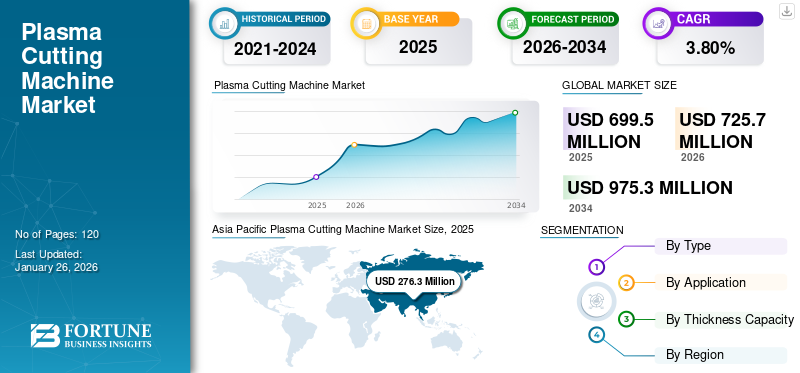
The global plasma cutting machine market size was valued at USD 699.5 million in 2025 and is projected to grow from USD 725.7 million in 2025 to USD 975.3 million by 2034, exhibiting a CAGR of 3.80% during the forecast period. Asia Pacific dominated the global market with a share of 39.50% in 2025.
Plasma cutting technology is widely used in different industries for cutting materials such as metal, steel, and other conductive materials. With the increasing demand for intricate products and higher-quality cuts, the need for plasma-operated cutting tools is also expected to witness a surge. Moreover, substantial increments in the incorporation of automation and robotic technology will also favor the growth prospects. Most of the manufacturers are introducing new and automated products in their product portfolio and trying to offer cost-effective products to stay in the competition, thus providing new growth horizons to the market.
While the market has stabilized after initial rapid growth, it continues to grow steadily due to new industrial development, sustainability initiatives that are leading to the growth of energy-efficient solutions, and demand for after-market parts and services. The pandemic disrupted the market as the world experienced a forced change in the economy, such as factory shutdowns, labor shortages, and pandemic delays, which caused a slowdown in production output and capital spending. The demand decreased, impacting the burning equipment with reduced demand from sectors such as automotive and decreased spending to replace aging capital goods or to grow capacity for current or future anticipated demand. However, as restrictions eased, restrained demand came flooding back, bolstering the market. Many firms used the product as a catalyst to accelerate advancement in automation and digitalization to address labor shortages, strengthen resilience, and improve productivity.
The market is highly competitive, with several prominent global players such as Hypertherm, ESAB, Lincoln Electric Company, ITW Inc., and Messer Cutting Systems leading the charge. These companies collectively dominate a significant portion of the market, fueling innovation and delivering a variety of cutting solutions designed to meet diverse industrial requirements. Their focus on global expansion and relentless product development helps them maintain growth and a leading position in the industry.
Download Free sample to learn more about this report.
PLASMA CUTTING MACHINE MARKET KEY TAKEAWAYS
 Global Market Size & Forecast
- 2025 Market Size: USD 699.5 million
- 2026 Market Size: USD 725.7 million
- 2034 Forecast Market Size: USD 975.3 million
- CAGR: 3.80% from 2026-2034
 Market Share
- Asia Pacific secured 39.50% of the global market in 2025.
- The automotive segment is anticipated to contribute 31.25% of the market in 2026 and is expected to grow faster than other segments.
- The 15mm–50mm segment is expected to account for 40.75% of the market in 2026 while registering the highest growth rate.
 Key Regional Highlights
North America
North America accounted for USD 186.2 million in 2025, representing 26.60% of the global market.
Europe
Europe reached USD 158.7 million in 2025, capturing 22.70% of the global market.
Asia Pacific
Asia Pacific accounted for USD 276.3 million in 2025, representing 39.50% of the global market.
U.S.
The U.S. market is projected to reach USD 122.5 million by 2026.
Japan
The Japan market is projected to reach USD 38.4 million by 2026
Read More

IMPACT OF TARIFFS
Tariffs imposed on imported components and finished goods can have a considerable influence on the market. As manufacturers attempt to maximize productivity and provide precise cut quality for industrial construction applications, an increase in costs from tariff regulations can hamper their ability to remain competitive by keeping attention on low-cost innovative designs. Tariffs may compel companies to buy plasma cutting machines manufactured locally instead, as they should spend money in line with their decision to use a local labor market.
Recently, increasing acceptance of automation and global investments in infrastructure developments have resulted in strong demand for high-quality plasma cutting solutions. These trends will serve to augment plasma cutting demand in the regions that are growing and planning to put significant capital into the construction and manufacturing sectors. These factors are acting as a catalyst for the growth of the market, specifically as it relates to the demand for high-performance base equipment in a rapidly changing sector with evolving trade regulations across borders, making tariff policy a priority consideration for all parties.
Download Free sample to learn more about this report.
Plasma Cutting Machine Market Trends
Integration of CNC Technology and Multi-Process Capabilities to Fuel Market Growth
The integration of Computer Numerical Control (CNC) technology with plasma cutting machines allows for automated and precise control of the cutting process. CNC systems enable machines to follow programmed instructions, resulting in accurate and repeatable cuts.
Some of these machines offer multi-process capabilities, allowing them to perform various functions beyond cutting. This may include tasks such as plasma gouging, marking, and welding, providing versatility in fabrication processes. Pulse technology in plasma cutting allows for better control of heat input during the cutting process. This is particularly useful for cutting thin materials and intricate designs, minimizing distortion and delivering high-quality cuts.
Market Dynamics
Market Drivers
Proliferation of Customized Metal Fabrication and Elevated Level of Automation to Create an Optimistic Market Growth Situation
Automated plasma cutting systems can consistently execute precise cuts, ensuring high-quality and accurate results. This level of precision is highly challenging to achieve consistency with manual cutting methods. Automation allows for continuous and uninterrupted operation, leading to higher productivity. In addition, automated systems can work around the clock, reducing downtime and increasing overall efficiency. Automation enables these cutting machines to operate at higher speeds than manual methods. This increased cutting speed contributes to faster production cycles and shorter lead times for projects.
These aforementioned advantages of automation and its increasing incorporation in metal fabrication are poised to spur the market growth.
Market Restraints
Presence of Alternative Technologies and Stringent Regulatory Compliance to Hamper Market Growth
Different cutting technologies, such as laser cutting and waterjet cutting, compete with plasma cutting in the market. The choice between these technologies depends on the specific requirements of the application and advancements in competing technologies that can impact the demand for these machines. Plasma cutting is highly effective on conductive materials, and its performance may vary with different types of materials. Some industries may prefer alternative cutting methods based on the materials they commonly use.
Moreover, stringent safety and environmental regulations may affect the use of these cutting machines, especially in regions where emissions and waste disposal are closely regulated. Compliance with these regulations can add additional costs and complexities for businesses.
Market Opportunities
Technology Advancement and Integration of Robotic Process Automation (RPA) Create a Lucrative Opportunity for Businesses
The rising replacement of human labor with automated technologies, including cutting systems, is gaining higher prominence. Developing and manufacturing automation capabilities, along with widespread use of unconventional technologies such as the Internet of Things and Artificial Intelligence, are projected to propel the market forward. For decades, structural steel fabrication and manufacturing companies have been dependent on traditional manual and base cutting machines. However, the emergence of plasma cutting and laser cutting solutions has developed high plasma at the core, enabling quicker cutting with higher precision and finish.
Additionally, IoT has revolutionized metal cutting and processing, making smarter decisions with sensor data and creating profitable opportunities for businesses in the upcoming years. The Internet of Things creates enormous volumes of data as it gathers, cleans, and harmonizes IoT data, such as AI-enabled cutting, robotic process automation systems, and metal-specific temperature control that manage the temperature and provide efficient cutting, thus saving energy and cost.
For example, the Hypertherm Associates XPR460 industrial plasma cutting system is designed for seamless operation and features argon assist technology for extended piercing capability. Additionally, its advanced control mechanism with four gas connect control options offers unparalleled flexibility and control over the cutting process.
SEGMENTATION ANALYSIS
By Type
Adaptability of CNC Machines Drives Mechanized Plasma Cutting Machines Segment Growth
In terms of type, the market is classified into handheld plasma cutting machines and mechanized plasma cutting machines.
The mechanized plasma cutting machines segment is projected to dominate the market with a share of 53.22% in 2026. throughout the forecast period. Moreover, this segment is expected to show strong growth during the forecast period. Mechanized plasma is scaled to accommodate varying production demands. Whether a small job or a large-scale production run, these machines can be adapted to meet the requirements. In addition, many modern Computer Numerical Control (CNC) machines are equipped with remote monitoring and control capabilities. This allows operators to monitor the cutting process, make adjustments, and troubleshoot issues from a remote location. These factors are identified as crucial and are expected to support optimistic growth projections of the mechanized segment.
The handheld plasma cutting machines segment is expected to experience slower growth compared to the mechanized segment over the forecast period due to the increasing intricacy and demand for precise and accurate operations. However, the minimal initial investment for the setup of manual machines and the lesser maintenance involved in the handheld segment are seen as crucial factors supporting the sales of the handheld segment in the market.
By Application
Efficient Batch Production and Versatility in Materials to Drive Automotive Segment Growth
By application, the market is categorized into industrial manufacturing, automotive, construction, salvage and scrapping operations, shipbuilding, and others.
The automotive segment is projected to dominate the market with a share of 31.25% in 2026 and is set to outpace the growth rate of other segments during the forecast period. Increased focus of automobile manufacturers on precise and accurate components with tight tolerances for an optimum performing vehicle tends to increase the integration of plasma cutting operations in the automotive industry. Moreover, these machines can cut through a variety of materials used in the automotive industry, including mild steel, stainless steel, aluminum, and alloys. This versatility makes them suitable for fabricating a wide range of automotive components. Additionally, they are well-suited for batch production in the automotive industry. Their high cutting speeds and ability to handle multiple materials make them efficient for producing large quantities of components in a relatively short time.
It is employed in the manufacturing of heavy equipment to cut and shape metal components for construction machinery. Plasma cutting allows for the precise cutting of metal sheets, enabling manufacturers to create intricate and detailed components with ease in convenience.
Moreover, plasma cutting techniques are used for on-site cutting and repair of metal equipment and structures, providing a quick and efficient solution for maintenance tasks.
The shipbuilding segment is diminutive since it continues to develop at a lower rate due to the shipbuilding requirements for metal-cutting functionality.
By Thickness Capacity
To know how our report can help streamline your business, Speak to Analyst
Versatility and High-Volume Needs Propel 15mm–50mm Segment Expansion
By thickness capacity, the market is segmented into below 5mm, 5mm -15mm, 15mm- 50mm, and above 50mm.
The 15mm–50mm segment is projected to dominate the market with a share of 40.75% in 2026 and the highest projected growth rate, as it reflects the dominance of plasma cutting machines in cutting medium-thickness metals. Plasma cutting machines in this thickness range are extensively used across various industries, making the 15-50mm segment a popular choice for cutting medium-thickness metals.
The 5mm–15mm segment also has a large market share, as the demand for cutting thinner materials, which plasma cutting is used for, also has a high integrity component.
The segments below 5mm and above 50mm thickness will grow at a slower pace, as they are generally more specialized or niche segments. Overall, the market is clearly characterized, both in terms of application and thickness capacity, as having a clear concentration in segments where versatility and high-volume processing are required.
PLASMA CUTTING MACHINE MARKET REGIONAL OUTLOOK
Geographically, the market is divided into North America, South America, Europe, Asia Pacific, and the Middle East & Africa.
Asia Pacific
Asia Pacific Plasma Cutting Machine Market Size, 2025 (USD Million)
To get more information on the regional analysis of this market, Download Free sample
In 2025, Asia Pacific represented USD 276.3 million, accounting for 39.50% of the worldwide market, and is projected to grow to USD 288.5 million in 2026. The region is also expected to register a noteworthy CAGR in the global market over the forecast period. The automotive industry in the Asia Pacific region is expanding, driven by both domestic consumption and exports. Plasma-cutting machines are integral to the fabrication of automotive components, and their use has increased rapidly with the growth of the automotive sector. Similar to other regions, ongoing technological advancements in plasma-cutting technology have improved the capabilities of these machines. Enhanced precision, cutting speeds, and automation features are further supporting plasma cutting machine market growth in the region. The Japan market is projected to reach USD 38.4 million by 2026, the China market is projected to reach USD 111.2 million by 2026, and the India market is projected to reach USD 60.2 million by 2026.
China is a prominent market within the Asia Pacific region, driven by a large manufacturing base and ongoing industrialization in automation. There is a continual demand for advanced metal-cutting technologies, shifting China’s focus on exports, scale, and production of automotive, machinery, and construction equipment. Government continues to upgrade manufacturing through smart factories with modern production techniques, making CNC and contemporary plasma cutting automated systems highly effective.
North America
The North America market accounted for USD 186.2 million in 2025, representing 26.60% of the global industry, and is expected to reach USD 192.2 million in 2026. The automotive industry in North America is a major consumer of plasma-cutting technology. As the automotive sector continues to evolve and adopt advanced manufacturing processes, the demand for plasma cutting technology, which is a precision cutting tool, increases. North America has experienced a resurgence in manufacturing activities, driven in part by reshoring and a renewed focus on domestic production. The need for efficient cutting solutions, such as plasma cutting machines, has increased as manufacturers seek advanced technologies to enhance productivity. In the U.S., widespread adoption of automation in the fabrication industry contributes to consistent demand for the machines. Additionally, government initiatives to strengthen domestic manufacturing further support technology upgrades across production facilities. The U.S. market is projected to reach USD 122.5 million by 2026.
Europe
Europe recorded a market size of USD 158.7 million in 2025, capturing 22.70% of the global market share, and is projected to reach USD 165.1 million in 2026. Europe has a diverse and robust manufacturing sector that includes industries such as automotive, aerospace, machinery, and electronics. The demand for efficient and precise cutting solutions, such as plasma-driven cutting machines, has increased with the increase in manufacturing activities. Moreover, the automotive industry in Europe is a major consumer of plasma-cutting technology. As the automotive sector continues to advance and incorporate new materials, manufacturers are shifting to these machines for their ability to handle a variety of materials with precision. The UK market is projected to reach USD 36.8 million by 2026, while the Germany market is projected to reach USD 25.1 million by 2026.
Latin America
The Latin America market was valued at USD 45 million in 2025, capturing 6.40% of global revenue, and is estimated to reach USD 45.8 million in 2026.
Middle East & Africa
Middle East & Africa contributed 4.80% to the global market in 2025, with a valuation of USD 33.2 million, and is projected to reach USD 34 million in 2026. The Middle East & Africa region is witnessing an extensive infrastructure project and rapid urbanization. Plasma cutting machines are crucial for metal fabrication in construction, bridges, and other infrastructure developments.
South America
SMEs in South America are adopting advanced manufacturing technologies to enhance productivity. Offering cost-effective solutions has become more prevalent in smaller businesses, which aid the sales of products among SMEs. However, the limited domestic production and heavy dependence on imported plasma cutting machines are constraining market growth in South America.
COMPETITIVE LANDSCAPE
KEY INDUSTRY PLAYERS
Development of a Wide Array of Product Portfolio to Propel Market Share of Established Players
This market is highly fragmented with the presence of numerous global key players and the emergence of regional or domestic players across the globe. Most of the manufacturers are trying to develop a comprehensive range of cutting solutions. Moreover, global manufacturers are also focusing on global reach and introducing a wide variety of cutting products. The efforts to have a global reach and swift growth across multiple geographies will certainly increase the target customer base for the companies and result in strong growth in sales of the products.
Catering to diverse industrial needs and providing industry-specific solutions is driving the sales for tier 2 and tier 3 manufacturers. These regional players are also catering to bolster plasma cutting demand by offering cost-effective and reliable solutions for consumers operating in different end-use industries. To rival the established and tier 1 players in the global market, they focus on strategies that combine quality manufacturing with continuous innovation. This approach not only enhances product performance but also propels the adoption of plasma cutting systems across multiple industrial applications.
Major Players in the Market
To know how our report can help streamline your business, Speak to Analyst
Hypertherm, ESAB, Lincoln Electric Company, ITW Inc., and Messer Cutting Systems are the leading players, accounting for around 60% of the market share.
Long List of Key Plasma Cutting Machine Companies Studied (including but not limited to)
- AMADA Co., Ltd (Japan)
- Bystronic Laser AG (Switzerland)
- Carlson Engineering & Manufacturing, Inc. (U.S.)
- Coherent Corp. (U.S.)
- DAIHEN Corporation (Japan)
- ESAB Corporation (U.S.)
- Hypertherm (U.S.)
- Illinois Tool Works Inc. (U.S.
- Kemppi Oy (Finland)
- KERF DEVELOPMENTS LIMITED (U.K.)
- Koike Aronson, Inc. (U.S.)
- Machitech (Canada)
- Messer Cutting Systems (Germany)
- MicroStep Europa (Slovakia)
- Miller Electric Mfg. LLC (U.S.)
- Panasonic Holdings Corporation (Japan)
- Plazmamax (Israel)
- Stürmer Maschinen GmbH (Germany)
- The Lincoln Electric Company (U.S.)
- TRUMPF (Germany)
- voestalpine Böhler Welding Group GmbH (Austria)
And more
KEY INDUSTRY DEVELOPMENTS
- March 2025: Linde Engineering and Voestalpine AG announced a partnership that will jointly develop a welding wire technique for ammonia tank welding. This aims to minimize the complexities of ammonia tank storage construction by the selection of proper welding consumables together with an increased degree of automation in the welding process.
- March 2025: Miller, a leading welding brand, announced the release of Copilot Builder, the newest addition to its Collaborative Robots product portfolio. The robot is developed to address unique welding challenges with flexibility, delivering a versatile product solution that is reconfigurable, portable, and ready to tackle diverse welding needs.
- November 2024: Messer Cutting Systems at EuroBlech 2024 introduced a cutting-edge laser system for the metalworking industry. The technology was developed with GroB umstadt. The company features a Bevel U Beveling unit that can process metal material upto 50mm thickness.
- July 2024: Lincoln Electric announced the acquisition of Indiana-based mobile power solutions manufacturer Vanair Manufacturing LLC, serving the U.S. service truck market. Vanair offers a comprehensive product portfolio of mobile power solutions, vehicle-mounted compressors, generators, welders, chargers/boosters, hydraulics, and electrified power equipment.
- June 2023: voestalpine Böhler Welding Group GmbH expanded its local activities in India with an investment of USD 3.31 million to expand the production of welding consumables and expand its application technology to provide customers with more comprehensive local service. The company employs over 250 people in Thane/Mumbai, Delhi, and Bhiwandi.
REPORT COVERAGE
The report provides a detailed analysis of the market and focuses on key factors such as leading companies, types, and leading applications of the product. Besides, the report offers insights into the market trends and highlights key industry developments. In addition to the factors above, the report encompasses several factors that contributed to the growth of the market in recent years.
Request for Customization to gain extensive market insights.
REPORT SCOPE & SEGMENTATION
|
ATTRIBUTE |
DETAILS |
|
Study Period |
2021-2034 |
|
Base Year |
2025 |
|
Estimated Year |
2026 |
|
Forecast Period |
2026-2034 |
|
Historical Period |
2021-2024 |
|
Growth Rate |
CAGR of 3.80% from 2026 to 2034 |
|
Unit |
Value (USD Million) |
|
Segmentation |
By Type
By Application
By Thickness Capacity
By Region
|
|
Companies Profiled in the Report |
Daihen Corporation (Japan), Machitech (Canada), ESAB Corporation (U.S.), Messer Cutting Systems GmbH (Germany), Hypertherm (U.S.), Panasonic Holdings Corporation (Japan) Illinois Tool Works Inc. (U.S.), The Lincoln Electric Company (U.S.), Kemppi Oy (Finland), and Voestalpine Böhler Welding Group GmbH (Austria). |
Frequently Asked Questions
The market is projected to reach USD 975.3 million by 2034.
In 2025, the market was valued at USD 699.5 million.
The market is projected to grow at a CAGR of 3.80% during the forecast period.
The mechanized plasma cutting machines segment is poised to hold a dominant market share throughout the forecast period.
The integration of IoT and Industry 4.0 is revolutionizing industrial digitalization, leading to a higher demand for IoT-enabled cutting solutions is the key factor driving market growth.
Hypertherm, ESAB Corporation, The Lincoln Electric Company, Illinois Tool Works Inc., and Messer Cutting Systems GmbH are among the leading players in the market.
Asia Pacific is anticipated to hold the major share over the forecast period.
By application, automotive is experiencing the highest CAGR.


- 2021-2034
- 2025
- 2021-2024
- 120
-
(Offer valid till 30th Sep 2026)
Get 30-60 hrs Free Customization
Expand Regional and Country Coverage, Segments Analysis, Company Profiles, Competitive Benchmarking, and End-user Insights.















Related Reports
-
US +1 833 909 2966 ( Toll Free )
-
Get In Touch With Us