Platform as a Service Market Size, Share & Industry Analysis, By Deployment (Public, Private, and Hybrid), By Enterprise Type (Small & Mid-size Enterprises and Large Enterprises), By Type (Application PaaS (aPaaS), Integration PaaS (iPaaS), Database PaaS (DPaaS), and Others), By End-user (BFSI, Consumer Goods & Retail, Telecommunication, IT & ITeS, Manufacturing, Healthcare & Life Sciences, Energy & Utilities, and Others), and Regional Forecast, 2026-2034
 Download Free Sample
Platform as a Service Market Size, Share & Trends
 Listen to Audio Version
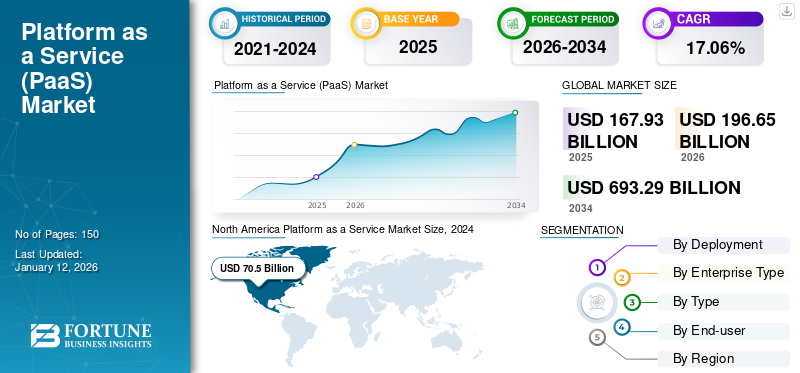
The global platform as a service market size was valued at USD 167.93 billion in 2025 and is projected to grow from USD 196.65 billion in 2026 to USD 693.29 billion by 2034, exhibiting a CAGR of 17.06% during the forecast period. North America dominated the platform as a service market with a share of 48.65% in 2024.
The market is driven by increasing demand for cloud-based solutions, rapid digital transformation, and the growing popularity of scalable and flexible infrastructure. The PaaS market is experiencing fast growth, which is determined by rising cloud adoption, which is requisite for scalable application development, and emergent technologies such as serverless computing, AI, and Kubernetes.
For instance - According to Industry Insights 2024, platform as a service spending was USD 171,565 million for the year 2024, with a growth rate of 19.1%, and for the year 2025, it is projected to be USD 208,644 million in 2025, with a growth rate of 21.6%.
Download Free sample to learn more about this report.
Platform as a Service (PaaS) Market Key Takeaways
 Global Market Size & Forecast
- 2025 Market Size: USD 167.93 billion
- 2026 Market Size: USD 196.65 billion
- 2034 Forecast Market Size: USD 693.29 billion
- CAGR: 17.06% from 2026–2034
 Market Share
- North America dominated the market with a 48.65% share in 2024.
- Integration PaaS (iPaaS) segment held the largest market share in 2024.
- IT & ITeS segment accounted for the largest market share in 2025.
 Key Regional Highlights
North America
The market reached USD 70.5 billion in 2024, supported by strong cloud adoption and the presence of major technology companies.
Asia Pacific
The region is expected to witness the fastest CAGR during the forecast period, driven by rapid public cloud adoption and digital transformation.
Europe
The market is growing steadily, supported by increasing investments in cloud infrastructure and digital transformation initiatives.
U.S.
The U.S. accounted for the largest regional share in North America, driven by enterprise cloud-first strategies and continuous PaaS innovations.
Japan
The market is expected to witness strong growth, supported by increasing adoption of public cloud infrastructure and digital transformation initiatives.
Read More

Key Metrics and Overview
|
Metric |
Details |
|
Market Size in 2025 |
USD 167.93 Billion |
|
Projected Market Size in 2034 |
USD 693.29 Billion |
|
CAGR (2026 - 2034) |
17.06% |
|
Market Segmentation |
By Deployment, Enterprise, Type, End-user, and Region |
|
Top Key Players |
Oracle Corporation, VMware Inc, Software AG, Amazon Web Service, Google, Inc, Microsoft Corporation, IBM Corporation, Red Hat Inc, EMC Corporation, ServiceNow, Nutanix, SAP SE, ActiveState Software Inc, AT&T Inc |
What is Platform as a service (PaaS)?
Platform as a service (PaaS) refers to a cloud computing model that offers developers a platform to develop, manage, and deploy applications deprived of any underlying infrastructure. It enables developers to focus on writing code while the cloud provider manages the infrastructure, scalability, and maintenance.
Impact of Generative AI
Rapid Implementation of Generative AI Help in Automating Operations to Fuel Market Growth
Implementation of generative AI across PaaS can help to automate various management operations that usually consumer more time. It can offer automated infrastructure that can help in resolving issues faster that leads to efficient utilization of resources. Other benefits of implementing generative AI include improved security, artificial data generation, smart assistance, and tailor-made recommendations.
The integration of AI and automation in PaaS solutions is improving the application development lifecycle. With AI, PaaS platforms are becoming smarter, enabling enhanced decision-making, predictive analytics, and autonomous operations. This trend is expected to drive the adoption of PaaS across various industries.
Platform as a Service Market Trends
Multi-cloud PaaS and Cloud Convergence to Boost the Market Progress
Several enterprises are implementing hybrid cloud and multi-cloud tactics, merging private cloud, public cloud, and on-premises infrastructure. However, they must completely understand the requirements of the complete organization and determine which work operations can be cloud-driven, which must remain on-premises, and how to fit the function in a hybrid structure best.
As new IT multi-cloud infrastructures are emerging, security, cloud services, and networking can be combined, they are no longer distinct devices and appliances. Hence, several big-tech firms are leveraging multiple public cloud platforms, such as Azure, AWS, and Google Cloud Platform, and are often getting engaged in multiple PaaS implementations.
Software facilities can function alongside cloud-driven applications, and PaaS vendors are catering to this trend by delivering unified integration and management proficiencies across various cloud environments. They offer services and tools to empower workload mobility, data synchronization, and combined management of resources over multi-cloud and hybrid architectures.
Download Free sample to learn more about this report.
MARKET DYNAMICS
MARKET DRIVERS
Increasing Demand for Low-code Development Applications to Drive Market Expansion
PaaS platforms provide more no-code tools and low-code enabling businesses to develop applications with nominal programming expertise. Citizen developers use visual development tools to build applications quickly.
Organizations require a quicker way to deliver applications. Low-code development platforms offer an upheld way to abbreviate the time to value for the development of new apps. For business leaders and IT experts, it's essential to examine platforms prudently and choose the strategy that fulfills their organization's requirements, now and in the future. The recent advancements in the PaaS mechanism provide low-code/no-code application options that empower non-developers to develop modified applications. For instance,
- As per Industry Experts, 75% of enterprises prefer to adopt a combination of low-code and conventional innovations. Businesses are likely to use low-code mechanisms for flexibility (83%), automation (67%), and speed (63%).
Various platform as a service providers offer low-code development for better development of applications. Thus, rising demand for low-code tools drives the market progress.
MARKET RESTRAINTS
Higher Ongoing and Maintenance Costs Can Hinder Market Progress
Ongoing costs can present certain downsides, such as subscription fees being continuous over time. A cost-associated issue is the subscription model itself. Moreover, costs tend to upsurge correspondingly as usage scales, possibly straining budgets.
Additionally, unpredicted spears in usage or additional services can cause unforeseen expenses. Also, service downtime or disruptions can hurt business and lead to lesser productivity or loss of money. To avoid these problems, it's essential to handle costs cautiously and have a backup plan in place. Cautious cost management and contingency planning are necessary to alleviate these possible downsides.
Another challenge for PaaS users is the potential for vendor lock-in. As businesses rely heavily on a particular cloud service provider's ecosystem, it becomes increasingly difficult to switch providers without incurring significant costs or facing compatibility issues with existing applications. Hence, higher ongoing costs can hamper the platform as a service market growth.
MARKET OPPORTUNITIES
Developments and Advancements in AI PaaS (Artificial Intelligence PaaS) to Create Lucrative Market Opportunities
AI PaaS refers to a collection of AI and machine learning platform services for testing, developing, and applying AI-driven application functionalities. AI PaaS helps enterprises develop AI-driven solutions without the need to invest in and manage infrastructure.
The two prominent components of AI PaaS include pre-trained ML models and AI APIs. They offer several benefits, such as premade infrastructure and structure, in-built tools to work with databases, ready-to-go AI algorithms, and many other benefits. Hence, several key players are offering new advancements with AI PaaS to enhance business growth. For instance,
- In October 2024, Singtel Digital's RE: AI and H2O.ai collaborated to offer generative AI as a Service. The unified GPU- and AI-as-a-Service will provide customers with a full stack AI platform as a service combined with powerful GPU infrastructure from Singtel AI cloud for predictive and generative AI to resolve comprehensive, robust Document AI business use cases.
Such developments and advancements are anticipated to create numerous market prospects.
Segmentation Analysis
Request for Customization to gain extensive market insights.
By Deployment
Public Segment Led the Market as It is Easier to Deploy and Scale Operations
Based on deployment, the market is classified as public, private, and hybrid. The public deployment segment holds the largest share of the market, as the public cloud makes it easier to deploy and scale operations. Platform as a Service within a public cloud provides various benefits, such as quicker time to market, minimized costs, and amplified scalability.
- As per CloudZero Insights, 31% of organizations spend around USD 12 million on public cloud services each year. Most organizations have huge amounts of workloads processing in the cloud, and they are investing in hosting them.
Hybrid deployment is anticipated to grow with the highest CAGR during 2026 – 2034. PaaS with hybrid deployment offers an accomplished environment for application deployment and development, while the hybrid cloud empowers a balance of cloud flexibility and on-premises control. The hybrid cloud allows enterprises to generate disaster recovery strategies by imitating applications and data in the cloud, while PaaS delivers capabilities for application flexibility and scalability. PaaS platforms are evolving to offer hybrid capabilities, enabling businesses to create applications that run across both cloud environments seamlessly.
By Enterprise Type
Numerous Benefits of PaaS for Small & Mid-sized Enterprises to Propel Segment Growth
By enterprise type, the market is bifurcated into small & mid-sized enterprises and large enterprises. Small & mid-sized enterprises are projected to grow with the highest CAGR during the studied period. Platform as a Service delivers significant aid for small and medium-sized enterprises (SMEs) by offering a pre-configured development structure with frameworks and tools to accelerate application deployment and development. Most small businesses have never been able to develop strong development environments on-premises, so PaaS offers a way to fast-track software development.
Large enterprises hold the highest market share for the year 2025. PaaS offers numerous benefits to large enterprises, such as enhanced compliance and security across various sectors such as finance, government, healthcare, and others. Most large enterprises operate in a hybrid IT environment, demanding smooth incorporation between cloud platforms and on-premise infrastructure, thereby aiding the demand for PaaS solutions in the market.
By Type
New Developments and Advancements within iPaaS to Upsurge Segment Growth
By type, the platform as a service market is classified as Application PaaS (aPaaS), Integration PaaS (iPaaS), Database PaaS (DPaaS), and others (Business PaaS (BPaaS), etc.).
The integration PaaS (iPaaS) segment has the highest market share. iPaaS is among the fastest-growing applications and infrastructure middleware. It is also a prominent contributor to the overall AIM (Application Infrastructure and Middleware) market performance and acts as a major individual integration segment. In terms of net revenue inflow, it remains the top contributor.
The database PaaS segment is anticipated to progress with the highest CAGR during the studied period, owing to the rising demand for data-driven decision-making, wider adoption of edge computing, and progress of advanced technologies. Hence, key market players are introducing and developing new solutions with collaborations and alliances. For instance,
- In September 2024, Tessell collaborated with NetApp and Microsoft Azure to launch copilot for cloud databases with enterprise-level PaaS. The solution incorporates an enterprise-level Database PaaS with a one-click feature for every Azure database, using Azure NetApp Files (ANF) as Tessell and enterprise cloud storage as the combined Database Service.
By End-user
Rising Emphasis on Cloud Computing Technologies Fueled IT & ITeS Segment Growth
By end-users, the market is divided into BFSI, consumer goods & retail, telecommunication, IT & ITeS, manufacturing, healthcare & life sciences, energy & utilities, and others (education, etc.).
IT and ITeS (IT-enabled Services) accounted for the highest market share in 2025, owing to a rise in emphasis on cloud computing, big data analytics, data centers, and many other areas. PaaS also helps IT enterprises in remote development and enhanced collaboration with the centralized environment for the development of projects. It reduces their time-to-market and offers various integration features.
Healthcare is projected to grow with the highest growth rate from 2026 to 2034 as more and more healthcare organizations are utilizing cloud mechanisms to enhance patient results, optimize operations, and have access to patient data on multiple devices. PaaS offers healthcare developers a structure to develop applications, which is comprised of a software development kit. It provides organizations with scalability and flexibility while reducing the coding needed to create an app.
Platform as a Service Market Regional Outlook
By geography, the market is categorized into North America, Europe, Asia Pacific, Middle East & Africa, and South America.
North America
North America Platform as a Service Market Size, 2024 (USD Billion)
To get more information on the regional analysis of this market, Download Free sample
North America held the highest platform as a service market share in 2024, owing to a greater presence of big tech firms across various sectors, such as IT & ITeS, telecom, BFSI, healthcare, and many other industries, thereby increasing cloud spending in the region. The region also has the presence of prominent market players such as Oracle Corporation, Microsoft, IBM Corporation, and Google, Inc., among other players. The U.S. market, in particular, accounts for the largest share, driven by cloud-first strategies among enterprises. Various new advancements and developments within PaaS in the U.S. and Canada aid market progress. For instance,
- In January 2025, Wheel Partner and Huma announced a joint venture to transform healthcare delivery by enabling enterprises to introduce end-to-end, digital-driven care solutions directly to consumers. The partnership combines the diverse strengths of both firms into a single, vertically incorporated platform to offer convenient, personalized, and enhanced-quality virtual care at scale.
Europe
Europe is projected to grow significantly, owing to rising investments across cloud data centers, data center infrastructure, and other cloud-native architectures. The European market is growing steadily due to increasing cloud adoption by small and medium-sized enterprises (SMEs) and ongoing digital transformation initiatives. However, the market is also highly regulated with strict data protection laws such as GDPR, which affect PaaS adoption. Governments in countries such as the U.K., Germany, France, Spain, and other countries are promoting cloud-driven architecture. They are investing in cloud mechanisms to fuel the adoption of PaaS in the region. For instance,
- In March 2025, Oracle announced that it would invest USD 5 billion in cloud infrastructure in the U.K. Extension of Oracle Cloud Infrastructure aids the U.K. Government's purpose for an AI-based future. It will help accomplish global requirements for cloud computing, multi-cloud, sovereign AI, and generative AI innovations.
Asia Pacific
Asia Pacific is anticipated to progress with the highest CAGR during the forecast period. The rising adoption of public cloud infrastructure in countries such as India, Japan, South Korea, and others drives market growth. PaaS offers several opportunities for startups and SMEs due to public cloud technologies bring within the range of small businesses the capabilities and features that were once reserved for large enterprises. For instance,
- As per Kinsta Insights, 60% of enterprises across countries in Asia use PaaS solutions, which include Amazon Web Services, Microsoft Azure, and Google Cloud, among others.
Middle East & Africa
The platform as a Service (PaaS) market is undergoing substantial progress in Middle East & Africa, owing to the rising adoption of cloud computing and the advantages it offers, such as simplified usage, quicker time to market, cost minimization, enhanced security, and many others. Such factors contribute to market share. Increasing investment in cloud infrastructure, along with rising digital transformation efforts across industries, is driving the demand for PaaS solutions in these regions.
South America
The rise of digital business, the increase in the usage rate of public cloud infrastructure, and the augmenting demand for cloud-native technologies aid the market growth in the region. Also, governments in countries such as Brazil are actively supporting technological advancement and the adoption of technologies such as big data analytics, artificial intelligence, cloud computing, and others to drive market progress.
COMPETITIVE LANDSCAPE
Key Industry Players
Strategic Alliances and Mergers by Top Players to Aid Business Growth
Players in the market, such as Oracle Corporation, VMware Inc., IBM Corporation, Amazon Web Services, Microsoft, and Google, among other players, are introducing new solutions to enhance their position in the market. These players form alliances, collaborations, and mergers to expand their business offerings and reach. They prioritize enhancing PaaS offerings and strategic partnerships, mergers, and investments to strengthen their portfolio.
LIST OF KEY PLATFORM AS A SERVICE COMPANIES PROFILED
- Oracle Corporation (U.S.)
- VMware Inc. (U.S.)
- Software AG (Germany)
- Amazon Web Service (U.S.)
- Google, Inc. (U.S.)
- Microsoft Corporation (U.S.)
- IBM Corporation (U.S.)
- Red Hat Inc. (U.S.)
- EMC Corporation (U.S.)
- ServiceNow (U.S.)
- Nutanix (U.S.)
- SAP SE (Germany)
- ActiveState Software Inc. (U.S.)
- AT&T Inc. (U.S.)
KEY INDUSTRY DEVELOPMENTS
- February 2025: SAP and PortSwigger collaborated to enhance web application security around the worldwide enterprise landscape. With the partnership, SAP Sovereign Cloud Services (SCS) use Burp Suite Enterprise Edition, PortSwigger's Dynamic Application Security Testing (DAST) platform, to protect SAP's web applications from multitenancy Platform-as-a-Service (PAAS) to single tenant Software-as-a-Service (SAAS) solutions.
- February 2025: Infobip and White Label Communications formed an alliance to offer CPaaS (Communication Platform as a Service) and SaaS to mid-sized and large enterprises. The alliance equips White Label Communications with cloud-driven, multi-layered middleware to build, process, and allot communication software, enabling its customers to offer an improved end-user experience.
- January 2025: ServiceNow collaborated with SoftwareOne to renovate IT modernization within the cloud. The partnership unifies ServiceNow's AI and workflow automation competencies and licensing consultancy of SoftwareOne to enhance and de-risk IT investments and fast-track digital transformation.
- August 2024: Trianz entered into a strategic partnership agreement with AWS to transform cloud management and adoption. The collaboration empowers PaaS modernization, migrations to the cloud, and hybrid cloud management, augmenting the cloud over 360-degree automation and observability, as well as artificial intelligence (AI)-driven anomaly remediations.
- December 2023: IBM purchased StreamSets and webMethods, Super iPaaS (integration platform-as-a-service) enterprise technology platforms, for USD 2.35 billion (EUR 2.13 billion) in cash from Software AG. The acquisition of webMethods and StreamSets is a further indication of IBM's investment and emphasis in hybrid cloud and AI.
REPORT COVERAGE
The report provides a detailed analysis of the market and focuses on key aspects such as leading companies, solution types, and end-users of the platform as a service. Besides, the report offers insights into the market trends and highlights key industry developments. In addition to the factors above, the report encompasses several factors that contributed to the growth of the market in recent years.
Report Scope & Segmentation
Request for Customization to gain extensive market insights.
|
ATTRIBUTE |
DETAILS |
|
Study Period |
2021-2034 |
|
Base Year |
2025 |
|
Estimated Year |
2026 |
|
Forecast Period |
2026-2034 |
|
Historical Period |
2021-2024 |
|
Growth Rate |
CAGR of 17.06% from 2026 to 2034 |
|
Unit |
Value (USD Billion) |
|
Segmentation |
By Deployment
By Enterprise Type
By Type
By End-user
By Region
|
Frequently Asked Questions
The market is projected to reach USD 693.29 billion by 2034.
In 2025, the market was valued at USD 167.93 billion.
The market is projected to grow at a CAGR of 17.06% during the forecast period.
The hybrid deployment is expected to lead the market with the highest CAGR during the forecast period.
Increasing demand for low-code development applications to drive the market
Oracle Corporation, Microsoft, IBM Corporation, and Amazon Web Services are the top players in the market.
North America held the highest market share in 2024.
By end-user, the healthcare segment is expected to grow with the highest CAGR during the forecast period.



- 2021-2034
- 2025
- 2021-2024
- 150
Get 30-60 hrs Free Customization
Expand Regional and Country Coverage, Segments Analysis, Company Profiles, Competitive Benchmarking, and End-user Insights.




















Related Reports
-
US +1 833 909 2966 ( Toll Free )
-
Get In Touch With Us