Plus Size Clothing Market Size, Share & Industry Analysis, By Type (Tops/Bottoms, Dresses, Outerwear, Activewear, Intimates/Lingerie, Swimwear, Formal/Occasion, and Others), By End-User (Women, Men, Children, and Unisex ), By Price Point (Economy, Mid/Premium, and Luxury/Designer), By Age Group (0-15 Years, 16-25 Years, 26-40 Years, 41-60 Years, and 60+ Years), By Design Style (Modern/Contemporary, Traditional/Classic, Ethnic and Athleisure), By Distribution Channel (Hypermarkets & Supermarkets, Specialty Stores, Online channels, and Others), and Regional Forecast, 2026-2034
 Download Free Sample
(Offer valid till 30th Sep 2026)

Plus Size Clothing Market Size and Future Outlook
 Listen to Audio Version
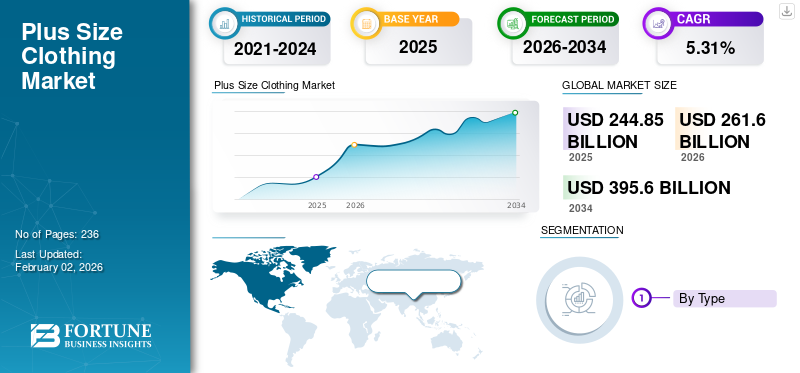
The global plus size clothing market size was valued at USD 244.85 billion in 2025 and is projected to grow from USD 261.60 billion in 2026 to USD 395.60 billion by 2034, exhibiting a CAGR of 5.31% during the forecast period. Asia Pacific dominated the plus size clothing market with a market share of 37.75% in 2025.
Rising consumer demand for size-inclusive fashion, increasing consumer empowerment, and a strong cultural push for body positivity and representation are reshaping the plus-size clothing market. In response to calls for garments that not only fit but also celebrate diverse body shapes and identities, brands are investing in broader size ranges, fashionable designs, and digital-first retail experiences. Additionally, sustainability and ethical fashion are gaining traction in the market, with labels focusing on responsible materials and transparent sourcing practices as part of their value proposition. Influencer-led communities, authentic marketing, and interactive features such as virtual fittings and social shopping now play pivotal roles in fostering deeper connections and loyalty among previously underserved plus-size shoppers.
Inditex Group, H&M Group, Fast Retailing Co., Ltd. (UNIQLO), Nike, Inc., and PVH Corp. are the leading players operating in the global market. These major players owning global and regional brands focused on producing plus-sized wearables for style, inclusivity, and comfort.
Download Free sample to learn more about this report.
MARKET DYNAMICS
MARKET DRIVERS:
Rising Prevalence of Obesity to Drive Demand for Plus-sized Apparel for Better Fittings
The growing global population of overweight and obese individuals is a major driver of the plus-size clothing market, expanding its potential consumer base. According to the World Obesity Atlas, the number of obese adults is expected to more than double by 2030 due to lifestyle changes and urbanization. This rapid growth means more people will require clothing that fits comfortably and caters to diverse body shapes. As obesity rates rise in high, middle, and low-income countries, the demand for plus size clothing is becoming a global trend, prompting brands to develop more inclusive collections. Manufacturers are responding with innovations in materials, fit, and design to capitalize on this growing market.
MARKET RESTRAINTS:
High Production Costs of Specialized Plus Size to Restrict Market Expansion
Plus-size clothing production costs are higher primarily as these garments require more fabric and specialized design work. Unlike standard sizes, plus sizes ranges involve complex pattern grading to ensure a proper fit, which adds time and labor to the design process. Larger fabric pieces and additional construction details increase material and sewing costs. Often, production runs for plus-size making lines are smaller, limiting economies of scale and raising per-unit expenses. Brands address these challenges by adopting vertical integration and partnering strategically with suppliers to balance quality and pricing, but the overall cost remains a significant barrier in the market.
MARKET OPPORTUNITIES:
Rising Demand for Personalized Plus-size Apparel to Create Lucrative Growth Opportunities
The rising popularity of personalized and made-to-measure clothing in the plus-size market is driven by advancements in AI-powered size recommendations and 3D body scanning, enabling precise fit customization. Brands such as eShakti and Universal Standard are leading this trend, expanding their plus size offerings that address the challenge of inconsistent sizing. Personalization not only improves customer satisfaction and loyalty by providing comfortable, flattering garments but also reduces return rates and enhances online shopping convenience.
PLUS SIZE CLOTHING MARKET TRENDS:
Rise of Body Positivity Campaigns to Upsurge Product Demand
The rise of body positivity campaigns has increased consumer awareness of diverse body types, prompting mainstream fashion brands globally to embrace size inclusivity. These campaigns challenge traditional beauty standards by showcasing models of all shapes and sizes and promoting self-love and acceptance. As a result, shoppers feel more seen and confident, driving demand for stylish, inclusive collections. Brands such as Savage X Fenty and Aerie have successfully capitalized on this trend, demonstrating that authentic representation fosters brand loyalty and boosts sales. This shift is reshaping fashion marketing and product development, establishing inclusivity as a central pillar of the industry. In April 2025, launched a fall collection designed specifically “for women with curves,” offering sizes 14–24. The marketing emphasizes confidence, style, and inclusivity.
MARKET CHALLENGES:
Regulatory Challenges Related to Size Inclusivity and Sustainability Compliance to challenge Operational Processes
There are increasing regulatory challenges in the plus-size clothing market due to stricter size inclusivity requirements and sustainability compliance. Governments are pushing for standardized measurements to ensure consistency and fairness in sizing across brands, pressuring manufacturers to adapt their production processes. Additionally, sustainability regulations require brands to use eco-friendly materials and adopt greener manufacturing practices, which increases operational complexity and costs. Meeting these demands requires investment in new technologies, sourcing strategies, and compliance mechanisms, which can be especially burdensome for smaller companies.
Download Free sample to learn more about this report.
Segmentation Analysis
By Type
High Adoption of Casualwear at Outdoor Settings to Increase Sales of Top/Bottom Wearables
On the basis of type, the market is classified into tops/bottoms, dresses, outerwear, active wear, intimates/lingerie, swimwear, formal/occasion, and others.
The tops/bottoms segment is projected to dominate the market with a share of 29.75% in 2026. This segment accounts for a significant share due to its practicality and adaptability across casual, work, and social settings. Consumers prioritize comfortable, well-fitting tops and bottoms that offer both style and ease of movement. The rise in remote work and casual dress codes post-pandemic has further boosted demand for this segment. Additionally, retailers are expanding plus-size tops/bottoms in diverse fabrics and trendy designs, catering to evolving consumer preferences. The segment's dominance reflects the importance of foundational wardrobe staples in the plus-size market.
To know how our report can help streamline your business, Speak to Analyst
The activewear segment is projected to grow at a fastest CAGR of 7.90% during the forecast period. Major brands such as Nike, Adidas, and Lane Bryant are expanding their plus-size activewear lines to cater to diverse body shapes and performance needs. This segment benefits from broader body positivity movements and the rise of athleisure as everyday wear. Online retail and digital marketing targeting plus-size consumers have also accelerated growth, while sustainability initiatives are leading to the adoption of eco-friendly, breathable, and adaptive fabrics
By End-User
Diverse Availability of Plus-sized Clothing for Ladies Led Women's Segment to Lead Market
Based on end-user, the market is categorized into women, men, children, and unisex (gender-biased consumers).
The women's segment is projected to dominate the market with a share of 67.29% in 2026. Its leading share is attributed to the significant women consumers’ demand for the diversely available plus-sized apparel for better fitting. The women's segment growth is fueled by increasing body positivity movements and the rising demand for stylish, well-fitting, and diverse clothing options tailored for plus-size women. Retailers are expanding their plus-size women’s collections to include casual, formal, active wear, and lingerie, reflecting evolving fashion preferences.
The unisex (gender-biased consumers) segment is slated to grow at the fastest rate of 7.96% during the forecasted period. The unisex segment in the plus-size clothing market is growing steadily, driven by demand for gender-neutral and versatile apparel. This segment appeals to consumers who prioritize comfort, self-expression, and inclusivity beyond traditional gender norms.
By Price Point
High Demand for Economic and Value-added Plus-size Clothing Led Economy Segment to Lead Market
Based on price points, the market is segmented into economy, mid/premium (mid range), and luxury/designer.
The economy segment is projected to dominate the market with a share of 52.55% in 2026. The economy segment leads the plus-size clothing market primarily due to its affordability, making it accessible to a wider consumer base across emerging and developed markets. This segment caters to budget-conscious buyers who prioritize value and essential wardrobe staples such as casual wear, activewear, and everyday basics. Its dominance is supported by mass-market retailers and online platforms that offer extensive plus-size selections at competitive prices.
The luxury/designer segment is projected to grow at a fastest CAGR of 7.68% during the forecast period of 2025-2032. The luxury/designer segment in the plus-size clothing market is rapidly growing, driven by demand for high-quality, stylish, and exclusive apparel. Premium brands such as Christian Siriano and 11 Honoré have introduced inclusive plus-size collections, elevating fashion beyond basic apparel. This segment attracts consumers seeking superior fabrics, tailored fits, and unique designs, reflecting individuality and fashion-forward styles. Despite higher costs, growing body positivity and consumer willingness to invest in luxury plus-size fashion are fueling this sector's expansion.
By Age Group
High Number of Fashion-conscious Consumers Spending on Plus Size Apparel Led 26-40 Years Segment to Lead Market
Based on age group, the market is segmented into 0-15 years, 16-25 years, 26-40 years, 41-60 years, and 60+ years.
The 26–40 years age group segment is projected to dominate the market with a share of 33.60% in 2026, as it represents the most fashion-conscious, digitally active, and financially independent consumer base. This segment has strong purchasing power and a high demand for trendy yet versatile apparel that balances work, social, and lifestyle needs. Their heavy reliance on e-commerce, social media influence, and preference for body-positive, stylish clothing make them the key plus size clothing market growth driver. Brands that cater to their expectations for fit accuracy, inclusivity, and modern styling witness higher loyalty and repeat purchases. As a result, this age group contributes the largest revenue share within the plus-size clothing industry.
The 16–25 years segment is witnessing the fastest growth of 6.82% during 2025-2032, fueled by rising body-positivity awareness and strong influence from social media and pop culture. This cohort is highly trend-driven, seeking fashionable, expressive, and affordable clothing that aligns with global youth styles. They are digital natives, heavily engaged with online shopping, influencer content, and peer recommendations, which accelerates adoption. Their openness to experimenting with bold designs and demand for inclusivity push brands to innovate more quickly. As disposable incomes rise and fast-fashion platforms expand, this segment’s growth outpaces older groups
By Design Style
High Preference for Clothing That Mirrors Mainstream Styles Led Modern/Contemporary Segment to Dominate Market
Based on design style, the market is segmented into modern/contemporary, traditional/classic, ethnic/cultural, and athleisure.
A high number of consumers seeking trendy, versatile, and fashion-forward options that mirror mainstream styles led the modern/contemporary segment to hold a leading global market share of 45.01% in 2024. In the modern/contemporary segment, plus-size consumers increasingly expect style parity with straight-size collections, demanding equal acceptance of the market trends without compromises in fit. This has pushed brands to integrate inclusive sizing into their core lines, making it the most competitive and innovation-driven style category.
The athleisure segment is slated to grow at the fastest rate of 6.68% during the forecast period. The athleisure segment in plus-size clothing is experiencing rapid growth as consumers prioritize comfort blended with style for both casual and active settings. Demand is driven by the global shift toward health, fitness, and hybrid lifestyles, where versatile outfits transition from workouts to everyday wear. Plus-size consumers seek performance fabrics with stretch, breathability, and durability that still appear fashionable. Influencer-led marketing and inclusive sportswear launches by major brands are further accelerating this segment’s momentum.
By Distribution Channel
Wider Adoption of Virtual Try-on Tools for Plus-Size Apparel Shopping Led Online Channels to Dominate Market
Based on distribution channel, the market is segmented into hypermarkets & supermarkets, specialty stores, online channels, and others.
The online channels segment is slated to hold a leading market share of 44.06% in 2024. The online channel has become the most dynamic segment in the global plus-size clothing market, fueled by the rapid adoption of e-commerce platforms, social media influence, and the demand for wider product accessibility. Consumers prefer online shopping due to broader size availability, detailed fit guides, virtual try-on tools, and the convenience of easy returns compared to physical stores that often understock larger sizes. Younger demographics (16–40 years) drive the bulk of online demand, discovering trends through influencers, user-generated content, and targeted digital campaigns. Additionally, online platforms allow for greater representation and inclusivity, showcasing diverse models and authentic styling that resonate strongly with plus-size shoppers. As technology advances and global logistics improve, the online segment is expected to remain the fastest-growing distribution channel for plus-size apparel.
The specialty stores segment is slated to grow at a CAGR of 5.86% during the forecast period. The specialty stores play a significant role in the plus-size clothing market by offering curated collections that specifically address the fit, comfort, and style needs of larger body types.
Plus Size Clothing Market Regional Outlook
By region, the market is categorized into North America, Europe, Asia Pacific, South America, and the Middle East & Africa.
Asia Pacific
Asia Pacific Plus Size Clothing Market Size, 2025 (USD Billion) To get more information on the regional analysis of this market, Download Free sample
The Asia Pacific market was valued at USD 92.42 billion in 2025, capturing 37.75% of global revenue, and is estimated to reach USD 99.13 billion in 2026. Rising middle-class incomes, urbanization, and growing awareness of body positivity are shifting consumer expectations in markets such as India, Japan, South Korea, Southeast Asia, and Australia. These consumers demand better style, better fit, and more inclusive sizing.
In 2026, the Chinese market was valued at USD 49.69 billion. The plus-size clothing market in China is expanding rapidly, driven by rising middle-class incomes, urbanization, and growing acceptance of body positivity through platforms such as Douyin and Xiaohongshu. Demand is shifting beyond basic wear to include fashionable, athleisure, and semi-custom options, with e-commerce and social commerce acting as the primary growth engines. However, sizing inconsistency, limited premium offerings, and lingering cultural stigma around body image remain challenges, leaving room for brands that can deliver stylish, well-fitted, and inclusive collections. The Japan market is projected to reach USD 13.5 billion by 2026, and the India market is projected to reach USD 16.1 billion by 2026.
Europe and North America
Other regions, such as Europe and North America, are anticipated to witness a notable growth in the coming years. During the forecast period, the market in the North American region is projected to record a growth rate of 5.88%, which is the second highest amongst all the regions, and touch the valuation of USD 73.08 billion in 2025. North America’s plus-size clothing market is driven by strong demand, high consumer awareness of body positivity, and the well-developed omni-channel retail infrastructure of the region. The U.S. market is projected to reach USD 61.89 billion by 2026.
Europe accounted for USD 68.09 billion in 2025, representing 27.81% of the global market share, and is projected to reach USD 72.46 billion in 2026. The Europe market growth is supported by rising consumer acceptance of body positivity, expanding e-commerce adoption, and strong demand for inclusive fashion across key markets such as Germany, U.K., France, and Italy. Brands in Europe are increasingly focusing on fit accuracy, inclusive collections, and sustainable fashion practices to capture a more diverse consumer base. The UK market is projected to reach USD 13.05 billion by 2026, while the Germany market is projected to reach USD 11.45 billion by 2026.
South America and Middle East & Africa
The market in Middle East & Africa reached USD 3.43 billion in 2025, representing 1.40% of total market revenue, and is projected to reach USD 3.64 billion in 2026. Over the forecast period, markets in the South America and the Middle East & Africa regions would witness a moderate growth rate during the forecast period. The South America market in 2025 is set to record USD 7.76 billion as its valuation. In South America, the plus-size clothing market is expanding, with Brazil, Argentina, and Colombia driving growth as rising urbanization, greater fashion accessibility, and growing body-positivity movements boost demand for inclusive apparel. The Middle East & Africa plus-size clothing market is experiencing rapid growth as inclusive fashion becomes more mainstream, social media raises awareness of body positivity, and e-commerce bridges access gaps, especially in urban centers across GCC countries and North Africa. Moreover, South Africa is set to attain the market value of USD 0.94 billion in 2025.
COMPETITIVE LANDSCAPE
Key Industry Players:
Strong focus on Expanding Inclusive Helps Key Companies Maintain Leading Position
Key players operating in the market are Inditex Group, H&M Group, Fast Retailing Co., Ltd. (UNIQLO), Nike, Inc., and PVH Corp. All these leading companies share a strong focus on expanding inclusive sizing, integrating plus-size options into mainstream collections rather than treating them as a niche. They leverage their global scale, strong brand equity, and omni-channel presence to offer fashionable, well-fitted clothing while aligning with body-positivity and inclusivity trends. In 2023, H&M appointed model and activist Tess Holliday as a size and inclusivity consultant. Further, expanded its U.S. plus-size range of 2XL for women & men from store and 4XL & 3XL from online portals.
LIST OF KEY PLUS-SIZE CLOTHING COMPANIES PROFILED:
- Inditex Group (Spain)
- H&M Group (Sweden)
- Fast Retailing Co., Ltd. (UNIQLO) (Japan)
- Nike, Inc. (U.S.)
- PVH Corp. (U.S.)
- Adidas AG (Germany)
- VF Corporation (U.S.)
- Levi Strauss & Co. (U.S.)
- Under Armour Inc. (U.S.)
- Puma SE (Germany)
KEY INDUSTRY DEVELOPMENTS:
- April 2025: JCPenney is launching a new plus-size collection in collaboration with Ashley Graham, sized 14-24, aiming to offer stylish and inclusive apparel both in stores and online.
- March 2025: Anthropologie collaborated with size-inclusive brand Universal Standard to produce a spring collection featuring new patterns of Universal Standard’s best-selling items, broadening the reach of size-inclusive designer partnerships.
- December 2024: AK Retail Holdings acquired the British plus-size brand Evans (including its IP and customer base) from City Chic Collective, expanding its U.K. plus-size portfolio.
- September 2024: Eloquii, a direct-to-consumer plus-size fashion brand, launched a capsule collection in collaboration with Kate Spade, helping bridge the gap between plus-size specialist and mainstream designer aesthetics.
- June 2024: FullBeauty Brands acquired U.S. plus-size retailer Avenue from City Chic Collective to strengthen its presence in digital specialty plus-size apparel.
REPORT COVERAGE
The global plus-size clothing market analysis provides an in-depth study of market size & forecast by all the market segments included in the report. It includes details on the market dynamics and market values in billion in the plus size clothing market trends that are expected to drive the market in the forecast period. It offers information on the technological advancements, new product launches, key industry developments, and details on partnerships, mergers & acquisitions. The plus-size clothing market research report also encompasses a detailed competitive landscape with information on the market share and profiles of key operating players.
Request for Customization to gain extensive market insights.
Report Scope & Segmentation
| ATTRIBUTE | DETAILS |
| Study Period | 2021-2034 |
| Base Year | 2025 |
| Estimated Year | 2026 |
| Forecast Period | 2026-2034 |
| Historical Period | 2021-2024 |
| Growth Rate | CAGR of 5.31% from 2026-2034 |
| Unit | Value (USD Billion) |
| Segmentation |
By Type
By End User
By Price Point
By Age Group
By Design Style
By Distribution Channel
By Region
|
Frequently Asked Questions
Fortune Business Insights says that the global market value stood at USD 244.85 billion in 2025 and is projected to reach USD 395.60 billion by 2034.
In 2025, the market value stood at USD 92.42 billion.
The market is expected to exhibit a CAGR of 5.31% during the forecast period.
The tops/bottoms segment led the market by type.
The rising prevalence of obesity drives demand for plus-sized apparel for better fitting globally.
Inditex Group, H&M Group, Fast Retailing Co., Ltd. (UNIQLO), Nike, Inc., and PVH Corp. are some of the prominent players in the market.
Asia Pacific dominated the market in 2025.
The rise of body positivity campaigns is expected to increase the product adoption rate.



- 2021-2034
- 2025
- 2021-2024
- 236
-
(Offer valid till 30th Sep 2026)
Get 30-60 hrs Free Customization
Expand Regional and Country Coverage, Segments Analysis, Company Profiles, Competitive Benchmarking, and End-user Insights.



















-
US +1 833 909 2966 ( Toll Free )
-
Get In Touch With Us