Polyethylene Furanoate (PEF) Market Size, Share & Industry Analysis, By Type (Bio-Based and Plant-Based), By Application (Packaging, Films, Fibers, and Others), and Regional Forecast, 2026-2034
 Download Free Sample
KEY MARKET INSIGHTS
 Listen to Audio Version
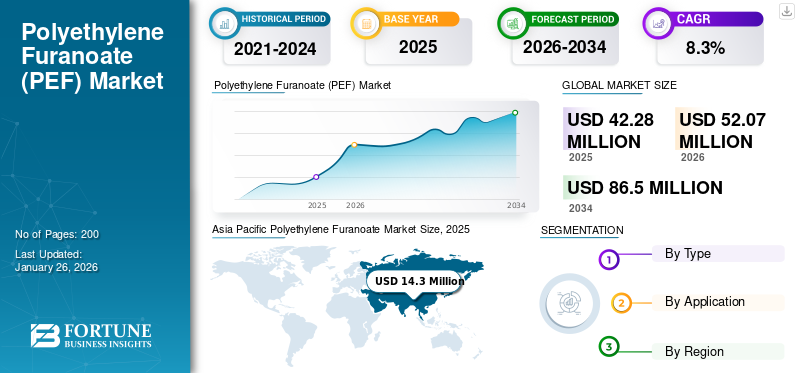
The global polyethylene furanoate market size was valued at USD 42.28 million in 2025 and is projected to grow from USD 52.07 million in 2026 to USD 86.5 million by 2034 at a CAGR of 8.3% during the forecast period. Asia Pacific dominated the polyethylene furanoate market with a market share of 34% in 2025.
Polyethylene furanoate (PEF) is a bio-based and recyclable polyester made from renewable resources like plant sugars. It is considered a renewable, non-toxic, and recyclable plastic that can be substituted with traditional or oil-based polymers. Furthermore, this plastic provides superior barrier properties and offers enhanced strength, good heat resistance, and puncture toughness making it a promising alternative to traditional petroleum-based plastics such as polyethylene terephthalate. The major factors that are influencing the growth of polyethylene furanoate include the growing demand for sustainable packaging solutions due to environmental concerns, rising awareness about plastic waste, along growing applications in the food and beverage industry. Moreover, rising favorable government regulations promoting bio-based materials coupled with rising advancements in production technology for more efficient and cost-effective PEF manufacturing will further upsurge the market growth. The major companies operating in the market include Avantium, Swicofil AG, Sulzer Ltd, TOYOBO CO., LTD., and ALPLA.
Download Free sample to learn more about this report.
Polyethylene Furanoate (PEF) Market KEY TAKEAWAYS
 Global Market Size & Forecast
- 2025 Market Size: USD 42.28 million
- 2026 Market Size: USD 52.07 million
- 2034 Forecast Market Size: USD 86.50 million
- CAGR: 8.3% from 2026–2034
 Market Share
- Asia Pacific dominated the polyethylene furanoate market with a 34.00% share in 2025
- The bio-based segment is projected to account for the largest market share of 72.13% in 2026
- The packaging segment is projected to hold a 72.52% share in 2026
 Key Regional Highlights
Asia Pacific
Asia Pacific reached USD 14.30 million in 2025, driven by packaging demand.
North America
North America reached USD 9.90 million in 2025, supported by sustainable packaging adoption.
Europe
Europe reached USD 11.81 million in 2025, driven by bio-based packaging regulations.
U.S.
U.S. is projected to reach USD 9.30 billion by 2026, fueled by recyclable packaging demand.
Japan
Japan is projected to reach USD 3.61 billion by 2026, driven by sustainable packaging adoption.
Read More

POLYETHYLENE FURANOATE MARKET TRENDS
Growing Demand of PEF over Polyethylene terephthalate (PET) to Create Lucrative Opportunities for the Market
The increasing global concern over environmental degradation along with pollution from single-use is driving the demand for sustainable and biodegradable materials like PEF over polyethylene terephthalate. PEF is a bio-based alternative and offers a better oxygen and carbon dioxide barrier in comparison with PET. Such benefits extend the shelf life of beverages and thereby make PEF a preferred choice for packaging sensitive products such as juices, carbonated drinks, and beer. The other factors that influence the PEF demand include, the rising shift toward sustainable materials, growing supportive government regulation on the manufacturing of eco-friendly plastics, and increasing technological innovation thereby expanding the application of PEF. Moreover, polyethylene furanoate is produced using renewable feedstocks, including plant-based sugars, thereby, this transition is gaining momentum as industries and customers seek the adoption of sustainable plastics. Also, the governments in many nations are implementing stringent policies and regulations to reduce plastic waste providing funding & subsidies and introducing tax benefits on renewable materials that support the development of technologies and manufacture eco-friendly products. Hence, such factors are leading to the innovation and development of polyethylene furanoate, which makes it a preferred choice over polyethylene terephthalate.
MARKET DYNAMICS
MARKET DRIVERS
Growth of the Packaging Industry to Surge the Demand for Polyethylene Furanoate
The rapid growth of the packaging industry to upsurge the demand for polyethylene furanoate. This is due to its sustainability, being derived from renewable plant-based sources and offering recyclability. Its superior gas barrier properties make it ideal for beverage bottles, food packaging, pharmaceutical containers, and flexible films, extending shelf life and reducing spoilage. Moreover, growing continuous research and development efforts to improve production processes, reduce production costs, and enhance PEF properties will further boost the PEF demand in packaging. Additionally, PEF's lower energy consumption in production and its alignment with corporate sustainability goals make it an attractive alternative to conventional plastics in industries like food, cosmetics, and pharmaceuticals.
MARKET RESTRAINTS
High Production Cost of PEF Compared to Other Plastics to Restrain the Market Growth
Despite the numerous advantages of polyethylene furanoate, its high production cost causes constraints compared to conventional plastics. The complex manufacturing process, limited production scale, and the high cost of bio-based feedstocks make PEF more expensive, posing a challenge for mass-market applications. Until economies of scale improve and production costs decrease, industries may hesitate to fully transition to PEF, especially in price-sensitive markets where cost-effectiveness remains a key priority. Hence, these factors act as a restraint for the market.
MARKET CHALLENGES
Low Commercial Availability Poses Challenge to the Market
The commercial availability of PEF remains limited due to the early-stage development of its production infrastructure and the lack of large-scale manufacturing facilities. The current manufacturing infrastructure for PEF is not as developed as that for conventional plastics, leading to affecting scalability, supply constraints, and widespread adoption. Moreover, the dominant market presence of conventional plastics due to their low cost and established production infrastructure, poses a significant challenge to PEF adoption. As a result, businesses looking to transition to PEF face challenges in securing a steady supply, making it difficult for the material to compete with widely available and cost-effective plastics.
TRADE PROTECTIONISM
The specific trade protectionism measures targeting PEF are not extensively documented. The broader context of tariffs on bio-based materials and international trade policies could influence the polyethylene furanoate market. Moreover, imposing restrictions on conventional plastics coupled with trade policies favoring sustainable materials could enhance PEF's competitiveness globally.
Download Free sample to learn more about this report.
IMPACT OF COVID-19
The demand for polyethylene furanoate has increased significantly during Covid-19. The most important opportunity developed by the COVID-19 pandemic is itself. The increasing demand for packaging worldwide has boosted the demand for polyethylene furanoate. Many leading industries such as pharmaceuticals, food & beverages, and e-commerce have increased the demand for bio-based plastic for packaging to maintain hygiene while saving the environment.
SEGMENTATION ANALYSIS
By Type
Bio-Based Segment Dominated the Market Owing to Reliance on Renewable Resources
Based on the type, the market is segmented into bio-based and plant-based.
The bio-based segment is anticipated to hold a dominant market share of 72.13% in 2026. Bio-based PEF is gaining traction due to its reliance on renewable resources, primarily plant-derived sugars, rather than fossil fuels. This makes it a key solution in reducing dependency on petroleum-based plastics and lowering carbon emissions. Additionally, as global policies and corporate sustainability initiatives push for bio-based alternatives, industries are increasingly investing in bio-based PEF to align with circular economy goals. Its potential for recyclability and biodegradability further enhances its appeal in sustainable packaging solutions.
On the other hand, plant-based PEF specifically benefits from the growing agricultural and biotech advancements that enable efficient production of raw materials like fructose from corn, sugarcane, and other biomass sources. The push for plant-derived polymers is also fueled by consumer demand for "natural" and environmentally friendly products, especially in food, beverage, and cosmetic packaging. Moreover, companies leveraging plant-based PEF can market their products as sustainable and non-toxic, improving brand perception and attracting eco-conscious consumers.
By Application
To know how our report can help streamline your business, Speak to Analyst
Packaging Segment to Hold Majority Share Owing to Growing Consumer Preference for Sustainable Packaging
Based on the application, the market is segmented into packaging, films, fibers, and others.
In 2026, the packaging segment is projected to lead the market with a 72.52% share. PEF is gaining momentum in the packaging industry due to its excellent barrier properties, which significantly outperform PET in protecting against oxygen, carbon dioxide, and moisture. Its major application in the packaging includes the manufacturing of bottles due to its high strength and excellent barrier properties against gases like oxygen and carbon dioxide, which help extend the shelf life of beverages. Additionally, the growing consumer preference for sustainable packaging, along with regulatory pressure to reduce plastic waste, is driving manufacturers to adopt PEF as a bio-based and recyclable solution.
The demand for polyethylene furanoate in films is rising due to their superior mechanical strength, thermal stability, and biodegradability. These properties make PEF an excellent choice for flexible packaging, food wraps, and high-performance coatings, reducing reliance on fossil fuel-based films. Furthermore, the increasing focus on eco-friendly alternatives in industries like electronics, food packaging, and medical applications is encouraging the shift toward PEF films, which offer both functionality and sustainability.
PEF fibers are emerging as a sustainable alternative in the textile and industrial fiber markets due to their high tensile strength, durability, and moisture resistance. Recycled PEF fibers are majorly utilized in sports apparel and clothing fashion, and home furnishings owing to their durability and sustainability. Additionally, industries such as automotive and construction are exploring PEF fibers for reinforcement applications, driven by the need for lightweight, high-performance, and biodegradable materials.
POLYETHYLENE FURANOATE MARKET REGIONAL OUTLOOK
Based on region, the market is segmented into North America, Europe, Asia Pacific, Rest of the World.
Asia Pacific
Asia Pacific Polyethylene Furanoate Market Size, 2025 (USD Million)
To get more information on the regional analysis of this market, Download Free sample
The Asia Pacific region is expected to dominate the PEF market during the forecast period, due to increasing demand from end-user industries such as packaging, food and beverage, automotive, and textile. The Asia Pacific market was valued at USD 14.3 million in 2025, capturing 34.00% of global revenue, and is estimated to reach USD 17.69 million in 2026. Furthermore, countries like China, Japan, and India are witnessing significant growth due to rapid industrialization and increasing awareness of sustainable materials. Additionally, the booming food and beverage industry, along with the rising demand for sustainable textiles in Southeast Asia, is fueling the polyethylene furanoate market growth. The Japan market is valued at USD 3.61 billion by 2026, the China market is valued at USD 5.41 billion by 2026, and the India market is valued at USD 4.72 billion by 2026.
To know how our report can help streamline your business, Speak to Analyst
North America
North America contributed 23.00% to the global market in 2025, with a valuation of USD 9.9 million, and is projected to reach USD 12.16 million in 2026. North America holds a significant share of the PEF market. The growth is attributed to substantial investments in sustainable technologies, advanced infrastructure, and stringent environmental regulations. Furthermore, high consumer awareness and demand for eco-friendly packaging solutions further drive PEF adoption in North America. In this region, the U.S. and Canada are witnessing a shift toward bio-based and recyclable packaging, particularly in the food, beverage, and personal care industries. Additionally, the presence of major research institutions and bioplastic startups is accelerating the innovation and commercialization of PEF-based products in the region. The U.S. market is valued at USD 9.3 billion by 2026.
Europe
Europe accounted for USD 11.81 million in 2025, representing 28.00% of the global market share, and is projected to reach USD 14.54 million in 2026. Europe with a strong emphasis on sustainability and circular economy principles, the region represents a substantial market for PEF, especially in the food and beverage packaging sector. Furthermore, a growing global shift toward sustainable packaging, driven by strict environmental policies such as the EU Green Deal and the ban on single-use plastics. Governments and organizations are promoting the use of bio-based materials like PEF to reduce carbon footprints and plastic waste. Consumer awareness and demand for eco-friendly products in countries like Germany, Switzerland, Spain, and France further encourage industries to adopt PEF for packaging, films, and textiles. The Germany market is valued at USD 5.19 billion by 2026.
Rest of World
The rest of the world includes Latin America and Middle East & Africa. The growing focus on sustainable agriculture and bio-based industries is a key driver for PEF adoption in these regions. Additionally, growing environmental consciousness, rising government initiatives promoting circular economy practices, and increasing demand for sustainable packaging solutions in food, beverages, and cosmetics are further flourishing the market growth in these regions.
COMPETITIVE LANDSCAPE
KEY INDUSTRY PLAYERS
Increasing Research & Development Activities and Product Expansion Remain Key Market Strategies of Companies
The global PEF market is consolidated, with key players operating globally and dominating the market with patented technologies. Notable companies include Avantium, Stora Enso, Toyobo, Sulzer, Origin Materials, Inc., Alpla Group, and Swicofil. These companies are focusing heavily on the investment in research and development activities to surge polyethylene furanoate characteristics, leveraging advancements in bio-based polymers and expanding its application scope, to meet the growing demand for sustainable packaging solutions.
LIST OF KEY MARKET PLAYERS PROFILED IN THE REPORT
- Swicofil AG (Switzerland)
- Sulzer Ltd (Switzerland)
- TOYOBO CO., LTD. (Japan)
- Avantium (Netherlands)
- ALPLA (Austria)
- Origin Materials (U.S.)
- AVA Biochem AG (Switzerland)
- Danone (France)
- Stora Enso (Finland)
- Sukano (Switzerland)
KEY INDUSTRY DEVELOPMENTS
- February 2025: Avantium N.V. has signed a joint development agreement with Amcor Rigid Packaging U.S., to explore the use of Avantium's PEF in rigid containers for several products, including beverage, food, medical, pharmaceutical, personal care, and home. Also, Amcor has committed to a multi-year capacity reservation for PEF from a future industrial-scale facility, based on a technology license from Avantium. This agreement guarantees Amcor preferred access to PEF volumes produced by Avantium's future licensee network.
- February 2025: Avantium N.V. signed a collaboration with EPC Engineering & Technologies GmbH, to advance the continuous PEF polyester production technology, with the target of achieving 100 kilotonnes per annum and beyond capacities. This collaboration will combine the expertise of both companies to commercialize continuous polymerization of PEF (“PEF cPol Technology”).
- November 2024: Avantium N.V. collaborated with Kirin Holdings to explore the applications of the company’s plant-based and recyclable material PEF, to the bottles and other packages of Kirin’s product portfolio.
- November 2023: Avantium N.V. collaborated with Albert Heijn to make packaging more sustainable. Refresco, the global independent beverage solutions provider produces Albert Heijn’s new fruit juice bottle made out of PEF. With this collaboration, this will be the first PEF application to be introduced in Albert Heijn stores, once Avantium’s commercial plant for PEF is operational. Albert Heijn is the first supermarket chain in the world to introduce PEF packaging for own-brand products.
- November 2023: Avantium N.V. made a strategic partnership with PANGAIA, in which PANGAIA will purchase Avantium’s PEF for use in their apparel collection to create fossil-fuel-free and recyclable products and materials.
REPORT COVERAGE
The report provides a detailed analysis of the market. It focuses on key aspects, such as leading companies, types, and end-use industries of the product. Besides this, it offers insights into the market and current industry trends and highlights key industry developments. In addition to the factors mentioned above, it encompasses several factors contributing to the market's growth.
Request for Customization to gain extensive market insights.
Report Scope & Segmentation
|
ATTRIBUTE |
DETAILS |
|
Study Period |
2021-2034 |
|
Base Year |
2025 |
|
Estimated Year |
2026 |
|
Forecast Period |
2026-2034 |
|
Historical Period |
2021-2024 |
|
Unit |
Value (USD Million) |
|
Growth Rate |
CAGR of 8.3% from 2026 to 2034 |
|
Segmentation |
By Type
|
|
By Application
|
|
|
By Region
|
Frequently Asked Questions
Fortune Business Insights says that the global market size was valued at USD 42.28 million in 2025 and is projected to record a valuation of USD 86.5 million by 2034.
Recording a CAGR of 8.3%, the market is slated to exhibit steady growth during the forecast period.
By application, the packaging segment led the market in 2025.
Growth of packaging industries to surge the demand for polyethylene furanoate.
Avantium, Swicofil AG, Sulzer Ltd, TOYOBO CO., LTD., and ALPLA are the major key players in the global market.
Asia Pacific dominated the market in terms of share in 2025.
The rising adoption of sustainable products and growing demand for PEF over PET is expected to drive the adoption.



- 2021-2034
- 2025
- 2021-2024
- 200
Get 30-60 hrs Free Customization
Expand Regional and Country Coverage, Segments Analysis, Company Profiles, Competitive Benchmarking, and End-user Insights.


















Related Reports
-
US +1 833 909 2966 ( Toll Free )
-
Get In Touch With Us