Port Equipment Automation and Electrification Market Size, Share & Industry Analysis, By Automation Level (Manual and Assisted, Semi-Automated, and Fully Automated and Autonomous Equipment), By Equipment Type (Container Handling Cranes, Yard Handling Equipment, and Terminal Tractors and Transport Vehicles), By Electrification Type (Battery-Electric, Hybrid-Electric, Plug-in Hybrid Electric, and Hydrogen Fuel Cell Electric), By Application (Vessel Loading and Unloading, Container Transportation, Yard Stacking and Storage, and Bulk Cargo Handling Equipment), and Regional Forecast, 2026-2034
 Download Free Sample
Port Equipment Automation and Electrification Market Size and Future Outlook
 Listen to Audio Version
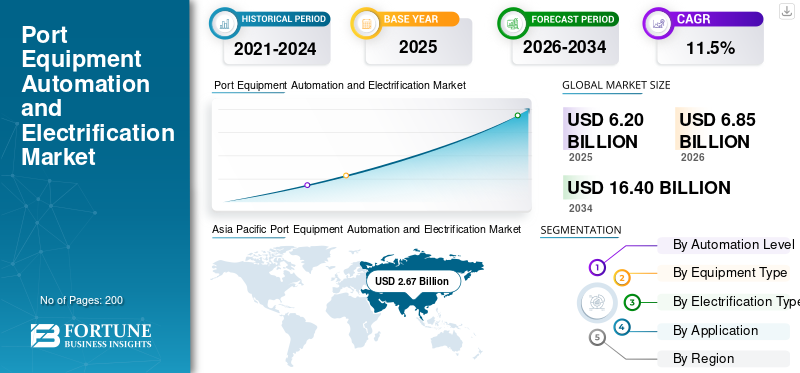
The global port equipment automation and electrification market size was valued at USD 6.20 billion in 2025. The market is projected to grow from USD 6.85 billion in 2026 to USD 16.40 billion by 2034, exhibiting a CAGR of 11.5% during the forecast period. Asia Pacific dominated the port equipment automation and electrification market with a market share of 43.06% in 2025.
Port equipment automation and electrification encompasses technologies and equipment enabling ports and terminals to transition from manually operated, fuel-powered systems toward automated, electrified, and digitally integrated operations. This includes automated container handling cranes, electric and hybrid yard equipment, remote-controlled vessel loading systems, and intelligent terminal management software. The market reflects a broader shift within maritime logistics toward safer, more efficient, and environmentally sustainable port operations. Stakeholders across shipping, terminal operations, and equipment manufacturing are increasingly adopting automation and electrification solutions to enhance throughput, reduce operational costs, minimize emissions, and improve workforce safety, positioning this market as a critical enabler of next-generation global trade infrastructure.
Key players in the market include Konecranes, Kalmar Corporation, Shanghai Zhenhua Heavy Industries – ZPMC, Liebherr Group, and ABB Ltd. These companies compete through advanced automation software, electrified crane and equipment portfolios, remote-control and autonomous operation capabilities, and integrated digital terminal management solutions tailored for container terminals, bulk cargo handling, shipyards, and broader maritime logistics applications.
Download Free sample to learn more about this report.
Port Equipment Automation and Electrification Market Key Takeaways
 Global Market Size & Forecast
- 2025 Market Size: USD 6.20 billion
- 2026 Market Size: USD 6.85 billion
- 2034 Forecast Market Size: USD 16.40 billion
- CAGR: 11.5% from 2026–2034
 Market Share
- Asia Pacific dominated the market with a 43.06% share in 2025.
- Semi-automated equipment held the largest market share in 2025.
- Container handling cranes dominated the market by equipment type in 2025.
 Key Regional Highlights
North America
North America is projected to grow at a CAGR of 11.8%, reaching USD 1.26 billion in 2026.
Europe
Europe is expected to remain the second-largest region, reaching USD 1.86 billion in 2026.
Asia Pacific
Asia Pacific dominated the market with a 43.06% share in 2025, reaching USD 2.67 billion.
U.S.
The U.S. market is estimated at around USD 1.15 billion in 2026 and is expected to grow at a CAGR of 11.6% during the forecast period.
Japan
The Japan market is estimated at USD 0.41 billion in 2026 and is projected to grow at a CAGR of 10.4% during the forecast period.
Read More

PORT EQUIPMENT AUTOMATION AND ELECTRIFICATION MARKET TRENDS
Rising Shift toward Autonomous and Remotely Operated Terminal Equipment is a Key Market Trend
Ports globally are increasingly adopting autonomous and remotely operated equipment as part of broader smart-terminal transformation initiatives. Automated stacking cranes, driverless yard trucks, and remote-controlled ship-to-shore cranes are becoming central to terminal modernization strategies, enabling continuous operations with reduced human intervention. This trend is reinforced by the integration of AI-based traffic management, real-time container tracking, and predictive maintenance systems, which collectively enhance operational visibility. Terminal operators are also prioritizing interoperability between automated equipment and digital port management platforms, reflecting a broader industry movement toward fully connected, data-driven port ecosystems capable of handling growing trade volumes efficiently.
MARKET DYNAMICS
MARKET DRIVERS
Download Free sample to learn more about this report.
Growing Emphasis on Operational Efficiency and Emissions Reduction at Ports is Driving Market Growth
Increasing pressure on ports to handle rising cargo volumes while meeting stringent environmental regulations is driving investment in automation and electrification. Automated equipment enables faster, more precise container handling with reduced downtime, while electrified systems help terminals lower fuel consumption and greenhouse gas emissions in line with international maritime sustainability targets. Additional drivers include labor shortages, rising wage costs, and the need for safer working environments, all of which encourage terminal operators to replace manually operated, diesel-powered machinery with automated and electric alternatives, reinforcing automation and electrification as essential components of modern port infrastructure strategies.
MARKET RESTRAINTS
High Capital Investment Requirements Limiting Widespread Adoption
The substantial upfront costs associated with deploying automated systems and electrified equipment are restraining the port equipment automation and electrification market growth. Retrofitting existing terminals with automation-ready infrastructure, along with the cost of battery-electric cranes and charging systems, requires considerable capital expenditure that smaller or budget-constrained ports may struggle to justify. Additionally, the need for supporting infrastructure such as reliable power grids and specialized workforce training adds to overall investment burdens. These financial and infrastructural barriers slow adoption rates, particularly in developing regions where port operators prioritize incremental upgrades over full-scale automation and electrification transformations.
MARKET OPPORTUNITIES
Expansion of Green Port Initiatives Creating Electrification Potential
Growing global emphasis on decarbonizing maritime and logistics operations is opening significant opportunities for electrified port equipment providers. Ports pursuing green certifications and emissions-reduction targets are exploring battery-electric cranes, hybrid yard tractors, and shore power systems as alternatives to diesel-powered equipment. This shift creates opportunities for equipment manufacturers to develop specialized electrification retrofits, charging infrastructure, and energy management solutions tailored to port environments. Additionally, emerging economies investing in new port infrastructure present opportunities to integrate automation and electrification from the outset, allowing manufacturers to capture long-term contracts by offering scalable, future-ready, and sustainability-aligned equipment solutions.
MARKET CHALLENGES
Integration Complexity with Legacy Port Infrastructure is Creating Challenges
Many ports continue to operate legacy equipment and systems that are not readily compatible with modern automation and electrification technologies, creating significant integration challenges. Retrofitting older terminals often requires extensive infrastructure modifications, software compatibility adjustments, and workforce retraining, which can disrupt ongoing operations. Additionally, ensuring cybersecurity for increasingly connected and automated port systems presents an ongoing challenge, as greater digital integration expands potential vulnerabilities. Coordinating phased implementation without compromising terminal throughput further complicates adoption, requiring operators to carefully balance modernization timelines against the operational demands of continuous cargo handling activities.
Segmentation Analysis
By Automation Level
Labor Shortages and Safety Concerns Boosted Semi-Automated Equipment Segment Growth
Based on automation level, the market is segmented into manual and assisted equipment, semi-automated equipment, and fully automated and autonomous equipment.
The semi-automated equipment segment accounted for the largest market share in 2025. Demand for semi-automated equipment is rising as terminal operators seek a balanced approach between cost and automation benefits. Semi-automated systems reduce reliance on manual labor while retaining human oversight, addressing workforce shortages and safety risks without requiring the full capital investment of fully autonomous systems.
The fully automated and autonomous equipment segment is anticipated to rise with a CAGR of 12.1% over the forecast period.
To know how our report can help streamline your business, Speak to Analyst
By Equipment Type
Rising Cargo Volumes and Throughput Pressures Fueled Demand for Container Handling Cranes
Based on equipment type, the market is segmented into container handling cranes, yard handling equipment, terminal tractors and transport vehicles, bulk cargo handling equipment, and mooring, berthing, and other port equipment.
In 2025, the container handling cranes segment dominated the global market. Demand for container handling cranes is increasing as global trade growth requires terminals to process higher container volumes faster. Automated and electrified cranes improve lifting precision, reduce turnaround time, and support continuous operations, making them essential for terminals aiming to enhance productivity and meet rising shipping schedules.
The bulk cargo handling equipment segment is projected to grow at a CAGR of 12.5% over the forecast period.
By Electrification Type
Battery-Electric Segment to Take the Lead Due to Decarbonization Goals and Fuel Cost Volatility
Based on electrification type, the market is segmented into battery-electric, hybrid-electric, plug-in hybrid electric, hydrogen fuel cell electric, and grid-connected electric.
The battery-electric segment is anticipated to witness a dominating market share over the forecast period of 2026-2034. Demand for battery-electric equipment is rising as ports face mounting pressure to cut emissions and reduce dependence on volatile diesel fuel costs. Battery-electric systems offer quieter, cleaner operations with lower maintenance needs, aligning with sustainability commitments while improving long-term operational cost predictability for terminal operators.
The grid-connected electric segment is projected to grow at a high CAGR of 12.0% over the forecast period.
By Application
Growing Vessel Sizes and Turnaround Efficiency Needs Boosted Demand for Vessel Loading and Unloading Systems
Based on application, the market is segmented into vessel loading and unloading, container transportation, yard stacking and storage, bulk cargo handling, gate and terminal operations, and berthing and mooring operations.
The vessel loading and unloading segment dominated the port equipment automation and electrification market share in 2025. Demand for vessel loading and unloading systems is rising as larger vessels require faster, more precise handling to minimize dock time. Automated loading and unloading technologies improve accuracy and speed, helping terminals reduce vessel waiting times and maintain competitiveness amid increasing global shipping traffic.
Gate and terminal operations are projected to grow at a CAGR of 13.4% during the forecast period.
Port Equipment Automation and Electrification Market Regional Outlook
By geography, the market is categorized into North America, Europe, Asia Pacific, and the Rest of the World.
Asia Pacific
Asia Pacific Port Equipment Automation and Electrification Market Size, 2025 (USD Billion)
To get more information on the regional analysis of this market, Download Free sample
Asia Pacific held the dominant share in 2024, valued at USD 2.36 billion, and also maintained the leading share in 2025, with USD 2.67 billion. Demand is growing rapidly due to expanding trade volumes and large-scale port infrastructure development. Countries investing heavily in new and upgraded terminals are integrating automation and electrification early, supported by strong manufacturing capabilities and government-backed modernization initiatives.
China Port Equipment Automation and Electrification Market
China’s market is projected to be one of the largest in Asia Pacific, with 2026 revenues estimated at around USD 1.28 billion. Demand is high due to massive trade volumes and aggressive infrastructure expansion. Chinese ports lead in deploying automated and electrified systems, supported by strong domestic manufacturing and government modernization initiatives.
Japan Port Equipment Automation and Electrification Market
The Japan market size in 2026 is estimated at around USD 0.41 billion. It is expected to grow at a CAGR of 10.4% during the forecast period. Demand is steady as ports focus on efficiency amid labor shortages and an aging workforce. Automation and electrification help maintain high-precision operations while supporting national decarbonization and technological advancement goals.
India Port Equipment Automation and Electrification Market
The India market in 2026 is estimated at around USD 0.27 billion. Demand is growing as port infrastructure investment accelerates to support rising trade volumes. Government-backed modernization programs are encouraging gradual adoption of automation and electrification across major and emerging port terminals.
Europe
Europe is estimated to reach USD 1.86 billion in 2026 and secure the position of second-largest region in the market. Demand is strong due to strict environmental regulations and ambitious decarbonization targets. European ports are early adopters of automation and electrification, driven by sustainability mandates, high labor costs, and strong government support for green port infrastructure development.
U.K. Port Equipment Automation and Electrification Market
The U.K. market in 2026 is estimated at around USD 0.31 billion. It is expected to grow at a CAGR of 10.8% over the forecast period. Demand is increasing due to post-Brexit trade efficiency needs and strong sustainability commitments. Ports are adopting electrified equipment and automation to enhance competitiveness and comply with national emissions reduction targets.
Germany Port Equipment Automation and Electrification Market
Germany’s market is projected to reach approximately USD 0.41 billion in 2026. Demand is strong given Germany's advanced industrial base and strict environmental standards. Major ports prioritize automation and electrification to maintain efficiency, support export-driven trade, and meet European Union sustainability regulations.
North America
North America is projected to record a CAGR of 11.8% during the forecast period, which is the moderate among all regions, and reach a valuation of USD 1.26 billion in 2026. Demand is rising as ports modernize aging infrastructure and prioritize emissions reduction. Investment in automated cranes and electrified yard equipment reflects efforts to enhance efficiency, meet environmental regulations, and address persistent labor shortages across major coastal terminals.
U.S. Port Equipment Automation and Electrification Market
Based on North America’s moderate contribution and the U.S. dominance within the region, the U.S. market can be analytically approximated at around USD 1.15 billion in 2026. It is expected to grow at a CAGR of 11.6% over the forecast period. Demand is rising as major ports invest in automation to address labor shortages and improve efficiency. Federal infrastructure funding and emissions targets further encourage electrification of cranes and yard equipment across key coastal terminals.
Rest of the World
The rest of the world includes the Middle East & Africa and Latin America. These regions are expected to witness moderate growth in this market space during the forecast period. The Middle East & Africa and Latin America markets are set to reach a valuation of USD 0.51 billion and USD 0.25 billion in 2026. Demand is gradually increasing as emerging port economies pursue infrastructure modernization. Limited capital availability slows large-scale adoption, though selective automation and electrification investments are growing to improve competitiveness and support rising regional trade activity.
COMPETITIVE LANDSCAPE
Key Industry Players
Key Players Focus on Autonomous Cargo Handling, Electric Yard Equipment, and Integrated Terminal Control to Boost Market Growth
The port equipment automation and electrification market is being strengthened by key players that are shifting ports from diesel-powered, operator-dependent cargo handling toward connected, remotely controlled, and increasingly autonomous terminal operations. Companies such as Konecranes, Kalmar, ZPMC, ABB, and Hyster-Yale are focusing on battery-electric cranes and container handlers, automated guided vehicles, autonomous terminal tractors, remote crane operations, intelligent fleet management, digital twins, charging infrastructure, shore power, and automated mooring systems. Konecranes is expanding its Ecolifting portfolio through battery-powered RTGs, straddle carriers, mobile harbor cranes, and software-controlled automated guided vehicles (AGVs), enabling terminals to reduce fuel consumption and automate container movement between quays and yards. Kalmar is combining its electric cargo-handling portfolio with the Kalmar One automation platform and developing autonomous terminal tractors with Forterra to support scalable fleet automation in mixed-traffic environments.
LIST OF KEY PORT EQUIPMENT AUTOMATION AND ELECTRIFICATION COMPANIES PROFILED
- Konecranes (Finland)
- Kalmar Corporation (Finland)
- Shanghai Zhenhua Heavy Industries – ZPMC (China)
- Liebherr Group (Switzerland)
- ABB Ltd. (Switzerland)
- Siemens AG (Germany)
- SANY Group (China)
- TMEIC Corporation (Japan)
- Cavotec SA (Switzerland)
- Hyster-Yale, Inc. (U.S.)
KEY INDUSTRY DEVELOPMENTS
- July 2026: ABB & Høglund AS entered into an agreement to acquire the Norwegian marine automation firm to expand its capabilities in vessel automation and control systems.
- June 2026: Port of Helsingborg & Kalmar entered into a framework agreement to continuously transition the port's fleet to electric-powered cargo handling equipment, including electric reachstackers.
- December 2025: Port of Tanjung Pelepas (PTP) & Terberg Tractors Malaysia signed a major agreement to acquire 52 electric terminal tractors to electrify horizontal container movement.
- November 2025: Conductix-Wampfler & APM Terminals formed a framework purchase agreement for Rubber-Tired Gantry (RTG) crane electrification products and terminal operation services.
- November 2023: San Francisco Water Emergency Transportation Authority & Wärtsilä signed a strategic partnership agreement for Fleet Electrification and Systems Integrator Services to build zero-emission high-speed electric ferries.
REPORT COVERAGE
The port equipment automation and electrification market research offers a detailed analysis of emerging trends and rapidly adopted technologies in the industry across key regions. The report outlines key drivers of market growth and challenges to expansion, delivering a detailed overview of the maritime industry landscape. The study highlights recent advancements to boost industry insights and support stakeholders in making well-informed decisions.
Request for Customization to gain extensive market insights.
Report Scope & Segmentation
| ATTRIBUTE | DETAILS |
| Study Period | 2021-2034 |
| Base Year | 2025 |
| Estimated Year | 2026 |
| Forecast Period | 2026-2034 |
| Historical Period | 2021-2024 |
| Growth Rate | CAGR of 11.5% from 2026 to 2034 |
| Unit | Value (USD Billion) |
| Segmentation | By Automation Level, By Equipment Type, By Electrification Type, By Application, and By Region |
| By Automation Level |
|
| By Equipment Type |
|
| By Electrification Type |
|
| By Application |
|
| By Region |
|
Frequently Asked Questions
According to Fortune Business Insights, the global market value stood at USD 6.20 billion in 2025 and is projected to reach USD 16.40 billion by 2034.
In 2025, the market value in Asia Pacific stood at USD 2.67 billion.
The market is expected to exhibit a CAGR of 11.5% during the forecast period of 2026-2034.
By automation level, the semi-automated equipment segment led the market.
Growing emphasis on operational efficiency and emissions reduction at ports is driving market growth.
Konecranes, Kalmar Corporation, Shanghai Zhenhua Heavy Industries – ZPMC, Liebherr Group, and ABB Ltd. are few major players in the global market.
Asia Pacific dominated the market in 2025



- 2021-2034
- 2025
- 2021-2024
- 200
Get 30-60 hrs Free Customization
Expand Regional and Country Coverage, Segments Analysis, Company Profiles, Competitive Benchmarking, and End-user Insights.




















Related Reports
-
US +1 833 909 2966 ( Toll Free )
-
Get In Touch With Us