Portable Blender Market Size, Share & Industry Analysis, By Capacity (Less Than 300 ML, 300–500 ML, and 500 ML and Above), By Price Range (Economy, Mid-range, and Premium), By Material (Plastic, Stainless Steel, Glass, and Others), By End-User (Household, Foodservice Facilities [Hotels, Restaurants, Cafes & Juice Bars, and Others], Offices, Educational Institutions, and Others), By Distribution Channel (Hypermarkets & Supermarkets, Specialty Stores, Brand Stores, Online channels, and Others), and Regional Forecast, 2026-2034
 Download Free Sample
(Offer valid till 30th Sep 2026)

KEY MARKET INSIGHTS
 Listen to Audio Version
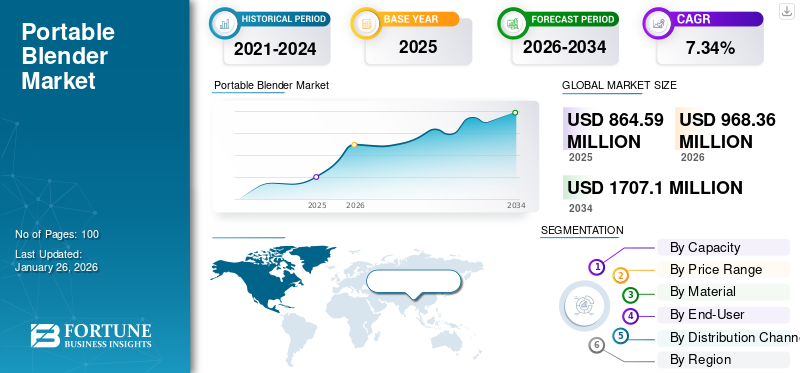
The global portable blender market size was valued at USD 864.59 million in 2025. The market is projected to grow from USD 968.36 million in 2026 to USD 1,707.10 million by 2034, exhibiting a CAGR of 7.34% during the forecast period. North America dominated the home decor market with a market share of 45.75% in 2025.
The global portable blender market is expanding rapidly, driven by increased health consciousness, the popularity of smoothies and shakes, and the need for convenient, on-the-go gadgets. Compact design, ease of use, and technological developments such as longer battery life and USB charging are increasing device acceptance, particularly among millennials, fitness fanatics, and busy urban professionals. In February 2025, Yuone Lifestyle launched the Gallery 1000 and Gallery 2000, compact portable juicer blenders for consumers at gyms, offices, and outdoors.
BlendJet Inc., DE Longhi Industrial S.A., Koninklijke Philips N.V., Robert Bosch GmbH, and Xiaomi Corporation are the leading players operating in the worldwide market. These players focus on launching innovative products to strengthen their portfolio of small domestic kitchen appliances.
Download Free sample to learn more about this report.
Portable Blender Market Takeaways
 Global Market Size & Forecast
- 2025 Market Size: USD 864.59 million
- 2026 Market Size: USD 968.36 million
- 2034 Forecast Market Size: USD 1,707.10 million
- CAGR: 7.34% from 2026–2034
 Market Share
- North America dominated the portable blender market with a market share of 45.75% in 2025.
- The 300–500 ml segment exhibited a leading global portable blender market share of 64.92% in 2026.
- The household segment is expected to exhibit a leading global market share of 82.74% in 2026.
 Key Regional Highlights
North America
North America dominated the market with a valuation of USD 255.4 million in 2025 and is projected to reach USD 282.66 million in 2026.
Europe
Europe contributed 25.95% to the global market in 2025, with a valuation of USD 224.36 million, and is projected to reach USD 246.64 million in 2026.
Asia Pacific
Asia Pacific accounted for USD 354.4 million in 2025, representing 40.99% of the global market share, and is projected to reach USD 405.65 million in 2026.
U.S.
The U.S. market is valued at USD 233.76 million by 2026.
Japan
Japan is valued at USD 71.29 million by 2026.
Read More

MARKET DYNAMICS
MARKET DRIVERS:
Increasing Demand for Portable Blenders Among Fitness Enthusiasts to Drive Market Growth
With fitness and wellness routines becoming integral to daily life, more consumers, especially millennials and fitness enthusiasts, are using portable blenders to prepare smoothies and protein shakes either at the gym, workplace, or while traveling. These compact appliances support nutritional goals by allowing users to blend fresh ingredients for workout recovery or healthy snacking, regardless of location. This trend aligns with broader preferences for quick, convenient, and health-focused food options, thereby fueling market demand for innovative and portable blending solutions.
MARKET RESTRAINTS:
Limited Battery Life to Restrain Market Growth
Limited battery life and long charging times in portable blenders can disrupt smooth usage, as users may find their devices unable to complete blending tasks without frequent recharging. Typically, these blenders offer around 10 to 20 blending cycles per full charge, with charging times often ranging from 2 to 4 hours, which can be inconvenient for users who require multiple uses in quick succession. Additionally, improper charging habits or overheating during operations can further reduce battery performance, limiting consumer convenience and user satisfaction.
MARKET OPPORTUNITIES:
Technological Innovations to Favor Market Growth
Technological innovations in portable blenders are enhancing convenience and appeal by offering longer battery life for extended use and faster USB-C charging. Smart features such as Bluetooth and app integration enable personalized blending experiences, while lightweight and durable materials improve portability and device lifespan. These advancements are attracting tech-savvy, active consumers seeking efficient and multifunctional blending solutions.
PORTABLE BLENDER MARKET TRENDS:
Rising Demand for Premium-based Steel Product Variants to Drive Market Growth
Plastic portable blenders are favored for their affordability, lightweight nature, and safety due to eco-friendly, BPA-free materials, making them highly convenient for travel and daily use. However, premium stainless steel variants are gaining market traction on account of their superior durability, sustainability, and high-end aesthetic appeal. Steel models also offer advanced functions and longer lifespans, appealing to eco-conscious and quality-seeking consumers despite their higher cost and heavier weight.
MARKET CHALLENGES:
Greater Consumers’ Accessibility to Cheaper Alternatives to Challenge Key Players' Market Position
Concerns about product durability and long-term reliability significantly impact buyer confidence, especially for lower-cost portable blenders, as many users report issues such as blade breakage, motor failure, and battery problems during regular use. These problems can lead to increased maintenance costs and potential safety risks, making consumers hesitant to invest in cheaper products that may not last or perform as expected.
Download Free sample to learn more about this report.
Segmentation Analysis
By Capacity
300–500 ml Segment Led the Market due to its Functionality
Based on capacity, the market is segregated into less than 300 ml, 300–500 ml, and 500 ml and above. The 300–500 ml segment exhibited a leading global portable blender market share of 64.92% in 2026, driven by its ideal balance of portability and functionality. This size caters to single-serve portions, making it perfect for busy consumers seeking convenient, on-the-go nutrition such as smoothies and protein shakes. Its compactness suits urban, fast-paced lifestyles where storage space is limited, and it supports quick blending tasks without being bulky. Consequently, this segment aligns well with consumer preferences for efficiency and ease of use.
To know how our report can help streamline your business, Speak to Analyst
The 500 ml and above segment is slated to grow at the fastest CAGR of 9.04% during the forecast period (2025-2032). This growth is due to increasing consumer demand for larger capacity blenders that can prepare multiple servings or blend larger quantities of ingredients at once. These models appeal to users who want the convenience of portability without sacrificing functionality for meal prep, family usage, or fitness routines requiring bigger portions. Additionally, advancements in motor power and battery capacity support this segment’s growth by enabling efficient blending of tougher ingredients, meeting diversified consumer needs beyond single-serve blends.
By Price Range
Mid-range Segment to Dominate the Market, Fueled by High Demand for Affordable Products
Based on price range, the market is categorized into economy, mid-range, and premium. The mid-range segment is slated to exhibit a leading global market share of 53.86% in 2026, driven by its ability to strike a balance between affordability and feature-rich performance. This segment appeals to the broadest consumer base by offering reliable quality, decent battery life, and sufficient motor power without the high price tag of premium models. Mid-range blenders typically meet the needs of everyday users seeking convenience and durability, making them the preferred choice for the majority. Additionally, they frequently incorporate popular features such as USB charging and lightweight design, contributing to their widespread acceptance and strong sales.
The premium segment is slated to grow at the fastest rate of 9.12% during the forecasted period (2025-2032), attributed to the increasing consumer demand for high-quality, durable, and feature-rich products. Consumers, particularly health-conscious and urban users, are willing to pay more for advanced functionalities such as powerful motors, extended battery life, smart connectivity, and premium materials such as stainless steel. Rising disposable incomes, technological innovations, and the appeal of eco-friendly and stylish designs also fuel the segment’s growth. Additionally, premium blenders are favored in commercial and professional settings, driving further market expansion.
By Material
Plastic Segment Dominated the Market Due to Its Lightweight Construction
Based on material, the market is segmented into plastic, stainless steel, glass, and others. The plastic segment dominated the global market with a share of 69.37% in 2026, due to its affordability, lightweight construction, and durability, making it highly accessible and convenient for on-the-go consumers. Plastic products are safer and more portable than glass models, with many made from BPA-free, recyclable materials, addressing health and environmental concerns. Their design flexibility and resistance to breakage also contribute to their widespread consumer preference, especially among budget-conscious buyers.
The stainless steel segment is expected to witness the fastest growth of 9.95% during 2025-2032, attributed to the rising consumer demand for high-quality, durable, and feature-rich products. Premium portable blenders often feature powerful motors, longer-lasting batteries, smart connectivity, and stylish stainless steel designs. Consumers with rising disposable incomes and a focus on health and lifestyle trends prefer these advanced models. Additionally, eco-conscious buyers favor premium blenders for their sustainability and longer lifespan, contributing significantly to this segment’s growth.
By End-User
Increasing Health Consciousness Boosted the Household Segment Growth
Based on end-user, the market is segmented into household, foodservice facilities, offices, educational institutions, and others.
The household segment is expected to exhibit a leading global market share of 82.74% in 2026. due to the widespread consumer demand for convenient, healthy, and quick meal preparation solutions. Busy lifestyles and increasing health consciousness drive consumers to use these blenders daily for smoothies and shakes. Rising disposable incomes and expanded online retail presence further boost adoption. This segment benefits from tailored product innovation focused on ease of use and portability, making it the largest and most stable market share.
The offices segment is growing due to increasing demand for convenient, healthy beverage options among working professionals. Portable blenders offer quick, on-the-go solutions for making smoothies, shakes, and juices during office hours, supporting wellness trends in workplace environments. Their compact size, USB charging compatibility, and ease of use make them ideal for office desks and break rooms, driving steady adoption in this segment.
The foodservice facilities segment is slated to grow at the fastest rate of 10.27% during 2025-2032. The foodservice facilities segment is further divided into hotels, restaurants, cafes & juice bars, and others. The cafes and juice bars segment is the fastest-growing within foodservice facilities due to rising consumer demand for fresh, nutritious, and customizable beverages. Portable blenders enable these establishments to efficiently offer on-the-go smoothies, shakes, and juices, aligning with health and wellness trends. Their portability and ease of use help cafes and juice bars diversify menus and enhance customer experience, driving strong adoption in this dynamic commercial segment.
The restaurant segment dominates the market for portable blenders due to high demand for versatile and efficient blending solutions in kitchen operations. Restaurants use portable blenders to quickly prepare smoothies, sauces, and dressings, enhancing menu variety and service speed. Their adoption is driven by a need to meet growing consumer preferences for fresh, healthy, and customizable food and beverage options, which supports consistent market growth in this segment.
By Distribution Channel
Wide Product Variety Offered by E-commerce Platforms Led the Online Channels Segment Growth
Based on distribution channel, the market is segmented into hypermarkets & supermarkets, specialty stores, brand stores, online channels, and others. The online channels segment exhibited a leading global market share of 49.80% in 2024 and is expected to grow at the fastest CAGR of 9.38% during the forecast period (2025-2032). The online channels segment dominates the portable blender market due to the convenience and wide product variety offered by e-commerce platforms. Consumers prefer online shopping for easy comparison, detailed reviews, and attractive discounts that are not typically available in offline channels’ stores. The rapid growth of online retail, supported by major players such as Amazon and Walmart, along with influencer marketing and targeted promotions, is driving strong sales through this channel worldwide.
Brand stores in the portable blender market play a key role by offering consumers direct access to authentic products, personalized service, and after-sales support. They help build brand loyalty through product demonstrations and exclusive models, catering to buyers who prefer hands-on evaluation and trusted purchasing experiences.
Portable Blender Market Regional Outlook
By geography, the market is categorized into North America, Europe, Asia Pacific, South America, and the Middle East & Africa.
North America
North America dominated the market with a valuation of USD 255.4 million in 2025 and is projected to reach USD 282.66 million in 2026. The market is driven by high disposable incomes, strong health and wellness trends, and increasing demand for convenient, on-the-go nutrition solutions. A well-established e-commerce infrastructure and the presence of leading brands further support market growth. The U.S. market is valued at USD 233.76 million by 2026.
Europe
Europe contributed 25.95% to the global market in 2025, with a valuation of USD 224.36 million, and is projected to reach USD 246.64 million in 2026. Growth is driven by increasing consumer focus on healthy lifestyles and sustainability. Technological innovations, eco-friendly products, and strong demand in countries such as the UK and Germany, along with rising online sales channels, support market expansion.
Asia Pacific
Asia Pacific accounted for USD 354.4 million in 2025, representing 40.99% of the global market share, and is projected to reach USD 405.65 million in 2026. Asia Pacific is the fastest-growing region in the global portable blender market, driven by rising health awareness, urbanization, and increasing disposable incomes in countries such as India, China, and Japan. Rapid lifestyle changes and demand for convenient nutrition solutions are boosting adoption. China reached USD 191.34 million in 2024, while Japan and India are valued at USD 71.29 million and USD 63.89 million respectively by 2026.
South America
South America maintained a strong presence in the global market, reaching USD 20.66 million in 2025, accounting for 2.39% share, and is expected to reach USD 22.56 million in 2026. Growth is supported by increasing health awareness, urbanization, and rising disposable incomes, particularly in countries such as Brazil. Expanding e-commerce channels and a young population adopting fitness trends are key contributors.
Middle East & Africa
Middle East & Africa held 1.13% of the global market in 2025, reaching USD 9.77 million, and is projected to grow to USD 10.85 million in 2026. The region is experiencing steady growth driven by rising health awareness, urbanization, and increasing demand for on-the-go nutrition solutions. Affluent consumers in GCC countries such as Saudi Arabia and the UAE, along with expanding e-commerce channels and a growing young population, are supporting market development. South Africa is projected to reach USD 2.08 million in 2025.
COMPETITIVE LANDSCAPE
Key Industry Players:
Strong Retail Partnership and Product Launch to Help Key Players Maintain Their Leading Market Position.
BlendJet Inc., DE Longhi Industrial S.A., Koninklijke Philips N.V., Robert Bosch GmbH, and Xiaomi Corporation are the leading players operating in the worldwide market. These brands hold substantial market shares due to strong retail partnerships, distinct product innovations, and focused consumer marketing. NutriBullet leads in global recognition and repeat purchases, while BlendJet stands out for its direct-to-consumer sales approach and innovative portable designs. Hamilton Beach and Oster maintain strength through broad retail availability and brand loyalty, and Beast Health is notable for sleek aesthetics and smart blending features targeting wellness-focused users.
LIST OF KEY PORTABLE BLENDER COMPANIES PROFILED:
- BlendJet Inc. (U.S.)
- DE Longhi Industrial S.A. (Italy)
- Koninklijke Philips N.V. (Netherlands)
- Robert Bosch GmbH (Germany)
- Xiaomi Corporation (China)
- JS Global Lifestyle (Hong Kong)
- Hamilton Beach Brands, Inc. (U.S.)
- Sunbeam Products, Inc. (U.S.)
- Conair Corporation (U.S.)
- Newell Brands Inc. (U.S.)
KEY INDUSTRY DEVELOPMENTS:
- September 2025: NutriBullet announced a high-speed, co-branded collection with McLaren F1, featuring Ultra, Pro 900, and Portable models with McLaren design motifs.
- September 2025: ElectMix expanded its portable/commercial blender range with customizable jar materials, motor powers, and designs. The OEM brand is also pursuing partnerships with smaller and larger brands globally.
- May 2025: NutriBullet launched a Limited-edition, co-branded blender collection with McLaren, featuring the brand’s signature papaya accents. The collection includes Ultra, Pro 900, and Portable models, with premium features such as titanium-coated extractor blades and Tritan Renew cups for style or performance.
- July 2024: NutriBullet launched the Flip, an insulated stainless steel tumbler with a built-in blender in the lid. The device blends via the lid/motor closure and is rechargeable via USB-C.
- December 2024: NutriBullet launched ‘the new NutriBullet Portable Blender,’ to expand its product portfolio.
REPORT COVERAGE
The global portable blender market analysis provides an in-depth study of market insights, size, and forecast by all the market segments included in the report. It includes details on the market dynamics and market trends expected to drive the market in the forecast period. It offers information on the technological advancements, new product launches, key industry developments, and details on partnerships, mergers & acquisitions. The market research report also encompasses a detailed competitive landscape with information on the market share and profiles of key operating players.
Request for Customization to gain extensive market insights.
Report Scope & Segmentation
| ATTRIBUTES | DETAILS |
| Study Period | 2021-2034 |
| Base Year | 2025 |
| Estimated Year | 2026 |
| Forecast Period | 2026-2034 |
| Historical Period | 2021-2024 |
| Growth Rate | CAGR of 7.34% from 2026-2034 |
| Unit | Value (USD Million) |
| Segmentation |
By Capacity
By Price Range
By Material
By End-User
By Distribution Channel
By Geography
|
Frequently Asked Questions
Fortune Business Insights says that the global market value stood at USD 864.59 million in 2025 and is projected to reach USD 1,707.10 million by 2034.
In 2025, the market value stood at USD 354.4 million.
The market is expected to exhibit a CAGR of 7.34% during the forecast period (2026-2034).
The 300–500 ml segment led the market by capacity.
The increasing demand for portable blenders among fitness enthusiasts to make protein shakes is driving the sales of portable blenders.
BlendJet Inc., DE Longhi Industrial S.A., Koninklijke Philips N.V., Robert Bosch GmbH, and Xiaomi Corporation are some of the prominent players in the market.
Asia Pacific dominated the market in 2025.
The rising demand for premium-based steel product variants is expected to favor the product adoption.



- 2021-2034
- 2025
- 2021-2024
- 100
-
(Offer valid till 30th Sep 2026)
Get 30-60 hrs Free Customization
Expand Regional and Country Coverage, Segments Analysis, Company Profiles, Competitive Benchmarking, and End-user Insights.

















Related Reports
-
US +1 833 909 2966 ( Toll Free )
-
Get In Touch With Us