Portable Energy Storage Market Size, Share & Industry Analysis, By Capacity (Below 300 Wh, 301 Wh – 500 Wh, 501 Wh – 1,000 Wh, 1,001 Wh – 2,000 Wh, and Above 2,000 Wh), By Battery Chemistry (Lithium Iron Phosphate (LFP), Lithium-ion (NMC), and Others), By Application (Emergency Backup Power, Residential Off-grid, RV & Overlanding, Outdoor Recreation & Camping, Construction & Field Operations, and Others), and Regional Forecast, 2026-2034
 Download Free Sample
Portable Energy Storage Market Size and Future Outlook
 Listen to Audio Version
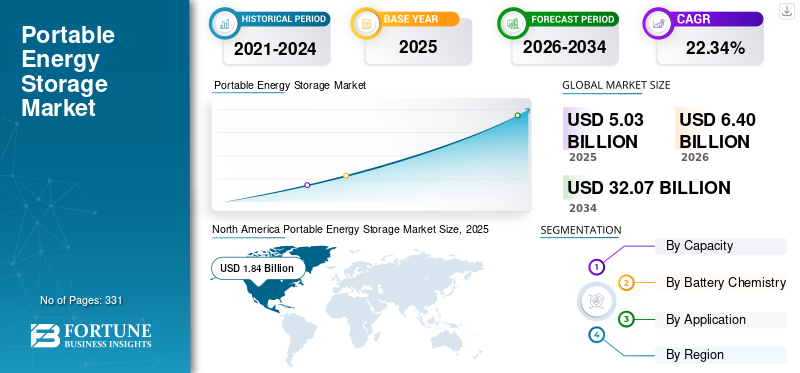
The global portable energy storage market size was valued at USD 5.03 billion in 2025. The market is projected to grow from USD 6.40 billion in 2026 to USD 32.07 billion by 2034, exhibiting a CAGR of 22.34% during the forecast period. North America dominated the portable energy storage market with a market share of 36.58% in 2025.
Portable energy storage refers to compact, rechargeable battery-based energy storage systems designed to supply electricity for mobile, off-grid, or backup power applications. These systems typically integrate lithium-ion or Lithium Iron Phosphate (LFP) batteries, Battery Management Systems (BMS), inverters, and multiple AC/DC/USB output ports within a portable enclosure. Portable energy storage products are widely used for emergency power systems, outdoor recreation, camping, RVs, construction sites, remote work, and residential off-grid applications, and can be recharged using AC power, solar panels, or vehicle charging. Compared with conventional fuel-powered generators, they offer quiet, zero-emission operation, lower maintenance requirements, and compatibility with renewable energy sources.
The market is primarily driven by the increasing frequency of power outages, extreme weather events, and growing consumer demand for reliable backup power solutions. Declining lithium iron phosphate (LFP) battery costs, improvements in energy density, and longer battery life have made portable power stations more affordable and efficient. Rising participation in outdoor recreation, camping, RV travel, and overlanding, along with the growing adoption of portable solar panels, is further accelerating demand. Additionally, expanding rural electrification initiatives, off-grid applications, and the global transition toward clean, silent, and zero-emission alternatives to fuel-powered generators are supporting sustained market growth.
The market is led by EcoFlow Technology Ltd., Jackery Inc., Bluetti Power Inc., Anker Innovations Technology Co., Ltd. (Anker SOLIX), and Goal Zero, which have significantly contributed to the industry's expansion through continuous product innovation and technology advancements. These companies have broadened their product portfolios with higher-capacity LFP-based power stations, faster charging capabilities, smart energy management systems, and seamless integration with portable solar panels. Their investments in research and development, global distribution networks, e-commerce channels, and strategic partnerships have improved product accessibility and consumer awareness across residential, commercial, and outdoor applications. Furthermore, their focus on safe, reliable, and zero-emission portable power solutions has accelerated the replacement of conventional fuel-powered generators and supported the widespread adoption of portable energy storage globally.
Download Free sample to learn more about this report.
Portable Energy Storage Market Trends
Transition Toward Lithium Iron Phosphate (LFP)-Based Portable Power Stations to be a Significant Market Trend
One of the most significant trends in the market is the rapid transition from nickel manganese cobalt (NMC) batteries to lithium iron phosphate (LFP) batteries. Manufacturers are increasingly adopting LFP chemistry as it offers superior thermal stability, longer cycle life (often exceeding 3,000–6,000 charge cycles), improved safety, and lower lifecycle costs. The International Energy Agency (IEA) reported that LFP batteries accounted for nearly 90% of battery storage deployments globally in 2025, highlighting the technology's growing dominance in energy storage applications. Leading manufacturers including EcoFlow, Jackery, Bluetti, and Anker SOLIX have expanded their product portfolios with LFP-based portable power stations ranging from 500 Wh to over 5 kWh, replacing earlier NMC models. The decline in lithium battery manufacturing costs and improvements in battery management systems have further accelerated this transition. Consumers are increasingly prioritizing durability and safety over marginal gains in energy density, particularly for residential backup, camping, and RV power systems. As a result, LFP technology is becoming the preferred battery chemistry across premium and mid-range portable energy storage products, driving innovation and enhancing product reliability globally.
MARKET DYNAMICS
Market Drivers
Download Free sample to learn more about this report.
Increasing Demand for Reliable Backup Power Amid Rising Grid Instability to Drive Market Growth
The growing frequency of power outages caused by extreme weather events, aging electricity infrastructure, and rising electricity demand is a major driver for the portable energy storage market growth. Consumers and businesses increasingly seek portable battery systems as clean, quiet, and maintenance-free alternatives to conventional fuel-powered generators. According to the U.S. Energy Information Administration (EIA), the average U.S. electricity customer experienced over seven hours of power interruptions in 2021, excluding major catastrophic events, while outage durations have continued to increase due to climate-related disruptions and natural disasters. At the same time, the International Energy Agency projects continued growth in electricity demand globally as electrification accelerates across residential and commercial sectors also supports growth. Portable energy storage systems provide immediate backup power for essential appliances, communication equipment, medical devices, and remote work setups without fuel dependency or emissions. Their compatibility with portable solar panels further enhances energy resilience during prolonged outages. Increasing investments in resilient energy infrastructure, off-grid energy storage coupled with consumer awareness of emergency preparedness, are significantly boosting demand across North America, Europe, Asia Pacific, and emerging economies.
|
Rank |
Market Driver |
Overall Impact Rank |
CAGR Contribution (2026-2034) |
Impact 2026-2028 |
Impact 2029-2031 |
Impact 2032-2034 |
|
1 |
Rising demand for emergency backup power due to increasing grid outages and extreme weather events |
High |
6.75% |
High |
High |
High |
|
2 |
Declining lithium battery prices and rapid adoption of Lithium Iron Phosphate (LFP) technology |
High |
5.45% |
High |
High |
Medium |
|
3 |
Growing popularity of outdoor recreation, camping, RV travel, and mobile lifestyles |
High |
4.45% |
Medium |
High |
High |
|
4 |
Increasing integration of portable energy storage with portable solar systems and residential renewable energy solutions |
Medium-High |
3.95% |
Medium |
High |
High |
|
5 |
Continuous innovation in fast charging, high-power inverters, smart energy management, and modular battery expansion |
Medium |
3.20% |
Medium |
Medium |
High |
|
6 |
Others, including growth in remote work, disaster preparedness, telecommunications, field operations, humanitarian applications, and military deployments |
Low |
1.60% |
Low |
Medium |
Medium |
|
Total Positive Growth Contribution |
+25.40% |
Market Restraints
High Upfront Cost Compared with Conventional Portable Generators to Limit Market Growth
Despite technological advancements, the relatively high purchase cost of portable energy storage systems remains one of the primary restraints limiting widespread adoption. High-capacity portable power stations utilizing LFP batteries, pure sine wave inverters, and advanced battery management systems often cost substantially more than comparable gasoline-powered portable generators. Although battery prices have declined significantly over the past decade, premium portable energy storage products above 1 kWh capacity continue to represent a considerable upfront investment for price-sensitive consumers, particularly in developing economies. According to the U.S. Department of Energy (DOE), average lithium ion batteries pack prices declined to USD 139/kWh in 2023, yet batteries remain the largest cost component of portable power stations. Additionally, inverter electronics, thermal management systems, and safety certifications further increase manufacturing costs. While lower operating and maintenance expenses partially offset the initial investment over time, many residential users continue to prioritize lower-cost fuel generators for occasional emergency use. This pricing gap remains a key barrier to broader penetration, especially in cost-sensitive markets across Latin America, Africa, and parts of Asia.
|
Rank |
Market Restraint |
Impact on Market Growth |
Estimated Contribution to CAGR (2026-2034) |
2026-2028 |
2029-2031 |
2031-2034 |
|
1 |
High upfront cost of high-capacity portable energy storage systems compared to conventional generators |
High |
-1.10% |
High |
High |
Medium |
|
2 |
Supply chain volatility and price fluctuations of lithium, graphite, semiconductors, and other battery materials |
High |
-0.85% |
High |
Medium |
Medium |
|
3 |
Limited runtime for high-power appliances and slower recharging in off-grid conditions |
Medium-High |
-0.65% |
High |
Medium |
Low |
|
4 |
Others, including battery recycling challenges, transportation regulations, product standardization issues, and consumer awareness in developing markets |
Low |
-0.46% |
Medium |
Low |
Low |
|
|
Total Negative Growth Impact |
|
--3.06% |
|
|
|
Market Opportunities
Expanding Integration with Portable Solar Energy Systems to Create New Growth Avenues
The growing adoption of portable solar panels presents a significant opportunity for the market by enabling clean, renewable, and self-sufficient electricity generation. Increasing consumer interest in energy independence, outdoor recreation, and off-grid living has accelerated demand for integrated solar-plus-storage solutions. According to the International Energy Agency (IEA), global renewable electricity capacity additions continue to reach record levels, with solar photovoltaic installations accounting for the largest share of new capacity globally. Manufacturers are increasingly offering portable power stations with built-in Maximum Power Point Tracking (MPPT) controllers, enabling efficient charging from foldable solar panels. This combination is becoming increasingly popular among campers, RV users, disaster relief organizations, remote workers, and rural households lacking reliable grid access. Government initiatives promoting clean energy and rural electrification further enhance market potential, particularly across Asia Pacific, Africa, and Latin America. As solar module prices continue to decline and battery efficiency improves, integrated portable solar energy systems are expected to become a mainstream solution for residential backup, outdoor recreation, and mobile commercial applications, creating substantial long-term growth opportunities.
Market Challenges
Supply Chain Dependence on Critical Battery Raw Materials to Limit Market Growth
A major challenge facing the market is the continued dependence on critical battery raw materials such as lithium, graphite, and other strategic minerals, which exposes manufacturers to supply chain disruptions and price volatility. Although LFP batteries reduce dependence on nickel and cobalt, they still require significant quantities of lithium and graphite. According to the International Energy Agency (IEA), global demand for lithium has increased several-fold since 2020 due to accelerating deployment of electric vehicles and battery energy storage systems, placing pressure on mining and refining capacity. Furthermore, battery material processing remains geographically concentrated, with China accounting for a significant share of global lithium-ion battery manufacturing and refining activities. Geopolitical tensions, export restrictions, logistics disruptions, and fluctuations in raw material prices can increase production costs and extend product lead times for portable energy storage manufacturers. To address these risks, companies are investing in diversified sourcing strategies, battery recycling, localized manufacturing, and alternative chemistries. Nevertheless, maintaining a resilient and cost-effective supply chain remains a critical challenge as global demand for advanced battery technologies continues to expand.
Segmentation Analysis
By Capacity
Optimal Balance Between Storage Capacity, Portability, and Affordability Led to 501 Wh –1,000 Wh Segment Growth
Based on capacity, the market segment covers below 300 Wh, 301 Wh – 500 Wh, 501 Wh – 1,000 Wh, 1,001 Wh – 2,000 Wh, and above 2,000 Wh.
The 501 Wh – 1,000 Wh segment accounted for 27.41% of the portable energy storage market share in 2025 as it offers an optimal balance between storage capacity, portability, and affordability. These systems can power laptops, televisions, mini refrigerators, power tools, communication equipment, and essential household appliances for extended periods, making them suitable for residential backup, outdoor recreation, mobile offices, and professional field work. Continuous improvements in inverter efficiency, LFP battery adoption, and rapid charging technologies have strengthened demand in this category. The versatility of this capacity range has made it the preferred choice among both residential and commercial users.
Above 2,000 Wh is the fastest growing segment at a CAGR of 22.99% during the forecast period.
To know how our report can help streamline your business, Speak to Analyst
By Battery Chemistry
Superior Safety and Long Cycle Life Characteristics of Lithium Iron Phosphate (LFP) Boosted Segment Growth
Based on battery chemistry, the market is segmented into lithium iron phosphate (LFP), lithium-ion (NMC), and others.
The lithium iron phosphate (LFP) segment accounted for 63.19% of the market share in 2025 due to its superior safety, long cycle life, thermal stability, and lower total cost of ownership. LFP batteries typically deliver 3,000–6,000 or more charge cycles, making them well suited for frequent charging and discharging in applications such as residential backup, camping, RVs, and portable solar power systems. Their resistance to overheating and reduced reliance on nickel and cobalt have encouraged widespread adoption by manufacturers. As battery production scales and costs continue to decline, LFP technology is becoming the preferred choice for medium- and high-capacity portable power stations, particularly those above 500 Wh.
Lithium-ion (NMC) segment is expected to grow at a CAGR of 22.06% during the forecast period.
By Application
Increasing Frequency of Grid Outages and Extreme Weather Events Propelled Emergency Backup Power Segment Growth
Based on application, the market is segmented into emergency backup power, residential off-grid, RV & overlanding, outdoor recreation & camping, construction & field operations, and others.
The emergency backup power segment represented the largest market share of 30.17% in 2025. The growth is driven by the increasing frequency of grid outages, extreme weather events, and rising demand for reliable household power solutions. Portable power stations provide instant electricity for essential appliances such as refrigerators, communication devices, lighting, medical equipment, and internet routers during power interruptions. Compared with conventional fuel-powered generators, they offer quiet operation, zero emissions, and minimal maintenance. Increasing consumer awareness of disaster preparedness and growing adoption of solar-compatible backup systems continue to strengthen demand across residential and small commercial sectors.
The residential off-grid is the fastest growing segment with a CAGR of 23.64% during the forecast period.
Portable Energy Storage Market Regional Outlook
By region, the market has been studied across North America, Europe, Asia Pacific, Latin America, and the Middle East & Africa.
North America
North America Portable Energy Storage Market Size, 2025 (USD Billion)
To get more information on the regional analysis of this market, Download Free sample
North America is the dominant region in the market was valued at USD 1.84 billion in 2025, accounting for approximately 36.53% of global revenues. The growth is driven by strong consumer demand for emergency backup power, outdoor recreation, RV power systems, and residential energy resilience. The U.S. accounts for the majority of regional demand due to increasing weather-related power outages and high adoption of portable solar-powered solutions. According to the RV Industry Association (RVIA), North American RV shipments reached 342,220 units in 2025, supporting sustained demand for portable power stations among RV owners. The presence of major manufacturers such as Jackery, Goal Zero, and Lion Energy, along with well-developed retail and e-commerce channels, further strengthens market growth.
U.S. Portable Energy Storage Market
The U.S. market was valued at USD 1.52 billion in 2025 and is estimated to reach USD 1.92 billion in 2026. The U.S. market is strongly supported by grid resilience spending, household backup demand, outdoor power use, and rising adoption of battery-based alternatives to gasoline generators. The U.S. DOE’s grid resilience programs under the Bipartisan Infrastructure Law are supporting state-level outage prevention and grid modernization, creating broader awareness of backup power solutions. Portable energy storage is increasingly adopted for homes, small businesses, mobile work, and disaster preparedness.
Europe
Europe accounted for USD 1.22 billion in 2025, representing approximately 24.15% of global revenues. Europe represents a mature and steadily growing market, supported by rising energy security concerns, widespread caravan tourism, and increasing adoption of renewable energy solutions. Portable energy storage systems are increasingly used for residential backup, camping, outdoor recreation, and integration with portable solar panels. According to Eurostat, camping grounds, RV parks, and trailer parks accounted for approximately 13.5% of all tourist accommodation nights in the European Union during 2024, highlighting the region's strong outdoor recreation culture. Government initiatives promoting clean energy and energy efficiency further encourage the adoption of battery-powered portable electricity solutions across the region.
Germany Portable Energy Storage Market
Germany was valued at USD 0.11 billion in 2025 and is estimated to reach USD 0.15 billion in 2026. Germany is one of Europe’s strongest markets due to rooftop solar penetration, balcony solar growth, and strong consumer preference for energy-efficient technologies. Germany had 99.3 GW of installed solar capacity at the end of 2024, and two-thirds of new solar capacity was installed on rooftops or buildings, supporting demand for compact storage solutions. In 2025, Germany also registered about 430,000 new plug-in balcony solar installations, strengthening the base for small portable and modular storage adoption.
U.K. Portable Energy Storage Market
The U.K. market was valued at USD 0.22 billion in 2025 and is estimated to reach USD 0.28 billion in 2026. The U.K. market is growing due to rising interest in residential solar, battery backup, and clean portable power for households, camping, and temporary outdoor events. The U.K. Solar Roadmap states that solar capacity reached around 18 GW in Q1 2025, with a target of 45–47 GW by 2030, which supports future solar-compatible portable storage demand. Portable energy storage is also benefiting from consumer preference for low-noise, zero-emission alternatives to small fuel generators.
Asia Pacific
Asia Pacific market was valued at USD 1.50 billion in 2025, accounting for approximately 29.81% of the global market. Asia Pacific is the fastest-growing market for portable energy storage, driven by China's leadership in battery manufacturing, expanding consumer electronics production, and increasing demand for backup power across developing economies. China serves as the global manufacturing hub for leading brands such as EcoFlow, Bluetti, Anker, and DJI, while Japan, South Korea, India, and Australia continue to experience growing demand for residential backup and outdoor applications. According to the China Outdoor Sports Industry Development Report, the country had more than 400 million outdoor sports participants by 2025, significantly expanding demand for portable power products. Rapid battery cost reductions and increasing solar adoption are expected to further accelerate regional market growth.
China Portable Energy Storage Market
China remains the dominant contributor in Asia Pacific, valued at USD 0.49 billion in 2025, and is estimated to reach USD 0.63 billion in 2026. China plays a dual role as both a major manufacturing hub and a growing domestic market for portable energy storage. The country’s strong lithium battery supply chain supports large-scale production of portable power stations by brands such as EcoFlow, Bluetti, Anker, and DJI. China’s lithium battery exports reached 3.4 billion units during January–September 2025, up 19% year-on-year, reflecting the country’s strong battery manufacturing and export base.
India Portable Energy Storage Market
India was valued at USD 0.19 billion in 2025 and is estimated to reach USD 0.24 billion in 2026. India is an emerging high-growth market due to rising rooftop solar adoption, backup power demand, and the shift from diesel generators toward cleaner battery-based systems. Under the PM Surya Ghar: Muft Bijli Yojana, India crossed 10 lakh residential rooftop solar installations by March 2025, creating a strong foundation for solar-compatible portable storage systems. Demand is expected to grow across homes, small shops, remote work sites, and rural/off-grid users.
Japan Portable Energy Storage Market
Japan was valued at USD 0.30 billion in 2025 and is estimated to reach USD 0.38 billion in 2026. Japan’s portable energy storage demand is shaped by disaster preparedness, household energy security, and increasing use of residential solar-plus-storage systems. Earthquakes, typhoons, and emergency planning have made battery backup solutions an important household category. Japan is also reforming battery energy storage regulations to support renewable integration and reduce grid constraints, which strengthens the broader acceptance of battery-based backup and portable storage solutions.
Latin America
Latin America accounted for USD 0.22 billion in 2025, accounting for approximately 4.47% of global revenues. Latin America is witnessing increasing adoption of portable energy storage systems due to grid reliability challenges, growing off-grid applications, and expanding renewable energy integration. Brazil and Mexico are experiencing rising demand for portable backup power in residential, commercial, agricultural, and mining sectors where electricity interruptions remain relatively common. The growing popularity of portable solar systems for remote communities and eco-tourism is further supporting market expansion. Increasing investments in distributed energy resources and rural electrification projects are expected to create new opportunities for portable battery energy storage solutions throughout the region.
Middle East & Africa
The Middle East & Africa was valued at USD 0.25 billion in 2025. The Middle East & Africa market is expanding steadily due to increasing demand for reliable electricity in remote locations, off-grid communities, oil & gas operations, mining sites, and humanitarian applications. Portable energy storage systems are increasingly replacing conventional fuel generators in residential backup, telecommunications, and mobile commercial operations owing to their lower maintenance requirements and zero local emissions. According to the International Energy Agency (IEA), approximately 600 million people in Sub-Saharan Africa still lacked access to electricity in 2024, highlighting the significant long-term opportunity for decentralized energy solutions. Growing investments in solar energy, rural electrification, and resilient power infrastructure are expected to drive continued adoption across the region.
GCC Portable Energy Storage Market
The GCC market was valued at USD 0.19 billion in 2025 and is estimated to reach USD 0.24 billion in 2026. The GCC market is expanding due to remote project sites, desert camping, oil & gas operations, construction activity, and growing renewable energy investments. Saudi Arabia launched the Bisha battery energy storage project with 2,000 MWh capacity in 2025, one of the largest in the Middle East & Africa, showing the region’s growing focus on battery storage. Large solar-plus-storage investments in Saudi Arabia and the UAE are increasing awareness and acceptance of portable battery systems.
COMPETITIVE LANDSCAPE
Key Industry Players
Extensive Product Portfolios Spanning Multiple Capacity Ranges by Key Players to Support Market Expansion
Leading companies such as EcoFlow Technology Ltd., Jackery Inc., Bluetti Power Inc., Anker Innovations Technology Co., Ltd. (Anker SOLIX), and Goal Zero hold major positions in the market due to their extensive product portfolios spanning multiple capacity ranges, continuous investment in battery and inverter technologies, and strong global distribution networks. These companies have accelerated market growth by introducing high-performance LFP-based portable power stations, fast-charging technologies, modular battery expansion, and seamless integration with portable solar panels. Their focus on research and development, product reliability, safety certifications, and smart energy management features has strengthened consumer confidence and expanded adoption across residential backup, outdoor recreation, RV, and commercial applications. Additionally, their robust e-commerce presence, strategic retail partnerships, effective branding, and expanding international footprints have enabled them to reach a broad customer base, reinforcing their leadership and maintaining a significant share of the global market.
List of Key Portable Energy Storage Companies Profiled in Report
- Jackery Inc. (U.S.)
- Goal Zero (U.S.)
- Anker Innovations Technology Co., Ltd. (China)
- Zendure USA Inc. (U.S.)
- DJI (China)
- Yoshino Technology Inc. (U.S.)
- EcoFlow Technology Ltd. (China)
- Duracell Inc. (U.S.)
- Bluetti Power Inc. (China)
- Energizer Holdings, Inc. (U.S.)
- ALLPOWERS Industrial International Ltd. (China)
- Lion Energy LLC (U.S.)
- OUPES Technology Co., Ltd. (China)
- Pecron Technology Co., Ltd. (China)
- VTOMAN Technology Co., Ltd. (China)
KEY INDUSTRY DEVELOPMENTS
- May 2026: EcoFlow launched its TRAIL Series, a compact DC-only portable power lineup designed for outdoor users such as campers, hikers, photographers, and weekend travelers. The series includes TRAIL 200, TRAIL 300, and TRAIL Plus 300 models, strengthening EcoFlow’s presence in lightweight outdoor power solutions.
- September 2025: Bluetti unveiled the Pioneer Na, described as the world’s first sodium-ion portable power station, at IFA 2025 in Berlin. The unit features 900 Wh capacity and 1,500 W output, positioning Bluetti in next-generation battery chemistry for cold-weather and off-grid applications.
- July 2025: DJI introduced the Power 2000 Portable Power Station, featuring 2,048 Wh capacity, 3,000 W output, and expansion up to 22,528 Wh. The product targets home backup, camping, road trips, RVs, and film/TV production applications.
- June 2025: Anker SOLIX launched the F3000 Portable Power Station, designed for household backup during short-term outages caused by storms, heatwaves, and hurricanes. The system supports home backup use cases and reflects Anker’s expansion from consumer charging products into larger residential portable energy storage.
- April 2025: BioLite acquired Goal Zero, combining two established brands in portable power and off-grid energy. The deal strengthened their combined position across outdoor, emergency, and renewable portable energy solutions.
REPORT COVERAGE
The portable energy storage market report provides a comprehensive analysis of the market, focusing on key aspects such as leading companies, product processes, and Porter’s Five Forces. Additionally, the report provides valuable insights into market trends and highlights key industry developments. In addition to the factors mentioned above, the report also encompasses several factors that contributed to the market's growth in recent years.
Request for Customization to gain extensive market insights.
REPORT SCOPE & SEGMENTATION
| ATTRIBUTE | DETAILS |
| Study Period | 2021-2034 |
| Base Year | 2025 |
| Forecast Period | 2026-2034 |
| Historical Period | 2021-2024 |
| Growth Rate | CAGR of 22.34% from 2026 to 2034 |
| Unit | Value (USD Billion) |
|
Segmentation |
By Capacity
|
|
By Battery Chemistry
|
|
|
By Application
|
|
|
By Region
|
Frequently Asked Questions
Fortune Business Insights says that the global market value stood at USD 5.03 billion in 2025 and is projected to reach USD 32.07 billion by 2034.
The market is expected to exhibit a CAGR of 22.34% during the forecast period of 2026-2034.
The emergency backup power segment led the market in terms of application.
Increasing frequency of power outages, extreme weather events, and growing consumer demand for reliable backup power solutions are the key factors driving the market.
EcoFlow Technology Ltd., Jackery Inc., Bluetti Power Inc., Anker Innovations Technology Co., Ltd. (Anker SOLIX), and Goal Zero are the top players in the market.
North America is the leading region in the market.



- 2021-2034
- 2025
- 2021-2024
- 331
Get 30-60 hrs Free Customization
Expand Regional and Country Coverage, Segments Analysis, Company Profiles, Competitive Benchmarking, and End-user Insights.



















Related Reports
-
US +1 833 909 2966 ( Toll Free )
-
Get In Touch With Us