Potassium Iodide Market Size, Share & Industry Analysis, By Form (Liquid and Solid), By End-Use Industry (Pharmaceuticals, Food & Beverages, Chemicals, Laboratories, and Others), and Regional Forecast, 2026-2034
 Download Free Sample
Potassium Iodide Market Size and Future Outlook
 Listen to Audio Version
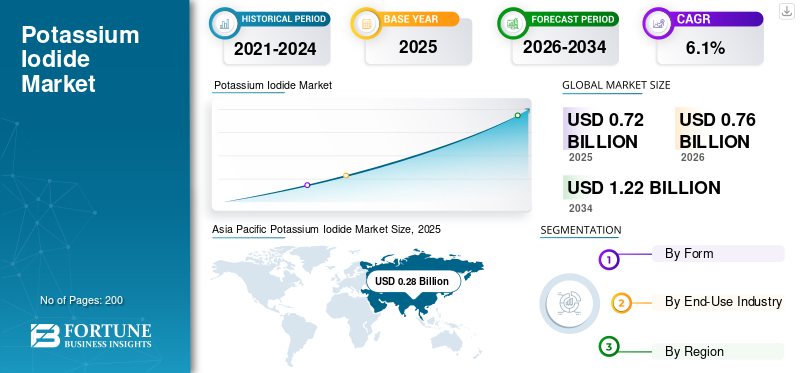
The global potassium iodide market size was valued at USD 0.72 billion in 2025. The market is projected to grow from USD 0.76 billion in 2026 to USD 1.22 billion by 2034, exhibiting a CAGR of 6.1% during the forecast period. Asia Pacific dominated the potassium iodide market, accounting for 38.88% of the market in 2025.
The potassium iodide (KI) market is expanding steadily due to its wide use across essential industrial and commercial applications. Product demand is rising as it is widely used in pharmaceuticals, food and beverages, chemicals, laboratory applications, and selected industrial formulations. Its high solubility, stable chemical behavior, and effective iodine content make it a preferred material in industries that require reliable formulation performance and product consistency. In addition, expansion in industrial processing activities, higher consumption in the pharmaceutical and chemical sectors, and the increasing need for efficient iodine-based compounds are further driving market growth.
Key companies in the market include Merck KGaA, Samrat Pharmachem Limited, Sisco Research Laboratories Pvt. Ltd., FUJIFILM Wako Pure Chemical Corporation, and Kishida Chemical Co., Ltd. They are reinforcing their presence in the market by advancing product development, enhancing processing and manufacturing capacities, and strengthening their global supply chains.
Download Free sample to learn more about this report.
Potassium Iodide Market KEY TAKEAWAYS
 Global Market Size & Forecast
- 2025 Market Size: USD 0.72 billion
- 2026 Market Size: USD 0.76 billion
- 2034 Forecast Market Size: USD 1.22 billion
- CAGR: 6.1% from 2026-2034
 Market Share
- Asia Pacific dominated the global market with a 38.88% share in 2025.
- Solid held the largest form segment share in 2025, supported by its ease of storage.
- Pharmaceuticals held the largest end-use industry share in 2025.
 Key Regional Highlights
Asia Pacific
Dominated the market with USD 0.28 billion in 2025, supported by a large population base.
Europe
Reached USD 0.16 billion in 2025, supported by demand from pharmaceuticals, food and beverage fortification.
North America
Remains an important market, supported by its advanced pharmaceutical manufacturing base.
U.S.
The market is estimated at approximately USD 0.16 billion in 2026, accounting for roughly 88.7% of regional sales.
Japan
The market is estimated at approximately USD 0.06 billion in 2026.
Read More

POTASSIUM IODIDE MARKET TRENDS
Rising Use of Potassium Iodide in Nutritional Formulations to Surge Market Growth
Nutritional applications are emerging as an important trend in the market, supported by the growing need for reliable iodine-based ingredients in dietary and fortified products. KI is gaining wider use in formulations as it provides a stable and effective source of iodine for supplements and nutrition-focused products. It is particularly valued in applications where dosage accuracy, solubility, and formulation consistency are essential. As nutrition-focused industries continue to emphasize iodine supplementation, product quality, and preventive health support, product use is increasing steadily.
- According to the NIH Office of Dietary Supplements, iodine in dietary supplements is often present as KI, reflecting its established use in nutritional formulations.
MARKET DYNAMICS
MARKET DRIVERS
Download Free sample to learn more about this report.
Strong Demand from Pharmaceutical Applications Supports Market Growth
The market is strongly driven by high demand for potassium iodide in pharmaceutical applications. KI is widely used in medicinal formulations, where it serves as an important iodine source and supports a range of healthcare applications. Its high solubility, reliable stability, and consistent formulation performance make it a valuable ingredient in pharmaceutical products that require accuracy and quality. Rapid expansion of the pharmaceutical industry, rising healthcare demand, and increased focus on effective iodine-based formulations are driving the potassium iodide market growth.
- According to the U.S. FDA, KI is a thyroid-blocking medicine used in a nuclear radiation emergency, reflecting its established role in pharmaceutical applications.
MARKET RESTRAINTS
Sensitivity to Moisture and Storage Conditions Restricts Wider Product Adoption
The market faces a key restraint due to potassium iodide's sensitivity to storage conditions and product stability requirements in end-use applications. KI can be affected by moisture, light exposure, and improper storage, which may influence its quality and formulation reliability over time. Industries that use KI often require controlled packaging, appropriate storage practices, and careful handling to maintain product integrity and consistent performance. These requirements can increase operational burden and limit wider adoption in applications where long shelf life, simple storage, and easy handling are important.
- According to a Sigma-Aldrich safety data sheet, KI is sensitive to air, light, and moisture and should be stored in a dry, tightly closed container, supporting the restraint related to storage sensitivity and handling requirements.
MARKET OPPORTUNITIES
Food Fortification Initiatives are Expanding Market Growth Potential
An important opportunity in the potassium iodide industry is coming from the wider use of iodine-enriched food and beverage products. KI is increasingly used by manufacturers seeking a dependable iodine ingredient for fortified foods, nutritional supplements, and selected beverage formulations. Its value lies in supporting micronutrient enrichment in products aimed at improving dietary intake and public health outcomes. As more producers focus on nutrition-oriented product development and awareness of iodine intake continues to rise, KI is gaining greater commercial potential in food and beverage applications.
- According to the USDA Agricultural Marketing Service, KI fortification of salt and food commodities is a cost-effective way to ensure daily iodine intake, reflecting its role in food fortification.
MARKET CHALLENGES
Fluctuations in Iodine Raw Material Availability and Processing Costs Challenge Market Growth
The market faces challenges due to fluctuations in iodine raw material availability and in processing costs for potassium iodide production. Manufacturing KI depends on the stable supply of iodine-based inputs and cost-efficient production conditions, and any disruption in these factors can directly affect overall production expenses. Producers often face pressure to maintain pricing stability, especially when raw material markets remain uncertain and operating costs shift frequently. These cost-related challenges can affect profit margins, create pricing pressure for end users, and make market growth more difficult in price-sensitive applications.
- According to the U.S. Geological Survey (USGS), Chile accounted for about two-thirds of global iodine production in 2025, reflecting a concentrated raw-material base that can affect KI supply and production costs.
Segmentation Analysis
By Form
Ease of Storage, Precise Dosing, and Broad End-Use Support Dominance of Solid Segment
Based on the form, the market is segmented into solid and liquid.
The solid segment holds the largest potassium iodide market share due to its wide use across pharmaceuticals, food and beverages, laboratory applications, and chemical formulations. The solid form of the product is widely preferred because it is easier to store, convenient for accurate dosing, and suitable for direct use in tablets, powders, salt iodization, and controlled preparation systems. It is commonly used in pharmaceutical products, nutritional formulations, laboratory reagents, and fortified food applications where stability, measurement accuracy, and formulation consistency are important. Its practicality in packaging, transport, and application-specific use continues to support the dominance of the solid segment.
The liquid segment is expected to grow at a CAGR of 5.5% over the forecast period.
By End-Use Industry
To know how our report can help streamline your business, Speak to Analyst
Strong Demand for Iodine-Based Therapeutic and Protective Uses Supports Dominance of Pharmaceuticals Segment
In terms of end-use Industry, the market is categorized into pharmaceuticals, food & beverages, chemicals, laboratories, and others.
Pharmaceuticals hold the largest share of the market due to their wide use in iodine-based therapeutic and protective applications across healthcare systems. KI is commonly used in pharmaceutical products as it serves as a reliable iodine source and is valued in formulations that require high purity, accurate dosing, and consistent performance. It plays an important role in applications where treatment reliability, patient safety, and formulation stability are essential. Its broad use across medicinal and healthcare-related products continues to support the dominance of the pharmaceuticals segment.
- According to the World Health Organization (WHO), KI is used to block thyroid iodine during radiological or nuclear accidents, reflecting its established role in pharmaceutical applications.
The food & beverages segment is expected to grow at a CAGR of 5.7% over the forecast period.
Potassium Iodide Market Regional Outlook
By geography, the market is categorized into North America, Europe, Asia Pacific, Latin America, and the Middle East & Africa.
Asia Pacific
Asia Pacific Potassium Iodide Market Size, 2025 (USD Billion)
To get more information on the regional analysis of this market, Download Free sample
In 2024, Asia Pacific accounted for the largest share of the market, valued at USD 0.25 billion, and continued to lead in 2025, valued at USD 0.28 billion. The region benefits from its large population base, expanding pharmaceutical demand, growing nutritional awareness, and established chemical and formulation manufacturing activities across China, India, Japan, South Korea, and Southeast Asia. KI is widely used across pharmaceuticals, food and beverage fortification, laboratory applications, and chemical formulations, all of which are seeing steady consumption in the region’s growing end-use sectors. Rising healthcare needs, increasing focus on iodine supplementation, and continued expansion in downstream formulation activity continue to reinforce Asia Pacific’s leading market position.
China Potassium Iodide Market
By 2026, the Chinese market is projected to reach USD 0.10 billion. China remains the region’s largest demand center, supported by its broad pharmaceutical manufacturing base, growing nutrition-related demand, and extensive product use in food fortification, laboratory reagents, and chemical applications. Growth is reinforced by large-scale production activity, rising healthcare consumption, and continued expansion in downstream industrial processing.
To know how our report can help streamline your business, Speak to Analyst
India Potassium Iodide Market
The Indian market in 2026 is estimated at around USD 0.07 billion, accounting for roughly 24.6% of regional revenues.
Japan Potassium Iodide Market
The Japanese market in 2026 is estimated to be around USD 0.06 billion, accounting for roughly 20.9% of the regional revenues.
Europe
Europe is expected to experience significant market growth in the coming years. Throughout the forecast period, the region is expected to expand at a steady rate, attaining a market valuation of USD 0.16 billion in 2025. Europe is projected to witness stable growth during this period, supported by strong demand from pharmaceuticals, food and beverage fortification, laboratory uses, and chemical applications. The region also benefits from its established healthcare systems, advanced manufacturing capabilities, and increasing focus on nutritional quality and iodine-related health support.
U.K. Potassium Iodide Market
The U.K. market in 2026 is estimated at around USD 0.03 billion, accounting for roughly 18.0% of regional revenues.
Germany Potassium Iodide Market
Germany’s market in 2026 is estimated at around USD 0.05 billion, accounting for roughly 31.6% of regional revenues.
North America
North America remains a well-established and attractive market, supported by strong demand across pharmaceuticals, food and beverage fortification, laboratory applications, and other healthcare applications. The region benefits from its advanced pharmaceutical manufacturing base, stable healthcare demand, and widespread product use in formulations that require reliable iodine content, accurate dosing, and consistent quality. Its mature industrial structure and steady downstream consumption continue to underscore North America's importance in the market.
U.S. Potassium Iodide Market
Given North America’s significant contribution and the U.S. dominance in the region, the U.S. market is estimated at around USD 0.16 billion in 2026, accounting for roughly 88.7% of regional sales.
Latin America and Middle East & Africa
Latin America and the Middle East & Africa are relatively smaller in absolute size, yet continue to present meaningful growth prospects for the market. Growth in Latin America is supported by expanding pharmaceutical demand, rising use of fortified food products, and increasing consumption of products for laboratory and chemical applications. The region is also benefiting from improved healthcare access, gradual industrial development, and broader awareness of iodine-related nutritional needs.
The Middle East & Africa region is also showing steady potential, supported by growing healthcare demand, expanding pharmaceutical distribution, and increasing product use in nutritional and laboratory applications. The rising focus on public health, improved access to iodine-related products, and the gradual development of downstream formulation and supply systems are further supporting market opportunities across both regions.
Brazil Potassium Iodide Market
The Brazilian market in 2026 is estimated at USD 0.03 billion, accounting for approximately 46.7% of regional revenues.
COMPETITIVE LANDSCAPE
Key Industry Players
Product Quality, Supply Reliability, and Application-Specific Offerings Shape Market Competition
The market remains moderately consolidated, with supply concentrated among established producers with strong iodine compound manufacturing capabilities, dependable access to raw materials, and well-developed distribution networks. Participation in this market requires investment in production infrastructure, quality control, purity management, and application-specific processing, thereby creating higher entry barriers for new entrants.
Leading companies such as Merck KGaA, Samrat Pharmachem Limited, Sisco Research Laboratories Pvt. Ltd., FUJIFILM Wako Pure Chemical Corporation, and Kishida Chemical Co., Ltd. compete by focusing on product quality, production efficiency, supply reliability, and broad customer support across pharmaceuticals, food and beverages, laboratories, chemicals, and other industrial applications.
LIST OF KEY POTASSIUM IODIDE COMPANIES PROFILED
- Merck KGaA (Germany)
- Samrat Pharmachem Limited (India)
- Sisco Research Laboratories Pvt. Ltd. (India)
- LobaChemie Pvt. Ltd. (India)
- HiMedia Laboratories. (India)
- FUJIFILM Wako Pure Chemical Corporation (Japan)
- GFS Chemicals. (U.S.)
- Scharlab, S.L. (Spain)
- Junsei Chemical Co., Ltd. (Japan)
- Kishida Chemical Co., Ltd. (Japan)
REPORT COVERAGE
The global potassium iodide market analysis provides an in-depth study of the market size and forecast for all segments included in the report. It includes details on the market dynamics and market trends expected to drive the market over the forecast period. It offers information on technological advancements, new product launches, key industry developments, and details on partnerships, mergers, and acquisitions. The market research report also includes a detailed competitive landscape, including market share and profiles of key players.
Request for Customization to gain extensive market insights.
Report Scope & Segmentation
| ATTRIBUTE | DETAILS |
| Study Period | 2021-2034 |
| Base Year | 2025 |
| Estimated Year | 2026 |
| Forecast Period | 2026-2034 |
| Historical Period | 2021-2024 |
| Growth Rate | CAGR of 6.1% from 2026 to 2034 |
| Unit | Value (USD Billion) Volume (Kiloton) |
| Segmentation | By Form, End-Use Industry, and Region |
| By Form |
|
| By End-Use Industry |
|
| By Region |
|
Frequently Asked Questions
Fortune Business Insights says that the global market size was valued at USD 0.72 billion in 2025 and is projected to reach USD 1.22 billion by 2034.
Recording a CAGR of 6.1%, the market is slated to exhibit steady growth during the forecast period of 2026-2034.
The pharmaceuticals end-use industry segment leads the market.
Asia Pacific held the highest market share in 2025.
Rising demand from pharmaceutical applications is driving market growth.



- 2021-2034
- 2025
- 2021-2024
- 200
Get 30-60 hrs Free Customization
Expand Regional and Country Coverage, Segments Analysis, Company Profiles, Competitive Benchmarking, and End-user Insights.


















Related Reports
-
US +1 833 909 2966 ( Toll Free )
-
Get In Touch With Us