Potassium Phosphate Market Size, Share & Industry Analysis, By Type (Monopotassium Phosphate, Dipotassium Phosphate, Tripotassium Phosphate, and Others), By Application (Fertilizers, Food & Beverages, Pharmaceuticals, Water Treatment, Industrial Processing, and Others), and Regional Forecast, 2026-2034
 Download Free Sample
Potassium Phosphate Market Size and Future Outlook
 Listen to Audio Version
The global potassium phosphate market size was valued at USD 15.51 billion in 2025. The market is projected to grow from USD 16.94 billion in 2026 to USD 28.56 billion by 2034, exhibiting a CAGR of 6.7% during the forecast period. Asia Pacific dominated the potassium phosphate market with a market share of 49.96% in 2025.
Potassium phosphate refers to a family of potassium salts of phosphoric acid that are widely used across water-soluble fertilizers, food additives, pharmaceutical and nutraceutical formulations, water treatment systems, buffering applications, and selected industrial processes. Commercial demand centers on monopotassium phosphate (MKP), dipotassium phosphate (DKP), tripotassium phosphate (TKP), and related specialty grades, supplied primarily as powders, granules, and crystals depending on purity, solubility, and end-use requirements.
The market growth is driven by its broad applications in precision agriculture, pH control, buffering, mineral supplementation, corrosion control, and regulated food and pharmaceutical formulations. The product consumption is further supported by the use of MKP in fertigation and foliar feeding, DKP and TKP in food processing and beverages, phosphate salts in formulation and excipient systems, and the continuing need for technical phosphates in water treatment and industrial processing.
Furthermore, the market comprises several major players, including ICL, Innophos, Haifa Group, Yara International ASA, and Budenheim, as well as other regional phosphate and specialty ingredient suppliers. Product purity, water solubility, process integration, regulatory approvals, technical support, and distribution reach continue to influence competitive positioning in the global market.
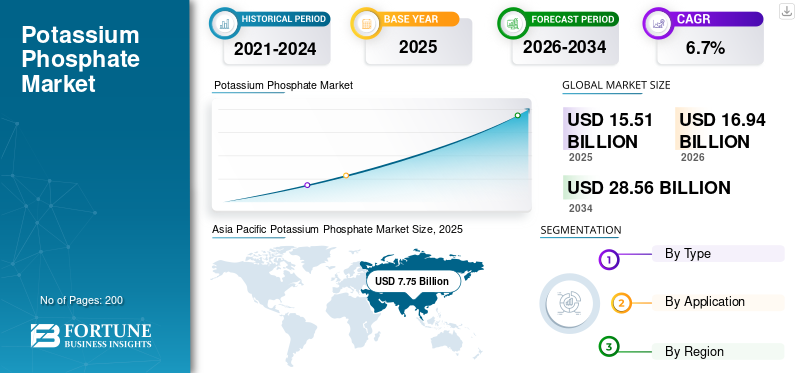
Download Free sample to learn more about this report.
POTASSIUM PHOSPHATE MARKET KEY TAKEAWAYS
 Market Size & Forecast
- 2025 Market Size: USD 15.51 Billion
- 2026 Market Size: USD 16.94 Billion
- 2034 Forecast Market Size: USD 28.56 Billion
- CAGR: 6.7% from 2026–2034
 Market Share
- Asia Pacific dominated the potassium phosphate market with a 49.96% share in 2025.
- The monopotassium phosphate segment accounted for the largest market share in 2025.
- The fertilizers segment held the largest market share in 2025.
 Key Regional Highlights
Asia Pacific
Asia Pacific led the market with a value of USD 7.75 billion in 2025.
Europe
Europe is projected to reach USD 2.09 billion in 2026, growing at a 5.2% CAGR.
North America
North America is expected to reach USD 1.92 billion in 2026, supported by strong demand across food and pharmaceutical applications.
U.S.
The market reached USD 1.46 billion in 2025, driven by food, beverage, and specialty agriculture demand.
Japan
The market is witnessing steady growth, supported by demand from agriculture, food processing, and pharmaceutical applications.
Read More

POTASSIUM PHOSPHATE MARKET TRENDS
Fertigation-Led MKP Demand, Regulated Food and Pharmaceutical Uses, and Technical Phosphate Specialization
The product demand is increasingly shaped by the expansion of precision agriculture, especially fertigation and foliar programs that rely on highly soluble phosphorus and potassium nutrition. Monopotassium phosphate continues to benefit from its strong fit with drip irrigation, hydroponics, and high-value crop production, while dipotassium phosphate and tripotassium phosphate remain relevant in buffering, protein stabilization, acidity regulation, and formulation support across food and industrial channels. This supports a demand profile that combines large agricultural consumption with higher-value regulated and technical uses.
At the same time, manufacturers are paying greater attention to purified food- and pharmaceutical-grade materials, low-impurity process control, and differentiated phosphate solutions for beverage systems, nutrient products, water-treatment chemistries, and specialty industrial formulations. Portfolio strategies increasingly emphasize purity assurance, traceability, formulation support, and application-specific technical guidance as customers seek performance consistency in regulated uses. As a result, suppliers are positioning potassium phosphate as a fertilizer input and as a value-added ingredient platform serving food, healthcare, water, and industrial customers.
- For instance, official and producer materials continue to position MKP as a fully water-soluble fertilizer for fertigation and foliar feeding, while potassium phosphates are also recognized for acidity regulation, sequestration, buffering, and stabilizing functions in food and technical applications.
MARKET DYNAMICS
MARKET DRIVERS
Download Free sample to learn more about this report.
Precision Agriculture Adoption, Water-Soluble Fertilizer Demand, and Regulated Buffering Applications to Support Product Consumption
Agriculture remains the primary demand center for product, particularly through the use of MKP in fertigation, foliar nutrition, hydroponics, and specialty crop programs. The product combines high solubility, efficient phosphorus and potassium delivery, and compatibility with modern irrigation systems, creating a large and relatively resilient demand base across horticulture, open-field crops, and protected cultivation. This makes fertilizer-linked consumption the primary aspect fueling the global potassium phosphate market growth.
Beyond agriculture, food processing, beverages, pharmaceuticals, water treatment, and industrial processing provide additional support to market expansion. The compound continues to be used as a buffering and stabilizing agent, an acidity regulator, a mineral source, and a formulation aid where pH control, process consistency, and purity matter. Producers that can serve both volume-driven fertilizer demand and specification-driven food, healthcare, and technical channels are, therefore, better positioned to capture broad-based growth.
MARKET RESTRAINTS
Raw-Material Cost Exposure, Regulatory Stringency, and Application-Specific Substitution May Restrict Market Expansion
While potassium phosphate remains an essential phosphate material across several sectors, the market is exposed to volatility in phosphoric acid, potash-based intermediates, purification chemistry, and energy-linked processing costs. Production economics can tighten when feedstock pricing rises or environmental compliance costs increase, especially for food-grade and pharmaceutical-grade materials, where impurity control adds cost and complexity.
The market also faces substitution risk in selected applications. Alternative phosphate salts, citrate-based buffers, carbonate systems, crop-specific nutrient blends, and customer-specific reformulation options may reduce reliance on direct potassium phosphate, depending on performance requirements and cost considerations. These factors can pressure margins and make adoption more sensitive to qualification timelines, formulation testing, and regulatory approvals.
MARKET OPPORTUNITIES
Premium Water-Soluble Nutrition, Functional Formulation Systems, and Specialty Technical Uses to Create Lucrative Growth Opportunities
High-purity MKP grades continue to gain attention in premium crop nutrition programs where irrigation efficiency, nutrient-use precision, and product purity are important. At the same time, food and beverage manufacturers continue to seek product grades with reliable buffering, mineral-delivery, and stability performance, while pharmaceutical and nutraceutical producers require controlled purity and documentation support for regulated formulations.
Additional opportunities exist in advanced hydroponic systems, clean-label processing support, beverage stabilization, technical water-treatment chemistries, and differentiated industrial phosphate solutions. Suppliers that combine process integration with technical support, regulatory documentation, and customer-specific grade development are better positioned to capture incremental value outside purely volume-driven channels.
MARKET CHALLENGES
Qualification Timelines, Purity Expectations, and Multi-Industry Compliance Requirements Can Hamper Market Growth
Manufacturers and distributors must navigate food additive requirements, pharmaceutical and nutraceutical specifications, industrial quality expectations, and customer-specific validation protocols across multiple end-use industries. This increases complexity in product qualification, production planning, and documentation management, especially for suppliers serving both bulk fertilizer channels and regulated specialty applications.
In addition, end users are increasingly focused on solubility, contaminant control, formulation consistency, and total system cost rather than only purchase price. Suppliers, therefore, need dependable quality systems, flexible production capabilities, and strong application support to sustain long-term growth while maintaining customer confidence across agriculture, food, healthcare, water, and industrial markets.
Segmentation Analysis
By Type
Monopotassium Phosphate Segment Led the Market fostered by Extensive Adoption in Fertigation and Foliar Spraying
Based on type, the market is segmented into monopotassium phosphate, dipotassium phosphate, tripotassium phosphate, and others.
The monopotassium phosphate segment accounted for the largest potassium phosphate market share in 2025. The segment’s growth is driven by its broad use in fertigation, foliar spraying, hydroponics, and specialty crop nutrition systems, where complete water solubility, high purity, and efficient phosphorus-potassium delivery are important. Furthermore, the segment held a 56.2% market share in 2025.
The dipotassium phosphate segment is expected to grow significantly, driven by rising use in food processing, beverages, buffering systems, and selected technical applications where pH control and formulation stability support processing efficiency. The segment is projected to grow at a CAGR of 6.4% during the analysis period.
By Application
To know how our report can help streamline your business, Speak to Analyst
Fertilizers Segment Dominated the Market Due to the Extensive Use in Crop Cultivation
By application, the market is categorized into fertilizers, food & beverages, pharmaceuticals, water treatment, industrial processing, and others.
The fertilizers segment accounted for the largest share in 2025. The segment growth is driven by the widespread use of monopotassium phosphate in precision agriculture, fertigation, foliar nutrition, hydroponics, and water-soluble fertilizer systems, as well as by its role in supporting phosphorus and potassium delivery for high-value crops. The segment held a share of 51.8% in 2025.
The food & beverages segment is expected to grow favorably over the projection period. The segment growth is driven by continued product use in buffering systems, electrolyte formulations, injectable products, and nutrient-support applications where controlled purity and formulation performance are critical. The segment is expected to grow at a CAGR of 6.4% over the forecast period.
Potassium Phosphate Market Regional Outlook
By geography, the market is categorized into North America, Europe, Asia Pacific, Latin America, and the Middle East & Africa.
Asia Pacific
Asia Pacific Potassium Phosphate Market Size, 2025 (USD Billion)
To get more information on the regional analysis of this market, Download Free sample
Asia Pacific held the dominant share in 2025, valued at USD 7.75 billion, and is expected to maintain its leading share in 2026, valued at USD 8.54 billion. The region benefits from high fertilizer consumption, strong demand for water-soluble crop nutrients, broad-based food-processing and healthcare-manufacturing activity, and the central role of China and India in global phosphate demand. China remains the largest market, while India, Japan, South Korea, and the broader Asia Pacific region continue to support demand, driven by fertigation needs, food additive uses, pharmaceutical production, and diverse industrial processing requirements.
China Potassium Phosphate Market
In 2025, the Chinese market reached a value of USD 2.99 billion. The product demand in the country is supported by its large agricultural base, extensive phosphate-chemistry ecosystem, substantial food and pharmaceutical manufacturing footprint, and continued product use across crop nutrition, buffering systems, and technical applications.
To know how our report can help streamline your business, Speak to Analyst
North America
North America is a significant contributor to the global market and is estimated to reach USD 1.92 billion by 2026. The market growth is driven by strong adoption in regulated food ingredients, beverages, pharmaceuticals, water treatment, and specialty crop nutrition, alongside its established use in industrial processing. Application intensity remains strong in the U.S., supported by its large food and healthcare sectors, a developed agricultural-input system, and a robust regulatory and formulation infrastructure.
U.S. Potassium Phosphate Market
In 2025, the U.S. market reached USD 1.46 billion. The U.S. dominates regional consumption due to its large food, beverage, pharmaceutical, water treatment, and specialty agriculture bases, significant demand for buffered and stabilized formulations, and the established product use in ingredient systems and technical applications.
Europe
Europe is expected to experience significant growth in the coming years. The regional market is anticipated to reach a valuation of USD 2.09 billion in 2026 and is projected to grow at a CAGR of 5.2% during the forecast period. The regional market growth is supported by the demand for efficient nutrient inputs, continued use of food-grade buffering and stabilizing ingredients, and strong adoption of regulated pharmaceutical and technical phosphate materials. The region benefits from mature food and industrial systems, high formulation standards, and an emphasis on quality, compliance, and supply security.
U.K. Potassium Phosphate Market
The U.K. market reached a value of around USD 0.35 billion in 2025, representing approximately 4.6% of global market revenue.
Germany Potassium Phosphate Market
The Germany market reached a valuation of approximately USD 0.45 billion in 2025, accounting for about 5.8% of global sales.
Latin America
Latin America is experiencing steady growth. The Latin America market is expected to reach a valuation of USD 1.05 billion in 2026. The product demand is concentrated in fertilizer consumption, horticulture and plantation-crop nutrition, food processing, and selected industrial uses, supported by large-scale agriculture, regional fertilizer distribution, and the rising adoption of water-soluble nutrient products. Strong agricultural economics and the growing use of precision nutrition continue to support the regional product demand.
Brazil Potassium Phosphate Market
The Brazil market reached approximately USD 0.48 billion in 2025, equivalent to around 6.5% of global sales.
The Middle East & Africa
The Middle East & Africa regional market is gradually expanding, driven by food-security priorities, controlled-environment agriculture, rising water-treatment needs, selected food and pharmaceutical applications, and the strategic role of regional phosphate supply chains. Fertilizers remain the region’s most important application, while water treatment, regulated food uses, and industrial processing continue to contribute incremental demand growth.
GCC Potassium Phosphate Market
The GCC market reached USD 1.33 billion in 2025, accounting for approximately 6.8% of the global revenues. The product demand is supported by investments in food and water security, integrated phosphate value chains, controlled agricultural systems, and the continued product use in technical and formulation-based applications.
COMPETITIVE LANDSCAPE
Key Industry Players
Key Players to Focus on Formulation Support and Expanded Distribution Networks to Maintain their Positions
The market includes a mix of phosphate-integrated producers, water-soluble fertilizer manufacturers, specialty ingredient suppliers, and technical phosphate companies that supply potassium phosphate materials across agriculture, food, pharmaceutical, water treatment, and industrial end uses. Competition is shaped by access to phosphate intermediates, purification capabilities, agronomic and application support, regulatory compliance, and the ability to maintain quality consistency across multiple grades and regions.
Leading companies differentiate through feedstock integration, formulation support, contaminant control, downstream registrations, distribution reach, and the flexibility to serve both volume-based agricultural channels and higher-value specialty applications. Some key market players include ICL, Innophos, Haifa Group, Yara International ASA, and Budenheim.
LIST OF KEY POTASSIUM PHOSPHATE COMPANIES PROFILED
- ICL Group Ltd. (Israel)
- Innophos (U.S.)
- Haifa Group (Israel)
- Yara International ASA (Norway)
- Budenheim (Germany)
- Prayon (Belgium)
- Aditya Birla Chemicals (India)
- FOSFA (Czech Republic)
- J J CHEMICALS (India)
- Vinipul Chemicals Pvt. Ltd. (India)
KEY INDUSTRY DEVELOPMENTS
- May 2024: Budenheim announced an additional 4,400 tons per year of mineral phosphate capacity and opened its new House of Nutrition after a EUR 57 million (USD 61.69 million) investment in Germany. The move signals expanded high-purity phosphate production for early-life, preventive, and medical nutrition applications that support specialty phosphate demand.
- September 2022: Phosphea completed the acquisition of SPO in Brazil, adding a production unit with 100,000 tons of feed-phosphate capacity and another 100,000 tons of natural-salt distribution capacity. The step signals a stronger Latin American phosphate footprint and improved regional supply capability for phosphate-based nutrition inputs.
REPORT COVERAGE
The global market analysis provides an in-depth study of market size and forecast by all the market segments included in the report. It includes details on market dynamics and trends expected to drive the market during the forecast period. It offers information on technological advancements, new product launches, key industry developments, and partnerships, mergers, and acquisitions. The market research report also includes a detailed competitive landscape, providing market share and the profiles of key players.
Request for Customization to gain extensive market insights.
Report Scope & Segmentation
| ATTRIBUTE | DETAILS |
| Study Period | 2021-2034 |
| Base Year | 2025 |
| Estimated Year | 2026 |
| Forecast Period | 2026-2034 |
| Historical Period | 2021-2024 |
| Growth Rate | CAGR of 6.7% from 2026 to 2034 |
| Unit | Value (USD Billion), Volume (Kiloton) |
| Segmentation | By Type, Application, and Region |
| By Type |
|
| By Application |
|
| By Region |
|
Frequently Asked Questions
According to Fortune Business Insights, the global market size was USD 15.51 billion in 2025 and is projected to reach USD 28.56 billion by 2034.
The market is slated to exhibit steady growth at a CAGR of 6.7% during the forecast period of 2026-2034.
By application, the fertilizer segment led the market in 2025.
Asia Pacific held the highest market share in 2025.
ICL, Innophos, Haifa Group, Yara International ASA, and Budenheim are the prominent players in the market.
The key factor driving market growth is the broad product use in fertilizers, supported by the rising demand for efficient water-soluble nutrient inputs in modern agriculture.
The major factors expected to favor product adoption are its growing use in food & beverages, pharmaceuticals, water treatment, and industrial processing alongside its value as a pH regulator, buffering agent, and nutrient source across multiple applications.



- 2021-2034
- 2025
- 2021-2024
- 200
Get 30-60 hrs Free Customization
Expand Regional and Country Coverage, Segments Analysis, Company Profiles, Competitive Benchmarking, and End-user Insights.


















Related Reports
-
US +1 833 909 2966 ( Toll Free )
-
Get In Touch With Us