Precision Aquaculture Market Size, Share & Industry Analysis, By Water Environment (Marine Water, Fresh Water, and Brackish Water), By Type (Fish {Tuna, Salmon, Tilapia, and Others}, Crustaceans {Crabs, Lobsters, Crayfish, Shrimps, and Others}, and Others), By Farm Type (Open Aquaculture Farms and RAS Farms), and Regional Forecast, 2026-2034
 Download Free Sample
(Offer valid till 15th Oct 2026)

KEY MARKET INSIGHTS
 Listen to Audio Version
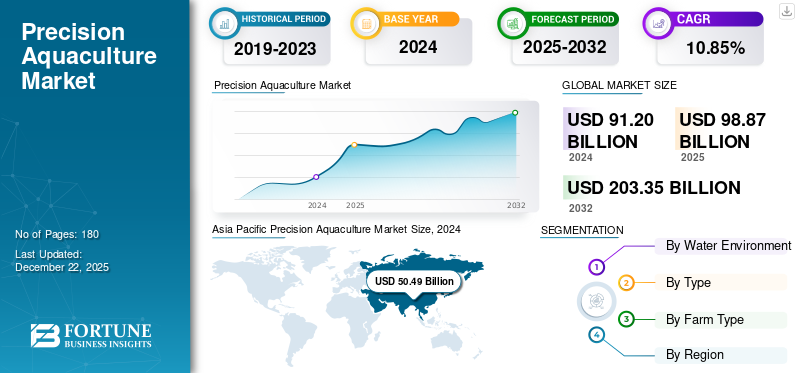
The global precision aquaculture market size was valued at USD 98.87 billion in 2025 and is projected to grow from USD 107.32 billion in 2026 to USD 259.84 billion by 2034, exhibiting a CAGR of 11.69% during the forecast period. Asia Pacific dominated the precision aquaculture market with a market share of 55.58% in 2025.
Precision aquaculture is an advanced aqua-farming approach that utilizes various hardware, software, and services, including data analysis, such as AI, IoT, and sensors, to optimize aqua-farming operations for more efficiency and sustainability. Increasing aquaculture production across developing nations, including India, China, and Brazil, will likely drive the demand for the practices. Companies focusing on achieving sustainable fish farming are further driving the industry growth.
Blue Ridge Aquaculture, Inc., Kaiko Yukinoya Co. Ltd., Avanti Feeds Limited, Mowi ASA, and Grieg Aqua AS are the leading companies operating in the market.
Download Free sample to learn more about this report.
Precision Aquaculture Market Key Takeaways
 Global Market Size & Forecast
- 2025 Market Size: USD 98.87 billion
- 2026 Market Size: USD 107.32 billion
- 2034 Forecast Market Size: USD 259.84 billion
- CAGR: 11.69% (2026–2034)
 Market Share
- Asia Pacific dominated the market with a 55.58% share in 2025.
- The open aquaculture farms segment is projected to lead the market with a 88.81% share in 2026.
- The fish segment is expected to dominate the market, accounting for 76.50% of the global market in 2026.
 Key Regional Highlights
Asia Pacific
Asia Pacific generated USD 54.96 billion in 2025 and is projected to reach USD 59.88 billion in 2026.
North America
North America held USD 16.95 billion in 2025 and is projected to reach USD 18.25 billion in 2026.
Europe
Europe accounted for USD 21.22 billion in 2025 and is expected to grow to USD 22.96 billion in 2026.
U.S.
U.S. market is projected to reach USD 10.89 billion by 2026.
Japan
Japan market is projected to reach USD 0.76 billion by 2026.
Read More

MARKET DYNAMICS
Market Drivers
Companies Focus on Excelling their Production Using Data-driven Solutions to Drive the Industry Growth
Over the past decades, the aquaculture industry has been evolving with various factors, including investment in technologies, government policies, adoption of digitalization, increased product demand, sustainability concerns, and others. Emerging industrial revolutionary aspects such as AI, IoT, machine learning, and advanced data analytics are contributing significantly to changing the industry landscape by leveraging of data to make accurate decisions. Companies are concerned about efficiency in production practices to reduce wastages & operational overheads and achieve higher profitability. The precision aquaculture model offers effective solutions for operators to achieve their business objectives with effective feed optimization, monitoring, and surveillance. Major players have adopted these technologies in their production farms and achieved satisfactory results from the advanced technology. For instance, Grieg Aqua AS, a key salmon-producing company, adopted precision aquaculture technology in 2020. The company spokesperson claimed that after adopting the new technology, the average survival rate of post-smolt salmon has increased from 88% in 2019 to 90% in 2020 on its British Columbia farm. Further, the growth of harmful algae was reduced from 3.4% in 2019 to 0.9% in 2020. Advanced analytical tools and data-driven decision support assisted the company in achieving its operational goals. Thus, industry players focusing on adopting data-driven solutions to enhance their production capacity will drive global market growth in the near future.
Funding from the Government for Inland Aquaculture to Drive the Market
The blue economy is one of the key sectors contributing significantly to the national economy. The sector is one of the important wings that creates several employment opportunities for both skilled and unskilled laborers. According to the Indian government, the blue economy accounted for nearly 4-5% of the contribution to the national GDP. Thus, the government is investing significantly in advancement and technological adoption in the sector. Under the Flagship Scheme Pradhan Mantri Matsya Sampada Yojana (PMMSY), the Indian government has invested nearly USD 2,472.28 million in funding to improve inland aquaculture in the country over the five years from FY2020- 21 to FY2024- 25. Such an investment will improve the country's adoption of precision aquaculture technologies, thereby boosting fish production in the upcoming years.
Market Restraint
High Investment and Technical Expertise are Hampering the Market Growth
Precision aquaculture is one of the promising technologies in the industry. However, it has several challenges to adopt on a large scale across the world in aquaculture practices. High initial costs for technology and infrastructure, specialized technical expertise, and security & data management-related challenges are primarily slowing the industry's growth globally. To implement precision aquaculture technologies, aqua farmers must invest in sensors, automation systems, and data analytics platforms. It will be more challenging for small-scale aquaculture producers, especially in developing economies.
Furthermore, there is a need for skilled labor to maintain and utilize advanced technologies and data analysis. It will further increase the operational expenses of the producer and impede the industry growth in the forecast period.
Market Opportunity
Collaboration with Institutes and Companies to Develop New Technologies to Change the Industry Outlook
As precision aquaculture adoption is increasing globally, companies are collaborating with industry researchers and institutes to develop next-generation technologies. Furthermore, collaboration with institutes for research & development activities to diversify the usage and excel productivity, unlock new opportunities for farmers. As a result, the collaboration with institutes will change the global precision aquaculture market share globally. For instance, in April 2025, Innovasea, a leading global aquaculture technological solutions provider, signed a new partnership agreement with Mila, the Quebec Artificial Intelligence Institute, to develop advanced AI-driven solutions for sustainable fish tracking, protection, and production.
Precision Aquaculture Market Trends
Trend of Sustainability with the Adoption of New Technologies to Support the Market Growth
A larger number of manufacturers following Recirculated Aquaculture Systems (RAS-farming) are adopting new technologies to achieve more sustainability in their operations. As this technology is in the introduction stage, companies seek more accurate and targeted solutions to cater to their requirements. It is likely to encourage service providers to develop innovative technologies to serve their customers. It will drive the market growth in the upcoming years. For instance, in April 2025, Paras Aqua, a Finnish startup, launched a modular and scalable system - a Hybrid Flow-Through System (Precision HFS) to minimize the use of new water for land-based fishing. It will assist in controlling the water flow & temperature more cost-effectively.
Download Free sample to learn more about this report.
Impact of Tariffs on the Market
Recently proposed reciprocal tariffs on several countries, including Canada, Mexico, and China, have significantly impacted the price spikes of precision aquaculture equipment in the U.S. A larger number of service providers depend on importing semiconductors, sensors, and machinery from China. The imposition of tariffs has raised the price of these components. It will negatively impact the market growth. Additionally, the U.S. is one of the key markets for Asian aquaculture producers. India, China, and Bangladesh export a significant amount of produced aquatic animals to the U.S. Imposed tariffs may disturb the seafood imports from these countries. Due to the price rise, U.S. seafood importers have shifted their orders to Ecuador. It impacted Indian seafood manufacturers such as Avanti Feeds. As a result, Asian seafood companies are anticipating a declining trend in their quarterly revenue growth. According to the Global Trade Research Initiative, seafood export, especially fish and crustaceans from India to the U.S., will decline by upto 20.2% in 2025 due to the new tariff.
SEGMENTATION ANALYSIS
By Farm Type
Open Aquaculture Farming Holds the Highest Market Share Due to Globally Wider Adoption
Based on farm type, the market is segmented into open aquaculture farms and recirculating aquaculture systems (RAS).
The open aquaculture farms segment held the largest market proportion in 2026 with a share of 88.81%. This fish farming technique offers several benefits, such as access to optimal environmental conditions. It helps to minimize the spread of diseases. This method offers wide areas to aquatic animals; thus, it allows them to potentially avoid surface-level parasites. Thus, it is more helpful and economical for farmers. Hence, the segment is anticipated to hold the highest market share by the end of 2032.
RAS farming technique is anticipated to hold the fastest growth trajectory during the forecast period. Benefits such as reducing water usage, greater control in farming, real-time monitoring & control system benefits, effective disease management, and help to reduce environmental impact will likely make the segment more popular during the forecast period. Furthermore, RAS farming offers a more controlled environment for precision aquaculture, allowing water quality and temperature maintenance. Thus, the segment is anticipated to exhibit the highest CAGR during the forecast period.
By Type
High Nutritional Value and Taste Leads to the Dominance of the Fish Segment
On the basis of type, the market is segmented into fish, crustaceans, and others.
The fish segment holds the highest market share of 76.50% in the year 2026. The fish segment includes tuna, salmon, tilapia, and others. Fish is a traditional source of omega-3 fatty acids and other essential nutrients. Additionally, salmon, tuna, shark, and tilapia are key ingredients in Asian traditional foods such as noodles, sushi, and sashimi. Increasing Asian cuisine across the world creates demand for fish. The constant demand for seafood, especially fish, will likely encourage aqua-farmers to produce fish. Thus, the segment is anticipated to hold the highest share and grow at a steady CAGR during the forecast period.
The crustaceans segment includes crabs, lobsters, crayfish, shrimps, and others, and it is anticipated to grow at the fastest growth rate during the forecast period. Rising demand for ready-to-eat seafood, along with the popularity of protein-rich nutrient food products, is likely to drive the segment growth. Additionally, increasing disposable income across developing nations will likely drive the demand for crustaceans. Thus, the production of crustaceans under advanced technology will increase significantly in the foreseeable period.
By Water Environment
To know how our report can help streamline your business, Speak to Analyst
Advancement in Technologies and Government Support to Drive the Freshwater Aquaculture Growth
Based on the water environment, the market is segmented into freshwater, marine water, and brackish water.
The freshwater environment holds the highest share of 47.14% the market in 2026, as freshwater aquaculture systems, including ponds, lakes, and rivers. Government policies to improve inland aquaculture will likely drive freshwater aquaculture globally. According to the International Aquaculture Feed Formulation Database (IAFFD), the global aquaculture production in inland or freshwater reached 59.1 million tonnes, representing 62.6% of the total aquatic animal production. Adoption of precision aqua-farming is relatively high in the inland or freshwater aquaculture. Thus, aqua-farming using advanced technology in freshwater is anticipated to hold the largest market share.
The marine water aquaculture segment is anticipated to expand with the highest CAGR during the forecast period. Key service providers offer advanced machinery and sensors to monitor aqua-animals' health, feed consumption, spreading diseases, and overall growth. It assists marine aquaculture operators in achieving more sustainability in production. Thus, the adoption rate of precision technologies in marine aqua farming is likely to increase at the fastest growth rate during the near future.
Precision Aquaculture Market Regional Outlook
The global precision aquaculture market report includes regional analysis of North America, Europe, Asia Pacific, South America, and the Middle East & Africa.
Asia Pacific
Asia Pacific Precision Aquaculture Market Size, 2025 (USD Billion)
To get more information on the regional analysis of this market, Download Free sample
Asia Pacific contributed approximately USD 54.96 billion to the global market in 2025, accounting for 55.58% share, and is expected to reach USD 59.88 billion in 2026. Countries such as China, India, Indonesia, Bangladesh, and Japan are a few leading aquatic animal producers and consumers. Thus, the region holds the highest proportion in the market. Regional governments are investing significantly to improve the blue economy as it offers constant revenue to countries' economies. It is likely to drive the industry in the upcoming years. The Japan market is projected to reach USD 0.76 billion by 2026, the China market is projected to reach USD 38.03 billion by 2026, and the India market is projected to reach USD 7.84 billion by 2026.
Additionally, increasing inland aquaculture production will likely drive the industry across the region. According to the World Aquaculture Society, Indonesia's fish and shrimp production increased from 5.54 million tons in 2022 to 12.52 million tons in 2024. Friendly government policies and strategies will likely push the country's aquaculture production. Such instances will likely drive the Asia Pacific precision aquaculture industry growth in the upcoming years.
China
China is the leading producer and consumer of seafood produced from precision aqua-farming. The aquaculture production growth in the country has been driven by various key factors, including rising seafood demand, adoption of advanced technologies, government policies, and efforts to balance the declining marine fish stocks. According to the Food and Agriculture Organization of the United Nations (FAO), China's aquaculture production reached 58.1 million metric tonnes in 2024, an increase of 4.5% year-on-year.
Europe
The market in Europe reached USD 21.22 billion in 2025, representing 21.46% of total market revenue, and is projected to reach USD 22.96 billion in 2026. Europe is one of the prominent markets. Increasing per capita spending on fishery and aquaculture products across the EU-27 will likely drive industry growth. According to the European Market Observatory for Fisheries and Aquaculture (EUMOFA), household spending on fishery and aquaculture products in the EU-27 surged by nearly 11% in 2022 over 2021. Additionally, consumer health concerns and seafood awareness are likely to drive the aquaculture industry in the region. The UK market is projected to reach USD 2.98 billion by 2026, while the Germany market is projected to reach USD 3.46 billion by 2026.
North America
In 2025, North America held 17.14% of the global market share, reaching a valuation of USD 16.95 billion, and is projected to grow to USD 18.25 billion in 2026. The region is expected to have potential for seafood growth. As a result, the inland aquaculture sector is experiencing steady growth. According to the National Oceanic and Atmospheric Administration, freshwater and marine water aquaculture production in the U.S. reached 663 million pounds with a value of USD 1.7 billion in 2022. Additionally, increasing aquaculture farms in the U.S. is likely to drive the North America precision aquaculture market growth. According to the USDA National Agricultural Statistics Service (NASS) Census of Aquaculture, the number of aquaculture farms accounted for 3,453 by the end of 2023, which increased by nearly 18% from 2018. The U.S. market is projected to reach USD 10.89 billion by 2026.
South America
South American countries such as Brazil, Chile, and Ecuador are a few noticeable countries in the global aquaculture industry. Salmon, shrimp, trout, and tuna are key aquatic animals produced in these countries. Increasing industry players' collaboration with regional inland fisheries significantly drives industry growth. Additionally, government policies and funding to expand inland fisheries will likely drive the precision aqua-farming in the region. In April 2024, World Wildlife Fund and Finance Earth announced a new, innovative financing mechanism - the Fisheries Improvement Fund (FIF) to improve fishing practices and management. The Fishery Improvement Project in Chile will be the first to be funded under the FIF, aimed at receiving over USD 100 million for fisheries improvement by 2030. In 2025, Latin America generated USD 4.25 billion, contributing 4.30% to global market revenue, and is projected to grow to USD 4.62 billion in 2026.
Middle East & Africa
The Middle East & Africa region captured 1.51% of the global market in 2025, generating USD 1.49 billion in revenue, and is projected to reach USD 1.6 billion in 2026. The Middle East and Africa are one of the lucrative markets for seafood. Increasing tourism, food service industry expansion, traditional food practices, and the importance of seafood are several factors driving the demand for aquaculture products produced from precision aqua farming. Nigeria, Egypt, and other African countries are key producers that fulfill the seafood demand across the region. Increasing technology adoption and practicing next-generation aquaculture methods to drive the precision aquaculture demand in the region.
COMPETITIVE LANDSCAPE
Key Industry Players
Key Industry Players’ Focus on Improved Product Functionality to Support Market Growth
The global precision aquaculture market share is fragmented, with several market players competing and developing new products. Companies are focusing on adopting innovative technologies such as AI and IoT to enhance their efficiency in production. Additionally, companies are strategically collaborating with the service providers to develop target-oriented customized solutions. It will allow them to stay ahead of the competitive curve in the upcoming years.
Key Players in the Market
|
Rank |
Company Name |
|
1 |
Blue Ridge Aquaculture, Inc. |
|
2 |
Kaiko Yukinoya Co. Ltd. |
|
3 |
Avanti Feeds Limited. |
|
4 |
Mowi ASA |
|
5 |
Grieg Aqua AS |
Blue Ridge Aquaculture, Inc., Kaiko Yukinoya Co. Ltd., Avanti Feeds Limited, Mowi ASA, and Grieg Aqua AS are some of the largest players in the market. The global market is fragmented, with the top 5 players accounting for a limited portion of the global precision aquaculture market share.
List of Key Precision Aquaculture Companies Profiled
- Thai Union Group PCL (Thailand)
- Blue Ridge Aquaculture, Inc. (U.S.)
- Kaiko Yukinoya Co. Ltd. (Japan)
- Avanti Feeds Limited (India)
- Mowi ASA (Norway)
- Grieg Aqua AS (Norway)
- Nippon Suisan Kaisha Ltd (Japan)
- Tassal Group Ltd. (Australia)
- Maruha Nichiro Corporation (Japan)
- Stolt Sea Farm (Spain)
KEY INDUSTRY DEVELOPMENTS
- June 2025: Tidal, an aquaculture technology company, announced a strategic alliance with Maqsur Enterprises, a Chilean aquaculture services provider, to improve the production of salmon in Chile by using a Google spin-off tailors artificial intelligence-based system.
- May 2025: InnovaSea Systems Inc., an aquaculture technology provider, partnered with a Canadian project to launch and test advanced precision technologies for aquaculture to improve fish welfare, boost sustainability, and optimize production. Primarily, they applied the new technology for RAS-based salmon production.
- October 2024: Farm in a Box, a tech startup offering solutions for aquaculture, collaborated with ReelData AI to offer scalable, cost-effective, highly efficient, and reliable land-based aquaculture solutions to aqua farmers.
- July 2024: AKVA group, one of the leading solutions and services providers to aquaculture, acquired Observe Technologies Limited (Observe). The acquisition allows the company to strengthen its digital and precision services to aquaculture operators.
- July 2022: NewSeas, a sustainable aquaculture production for producers & investors, collaborated with Skretting Indonesia, an aquaculture manufacturer, to improve advanced fish health management and precision farming methods for barramundi nurseries in Indonesia.
REPORT COVERAGE
The global precision aquaculture market report analyzes the market in depth and highlights crucial aspects such as global market trends, market dynamics, prominent companies, and applications. Besides this, the market statistics report also provides insights into the market trends and highlights significant industry developments.
Request for Customization to gain extensive market insights.
Report Scope & Segmentation
|
ATTRIBUTE |
DETAILS |
|
Study Period |
2021-2034 |
|
Base Year |
2025 |
|
Estimated Year |
2026 |
|
Forecast Period |
2026-2034 |
|
Historical Period |
2021-2024 |
|
Growth Rate |
CAGR of 11.69% from 2026 to 2034 |
|
Unit |
Value (USD Billion) |
|
Segmentation |
By Water Environment
|
|
By Type
|
|
|
By Farm Type
|
|
|
By Region
|
Frequently Asked Questions
Fortune Business Insights says that the global market was USD 98.87 billion in 2025.
The global market is expected to exhibit a CAGR growth of 11.69% over the forecast period.
By water environment, the marine water segment held the largest share of the market in 2025.
Asia Pacific holds the largest market share in 2025.
Companies focus on excelling in their production using data-driven solutions to drive the industrys growth.
Blue Ridge Aquaculture, Inc., Kaiko Yukinoya Co. Ltd., Avanti Feeds Limited, Mowi ASA, and Grieg Aqua AS are the leading companies in the market.
Product innovation and new launches are to drive the industry.



- 2021-2034
- 2025
- 2021-2024
- 180
-
(Offer valid till 15th Oct 2026)
Get 30-60 hrs Free Customization
Expand Regional and Country Coverage, Segments Analysis, Company Profiles, Competitive Benchmarking, and End-user Insights.














-
US +1 833 909 2966 ( Toll Free )
-
Get In Touch With Us