Prescription VR Therapeutics Market Size, Share & Industry Analysis, By Type (Integrated Prescription VR Therapeutic Systems, Therapeutic Software & Content Modules, and Clinical Management & Support Services), By Therapeutic Area (Pain Management, Mental & Behavioral Health, Neurological & Cognitive Disorders, Rehabilitation & Functional Recovery, and Others), By Therapeutic Approach (Virtual Reality Exposure Therapy (VRET), Cognitive Behavioral Therapy (CBT), and Others), By Care Setting (Hospitals, Specialty Clinics, Homecare Settings, and Others), and Regional Forecast, 2026-2034
 Download Free Sample
Prescription VR Therapeutics Market Size and Future Outlook
 Listen to Audio Version
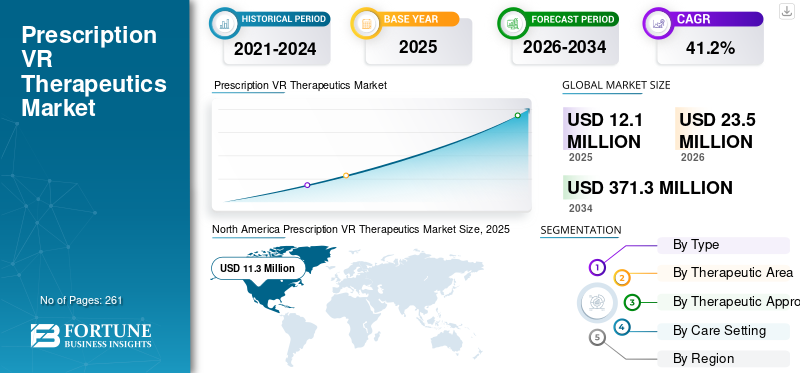
The global prescription VR therapeutics market size was valued at USD 12.1 million in 2025 and is projected to grow from USD 23.5 million in 2026 to USD 371.3 million by 2034, exhibiting a CAGR of 41.2% during the forecast period. North America dominated the prescription VR therapeutics market with a market share of 93.38% in 2025.
Prescription VR therapeutics are FDA-regulated virtual reality software programs prescribed by healthcare specialists for the treatment of psychological and medical conditions. The increasing prevalence of chronic diseases, rising non-invasive treatment options, and expansion of healthcare infrastructure are resulting the growing adoption of prescription digital therapeutics, including virtual reality, in the market. The increasing validation of virtual therapy as a medical device category by regulatory firms is further increasing the demand for these innovative tools among patients.
- For instance, according to the 2022 data published by the World Health Organization (WHO), about 1.71 billion people have musculoskeletal conditions globally.
Furthermore, the growing R&D activities for these products among the major companies, such as AppliedVR, Inc., Wundrsight Private Limited, among others, are further contributing to the adoption rate of these programs in the market.
Download Free sample to learn more about this report.
Peptide Mapping Market Key Takeways
 Global Market Size & Forecast
- 2025 Market Size: USD 765.2 million
- 2026 Market Size: USD 834.5 million
- 2034 Forecast Market Size: USD 1,668.8 million
- CAGR: 9.05% from 2026–2034
 Market Share
- North America dominated the peptide mapping market with a 38.11% share in 2025.
- The monoclonal antibody-derived peptides segment is set to hold a 36.6% share in 2026.
- The pharmaceutical & biotechnology companies segment is set to hold a 55.1% share in 2026.
 Key Regional Highlights
North America
North America maintained its leading position in 2025, with the market valued at USD 291.6 million.
Europe
Europe is projected to expand at a CAGR of 8.36% during the forecast period, supported by a strong biosimilar development ecosystem and established biopharma manufacturing base.
Asia Pacific
Asia Pacific market size is expected to reach USD 221.8 million by 2026, driven by increasing biologics research and manufacturing activities.
U.S.
U.S. The market is projected to reach approximately USD 295.1 million by 2026, leading the North American region.
Japan
Japan The market is estimated to reach around USD 50.5 million by 2026.
Read More

Prescription VR Therapeutics Market Trends
Artificial Intelligence-enabled Personalization and Data-Driven Therapy to be the Key Trend
AI-enabled personalization and data-driven therapy are emerging as a key trend in the global market, as manufacturers are focusing on advanced VR programs toward adaptive and outcome-oriented treatment platforms. Prescription VR therapies generate patient-level data including symptom scores, session completion, engagement, pain intensity, functional progress, and patient-reported outcomes, which help clinicians monitor personalized therapy pathways and support value-based care models.
Additionally, increasing focus on the integration of AI, remote monitoring, triage, and outcome tracking among therapeutic extended reality (XR) companies and a rising number of randomized studies are further contributing to the growing innovations in self-administered VR therapy.
- According to 2023 data published by the National Center for Biotechnology Information (NCBI), it was reported that patients showed reductions in pain intensity and interference after using RelieVRx after 56 days.
Market Dynamics
Market Drivers
Download Free sample to learn more about this report.
Increasing Prevalence of Chronic Conditions to Drive Market Growth
The increasing prevalence of chronic conditions, including musculoskeletal disorders, mental health disorders, and others, is resulting in the rising demand for non-invasive treatment options among the patient population, consequently driving the market demand.
- For instance, according to 2024 data published by the Centers for Disease Control & Prevention (CDC), it was reported that about 1 in 20 adults has coronary artery disease in the U.S.
This, along with the expansion of immersive healthcare technologies, AI-powered patient monitoring, and personalized VR therapy platforms, is further augmenting the adoption rate of these programs in the market. Therefore, the factors above, along with the growing focus of key companies on R&D activities to launch novel devices, are anticipated to fuel the adoption rate of these devices, thereby supporting the global market size.
Market Restraints
Uncertain Reimbursement and Payer Coverage to Hinder the Market Growth
There is an increasing demand for regulatory validation for prescription VR therapeutics; however, limited reimbursement is restraining the commercialization of products. The prescription VR therapeutics systems require the intersection of software, behavioral therapy, durable medical equipment, and digital therapeutics, making pricing, coding, benefit categorization, and coverage decisions complex.
Additionally, these products are often intended for repeated home-based use and require software, headset, clinical onboarding, patient support, and outcome monitoring, resulting in growing treatment costs among patients. Thus, limited reimbursement is expected to hamper the adoption, thereby limiting the growth of the market.
- For instance, according to 2022 data published by APACMed, it was reported that there are no explicit standards or guidelines for digital health reimbursement in India.
Market Opportunities
Integration with Value-Based Care and Remote Monitoring To Bring Lucrative Market Growth Opportunities
The incorporation of value-based care and remote monitoring presents a strong opportunity for the market. Prescription VR therapeutics delivers immersive therapy sessions and generates patient-level data on session completion, therapy adherence, symptom improvement, pain intensity, pain interference, and functional outcomes, resulting in growing demand for these value-based care models, where payers and providers increasingly emphasize measurable clinical outcomes rather than only treatment volume.
Additionally, remote monitoring further enhances the commercial value of prescription VR therapeutics by enabling clinicians to track patient engagement and therapeutic response outside the healthcare setting.
- According to 2022 data published by the American Medical Association, CMS recognizes Remote Therapeutic Monitoring code 98977 for musculoskeletal-system monitoring, including therapy adherence, therapy response, and digital therapeutic intervention for 16–30 days. This creates an opportunity for prescription VR therapeutics to integrate with remote monitoring and value-based care models, especially in chronic pain and musculoskeletal conditions.
Market Challenges
Limited Healthcare Access in Developing Countries to Limit the Market Growth
There is a growing demand for non-invasive treatment options among the patient population. However, shortage of technologically advanced devices, limited healthcare spending, and reimbursement policies, coupled with limited real-world evidence to support the treatment programmes, particularly in developing nations, are resulting in limited access to advanced treatment options among the patient population.
Moreover, shortage in the number of healthcare specialists, data privacy concerns, lack of awareness among healthcare professionals, among others, are some of the vital factors resulting in the inadequate access to advanced healthcare treatment among the patient population, especially in emerging nations, such as India, China, among others. Additionally, ensuring clinical validation, long-term treatment effectiveness, and seamless integration with healthcare systems also creates challenges, further hampering the prescription VR therapeutics market growth.
- For instance, according to 2023 data published by The World Bank Group, approximately 4.5 billion people lack full access to essential health services worldwide.
Other Prominent Challenges
- Regulatory complexities related to prescription-based vr healthcare solutions.
SEGMENTATION ANALYSIS
By Type
Increasing Prevalence of Chronic Conditions Propels the Integrated Prescription VR Therapeutic Segment’s Dominance
Based on the type, the market is classified into integrated prescription VR therapeutic systems, therapeutic software & content modules, and clinical management & support services.
The integrated prescription VR therapeutic systems segment held the largest revenue share in 2025. The growth is due to the increasing prevalence of chronic conditions among patients, resulting in a rising demand for non-invasive treatments worldwide. This, coupled with growing focus of key companies on launching novel integrated devices, is further expected to contribute to the global market growth.
- For instance, according to 2025 data published by the Alzheimer’s Association, more than 7 million Americans are living with Alzheimer's.
The therapeutic software & content modules segment is expected to grow at a CAGR of 42.4% over the forecast period.
To know how our report can help streamline your business, Speak to Analyst
By Therapeutic Area
Pain Management Leads Due to Rising Number of Surgical Procedures
Based on therapeutic area, the market is segmented into pain management, mental & behavioral health, neurological & cognitive disorders, rehabilitation & functional recovery, and others.
The pain management segment dominated the global market in 2025 with a share of 70.6% in 2025. The growth is due to the increasing prevalence of chronic disorders and growing number of surgical procedures, resulting in a growing demand for prescription VR therapeutics for pain management, thereby supporting the adoption rate of these devices in the market.
- For instance, according to 2025 statistics published by the Osteoarthritis (OA) Action Alliance, about 32.5 million adults are affected by osteoarthritis in the U.S.
The mental & behavioral health segment is set to flourish with a growth rate of 44.7% across the forecast period.
By Therapeutic Approach
Prevalence of Mental Health Disorders Is Pushing the Governance of VRET Segment
Based on the therapeutic approach, the market is segmented into Virtual Reality Exposure Therapy (VRET), Cognitive Behavioral Therapy (CBT), and others.
The Virtual Reality Exposure Therapy (VRET) segment dominated the global market in 2025 with a share of 59.9% in 2025. The growth is due to the growing prevalence of mental health disorders, including anxiety disorders among others, resulting in the adoption of virtual reality exposure therapy (VRET) devices, thereby contributing to the segmental growth in the market.
- For instance, according to 2024 data published by the World Health Organization (WHO), an estimated 3.9% of the population has had post-traumatic stress disorder (PTSD) at some stage in their lives globally.
The Cognitive Behavioral Therapy (CBT) segment is set to flourish with a growth rate of 42.4% across the forecast period.
By Care Setting
Homecare Settings is the Most Favored Care Setting Due to Preference for At-Home Treatment Options
Based on the care setting, the market is classified into hospitals, specialty clinics, homecare settings, and others.
The homecare settings segment dominated the market in 2025. The increasing prevalence of chronic conditions, rising adoption of prescription VR therapeutics, growing preference towards at-home treatment options, among others, are some of the key factors contributing to the growth of the segment in the market. Furthermore, the segment is set to hold a 56.2% share in 2026.
- For instance, according to a 2021 survey published by the Homecare Association, more than 35% of people surveyed chose care in their own home, with 38% of over 65-year-olds preferring to opt for home care in the U.K.
In addition, specialty clinics are projected to grow at a 42.1% CAGR during the forecast period.
Prescription VR Therapeutics Market Regional Outlook
Based on region, the market has been studied across North America, Europe, Asia Pacific, Latin America, and the Middle East & Africa.
North America
North America Prescription VR Therapeutics Market Size, 2025 (USD Million)
To get more information on the regional analysis of this market, Download Free sample
The North America market held the dominant share in 2024, valued at USD 5.2 million, and also took the leading share in 2025 with USD 11.3 million. The growing prevalence of chronic conditions, advanced healthcare infrastructure, and growing adoption of prescription VR therapeutics, among others, are some of the factors contributing to the growth of the segment in the market.
- For instance, according to 2023 statistics published by the Parkinson's Foundation, approximately 1.1 million people affects Parkinson’s Disease in the U.S.
U.S. Prescription VR Therapeutics Market
Based on North America’s strong contribution and the U.S.’s dominance within the region, the U.S. market can be analytically approximated at around USD 20.9 million in 2026, accounting for roughly 89.1% of global market sales.
Europe
Europe is projected to record a growth rate of 50.9% in the coming years, which is the second highest among all regions, and reach a valuation of USD 1.3 million by 2026. The growing healthcare expenditure is likely to support the regional market growth.
U.K Prescription VR Therapeutics Market
The U.K. market in 2026 is estimated at around USD 0.3 million, representing roughly 1.2% of global market revenues.
Germany Prescription VR Therapeutics Market
Germany’s market is projected to reach approximately USD 0.3 million in 2026, equivalent to around 1.2% of global prescription VR therapeutics sales.
Asia Pacific
Asia Pacific is estimated to reach USD 0.4 million in 2026 and secure the position of the third-largest region in the market. The increasing prevalence of chronic conditions and improving healthcare access are likely to support the growth of the regional market.
Japan Prescription VR Therapeutics Market
The Japan market in 2026 is estimated at around USD 0.1 million, accounting for roughly 0.5% of global revenues. Japan is expected to grow due to the rising prevalence of chronic disorders, with a widespread adoption of non-invasive treatment options, including VR technology.
China Prescription VR Therapeutics Market
China’s market is expected to be one of the largest markets globally, with 2026 revenues estimated at around USD 0.1 million, representing roughly 0.5% of global sales.
India Prescription VR Therapeutics Market
The India market size in 2026 is estimated at around USD 0.1 million, accounting for roughly 0.2% of global revenues.
Latin America and Middle East & Africa
The Latin America and Middle East & Africa regions are expected to witness moderate growth in this market space during the forecast period. The Latin America market is set to reach a valuation of USD 0.02 million in 2026. The growth is due to the gradual growth tied to public healthcare investment and demand for clinically validated digital health solutions in the region. Middle East & Africa is also expected to grow due to the rising number of product approvals among the key companies in the market. In the Middle East & Africa, the GCC is set to reach a value of USD 0.01 million in 2026.
South Africa Prescription VR Therapeutics Market
The South Africa market is projected to reach around USD 0.01 million in 2026, representing roughly 0.03% of global revenues.
Competitive Landscape
Key Industry Players
Increasing Number of Companies Receiving Insurance Code to Support Their Dominance
AppliedVR, Inc., and Smileyscope are major companies in the market in 2025. A significant product channel, along with a strong emphasis on inorganic growth strategies worldwide, is one of the key factors contributing to the dominance of these companies in the market. Moreover, the growing focus of key companies on receiving health insurance coverage is likely to support their global prescription VR therapeutics market share.
- For instance, in March 2023, AppliedVR, Inc., an immersive therapeutics (ITx) company advancing a novel approach to medicine, announced that the Centers for Medicare and Medicaid Services (CMS) established a unique Healthcare Common Procedure Coding System (HCPCS) Level II code (E1905) for its flagship product, the RelieVRx program.
Other key players, including Floreo and others, are also growing in the market, primarily due to their increasing focus on mergers with other companies to strengthen their presence in the market.
List of Key Prescription VR Therapeutics Companies Profiled
- AppliedVR, Inc. (U.S.)
- Smileyscope (U.S.)
- Floreo (U.S.)
- Mindmaze SA (Switzerland)
- HypnoVR (France)
- BiPSEE Inc. (Japan)
- Sana Health Inc (U.S.)
- Rocket VR Health (U.S.)
- C2CARE (France)
KEY INDUSTRY DEVELOPMENTS
- April 2026: Floreo, a developer of virtual reality (VR)-based therapeutic technologies, announced the submission of a De Novo request to the U.S. FDA for FloreoRx, its software-based product being evaluated for use in supporting skill development in individuals with Autism Spectrum Disorder.
- February 2024: AppliedVR, Inc., a medical device company advancing a novel, virtual reality-based approach to medicine, collaborated with Kernel to measure the impact of VR pain treatment on the brain. This helped the company in increasing its brand presence.
- November 2023: Smileyscope received U.S. FDA Class II approval for its virtual reality (VR) device for acute pain. This approval recognizes Smileyscope's innovative Procedural Choreography technique, which uses positive virtual stimuli to reduce pain and anxiety during medical procedures.
- November 2023: AppliedVR Inc., an immersive therapeutics (ITx) company advancing a novel, virtual reality-based approach to medicine, announced results from a large randomized controlled trial (RCT), evaluating virtual reality (VR) therapy for treating chronic low back pain (CLBP) at home.
- October 2023: HypnoVR, a company offering digital therapies to manage pain and anxiety, acquired Belgian company Oncomfort, the inventor of Digital Sedation, a pharmacological method of relieving patients’ pain and anxiety. This helped the company in strengthening its presence in the market.
- July 2023: AppliedVR, Inc., collaborated with the National Cancer Institute (NCI) and announced interim analysis results of a phase 2 clinical trial study. The phase 2 clinical trial explored whether virtual reality (VR) could be an intervention for primary brain tumor (PBT) patients who experience distress and anxiety before their clinical evaluations.
- December 2022: BehaVR merged with OxfordVR, supported by an initial USD 13.0 million in Series B funding led by Optum Ventures and Oxford Science Enterprises, to create a VR delivery platform for evidence-based digital behavioral therapies, further accelerating the combined company's growth strategy.
REPORT COVERAGE
The report provides a detailed global prescription VR therapeutics market analysis and focuses on key aspects such as leading companies and market segmentation, including type, therapeutic area, therapeutic approach, and care setting. Besides this, the global report offers insights into the market growth trends and highlights key industry developments. In addition to the aforementioned factors, the report encompasses several factors that have contributed to the growth and advancement of the market over recent years.
Request for Customization to gain extensive market insights.
Report Scope & Segmentation
| ATTRIBUTE | DETAILS |
| Study Period | 2021-2034 |
| Base Year | 2025 |
| Estimated Year | 2026 |
| Forecast Period | 2026-2034 |
| Historical Period | 2021-2024 |
| Growth Rate | CAGR of 41.2% from 2026-2034 |
| Unit | Value (USD Million) |
| Segmentation | By Type, Therapeutic Area, Therapeutic Approach, Care Setting, and Region |
| By Type |
|
| By Therapeutic Area |
|
| By Therapeutic Approach |
|
| By Care Setting |
|
| By Region |
|
Frequently Asked Questions
Fortune Business Insights says that the global market size was USD 12.1 million in 2025 and is projected to reach USD 371.3 million by 2034.
In 2025, the North America regional market value stood at USD 11.3 million.
Growing at a CAGR of 41.2%, the market will exhibit steady growth over the forecast period.
By type, the integrated prescription VR therapeutic systems segment is the leading segment in this market.
The introduction of novel prescription VR therapeutic devices is one of the major factors driving the market's growth.
AppliedVR, Inc. and Smileyscope are the major players in the global market.
North America dominated the market share in 2025.
Growing prevalence of chronic conditions, increasing demand for prescription VR therapeutic devices, among others, are some of the vital factors expected to boost the adoption of these devices globally.



- 2021-2034
- 2025
- 2021-2024
- 261
Get 30-60 hrs Free Customization
Expand Regional and Country Coverage, Segments Analysis, Company Profiles, Competitive Benchmarking, and End-user Insights.













.webp)






Related Reports
-
US +1 833 909 2966 ( Toll Free )
-
Get In Touch With Us