Protein Ice-Cream Market Size, Share & Industry Analysis, By Protein Source (Dairy-based Protein and Plant-based Protein), By Packaging (Tubs/Pints, Bars & Sticks, and Others), By Distribution Channel (Supermarkets/Hypermarkets, Convenience Stores, Specialty Stores, and Online Retail) and Regional Forecast, 2026-2034
 Download Free Sample
(Offer valid till 30th Sep 2026)

Protein Ice-Cream Market Size and Future Outlook
 Listen to Audio Version
The protein ice-cream market size was valued at USD 1.90 billion in 2025. The market is projected to grow from USD 2.02 billion in 2026 to USD 3.37 billion by 2034, exhibiting a CAGR of 6.62% during the forecast period. North America dominated the protein ice-cream market with a market share of 44.21% in 2025.
Protein ice-cream is a frozen dessert comprising elevated protein content, which is mainly sourced from plant-based/dairy (casein or whey) components. Originally, the concept of protein-based ice cream emerged in North America as part of the high-protein food movement. With respect to target end-users, this ice-cream is highly preferred by athletes, fitness enthusiasts, and people following calorie-controlled or high-protein diets. Compared to regular ice cream, it contains a reduced amount of fat and sugar, which appeals to a wide health conscious consumers base. The growing fitness trends and surging inclination toward functional foods are key drivers boosting the market’s potential. Geographically, North America and Europe are considered the key consumers of protein ice-creams.
Companies such as Unilever Plc, Protein Pints, and Blue Bell are prominent players in the market. New product launches are a pivotal strategy adopted by key players to improve their position.
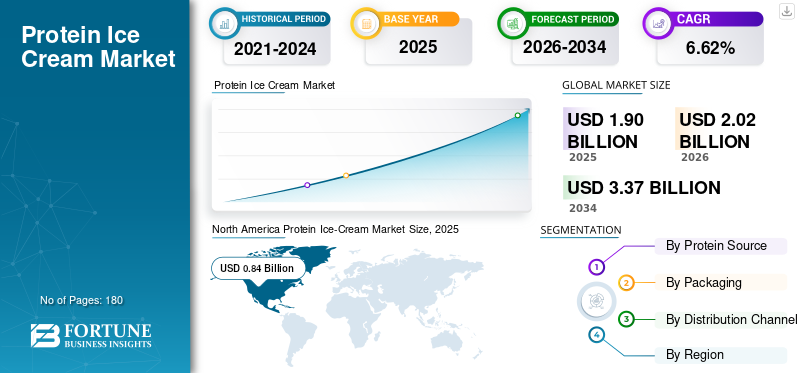
Download Free sample to learn more about this report.
Protein Ice Cream Market Key Takeaways
 Global Market Size & Forecast
- 2025 Market Size: USD 1.90 Billion
- 2026 Market Size: USD 2.02 Billion
- 2034 Forecast Market Size: USD 3.37 Billion
- CAGR: 6.62% from 2026–2034
 Market Share
- North America dominated the protein ice-cream market with a 44.21% share in 2025.
- The dairy-based protein segment led the market in 2025.
- The tubs/pints packaging segment held the largest market share in 2025.
 Key Regional Highlights
North America
North America led the market with a value of USD 0.84 billion in 2025.
Europe
Europe reached USD 0.49 billion in 2025 and is projected to grow at a 5.90% rate.
Asia Pacific
Asia Pacific recorded USD 0.34 billion in 2025, supported by innovative product launches.
U.S
The market reached USD 0.65 billion in 2025.
Japan
The market reached USD 0.07 billion in 2025.
Read More

PROTEIN ICE-CREAM MARKET TRENDS
Rising Shift Toward Dairy-Free/Plant-based Variants is Emerging Market Trend
The global industry is witnessing a phenomenal trend toward vegan or dairy-free products. In this modern era, dairy-free/plant-based ice-creams are gaining traction as individuals are seeking products that are associated with cleaner eating preferences. Most brands are utilizing protein sources such as oats, peas, and soy, often blended with cashew or coconut, to enhance mouthfeel and creaminess. This trend is also fueling the need for precise and advanced formulation strategies, as plant-based protein can create difficulties such as poor solubility, earthy flavors, and grainy textures. To address these concerns, producers are enhancing fat replacement technologies, stabilizer systems, and protein processing to offer products that mimic the sensory attributes of conventional ice-creams.
MARKET DYNAMICS
MARKET DRIVERS
Download Free sample to learn more about this report.
Expansion of Active Lifestyles and Fitness Culture Drives Market Growth
The expansion of active lifestyles and fitness culture adoption is a main driver fueling the consumption of protein ice-creams. Recently, the surging influence of digital media platforms, increasing gym memberships, and recreational activities, has substantially improved awareness of protein intake and its role in satiety and muscle recovery. This shift is no longer restricted to athletes and now encompasses a wider consumer base, who actively participate in wellness regimes. As a result, there is a rising demand for ready-to-eat and convenient products, and protein ice-creams fit well in this trend. This proteinaceous frozen dessert can be consumed as a post workout snack or as a healthier substitute to regular ice-creams, further appealing to a wide consumer base. These factors collectively drive the protein ice-cream market growth.
MARKET RESTRAINTS
Texture and Taste Challenges Minimize Chances of Repeat Purchases Hampering Market Expansion
One of the key hurdles in the global market is replicating the similar taste and texture of traditional ice-cream. The inclusion of protein components such as casein or whey, combined with minimal fat and sugar content, can hamper the ice-cream’s structure, often resulting in a grainy, chalky, and icier texture. Moreover, protein concentrates and sweetener substitutes can create aftertaste challenges, thereby impacting overall acceptance. Additionally, protein-based ice-creams can easily become harder, specifically at low temperatures, which affects scoopability. Along with this, variations in temperatures during retail storage or distribution can weaken the end product’s mouthfeel and smoothness.
MARKET OPPORTUNITIES
Utilization of Modern Technologies in Ice-Cream Sector Builds Market Growth Opportunities
The adoption of advanced technologies in the ice-cream industry creates numerous growth opportunities. Specifically, in the protein ice-cream sector, the producers are using protein fractionation and microfiltration techniques. These techniques help in enhancing dispersion within the mix and minimizing off-notes. Encapsulation technology is another emerging method adopted by companies. Through this, the producers can mask off-flavors and protect sensitive components. Moreover, improvements in blending and fermentation techniques help in attaining more stable emulsions and smoother textures. Besides this, innovations in texture optimization and fat replacements also unlocks various growth possibilities.
Segmentation Analysis
By Protein Source
Dairy-based Protein Dominated Due to Its Better Digestibility
Based on protein source, the market is divided into dairy-based protein and plant-based protein.
The dairy-based protein sector led the market in 2025. Compared to vegan proteins, dairy-based proteins offer a complete amino acid profile and are easy to digest. These components have improved solubility in frozen systems and also exhibit stronger emulsification properties. Moreover, dairy proteins impart a neutral or mild taste and contribute to a creamier and richer texture. Additionally, it has minimal requirements for masking and additive agents, further boosting the segment’s growth.
The plant-based protein is projected to grow at a high CAGR of 8.58% over the forecast period.
By Packaging
Tubs/Pints Led the Market Due to Higher Consumption Volume
On the basis of packaging, the market is distributed into tubs/pints, bars & sticks, and others.
In 2025, the tubs/pints segment held largest protein ice-cream market share. Tubs/pints mostly provide a benefit of lower cost/serving, which makes them affordable for regular buyers. This pack size offers greater flexibility in portion control and aligns with calorie-sensitive dietary patterns. Moreover, the majority of the ice-cream brands prioritize introducing new formulations and flavors in pint format, which further fuels the segment’s expansion. Additionally, stronger retail shelf visibility propels segment growth.
The bars & sticks are projected to grow at a high CAGR of 8.36% over the forecast period.
To know how our report can help streamline your business, Speak to Analyst
By Distribution Channel
Supermarkets/Hypermarkets Leads Owing to Extensive Product Assortment
Based on distribution channel, the market is segmented into supermarkets/hypermarkets, convenience stores, specialty stores, and online retail.
The supermarkets/hypermarkets lead the industry. It offers a broad array of formats, brands, and flavors, which allows easy choice and comparison. These large outlets captivate a wide consumer base, mainly due to their accessibility and affordability. Moreover, advanced refrigeration systems help in supporting large-scale distribution of ice creams and maintain the end product’s quality. Also, the option of bulk purchasing and promotional discounts during festivals further drives the segment’s momentum.
The online retail is projected to grow at a high CAGR of 8.45% over the forecast period.
Protein Ice-Cream Market Regional Outlook
By geography, the market is categorized into Europe, North America, Asia Pacific, South America, and the Middle East & Africa.
North America
North America Protein Ice-Cream Market Size, 2025 (USD Billion)
To get more information on the regional analysis of this market, Download Free sample
North America dominates the market, reaching a valuation of USD 0.84 billion in 2025. The market in North America is expected to grow due to surging consumer preferences for plant based protein and increasing health conscious individuals. Moreover, the demand for innovative flavors of high protein ice-cream and the adoption of advanced technologies are also driving regional growth.
U.S. Protein Ice-Cream Market
Based on North America's strong contribution, the U.S. market reached USD 0.65 billion in 2025, accounting for roughly 34.18% of global sales.
Europe
Europe was valued at USD 0.49 billion in 2025, recording a growth rate of 5.90% in the coming years, and secured the second position. The rising demand for protein ice-creams and the robust online platforms are boosting regional potential.
Germany Protein Ice-Cream Market
The German market in 2025 was at USD 0.12 billion, representing roughly 6.15% of the global market revenues.
U.K. Protein Ice-Cream Market
The U.K. market was valued at USD 0.10 billion in 2025, equivalent to around 5.35% of the global market sales.
Asia Pacific
The Asia Pacific region reached at USD 0.34 billion in 2025 and held third position globally. Innovative product launches and the surge in consumers seeking keto-friendly products strengthen the region's potential.
India Protein Ice-Cream Market
The India market in 2025 was at USD 0.06 billion, accounting for roughly 3.02% of the global market revenues.
China Protein Ice-Cream Market
China's market is projected to be one of the largest worldwide, and its revenues stood USD 0.12 billion in 2025, accounting for roughly 6.47% of global market sales.
Japan Protein Ice-Cream Market
The Japan market in 2025 was valued at USD 0.07 billion, accounting for approximately 3.89% of the global market revenues.
South America and Middle East & Africa
The South America and Middle East & Africa regions are expected to witness moderate growth during the forecast period. The South America market reached USD 0.14 billion in 2025. The expanding functional foods industry and rising popularity of high protein diets are expected to drive this demand. The Middle East and Africa market was at USD 0.09 billion in 2025.
South Protein Ice-Cream Market
The South African market reached USD 0.03 billion in 2025, representing roughly 1.50% of global revenues.
COMPETITIVE LANDSCAPE
Key Industry Players
Innovative Product Launches by Key Players Increasing Market Competition
The protein ice-cream sector is recognized as a moderately fragmented market that comprises a mix of emerging and multinational ice-cream players. The competition is mainly centered on expansion across retail channels, new product launches, and clean-label positioning. Moreover, the players should try to enter into acquisitions or joint ventures to improve their position in the global market.
LIST OF KEY PROTEIN ICE-CREAM COMPANIES PROFILED
- Unilever Plc (U.K.)
- Yasso Inc. (U.S.)
- Rebel Creamery LLC (U.S.)
- Protein Pints (U.S.)
- Gujarat Co-operative Milk Marketing Federation Ltd. (India)
- Arctic Zero Inc. (U.S.)
- Heritage Foods Ltd (India)
- Beyond Better Foods LLC (U.S.)
- Blue Bell (U.S.)
- Go Zero (India)
KEY INDUSTRY DEVELOPMENTS
- March 2026: Protein Pints, an American Protein Ice-Cream enterprise, revealed new flavors of protein ice-creams, which include banana graham slam and salted caramel. Each pint offers 30 grams of protein and is gluten-free.
- March 2026: Blue Bell, a U.S. based producer of ice cream, introduced a line of protein ice-cream for Americans. The new range provides 12 grams of protein per serving and is available in five flavors.
- April 2025: Amul, one of the biggest FMCG brands in India, released protein kulfi for Indian consumers. This product is lactose-free, low in fat, and free from added sugar.
- April 2025: Two Spoons Creamery, a frozen yogurt chain in Australia, announced the launch of its first-ever high-protein ice-cream with GLP-1 compatibility and zero added sugar.
- February 2024: Perfect Day, a precision fermentation supplier in the U.S., collaborated with Breyer’s, a brand of Unilever, a British consumer packaged goods firm, to unveil a lactose-free protein-rich chocolate ice cream. This frozen item is available in a 48-oz tub pack size.
REPORT COVERAGE
The global protein ice-cream market provides an in-depth study of the market size & forecast by all the market segments included in the market reports. The market forecast analysis includes details on the market dynamics and trends expected to drive the market during the forecast period. The market analysis offers information on the technological advancements, new product launches, key industry developments, and details on partnerships, mergers & acquisitions. The industry forecast also encompasses a detailed competitive landscape with information on the market segmentation, market share, and profiles of key operating players.
Request for Customization to gain extensive market insights.
Report Scope & Segmentation
| ATTRIBUTE | DETAILS |
| Study Period | 2021-2034 |
| Base Year | 2025 |
| Estimated Year | 2026 |
| Forecast Period | 2026-2034 |
| Historical Period | 2021-2024 |
| Growth Rate | CAGR of 6.62% from 2026-2034 |
| Unit | Value (USD Billion) |
| Segmentation | By Protein Source, Packaging, Distribution Channel, Region |
| By Protein Source |
|
| By Packaging |
|
| By Distribution Channel |
|
| By Geography |
|
Frequently Asked Questions
Fortune Business Insights says that the global market value stood at USD 1.90 billion in 2025 and is projected to reach USD 3.37 billion by 2034.
In 2025, the North America market value stood at USD 0.84 billion.
The market is expected to exhibit a CAGR of 6.62% during the forecast period of 2026-2034.
By protein source, the dairy-based segment led the global market.
Expansion of active lifestyles and fitness culture drives market growth.
Unilever Plc, Protein Pints, and Blue Bell are top players in the market.
North America held the largest market share.
Rising shift toward dairy-free/plant-based variants is the current market trend.



- 2021-2034
- 2025
- 2021-2024
- 180
-
(Offer valid till 30th Sep 2026)
Get 30-60 hrs Free Customization
Expand Regional and Country Coverage, Segments Analysis, Company Profiles, Competitive Benchmarking, and End-user Insights.




















Related Reports
-
US +1 833 909 2966 ( Toll Free )
-
Get In Touch With Us