Protein Sequencing Market Size, Share & Industry Analysis, By Product & Services (Instruments, Reagents & Consumables, and Software and Services), By Technology (Mass Spectrometry, Edman Degradation, Next Generation Sequencing, and Others), By Application (Biotherapeutics & Biologics Characterization, Proteomics & Biomarker Discovery, Drug Discovery & Target Validation, Genetic Engineering & Synthetic Biology, and Others), By End User (Pharmaceutical & Biotechnology Companies, CROs & CDMOs, Academic & Research Institutes, and Others), and Regional Forecast, 2026-2034
 Download Free Sample
Protein Sequencing Market Size and Future Outlook
 Listen to Audio Version
The global protein sequencing market size was valued at USD 2.29 billion in 2025 and is projected to grow from USD 2.39 billion in 2026 to USD 3.45 billion by 2034, exhibiting a CAGR of 4.72% during the forecast period. North America dominated the global protein sequencing market with a market share of 41.48% in 2025.
The protein sequencing market is witnessing a noteworthy growth trajectory during the forecast period. The increasing advancements in analytical techniques and a growing demand for detailed protein analysis across the pharmaceutical and biotechnology sectors are contributing to market growth.
The rising prevalence of chronic diseases and genetic disorders, and the increasing adoption of protein sequencing for biomarker discovery, personalized medicine, and therapeutic protein characterization, are propelling market growth. Additionally, rising funding activities for research are likely to boost market growth.
- For instance, in October 2025, the University of Oulu received funding of USD 3.25 million from the European Innovation Council (EIC) to develop a novel optical technology for sequencing individual protein molecules.
The major players in the market include Thermo Fisher Scientific Inc., Agilent, with a robust portfolio and strategic activities, supporting the dominance of these companies in the market.
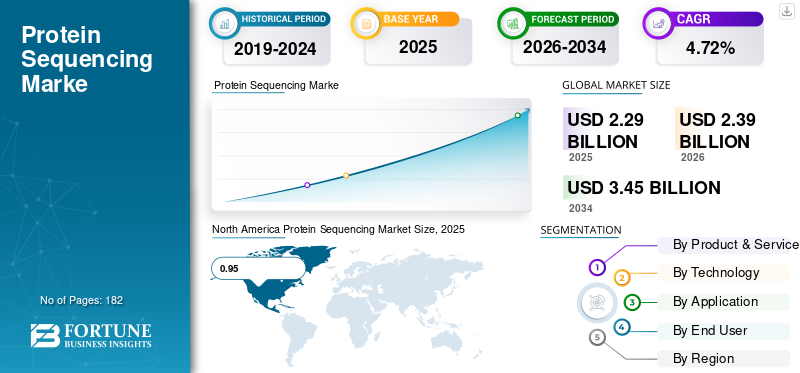
Download Free sample to learn more about this report.
Protein Sequencing Market Takeaways
 Market Size & Forecast
- 2025 Market Size: USD 2.29 billion
- 2026 Market Size: USD 2.39 billion
- 2034 Forecast Market Size: USD 3.45 billion
- CAGR: 4.72% from 2026–2034
 Market Share
- North America dominated the protein sequencing market with a 41.48% share in 2025.
- The sequencing systems segment held the leading share of 80.8% in 2025.
- The biotherapeutics & biologics characterization segment accounted for 44.7% of the market in 2025.
 Key Regional Highlights
North America
North America led the global market with a valuation of USD 0.95 billion in 2025 and remained the largest regional market.
Europe
Europe represented the second-largest regional market, reaching a valuation of USD 0.62 billion in 2025.
Asia Pacific
Asia Pacific secured the third-largest position, with the market valued at USD 0.55 billion in 2025.
U.S.
The U.S. protein sequencing market was valued at USD 0.88 billion in 2025, supported by strong biotechnology and pharmaceutical research activities.
Japan
Japan remains a significant Asia Pacific market, benefiting from continued investments in proteomics research and advanced life science technologies.
Read More

MARKET DYNAMICS
MARKET DRIVERS:
Rising Demand for Protein Therapeutics to Propel Market Growth
The rising demand for protein therapeutics, driven by the increasing prevalence of chronic diseases such as cancer, cardiovascular disorders, and genetic conditions, is significantly driving the global protein sequencing market demand.
Additionally, key pharma and biotech companies are focusing on developing and launching new products using protein sequencing to boost the growth of the market.
- For instance, in June 2025, CSL announced the U.S. Food and Drug Administration (FDA) approval for ANDEMBRY. Additionally, the only treatment targeting factor XIIa for prophylactic use to prevent attacks of hereditary angioedema (HAE) in adult and pediatric patients aged 12 years and older.
MARKET RESTRAINTS:
High Cost of Protein Sequencing Equipment to Restrict Market Growth
The high cost of the required equipment is one of the primary restraints on market growth. The advanced protein sequencing instruments, such as mass spectrometers and next-generation sequencers, involve significant capital investment. The high price point limits accessibility for many research laboratories, academic institutes, research centers, and smaller biotech companies, thereby restricting widespread adoption.
- For instance, as per a commercial website, the cost of Double Beam Portable LCMS/MS Liquid Chromatography Mass Spectrometry in India is around USD 239,014.3. Such a high cost of equipment hinders adoption among small-sized companies and start-ups, thereby restricting market growth.
MARKET OPPORTUNITIES:
Rising Funding Activities to Create Lucrative Growth Opportunities
The increased funding for proteomics research activities in the biotechnology sector is opening up significant opportunities in the market for protein sequencing. The rising focus of start-ups and small companies on investments and finding ways to expand their product portfolios and offer advanced products for sequencing, which are affordable and reproducible.
- For instance, in July 2025, Portal Biotech raised USD 32.4 million in a Series A funding round. The company is focused on utilizing nanopore-based protein sequencing, which allows the identification and analysis of proteins at the single-molecule level. This technique is employed to achieve highly accurate and rapid protein sequencing.
PROTEIN SEQUENCING MARKET TRENDS:
Automation and Workflow Integration is a Key Trend in the Market
Automation and workflow integration are emerging as key global protein sequencing market trends. AI integration increases efficiency, accuracy, and throughput, offering faster and more reliable methods for protein analysis. Automated systems also reduce manual intervention, minimize errors, and streamline complex sequencing processes. Additionally, QQaD is focusing on offering automation across the systems and platforms for revolutionizing the protein sequencing landscape in complex biological research.
- For instance, in June 2025, Ainnocence launched the BioSynthAI platform. The platform leverages cutting-edge AI algorithms to optimize protein and enzyme activity through in-silico design. This platform is aimed at accelerating innovation across biopharmaceuticals and sustainable biotechnology.
MARKET CHALLENGES:
Limited Availability of Skilled Personnel to Challenge Market Growth
The protein sequencing market is constrained by a limited pool of professionals who can operate advanced mass spectrometers, design proteomics experiments, and handle complex bioinformatics workflows. This skills gap slows down the adoption of high-end platforms, and thus hampers the overall protein sequencing market growth.
Download Free sample to learn more about this report.
Segmentation Analysis
By Product & Services
Continuous Adoption of Reagents & Consumables Propelled Segmental Growth
By product & services, the market is divided into instruments, reagents & consumables, and software and services.
To know how our report can help streamline your business, Speak to Analyst
The reagents & consumables segment held a dominant portion of the protein sequencing market share in 2025, driven by the continuous adoption of reagents and consumables for proteomics, research studies, and drug development. Additionally, increasing product launches of kits to drive the protein sequencing products and services segment.
- For instance, in September 2025, Quantum-Si Incorporated launched the V4 Sequencing Kit. The new kit is compatible with both the Platinum and Platinum Pro instruments and improves sequencing coverage.
The instruments segment is expected to grow at a CAGR of 3.96% over the forecast period.
By Technology
High Sensitivity and New Product Commercialization to Boost Mass Spectrometry Segment’s Growth
In terms of technology, the market is categorized into mass spectrometry, Edman degradation, next-generation sequencing, and others.
The mass spectrometry segment held the maximum portion of the market. In 2025, the segment is anticipated to dominate with an 80.8% share due to the system's ability to offer high sensitivity, accuracy, and throughput. The mass spectrometry instruments enable the identification and sequencing of thousands of proteins and peptides in complex samples in a single run. The increasing product launches and the commercialization of advanced systems are likely to boost market growth.
- In May 2025, Bruker Corporation announced the launch of the timsOmni system. It is a new mass spectrometer, based on the timsTOF platform, designed for scientific research, drug discovery, clinical applications, and advanced quality control of biologics.
The next-generation sequencing segment is expected to grow at a CAGR of 12.34% over the forecast period.
By Application
Increasing Product Adoption for Biopharmaceutical Manufacturing Purposes to Boost the Drug Segments' Growth
Based on application, the market is segmented into biotherapeutics & biologics characterization, proteomics & biomarker discovery, drug discovery & target validation, genetic engineering & synthetic biology, and others.
The biotherapeutics & biologics characterization segment held the dominating position in 2025. The biotherapeutics & biologics characterization segment held the share of 44.7% in 2025, attributed to the increasing adoption of pharma and biotech companies on detailed protein structural analysis to develop complex biologics such as monoclonal antibodies, fusion proteins, and biosimilars. Additionally, the launch of new platforms for biotherapeutics launch to boost the segment’s growth in the market.
- In September 2025, Illumina Inc. announced the launch of Illumina Protein Prep for next-generation sequencing (NGS) based proteomics discovery. This system helps to enable researchers for discovery and clinical research of proteomics across cancer and cardio metabolic, and immunologic diseases.
The proteomics & biomarker discovery segment is set to flourish with a growth rate of 5.53% during the forecast period.
By End User
Increasing Investments and Research Activities to boost the Pharmaceutical & Biotechnology Companies Segment Growth
Based on end user, the market is segmented into pharmaceutical & biotechnology companies, CROs & CDMOs, academic & research institutes, and others.
In 2025, the pharmaceutical & biotechnology companies segment is expected to witness a leading growth trajectory and is set to hold 49.8% share in 2025. The increasing focus on developing protein therapeutics and the presence of robust facilities for development and clinical studies to boosting the segment’s growth in the market.
- For instance, in June 2025, BioNTech SE and Bristol Myers Squibb collaborated for the co-development and co-commercialization of BioNTech’s investigational bispecific antibody BNT327 across numerous solid tumor types.
The CROs & CDMOs segment is projected to grow at a CAGR of 5.10% during the study period.
Protein Sequencing Market Regional Outlook
By geography, the market is categorized into Europe, North America, Asia Pacific, Latin America, and the Middle East & Africa.
North America
North America captured the dominant share in 2025, valued at USD 0.95 billion, and maintained its leading share in 2026, with USD 0.98 billion. The dominant share of the region is due to robust synthetic biology infrastructure and the presence of key players with advanced product offerings. In 2025, the U.S. market is estimated to reach USD 0.88 billion. The U.S. is expected to dominate the region's market. The rising investment programs and presence of established and start-up companies with advanced product offerings are expected to boost the country’s growth in the market.
North America Protein Sequencing Market Size, 2025 (USD Billion)
To get more information on the regional analysis of this market, Download Free sample
- For instance, in October 2025, Waters Corporation unveiled the Waters Xevo Charge Detection Mass Spectrometer (CDMS) for the broadest range of mega-mass biomolecules central to next-generation therapeutics and structural biology.
Europe
The region is projected to record a growth rate of 3.91%, which is the second-highest amongst all the regions, and touch the valuation of USD 0.62 billion in 2025. The increasing research and development, proteomics research, and presence of key players in the market with advanced product offerings are primarily driving industry. Backed by these factors, countries including the U.K. are expected to record the valuation of USD 0.13 billion, Germany to record USD 0.15 billion, and France to record USD 0.12 billion in 2025.
Asia Pacific
The market in the region is estimated to reach USD 0.55 billion in 2025 and secure the position of the third-largest region in the market. In the region, China and India are both estimated to reach USD 0.07 and USD 0.18 billion, respectively, in 2025.
Rest Of The World
The Latin America and the Middle East & Africa regions would witness a moderate growth in this market. The Latin America market in 2025 is set to record USD 0.10 billion as its valuation. Growing attention of key players to shift their presence in the region is likely to boost market growth at a slower rate. In the Middle East & Africa, GCC is set to attain the value of USD 0.04 billion in 2025.
COMPETITIVE LANDSCAPE
Key Industry Players:
Strong Focus on Automation to Expand Its Product Portfolio
The global protein sequencing market shows a semi-fragmented structure with a large number of companies actively operating across the globe. The market includes Thermo Fisher Scientific Inc., Agilent, and Sciex are some of the dominating players in the market. The company's dominance in the market is due to its expanded product portfolio and strategic activities.
Other prominent players in the market include Bruker Corporation and Quantum-Si Inc. are major players in the industry. These players are focusing on automation and offer advanced kits and reagents to boost their market presence.
LIST OF KEY PROTEIN SEQUENCING COMPANIES PROFILED:
- Thermo Fisher Scientific Inc. (U.S.)
- Merck KGaA (Germany)
- Agilent(U.S.)
- Shimadzu Corporation (Japan)
- Bruker Corporation(U.S.)
- Waters Corporation(U.S.)
- Bio-Rad Laboratories, Inc. (U.S.)
- SCIEX(U.S.)
- Quantum-Si Inc. (U.S.)
- Illumina, Inc. (U.S.)
KEY INDUSTRY DEVELOPMENTS:
- April 2025: DKSH Business Unit Technology collaborated with Quantum-Si to introduce their next-generation protein sequencing solutions in Taiwan.
- November 2024: Quantum-Si Incorporated entered into a distribution agreement with Avantor to distribute Quantum-Si's Next-Generation Protein Sequencing (NGPS) products across the U.S. and Canada for advanced proteomics solutions.
- October 2024: SCIEX launched the ZenoTOF 7600+ system, accompanied by three new collaborations advancing proteomics capabilities.
- September 2024: GenNext Technologies partnered with Agilent for integrating GenNext’s AutoFox Protein Footprinting System with Agilent’s 6560 IM-QTOF LC/MS platform. This collaboration offers researchers enhanced capabilities for detailed protein structure and biomolecular interaction analysis.
- June 2024: Bruker Corporation introduced the advanced timsTOF Ultra 2 system with improved sample loading flexibility. The system is coupled with the new Spectronaut 19 software and PreOmics ENRICHplus kit, thus establishing new standards in 4D-Proteomics.
REPORT COVERAGE
The global protein sequencing market analysis provides an in-depth analysis of the market size & forecast by all the market segments included in the report. The global protein sequencing market report also comprises new product launches, key industry developments, and details on partnerships, mergers & acquisitions. Additionally, the report offers details on the advancements in protein sequencing technologies, including market dynamics, trends, and opportunities. Moreover, the global market research report also encompasses a detailed competitive landscape with information on the market share and profiles of key operating players.
Request for Customization to gain extensive market insights.
Report Scope & Segmentation
| Study Period | 2021-2034 |
| Base Year | 2025 |
| Forecast Period | 2026-2034 |
| Historical Period | 2019-2024 |
| Growth Rate | CAGR of 4.72% from 2026-2034 |
| Unit | Value (USD Billion) |
| Segmentation |
By Product & Services
By Technology
By Application
By End User
By Geography
|
Frequently Asked Questions
Fortune Business Insights says that the global market value stood at USD 2.29 billion in 2025 and is projected to reach USD 3.45 billion by 2034.
In 2024, the market value stood at USD 0.95 billion.
The market is expected to exhibit a CAGR of 4.72% during the forecast period (2026-2034).
The reagents & consumables segment led the market by product & services.
The key factors driving the market are the rising number of proteomics and biotherapeutics research.
Thermo Fischer Scientific Inc., Agilent are some of the prominent players in the market.
North America dominated the market in 2025.
Increasing the automation in protein sequencing systems to favor product adoption.



- 2021-2034
- 2025
- 2021-2024
- 182
Get 30-60 hrs Free Customization
Expand Regional and Country Coverage, Segments Analysis, Company Profiles, Competitive Benchmarking, and End-user Insights.













.webp)






Related Reports
-
US +1 833 909 2966 ( Toll Free )
-
Get In Touch With Us