Push-To-Talk over Cellular (PoC) Market, Size, Share & Industry Analysis, By End User (Public Safety and Security, Construction, Energy and Utility, Transportation and Logistics, Manufacturing, Travel and Hospitality, and Others), By Solution (Devices (Rugged, Standard, and Others), Software (Cloud and On-Premise), and Services (Network Services, Integration and Deployment Services, and Maintenance and Support Services)), By Enterprise Size (Small, Medium, and Large), and Regional Forecast 2026 to 2034
 Download Free Sample
KEY MARKET INSIGHTS
 Listen to Audio Version
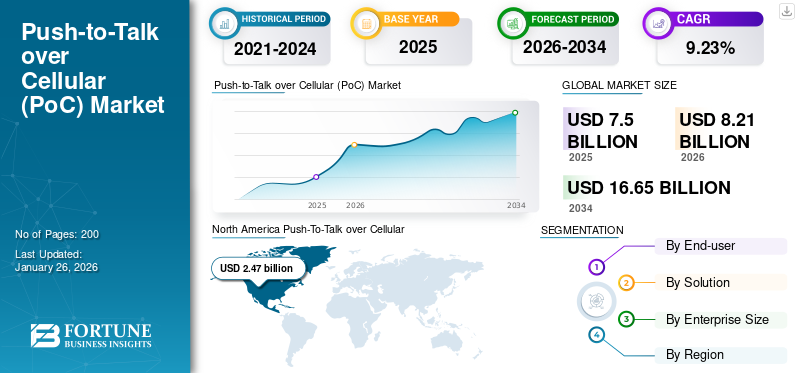
The global Push-To-Talk over Cellular (PoC) market size was valued at USD 7.50 billion in 2025 and is projected to grow from USD 8.21 billion in 2026 to USD 16.65 billion by 2034, exhibiting a CAGR of 9.23% during the forecast period. North America dominated the Push-To-Talk over Cellular (PoC) market with a market share of 32.91% in 2025.
The market has been growing rapidly due to a surge in demand from various industries, including public safety, transportation, and construction, for rapid, efficient, and scripted communication. This technology uses the broadband of cellular networks to provide users with instant communication, improving the efficiency of businesses. An increase in thefts in financial services, public transportation, and the challenges posed by natural disasters, among other things, have led some users to demand the ability to communicate with others even without an Internet connection, especially in the military sector.
Major players in the market are AT&T, Motorola Solutions, Sonim Technologies, Zebra Technologies, Hytera US, and others. These companies continuously inspect better push-to-talk over cellular (PoC) technologies, including evolution from 2G to 5G and AI and IoT Integration. Key programs include integration with data services, allowing for the sharing of multimedia and real-time updates. The development of 4G and 5G networks further drives the demand for services that provide better voice quality, wider service coverage, and improved call quality. Furthermore, the sustained concept of digital transformation and the merger of push-to-talk over cellular (PoC) with various applications and devices are anticipated to offer growth opportunities, thereby paving the way for future market growth.
Download Free sample to learn more about this report.
Push-to-Talk over Cellular Market Key Takeaways
 Global Market Size & Forecast
- 2025 Market Size: USD 7.50 billion
- 2026 Market Size: USD 8.21 billion
- 2034 Forecast Market Size: USD 16.65 billion
- CAGR: 9.23% from 2026–2034
 Market Share
- North America dominated the market with a 32.91% share in 2025.
- The Public Safety & Security segment is projected to lead the market with a 24.96% share in 2026.
- The Rugged Series segment is expected to dominate with a 45.70% share in 2026.
 Key Regional Highlights
Asia Pacific
Asia Pacific recorded USD 2.45 billion in 2025 and is expected to grow to USD 2.69 billion in 2026.
North America
North America reached USD 2.47 billion in 2025 and is projected to grow to USD 2.72 billion in 2026.
Europe
Europe generated USD 1.46 billion in 2025 and is projected to reach USD 1.59 billion in 2026.
U.S.
The market is projected to witness strong growth, driven by increasing demand for mission-critical communication solutions.
Japan
Rising 5G deployment and digital transformation initiatives are expected to support steady PoC market growth.
Read More

Market Dynamics
Market Drivers
Increasing Demand for Real-Time Communication in Critical Industries to Aid Market Growth
The increasing demand for real-time communication in critical industries such as public safety, energy, and logistics drives the adoption of push-to-talk solutions. These solutions are essential for instant and reliable communication during emergencies, allowing for rapid coordination and response, which can reduce emergency response times by up to 20%. The expansion of 5G and LTE networks has significantly improved push-to-talk devices' performance with ultra-low latency and enhanced coverage, supporting applications such as remote surgery and logistics for autonomous vehicles. Cellular network technology now represents 35% of market shipments, a rise from 18% in 2021.
Additionally, these systems offer cost efficiency by eliminating the need for expensive Land Mobile Radios infrastructure, allowing industries such as transportation to save up to 40% in capital costs. Integrating AI, IoT, and cloud management enhances these systems with features including real-time data sharing and improved voice clarity.
Industries such as healthcare and finance require secure, compliant communication channels to protect sensitive information and meet regulatory standards such as HIPAA and GDPR. Push-to-talk and real-time communication platforms increasingly offer end-to-end encryption and compliance features to address these needs. Governments are prioritizing secure communication infrastructure. The EU’s Broadband 2025 plan and CISA’s USD 3 billion FY 2025 budget (including USD 469 million for cybersecurity programs) emphasize modernizing critical systems. For Instance, in September 2023, Airbus’s cybersecurity-hardened PoC for defense exemplifies compliance with these standards.
For Instance, in February 2025, Simplex Wireless highlighted the importance of regional Push-to-talk traffic routing to reduce latency. By deploying local breakouts and PTT servers in North America, Europe, and Asia Pacific, companies can cut round-trip delays by 60%, which is critical for emergency services and autonomous systems.
Advancements in 5G Network Infrastructure to Propel Market Growth
Advancements in 5G networks are boosting push-to-talk over cellular (PoC) performance and reliability across various sectors. With ultra-low latency of under 1 millisecond and high bandwidth, 5G ensures dependable communication for critical applications in public safety, healthcare, and more. Modern platforms leveraging 5G can achieve up to 99.999% system availability with quick call establishment. In comparison, the expanded coverage of 5G allows seamless operation across vast geographic areas, maintaining connectivity for remote and mobile teams.
Advanced solutions can switch effortlessly between network types, including 2G, 3G, 4G, 5G, and Wi-Fi, without interruption. Network slicing further enhances communication by allowing operators to create tailored virtual networks that prioritize traffic during critical situations. Integrating edge computing reduces latency and boosts reliability by processing data closer to users, particularly in industrial settings.
For Instance, in June 2024, Tesla deployed a private 5G network at its Gigafactory Berlin-Brandenburg, enhancing AGV coordination and reducing production bottlenecks. In March 2025, Ericsson rolled out a private 5G network for offshore oil rigs, integrating push-to-talk for real-time communication between dispersed teams and IoT sensors.
Market Restraints
High Initial Deployment and Operational Costs to Hinder Market Growth
High initial deployment and operational costs deter price-sensitive industries from adopting push-to-talk solutions, which hinders overall market growth. Small and medium enterprises (SMEs) and logistics firms often prioritize affordability, with a 2024 survey indicating that 65% of SMEs cited high costs and inflation as significant barriers to PoC adoption. Emerging markets, particularly in regions including Latin America and Africa, face increased costs due to inadequate 5G infrastructure, as demonstrated by a pilot program in Brazil that revealed a 40% increase in operational costs for rural logistics. Additionally, budget-constrained public safety sectors frequently delay upgrades; a 2024 report noted that 30% of U.S. rural fire departments still rely on analog radios due to concerns about PTToC costs.
While the global market is projected to grow, cost barriers could reduce this growth by 3–5% in price-sensitive regions. The high interoperability costs associated with integrating PTToC with legacy systems can range from USD 10,000 to 50,000 per site, limiting adoption in sectors such as utilities. Furthermore, competition from low-cost alternatives, such as smartphone-based PTT apps, poses additional challenges for dedicated PTToC devices. These financial barriers significantly slow PTToC adoption, especially in sectors with lower budgets, despite technological advancements, including 5G and AI, that tend to escalate costs. There is a growing need for subsidized pricing models, modular solutions, and government incentives to address these challenges, such as the EU’s 2025 Critical Communications Fund, which aims to help SMEs offset systems costs.
Inconsistent Cellular Network Coverage in Emerging Regions Limits Reliable PoC Functionality and Restricts Market Growth
In emerging regions, inconsistent cellular network coverage significantly undermines the reliability of push-to-talk over cellular (PoC) solutions, leading to frequent service interruptions and limiting the use of advanced features. Poor infrastructure in rural and remote areas results in coverage gaps and network instability, with low 4G and 5G penetration rates hindering the adoption of PTT solutions. Challenges such as power supply instability, high latency, and economic barriers to infrastructure expansion further exacerbate the issue. For Instance, in Sub-Saharan Africa and Southeast Asia, only a fraction of rural areas have adequate 4G coverage, leading to mission-critical communication disruptions in industries such as public safety and logistics.
Despite efforts to improve network infrastructure, such as testing advanced LTE and 5G initiatives, persistent hurdles remain. Geographic challenges and regulatory delays complicate tower deployments, and funding shortfalls hinder expansion efforts. Consequently, potential PTT+ users in these regions remain underserved, widening the digital divide compared to developed markets where PoC adoption is rapidly growing. The ongoing challenges in cellular connectivity effectively restrict the overall market growth of PTT solutions, especially in vital sectors, a trend expected to persist through mid-2025.
For Instance, in April 2024, Viettel Cambodia reported that 40% of PTToC service complaints stemmed from rural connectivity issues, prompting a shift to satellite partnerships. For Instance, in February 2024, A World Bank study revealed that PTToC adoption in Sub-Saharan Africa lagged behind targets by 35%, directly linking delays to cellular infrastructure gaps.
Market Opportunities
Rising Adoption of IoT and Smart Devices in Various Sectors to Provide New Applications for PTToC Integration
Integrating IoT devices and smart sensors across manufacturing, energy, utilities, and logistics sectors enhances operational visibility and control by enabling real-time data collection from various assets. By combining push-to-talk over cellular (PoC) systems with IoT technologies, organizations can streamline incident responses and field operations through automated alerts triggered by sensor data. This integration supports rapid communication among dispersed teams, significantly improving response times and coordination, especially in remote or hazardous locations.
Moreover, incorporating advanced features such as GPS tracking and geofencing enhances data-driven decision-making, optimizing asset management and worker safety. Recent innovations, particularly the integration of Low Earth Orbit (LEO) satellite connectivity with PTToC, promise reliable communication even in connectivity-challenged areas. As the adoption of IoT continues to rise, industry reports project robust growth in the PTToC market, driven by the increasing need for mobile devices and workforce solutions and the convergence of automated communication systems across various industries.
In March 2025, Diga-Talk Solutions announced an initiative to integrate LEO satellite IoT connectivity with PTToC services. The goal is to provide seamless, reliable communication for industries, including energy and transportation, even in remote environments.
Increasing Demand for Hybrid Workforce Solutions Post-Pandemic to Accelerate PTToC Adoption in Enterprise and Field Service Sectors
Integrating push-to-talk over cellular with IoT devices transforms operational efficiency across the manufacturing, energy, and logistics industries. By enabling real-time communication triggered by sensor data, Ptt+ helps streamline incident responses, maintenance, and field operations. Automation through IoT allows for immediate alerts to personnel when anomalies occur, reducing response times and enhancing safety in industrial environments. Additionally, the advancement of features such as GPS tracking and geofencing facilitates improved asset management and worker safety, particularly for distributed workforces operating across various locations.
As organizations adapt to a hybrid work model, the demand for flexible and technology-driven communication solutions such as PTToC is increasing. This shift not only aids in attracting and retaining talent, especially since a significant percentage of workers prefer flexible roles, but also ensures that critical communications can persist in connectivity-challenged areas, thanks to innovations such as Low Earth Orbit satellite connectivity.
Push-To-Talk over Cellular (PoC) Market Trends
Deployment of 5G Networks by Major Telecom Providers Drives Market Growth
The deployment of 5G networks by major telecom providers such as Verizon, AT&T, and T-Mobile enhances mission-critical communication through ultra-low latency. Public safety modernization efforts, highlighted by federal initiatives such as FirstNet and the FCC’s NextGen 911 program, are driving widespread adoption, with FirstNet supporting over 5.5 million first responders nationwide.
Technology integration with IoT and cloud solutions such as AWS and Microsoft Azure also enables real-time asset tracking and data-driven workflows. In contrast, noise cancellation and predictive analytics are being incorporated into Ptt+ systems across various industries. However, challenges remain, including resistance to transitioning from legacy Land Mobile Radios (LMR) systems due to high upfront costs and heightened cybersecurity risks in government and critical infrastructure sectors.
Increasing Adoption for a Wide Range of Applications is a Noticeable Trend that Market Follows
The landscape of push-to-talk technology is experiencing significant advancements driven by key trends such as 5G network slicing, which enhances reliability for mission-critical applications, and AI-driven innovations, including automated workflows and real-time language translation in public safety. Integration with smart city initiatives aims to improve traffic management and disaster response. Various sectors are expanding their use of Ptt+, with healthcare leveraging telemedicine, retail adopting cellular networks-enabled devices for staff coordination, and federal agencies enhancing field operations. Strategic developments include partnerships between telecom giants and innovations in rugged devices for industrial use. However, challenges such as spectrum allocation issues and economic pressures from inflation may impact small and medium enterprises' adoption of these technologies.
North America witnessed Push-To-Talk over Cellular (PoC) market growth from USD 9884.2 Million in 2023 to USD 2242.1 Million in 2024.
Download Free sample to learn more about this report.
SEGMENTATION ANALYSIS
By End User
Rise in Mission-critical Communication Needs Boosted Public Safety and Security Segment Growth
By end user, the market is segregated into public safety and security, construction, energy and utility, transportation and logistics, manufacturing, travel and hospitality, and others.
The public safety and security segment is estimated to dominate the global market with 24.96% in 2026. The segment accounted for 24.48% of the market share in 2024 and is anticipated to grow at the highest rate during the forecast period. Mission-critical communication needs, replacement of legacy systems, regulatory and infrastructure investments, and technological advancements are the factors driving the segmental growth.
For instance, FirstNet’s expansion in the U.S. in January 2025 demonstrates the increasing institutional adoption of Ptt+ for public safety, with over 3.7 million connections as of 2022, up 30% year over year.
The transportation and logistics segment is estimated to grow at the second-fastest rate during the forecast period. The need for real-time coordination, scalability, integration, adoption of advanced networks, and cost-effectiveness are the factors propelling the segment's growth.
For instance, in June 2024, global logistics leader DHL signed a contract with a PoC vendor to upgrade its communication systems across its global transportation network, streamlining fleet operations.
By Solution
Rising Demand for Rugged and Specialized Handsets Boosted Devices Segmental Growth
By solution, the market is then divided into devices (rugged, standard, and others), software (cloud and on-premise), and services (network services, integration and deployment services, and maintenance and support services).
The devices segment is projected to hold the largest global push-to-talk over cellular market share of 78.29% in 2026. Technological integration and multi-functionality, demand for rugged and specialized handsets, and seamless integration with existing cellular networks are the factors driving the segmental growth. Further, the rugged sub-segment dominates the market in the devices segment.
The software segment was held a 6.68% share in 2024. The cloud segment is estimated to dominated the market with 4.80% in 2026.
For instance, in May 2023, Motorola Solutions launched its next-generation device that supports both LTE and emerging 5G networks. This new device features enhanced battery performance and improved ruggedness, designed for critical field operations, underscoring the market’s push toward high-performance, multi-functional devices.
For instance, in March 2023, Hytera's Rugged Series was introduced following suit. This series is optimized for extreme weather conditions and high-demand emergency scenarios. This move not only highlighted the importance of device reliability in mission-critical settings but also strengthened the devices segment’s position as the fastest-growing component. The rugged series segment is projected to dominate the market with 45.70% in 2026.
The services segment is estimated to grow significantly during the forecast period. The increasing complexity of deployments, managed service and network integration offerings, and training and subscription-based models are the factors propelling the segmental market growth. Further, in the devices segment, the network services sub-segment dominates the market.
For Instance, in January 2025, Cisco inked a comprehensive services contract with a major U.S. logistics firm to provide network integration, deployment, and maintenance support, ensuring uninterrupted Ptt+ operations across their international network.
To know how our report can help streamline your business, Speak to Analyst
By Enterprise Size
Large Segment Dominated Market with Long-Term Contracts and Existing Customer Base
By enterprise size, the market is segmented into small, medium, and large.
The large segment dominated the push-to-talk over cellular (PoC) market share in 2024. Comprehensive infrastructure needs, demand for end-to-end integration and customization, and long-term contracts and sustained support are the factors driving the segmental growth.
For Instance, in May 2023, Motorola Solutions launched a new enterprise-grade Ptt+ device tailored specifically for large organizations. The device boosted advanced network integration capabilities, robust security features, and enhanced scalability to meet the demands of critical infrastructure and public safety sectors. This development underscores the market’s commitment to serving large-scale applications where performance and reliability are paramount.
The small segment is estimated to grow at the highest rate during the forecast period. Affordability and flexibility, ease of deployment and scalability, and digital transformation of SMEs are the factors propelling the segmental growth.
For Instance, in March 2023, Hytera Compact Series Launch: Hytera rolled out a compact series of PoC devices optimized for small-scale operations. These devices emphasized ease of use, cost efficiency, and low maintenance, making them particularly attractive to small teams that require robust yet simple communication tools.
Push-To-Talk over Cellular (PoC) Market Regional Outlook
The market is divided into regions: North America, Europe, Asia Pacific, and the rest of the world.
North America
North America Push-To-Talk over Cellular (PoC) Market Size, 2025 (USD billion)
To get more information on the regional analysis of this market, Download Free sample
In 2025, North America held 32.91% of the global market share, reaching a valuation of USD 2.47 billion, and is projected to grow to USD 2.72 billion in 2026 and is likely to remain dominant throughout the forecast period. Robust infrastructure and integrated ecosystem, early adoption and regulatory support, and strong presence of industry leaders are the factors driving the segmental growth. The U.S. is experiencing significant push-to-talk over cellular (PoC) market growth, driven by the increasing demand for reliable and efficient communication solutions across various industries. Major players in the U.S. PoC market include Verizon Wireless, AT&T, Motorola Solutions, T-Mobile, and Qualcomm.
In May 2023, Motorola Solutions introduced an advanced PoC device tailored for North American public safety and enterprise markets. This launch featured enhanced integration capabilities, robust security features, and improved network interoperability, underscoring the region’s ongoing commitment to advancing mission-critical communications.
Europe
The market in Europe reached USD 1.46 billion in 2025, representing 19.51% of total market revenue, and is projected to reach USD 1.59 billion in 2026. Expanding 5G infrastructure will further enhance the capabilities of Ptt+ solutions, leading to higher adoption rates across various sectors. The increasing integration of AI and IoT technologies will also provide new functionalities and improve communication efficiency. Moreover, as businesses continue to adapt to digital transformation, the adoption of Ptt+ technologies is expected to surge, shaping the future communication landscape across the European region.
Asia Pacific
Asia Pacific contributed approximately USD 2.45 billion to the global market in 2025, accounting for 32.71% share, and is expected to reach USD 2.69 billion in 2026. Asia Pacific held a significant market share in the base year and is estimated to be the fastest-growing region over the forecast period. Rapid economic growth and digital transformation, expanding telecommunications infrastructure, and agile market dynamics and innovation are the factors propelling the segmental market growth.
Rest of the World
The market is further divided by the rest of the world segment into Latin America and the Middle East & Africa.
In 2025, Latin America generated USD 0.61 billion, contributing 8.18% to global market revenue, and is projected to grow to USD 0.66 billion in 2026. The Latin America region is showing moderate growth, driven by increasing demand for instant and reliable communication in various sectors such as public safety, logistics, and construction. In Latin America, the expansion of mobile networks and rising smartphone penetration are enhancing the accessibility of cellular network solutions, catering to industries that require real-time communication capabilities.
Meanwhile, the Middle East & Africa region captured 6.69% of the global market in 2025, generating USD 0.5 billion in revenue, and is projected to reach USD 0.55 billion in 2026. The Middle East & Africa region is witnessing a push toward modernizing communication infrastructure, fueled by government initiatives to improve public safety and emergency response systems. Integrating advanced technologies such as 5G further enhances cellular network devices' performance, providing low-latency communication essential for mission-critical applications. As challenges, including urbanization and natural disasters, become more prominent, the demand for robust cellular network solutions will escalate, presenting significant opportunities for market players in both regions.
Competitive Landscape
Key Industry Players
Growing Focus on Offering Secure Communication Solutions by Key Players to Boost Market Revenue
The market's competitive landscape features a mix of major telecommunications providers, including Verizon and AT&T, alongside specialized software developers focusing on industry-specific applications such as Zello. These companies leverage their robust network infrastructures and user bases to deliver PTT services while enhancing functionality through IoT devices integration and ensuring compatibility across different platforms.
Additionally, as concerns over security and compliance grow, providers emphasizing secure communication solutions are becoming more competitive. The market is further driven by trends such as the increasing demand for instant communication in various sectors and the rise of remote work, creating opportunities for innovation and expansion, especially in emerging markets.
List of Key Push-To-Talk over Cellular (PoC) Companies Profiled
- AT&T (U.S.)
- Motorola Solutions (U.S.)
- Sonim Technologies (U.S.)
- Zebra Technologies (U.S.)
- Hytera US (U.S.)
- Samsung (South Korea)
- SK Telecom (South Korea)
- LG U+ (South Korea)
- KT Corporation (South Korea)
KEY INDUSTRY DEVELOPMENTS
- January 2025: Siyata Mobile Inc., a global vendor of push-to-talk over cellular devices and cellular signal booster systems, announced a new order for several thousand SD7 handsets and related accessories for a new customer, a major transit authority serving the western U.S.
- October 2024: PeakPTT, a leading provider of advanced communication solutions, launched its latest innovation, the PTT-284G Push-To-Talk Over Cellular (PoC) Walkie Talkie Radio. The PTT-284G at a retail price of USD 129.95 is engineered to offer reliable and instant communication.
- October 2023: Japan’s Narita International Airport extended the reach and capacity of its mission-critical TETRA communications network with Motorola Solutions' (NYSE: MSI) innovative broadband push-to-talk communication service, WAVE PTX.
- May 2023: Radiocoms Systems Ltd (Radiocoms) secured a contract with the Home Office to upgrade their Border Force legacy radio systems to a push-to-talk over Cellular solution connecting their teams in the U.K. and other juxtaposed positions.
- July 2022: Siyata Mobile Inc. announced that Verizon fully integrated its rugged SD7 device into its network. As a channel partner, Verizon will sell the SD7 to its enterprise customers and the first responder network, which has 4.5 million connections, including over 30,000 public safety agencies.
REPORT COVERAGE
The research report delivers a detailed market analysis and emphasizes key aspects such as key players, offerings, objects, and end-users of push-to-talk over cellular. Moreover, the report deals with insights into market trends, competitive landscape, market competition, product pricing, regional analysis, market players, competition landscape, and the market status, and highlights key industry growth. In addition to the factors stated above, the report encompasses several direct and indirect influences that have subsidized the sizing of the market in recent years.
Request for Customization to gain extensive market insights.
Report Scope & Segmentation
|
ATTRIBUTE |
DETAILS |
|
Study Period |
2021-2034 |
|
Base Year |
2025 |
|
Estimated Year |
2026 |
|
Forecast Period |
2026-2034 |
|
Historical Period |
2021-2024 |
|
Growth Rate |
CAGR of 9.23% from 2026 to 2034 |
|
Unit |
Value (USD Billion) |
|
Segmentation |
By End-user
|
|
By Solution
|
|
|
By Enterprise Size
|
|
|
By Geography
|
Frequently Asked Questions
According to the Fortune Business Insights study, the global market was valued at USD 8.21 billion in 2026 and is anticipated to be USD 16.65 billion by 2034.
The market will likely grow at a CAGR of 9.23% over the forecast period (2026-2034).
The top players in the industry are AT&T (U.S.), Motorola Solutions (U.S.), Sonim Technologies (U.S.), Zebra Technologies (U.S.), Hytera US (U.S.), Samsung (South Korea), SK Telecom (South Korea), LG U+ (South Korea), and KT Corporation (South Korea).
North America dominated the global market in 2025.
Increasing demand for real-time communication in critical industries will drive the adoption of cellular network solutions and aid market growth.



- 2021-2034
- 2025
- 2021-2024
- 200
Get 30-60 hrs Free Customization
Expand Regional and Country Coverage, Segments Analysis, Company Profiles, Competitive Benchmarking, and End-user Insights.




















-
US +1 833 909 2966 ( Toll Free )
-
Get In Touch With Us