Queue Management System Market Size, Share & Industry Analysis, By Offering, By Solution Type (Linear Queuing, Virtual Queuing), By Queue Type, By Deployment, By Enterprise Size, By Application, By Vertical, and Regional Forecast, 2026-2034
 Download Free Sample
Queue Management System Market Overview
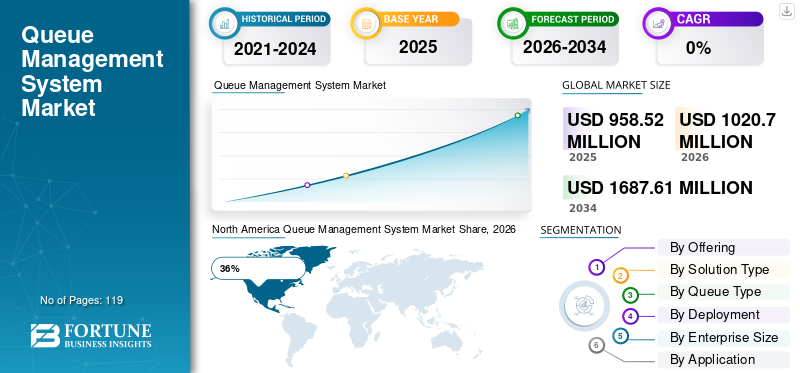
The global queue management system market size was valued at USD 958.52 billion in 2025. The market is projected to grow from USD 1020.70 billion in 2026 to USD 1687.61 billion by 2034, exhibiting a CAGR of 6.49% during the forecast period. The market in North America dominated with a revenue share of 36% in 2025.

The queue management system market is expanding steadily due to rising demand for customer flow optimization across banking, healthcare, retail, telecom, transportation, and government sectors. Organizations are increasingly deploying intelligent queue management platforms to reduce wait times, improve operational efficiency, and enhance customer satisfaction. Cloud-based queue management solutions, AI-enabled analytics, digital ticketing, and mobile appointment scheduling are transforming the industry landscape. queue management system market Trends indicate strong adoption of virtual queuing and self-service kiosks in high-footfall environments. The queue management system market Analysis also highlights growing integration with CRM, IoT, and digital signage systems to streamline customer engagement and improve real-time service delivery performance.
The USA queue management system market remains a leading contributor to global industry expansion due to rapid digital transformation across public and private sectors. More than 68% of large retail chains in the United States have implemented automated queue management technologies in customer service operations. Hospitals, airports, and financial institutions continue increasing deployment of AI-driven waiting management platforms to improve customer retention and workforce utilization. Queue Management System Industry Analysis shows that virtual queuing adoption in the USA increased by 31% during the last two years due to mobile-first customer engagement strategies. Government agencies are also modernizing citizen service infrastructure through smart queue scheduling and digital appointment systems.
Download Free sample to learn more about this report.
Queue Management System Market Key Takeaways
 Global Market Size & Forecast
- 2025 Market Size: USD 958.52 Billion
- 2026 Market Size: USD 1,020.70 Billion
- 2034 Forecast Market Size: USD 1,687.61 Billion
- CAGR: 6.49% from 2026-2034
 Market Share
- North America dominated with a 36% market share in 2025.
- Software solutions led by offering with a 58% market share.
- Virtual queuing solutions led by solution type with a 61% market share.
 Key Regional Highlights
North America
North America held the largest regional share at 36%.
Asia-Pacific
Asia-Pacific accounted for 29% of the global market.
Europe
Europe represented 27% of the global market.
U.S.
The U.S. market is supported by growing adoption of digital queue and customer experience solutions.
Japan
Japan accounted for 21% of the Asia-Pacific market, driven by increasing automation and digital service adoption.
Read More

Queue Management System Market Latest Trends
The queue management system market is witnessing significant technological advancements driven by automation, artificial intelligence, and digital customer engagement requirements. One major trend influencing the queue management system market Growth is the increasing deployment of cloud-based platforms capable of supporting centralized queue monitoring across multiple branches and locations. Organizations are shifting away from traditional physical lines toward virtual queuing systems that allow customers to reserve positions remotely using smartphones or QR-based applications.
AI-powered predictive analytics is becoming a critical feature within queue management system market according to research report findings. Businesses are using analytics engines to estimate waiting times, optimize staffing allocation, and improve branch productivity. Digital signage integration is also becoming more common across healthcare facilities, banks, and transportation terminals to improve customer communication and reduce service confusion.
Download Free sample to learn more about this report.
Queue Management System Market Dynamics
DRIVER
Increasing Adoption of Digital Customer Experience Management Solutions
The growing focus on customer satisfaction and operational efficiency is a major driver accelerating queue management system market Growth globally. Businesses operating in banking, retail, healthcare, and telecom sectors are increasingly investing in intelligent queue management technologies to minimize waiting periods and enhance customer engagement. More than 72% of financial institutions globally now utilize digital queue scheduling systems to improve branch management efficiency. Healthcare facilities are implementing virtual queuing applications to reduce patient congestion and streamline appointment scheduling. queue management system market Insights reveal that customer retention rates improve significantly when service waiting time falls below 10 minutes. Enterprises are also integrating queue analytics with workforce management systems to optimize staff deployment during peak operating hours.
RESTRAINT
High Implementation and Infrastructure Integration Costs
Despite increasing adoption rates, the queue management system market faces restraints associated with deployment expenses and infrastructure modernization requirements. Many small and medium enterprises struggle to adopt advanced queue management platforms due to high initial installation costs involving kiosks, digital signage systems, software licensing, and cloud integration. The queue management system market Forecast data indicates that nearly 41% of smaller enterprises delay digital queue transformation because of budget limitations. Integration challenges with legacy enterprise software systems also create operational barriers for organizations undergoing digital upgrades. Industries operating in rural or underdeveloped regions face limited access to high-speed network infrastructure necessary for cloud-based queue management deployment. Additionally, ongoing maintenance costs, cybersecurity risks, and employee training requirements continue to slow adoption among cost-sensitive organizations.
OPPORTUNITY
Expansion of Ai-Enabled Virtual Queuing Technologies
The increasing popularity of AI-driven virtual queuing platforms is creating substantial opportunities within the queue management system market. Businesses are adopting intelligent waiting management solutions capable of predicting customer flow patterns and dynamically adjusting service operations. queue management system market Opportunities are particularly strong in airports, hospitals, retail malls, and government offices experiencing rising visitor volumes. AI-powered customer analytics enables organizations to personalize service recommendations and optimize real-time resource allocation. Mobile queue reservation applications are gaining rapid traction among younger digital consumers seeking convenience and minimal physical waiting. Emerging economies are also investing heavily in smart city infrastructure, creating favorable conditions for intelligent public service queue management deployment. Integration of voice recognition, facial recognition, and multilingual support capabilities further expands product innovation opportunities.
CHALLENGE
Managing Real-Time Scalability Across Multi-Location Operations
One of the primary challenges in the queue management system market involves maintaining seamless operational scalability across geographically distributed facilities. Large enterprises managing hundreds of customer interaction points often encounter synchronization difficulties when integrating centralized queue analytics platforms. Queue Management System Industry Analysis shows that inconsistent network connectivity can negatively impact real-time queue monitoring performance in remote service centers. Rapid fluctuations in customer traffic volumes also create forecasting challenges for AI-based staffing optimization systems. Multi-language customer communication requirements in international markets further complicate software customization and deployment processes. Businesses operating across multiple regulatory environments must continuously update data management protocols to maintain compliance standards. Additionally, maintaining cybersecurity protection against cloud platform vulnerabilities remains a major operational challenge for vendors and service providers. Limited technical expertise among end-users in developing economies also affects efficient system deployment.
Queue Management System Market Segmentation
By Offering
Software solutions account for 58% share in the queue management system market due to increasing adoption of cloud-based customer management technologies across multiple industries. Enterprises are implementing intelligent queue software to improve operational efficiency and reduce customer waiting periods. AI-powered analytics and real-time monitoring tools are helping businesses optimize workforce allocation during high-traffic hours. Healthcare institutions are deploying digital patient scheduling platforms linked with mobile communication systems. Retail companies are integrating queue software with CRM applications for personalized customer engagement.
To know how our report can help streamline your business, Speak to Analyst
By Solution Type
Linear queuing systems hold nearly 39% market share within the queue management system market due to widespread deployment in retail stores, supermarkets, transportation hubs, and public service centers. Traditional physical queue structures remain highly relevant in environments where customer interaction requires visible waiting arrangements. queue management system market Insights indicate that retail chains continue investing in digital signage and ticketing enhancements to improve linear queue efficiency. Integration with customer flow analytics and staff allocation systems is improving service productivity in high-traffic facilities.
Virtual queuing solutions account for approximately 61% market share and represent the fastest-growing segment within the queue management system market Forecast. Customers increasingly prefer mobile-based waiting management systems that eliminate physical crowding and improve service flexibility. Healthcare providers, banks, and telecom operators are rapidly adopting virtual queue applications integrated with SMS alerts and mobile notifications. queue management system market Growth is strongly supported by rising smartphone penetration and digital-first customer behavior. AI-powered virtual queuing platforms allow businesses to predict customer arrival patterns and optimize service scheduling.
By Queue Type
Virtual queue systems account for 61% market share in the queue management system market due to rising adoption of mobile-based customer engagement technologies across healthcare, banking, retail, and transportation sectors. Businesses are increasingly implementing app-based reservation platforms and digital waiting management systems to improve operational efficiency and customer convenience. Healthcare facilities are deploying virtual patient scheduling systems linked with automated notifications and telemedicine platforms. Retail companies are integrating virtual queue applications with loyalty programs and CRM systems for personalized service experiences. Airports and telecom providers are adopting AI-driven virtual waiting solutions to reduce crowd congestion and optimize customer handling processes.
By Deployment
Cloud deployment holds 57% market share in the queue management system market due to growing enterprise demand for scalable and centralized operational management infrastructure. Organizations are transitioning toward cloud-based queue management platforms to improve remote accessibility and reduce infrastructure maintenance costs. Banking institutions and healthcare providers are implementing cloud-hosted queue analytics systems for real-time workflow visibility and customer flow monitoring. Retail chains are adopting SaaS deployment models for multi-location operational coordination and centralized reporting capabilities. Government agencies are modernizing citizen service management through cloud-integrated appointment scheduling platforms.
By Enterprise Size
Large enterprises contribute 64% market share within the queue management system market due to high customer interaction volumes and complex operational management requirements. Banks, hospitals, airports, telecom operators, and retail corporations are heavily investing in intelligent queue optimization technologies to improve service coordination and workforce productivity. Enterprises operating across multiple branches require centralized dashboard monitoring and AI-powered customer flow analytics for operational consistency. Healthcare organizations are deploying enterprise-level patient scheduling systems integrated with occupancy monitoring tools. Retail chains are implementing self-service kiosks and digital queue platforms to strengthen customer retention and checkout management efficiency.
By Application
Healthcare applications account for 24% market share in the queue management system market due to rising patient volumes and growing emphasis on operational efficiency across hospitals and diagnostic centers. Healthcare providers are implementing AI-enabled patient flow management systems to reduce waiting times and improve appointment coordination. Digital registration kiosks and mobile scheduling applications are helping hospitals streamline outpatient operations and administrative workflows. Telemedicine integration and virtual patient queue technologies are becoming increasingly common across urban healthcare facilities. Public healthcare institutions are modernizing customer service infrastructure through cloud-based queue analytics platforms. Hospitals are prioritizing occupancy monitoring systems and real-time patient communication tools for improved service delivery performance.
By Vertical
Banking and financial services hold 22% market share within the queue management system market due to increasing demand for branch automation and customer experience optimization. Financial institutions are deploying intelligent queue management systems integrated with predictive analytics and appointment scheduling software to reduce service delays. Banks are utilizing mobile-based reservation platforms and digital token systems to improve branch workflow efficiency. AI-driven customer flow analytics are helping financial institutions optimize staffing allocation during peak operating periods. Self-service kiosks and virtual waiting technologies are becoming standard operational tools across modern banking environments. Multi-branch banks are implementing centralized queue monitoring systems for consistent customer engagement management.
Queue Management System Market Regional Outlook
North America
North America Queue Management System Market Share, 2026 (%) To get more information on the regional analysis of this market, Download Free sample
North America holds 36% market share in the queue management system market due to strong digital infrastructure adoption across healthcare, banking, and transportation sectors. Enterprises across the United States and Canada are deploying AI-enabled customer flow systems to reduce service congestion and improve operational productivity. Retail chains are integrating smart kiosks and appointment scheduling software to strengthen customer engagement management. Airports across the region are implementing intelligent passenger queuing technologies for faster service coordination and crowd control. Healthcare providers are investing in digital patient scheduling platforms linked with real-time occupancy monitoring tools. Financial institutions continue expanding virtual branch management systems to optimize staffing and waiting time performance. Government agencies are modernizing public service centers through cloud-based queue monitoring technologies. Transportation hubs are increasing investments in mobile-enabled ticket management platforms. Businesses are focusing on omnichannel customer interaction systems for improved workflow visibility. Rising enterprise demand for predictive analytics continues supporting queue management system market Growth throughout North America.
Europe
Europe accounts for 27% market share in the queue management system market driven by rapid digital transformation across banking, healthcare, retail, and government sectors. Countries across the region are adopting intelligent queue scheduling technologies to improve customer service efficiency and reduce operational bottlenecks. Hospitals are increasingly implementing digital appointment management systems integrated with patient communication tools. Retail companies are deploying virtual queuing platforms combined with loyalty applications and self-service kiosks. Financial institutions continue modernizing branch operations through AI-powered customer flow analytics systems. Transportation facilities are integrating multilingual digital signage and mobile ticketing technologies to manage passenger movement effectively. Enterprises are adopting cloud-based queue management software for centralized operational monitoring across multiple locations. Smart city projects are supporting deployment of automated public service management platforms throughout urban areas. Demand for contactless customer interaction technologies continues increasing across major industries. Growing investments in workforce optimization solutions are strengthening queue management system market Trends across Europe.
Germany Queue Management System Market
Germany represents 29% share within the European queue management system market due to increasing investment in industrial automation and digital public infrastructure modernization. Hospitals and healthcare facilities are implementing AI-driven patient scheduling systems to improve operational coordination and reduce waiting periods. Banking institutions across Germany are deploying smart customer engagement platforms integrated with predictive analytics technologies. Transportation hubs are adopting multilingual digital queue systems to improve passenger communication and service efficiency. Retail operators continue expanding self-service kiosk deployment to strengthen customer convenience and checkout management. Manufacturing service centers are integrating virtual queue monitoring systems for workforce and visitor coordination. Government offices are modernizing citizen service operations through cloud-enabled appointment scheduling technologies. Smart building projects are increasing adoption of occupancy monitoring and customer traffic management platforms. Businesses are focusing on centralized dashboard visibility for branch-level service optimization.
United Kingdom Queue Management System Market
The United Kingdom holds 24% share within the European queue management system market due to rapid expansion of digital customer management technologies across financial institutions and healthcare organizations. Banks are increasingly deploying intelligent branch queue systems to improve customer flow management and reduce service delays. Hospitals are integrating cloud-based appointment scheduling solutions linked with mobile communication platforms. Airports and railway stations are implementing virtual passenger queue systems supported by digital signage technologies. Retail chains are adopting AI-powered customer analytics platforms to strengthen in-store engagement and personalized service delivery. Government agencies are modernizing citizen support operations through automated queue scheduling infrastructure. Enterprises are focusing on contactless customer interaction systems to improve convenience and operational efficiency. Businesses are expanding omnichannel service integration strategies for centralized workflow monitoring. Smart retail infrastructure projects are increasing deployment of self-service kiosks and virtual ticket management platforms.
Asia-Pacific
Asia-Pacific holds 29% market share in the queue management system market due to expanding smart city initiatives and rapid digital transformation across emerging economies. Countries throughout the region are deploying intelligent queue management platforms across healthcare, banking, transportation, and retail sectors. Urban hospitals are adopting virtual patient scheduling systems integrated with mobile notification technologies. Retail companies are implementing cloud-based customer engagement solutions to improve operational productivity and service coordination. Airports and railway networks are expanding AI-powered passenger flow management infrastructure for congestion reduction. Government offices are modernizing public service delivery through automated appointment scheduling technologies. Enterprises are increasingly adopting subscription-based queue management software because of scalability advantages and lower deployment costs. Telecom operators are integrating digital waiting management systems to improve customer handling efficiency. Businesses are prioritizing contactless customer interaction technologies and self-service kiosks.
Japan Queue Management System Market
Japan accounts for 21% share within the Asia-Pacific queue management system market due to advanced automation infrastructure and strong adoption of intelligent customer service technologies. Hospitals across Japan are deploying AI-enabled patient queue systems integrated with real-time scheduling and mobile communication tools. Banks are modernizing branch operations through predictive customer flow analytics and virtual appointment platforms. Retail centers are implementing robotic self-service kiosks and digital ticket management systems to improve customer convenience. Transportation hubs are integrating multilingual passenger queue technologies to support increasing tourism activity. Enterprises are investing in cloud-based queue monitoring systems for centralized operational visibility. Smart building projects are supporting deployment of occupancy management and automated visitor handling technologies. Businesses are focusing on workforce optimization through AI-powered service allocation platforms. Healthcare providers are strengthening digital patient coordination systems for improved treatment scheduling efficiency. Rising investment in robotics and smart infrastructure continues supporting queue management system market Trends across Japan.
China Queue Management System Market
China represents 26% share within the Asia-Pacific queue management system market due to rapid smart city expansion and growing adoption of digital public service technologies. Government offices are deploying cloud-based queue scheduling systems to manage increasing citizen service demand efficiently. Hospitals are integrating AI-powered patient flow management platforms linked with digital registration technologies. Retail companies are implementing mobile-enabled virtual queuing systems to improve customer engagement and reduce physical congestion. Banking institutions continue modernizing branch infrastructure through intelligent customer analytics and automated service coordination platforms. Airports and transportation networks are deploying facial recognition-enabled queue management technologies for passenger handling efficiency. Telecom operators are increasing investment in digital customer support systems integrated with real-time monitoring dashboards. Businesses are prioritizing contactless service technologies and mobile reservation platforms across urban commercial centers. E-commerce pickup locations are deploying automated queue monitoring systems for operational optimization.
Rest of World
Rest of World holds 8% market share in the queue management system market supported by increasing digital transformation initiatives across Latin America, the Middle East, and Africa. Governments in developing economies are modernizing public service infrastructure through intelligent appointment scheduling systems and automated queue monitoring technologies. Hospitals are adopting cloud-based patient management platforms to improve operational coordination and reduce waiting congestion. Airports and shopping malls are deploying digital signage and virtual queue systems to strengthen customer service quality. Banking institutions across Latin America are integrating AI-driven customer flow analytics into branch management operations. Telecom operators are investing in mobile-based service scheduling platforms to improve customer engagement efficiency. Businesses are increasingly adopting self-service kiosks and centralized workflow monitoring tools. Smart city development projects are supporting demand for intelligent crowd management infrastructure across urban areas. Enterprises are focusing on contactless service delivery technologies and cloud deployment models.
List of Top Queue Management System Companies
- Advantech
- Wavetec
- Aurionpro
- Lavi Industries
- QLess
- QMatic
- SEDCO
- Q-nomy
- Core Mobile
- MaliaTech
Top Two Companies with Highest Market Share
- QMatic – 18% market share
- Wavetec – 15% market share
Investment Analysis and Opportunities
The queue management system market is attracting increasing investments due to rising demand for digital customer experience optimization across multiple industries. Venture capital firms and enterprise technology investors are focusing on AI-powered queue analytics, cloud-based deployment platforms, and virtual customer engagement solutions. queue management system market Opportunities are especially strong in healthcare, transportation, retail, and banking sectors where customer flow efficiency directly impacts operational productivity.
Governments are also investing in public infrastructure modernization programs involving smart appointment scheduling and digital service delivery systems. Airports and railway authorities are expanding investment in intelligent passenger flow management technologies to support increasing travel volumes. queue management system market Analysis indicates that cloud-native software providers are receiving strong funding support because of scalable subscription-based business models. Emerging economies are presenting substantial investment opportunities due to rapid urbanization and digital transformation initiatives.
New Product Development
Innovation within the queue management system market is accelerating rapidly as vendors focus on artificial intelligence, automation, and personalized customer engagement technologies. Companies are developing AI-driven predictive queue management platforms capable of estimating waiting times and automatically reallocating service staff during high-traffic periods. queue management system market Trends show increasing launch activity related to mobile-first virtual queuing applications supporting QR-based check-ins and real-time notifications.
Advanced cloud-native queue management solutions featuring centralized dashboards and multi-location monitoring capabilities are becoming increasingly common. Vendors are also introducing self-service kiosks equipped with facial recognition, voice assistance, and multilingual interfaces to improve customer accessibility. queue management system market Research Report findings indicate growing innovation around analytics platforms capable of integrating customer behavior data with CRM and workforce management systems.
Five Recent Developments (2023-2025)
- In 2023, QMatic launched an AI-powered cloud queue analytics platform designed for multi-branch banking operations.
- In 2023, Wavetec expanded its virtual queuing solutions across major Middle Eastern airport terminals.
- In 2024, Aurionpro introduced mobile-integrated appointment scheduling software for healthcare institutions.
- In 2024, QLess enhanced its digital customer engagement platform with predictive waiting time algorithms.
- In 2025, SEDCO deployed smart queue management kiosks featuring biometric authentication and multilingual support.
Report Coverage of Queue Management System Market
The queue management system market Report provides comprehensive analysis of industry trends, deployment models, technological advancements, competitive landscape, and regional performance across major global markets. The report evaluates customer flow management technologies used in banking, healthcare, transportation, retail, telecom, and government sectors. queue management system market Research Report coverage includes analysis of software platforms, service offerings, virtual queuing technologies, and cloud deployment strategies.
Request for Customization to gain extensive market insights.
The study examines key growth drivers influencing demand for intelligent customer engagement systems, including digital transformation initiatives and rising adoption of AI-powered analytics. queue management system market Forecast assessments include evaluation of enterprise investment patterns, mobile integration trends, and operational automation strategies. The report also analyzes market restraints such as infrastructure modernization costs and cybersecurity concerns affecting implementation decisions.
Frequently Asked Questions
Fortune Business Insights says that the global market value stood at USD 958.52 billion in 2025 and is projected to reach USD 1,687.61 billion by 2034.Fortune Business Insights says that the global market value stood at USD 958.52 billion in 2025 and is projected to reach USD 1,687.61 billion by 2034.
The market is expected to exhibit a CAGR of 6.49% during the forecast period of 2026-2034.
Virtual queuing was the leading solution type, accounting for approximately 61% of the market, supported by growing preference for mobile-based waiting management and remote queue reservations.
Key players include Advantech, Wavetec, Aurionpro, Lavi Industries, QLess, and QMatic.
Major trends include increasing adoption of cloud-based platforms, virtual queuing, and AI-powered predictive analytics, alongside greater use of mobile and QR-based queue reservations. North America led the market with a 36% share.



- 2021-2034
- 2025
- 2021-2024
- 119
-

(Offer valid till 15th Oct 2026)
Get 30-60 hrs Free Customization
Expand Regional and Country Coverage, Segments Analysis, Company Profiles, Competitive Benchmarking, and End-user Insights.




















-
US +1 833 909 2966 ( Toll Free )
-
Get In Touch With Us