Redispersible Polymer Powder Market Size, Share & Industry Analysis, By Type (Vinyl Acetate-Ethylene (VAE), Acrylic, Vinyl Acetate/Vinyl Ester, and Others), By Application (Tile Adhesives, Grouts, Plasters & Renders, Repair Mortars, and Others), and Regional Forecast, 2026-2034
 Download Free Sample
REDISPERSIBLE POLYMER POWDER MARKET SIZE AND FUTURE OUTLOOK
 Listen to Audio Version
The global redispersible polymer powder market size was valued at USD 0.95 billion in 2025 and is projected to grow from USD 1.00 billion in 2026 to USD 1.58 billion by 2034 at a CAGR of 5.9% during the forecast period. Asia Pacific dominated the redispersible polymer powder market with a market share of 52.63% in 2025.
Redispersible Polymer Powder (RDP) is a spray-dried polymer emulsion that can redisperse in water to form a stable polymer film within cementitious or gypsum-based dry-mix materials. It is widely used in tile adhesives, grouts, plasters, renders, repair mortars, wall putty, waterproofing mortars, and other construction chemicals to improve adhesion, flexibility, workability, crack resistance, water resistance, and durability. A major demand driver for RDP is the rising adoption of factory-formulated dry-mix mortars, as builders increasingly prefer consistent, easy-to-apply, and high-performance construction materials over traditional site-mixed systems, especially in urban housing, renovation, and infrastructure projects.
Wacker Chemie, Celanese Corporation, DCC, Shandong Xindadi Industrial Group Co., Ltd., and Organik Kimya are the key players operating in the market.
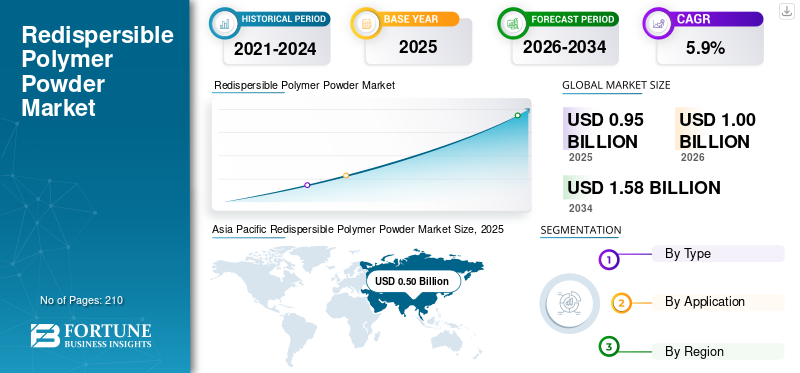
Download Free sample to learn more about this report.
Redispersible Polymer Powder Market Key Takeaways
 Global Market Size & Forecast
- 2025 Market Size: USD 0.95 billion
- 2026 Market Size: USD 1.00 billion
- 2034 Forecast Market Size: USD 1.58 billion
- CAGR: 5.9% from 2026-2034
 Market Share
- Asia Pacific dominated the redispersible polymer powder market with a 52.63% share in 2025.
- The acrylic segment is projected to grow at a CAGR of 6.5% during the forecast period.
- The repair mortars segment is projected to grow at a CAGR of 6.6% during the forecast period.
 Key Regional Highlights
North America
North America is witnessing steady growth due to rising demand for high-performance construction materials in renovation projects.
Asia Pacific
Asia Pacific accounted for the largest market share in 2025 and is expected to maintain its dominance throughout the forecast period.
Europe
Europe is experiencing strong demand driven by green building renovation, energy-efficient construction, and durable façade systems.
U.S.
The U.S. market was valued at USD 0.11 billion in 2025.
Japan
Japan's market was valued at approximately USD 0.04 billion in 2025.
Read More

REDISPERSIBLE POLYMER POWDER MARKET TRENDS
Increasing Preference for Dry-Mix Systems to Boost Market Growth
A major global trend in the industry is the shift from traditional site-mixed mortars to factory-formulated dry-mix construction materials. Builders, contractors, and construction chemical companies increasingly prefer dry-mix systems as they offer better consistency, easier handling, faster application, and more reliable performance. RDP plays a critical role in this transition by improving adhesion, flexibility, workability, crack resistance, water resistance, and durability. This trend is visible across tile adhesives, grouts, plasters, renders, repair mortars, waterproofing mortars, flooring compounds, and insulation-system mortars.
MARKET DYNAMICS
MARKET DRIVERS
Download Free sample to learn more about this report.
Growing Use of Large-Format Tiles to Drive Market Expansion
The major driving the market is the growth of urban construction, housing development, infrastructure upgrades, and renovation activity across the globe. As buildings become more complex and performance expectations rise, conventional cement-sand systems are increasingly being replaced by polymer-modified materials. RDP helps construction products deliver stronger bonding, better flexibility, longer open time, improved water resistance, and higher durability. Demand is especially supported by tile adhesives, wall finishing materials, facade systems, repair mortars, and waterproofing products. Growing use of large-format tiles and premium building materials further strengthens the need for RDP-based formulations.
MARKET RESTRAINTS
High Cost Associated With Dry-Mix Formulations to Limit Market Growth
A key restraint in the market is its cost impact associated with dry-mix formulations. Although RDP provides strong performance benefits, it remains more expensive than basic cement, sand, fillers, and conventional additives. In price-sensitive construction markets, manufacturers may reduce dosage, use lower-cost grades, or substitute with cheaper additives to protect profit margins. Small contractors and low-cost building material producers may also be slower to adopt polymer-modified products when buyers' decisions are driven primarily by price considerations. As a result, RDP adoption remains uneven across regions, especially where construction quality standards are still developing or where informal site-mixing practices continue to be widely used.
MARKET OPPORTUNITIES
Growing Demand For Energy-Efficient Systems to Create Several Growth Opportunities
A major opportunity within the market lies in the growing demand for energy-efficient, durable, and high-performance building systems. Applications such as external insulation systems, waterproofing mortars, repair mortars, facade renders, self-leveling compounds, and specialty tile adhesives require stronger polymer performance than basic dry-mix products. This creates room for premium RDP grades, including acrylic, vinyl acetate/vinyl ester, and specialty copolymer powders. As builders increasingly prioritize lifecycle durability, lower maintenance, better insulation, and weather-resistant construction, RDP suppliers can move beyond commodity grades and capture value through application-specific, performance-led formulations. Thus, in turn, benefiting and driving the redispersible polymer powder market growth.
MARKET CHALLENGES
Difficulty in Maintaining Profitability Amid Construction Cycles to Deter Market Development
The major challenge in a market is maintaining profitability amid construction cycles, feedstock volatility, and intense price competition. Although demand remains supported by rising dry-mix adoption, short-term consumption can weaken during slowdowns in commercial construction or infrastructure activity. At the same time, strong competition from regional and low-cost producers can limit price increases, especially in standard VAE-based grades. Producers must balance capacity utilization, raw material costs, product quality, and customer technical support. The challenge is especially significant for suppliers trying to defend margins while competing across both premium and price-sensitive markets.
SEGMENTATION ANALYSIS
By Type
Vinyl Acetate-Ethylene Segment to Lead due to its Strong Cost-Performance Balance Across Mainstream Dry-Mix Construction Applications
Based on the type, the market is segmented into vinyl acetate-ethylene (VAE), acrylic, vinyl acetate/vinyl ester, and others.
The vinyl acetate-ethylene (VAE) segment is anticipated to hold the dominant redispersible polymer powder market share during the forecast period. A major factor driving demand for VAE is its strong cost-performance balance across mainstream dry-mix construction applications. VAE grades provide reliable adhesion, flexibility, workability, and crack resistance at a commercially acceptable cost, making them highly suitable for tile adhesives, wall putty, skim coats, plasters, renders, and general mortars. As construction activities shift from traditional site-mixed materials to factory-formulated dry-mix products, VAE benefits as the preferred volume chemistry for broad-based adoption.
The acrylic segment is anticipated to rise with a CAGR of 6.5% over the forecast period. Demand for Acrylic is rising due to the need for premium construction materials with stronger durability, weather resistance, and water resistance. Acrylic grades are preferred in exterior renders, waterproofing mortars, repair mortars, facade systems, and high-performance tile adhesives where long-term exposure resistance is important. As builders and construction chemical producers focus more on lifecycle performance, reduced maintenance, and application-specific formulations, acrylic-based RDP gains demand as a higher-value solution for technically demanding building systems.
By Application
To know how our report can help streamline your business, Speak to Analyst
Tile Adhesives Segment to Lead due to Growing Use of Low-Porosity Tiles
Based on application, the market is segmented into tile adhesives, grouts, plasters & renders, repair mortars, and others.
The tile adhesives segment is anticipated to hold the dominant redispersible polymer powder market share during the forecast period. A major factor driving the segment’s growth is the growing use of large-format, vitrified, porcelain, and low-porosity tiles, which require stronger bonding than traditional cement-sand fixing methods. RDP improves adhesion, flexibility, open time, slip resistance, and durability, making tile adhesive formulations more reliable across residential, commercial, and renovation projects. As builders shift toward factory-formulated dry-mix adhesives for consistent performance and faster installation, RDP consumption in tile adhesives continues to expand, driving market growth in tandem.
The repair mortars segment is anticipated to rise with a CAGR of 6.6% over the forecast period.
Demand for repair mortars is increasing due to the need to rehabilitate aging buildings, bridges, industrial floors, facades, and concrete structures. RDP enhances bond strength, flexibility, cohesion, crack resistance, and durability, allowing repair mortars to perform better on old or damaged substrates. As asset owners prioritize lifecycle extension, reduced maintenance, and faster restoration over full replacement, polymer-modified repair mortars are gaining wider acceptance, supporting higher redispersible polymer powder consumption in this application.
REDISPERSIBLE POLYMER POWDER MARKET REGIONAL OUTLOOK
By region, the market is segmented into North America, Europe, Asia Pacific, Latin America, and the Middle East & Africa.
Asia Pacific
Asia Pacific Redispersible Polymer Powder Market Size, 2025 (USD Billion)
To get more information on the regional analysis of this market, Download Free sample
Asia Pacific accounts for the largest market share and is expected to maintain its dominance during the forecast period. The major factor driving regional demand for RDP is rapid urban housing development and the shift from traditional cement-sand systems to factory-made dry-mix materials. Tile adhesives are the leading demand-driving application, supported by high use of ceramic, vitrified, and porcelain tiles in commercial and residential construction. RDP improves bond strength, flexibility, slip resistance, and open time, making tile installation more reliable. Additional demand is being generated by applications that include wall putty, skim coats, plasters, renders, grouts, and waterproofing mortars as growing construction markets adopt higher-quality construction chemical systems.
Japan Redispersible Polymer Powder Market
Japan’s market reached approximately USD 0.04 billion in 2025, equivalent to around 4.2% of global sales.
China Redispersible Polymer Powder Market
China’s market is projected to be one of the largest worldwide, with 2025 standing at around USD 0.20 billion, representing roughly 21.1% of global sales.
India Redispersible Polymer Powder Market
India’s market reached approximately USD 0.11 billion in 2025, equivalent to around 11.6% of global sales.
North America
In North America, the major factor driving RDP demand is the growing need for higher-performance construction materials in renovation, remodeling, and repair-led building activity. Tile adhesives are a key demand-driving application, supported by the use of durable flooring, bathroom, kitchen, and commercial interior installations. RDP improves adhesion, flexibility, open time, and durability, making it important for reliable tile-setting systems. Additional demand is being generated by repair mortars, self-leveling flooring compounds, waterproofing mortars, and specialty dry-mix products as contractors seek materials that reduce failures and improve building performance.
U.S. Redispersible Polymer Powder Market
The U.S. market stood at around USD 0.11 billion in 2025, accounting for roughly 11.6% of global sales.
Europe
Europe’s demand for RDP is driven by the region’s focus on green building renovation, energy efficiency, and durable facade systems. Plasters and renders are key demand-driving applications as RDP improves adhesion, flexibility, crack resistance, weatherability, and long-term exterior performance. Demand is also supported by insulation systems, repair mortars, tile adhesives, and waterproofing mortars, as older buildings require refurbishment and improved thermal performance. Europe’s mature construction industry favors technically reliable dry-mix products, making RDP important in premium exterior wall systems and renovation-oriented construction materials.
U.K. Redispersible Polymer Powder Market
The U.K.’s market reached approximately USD 0.02 billion in 2025, equivalent to around 2.1% of global sales.
Germany Redispersible Polymer Powder Market
Germany’s market reached approximately USD 0.04 billion in 2025, equivalent to around 4.2% of global sales.
Latin America
In Latin America, the major factor driving RDP demand is the growing adoption of polymer-modified tile adhesives in residential and commercial construction. Tile adhesives are the primary demand-driving application as the region has strong tile usage in housing, bathrooms, kitchens, and commercial interiors. RDP helps improve adhesion, water resistance, flexibility, and durability compared with traditional installation methods. Additional demand is being generated by grouts, plasters, renders, wall finishing compounds, and repair mortars as construction chemical producers expand packaged dry-mix products for renovation, affordable housing, and urban building upgrades.
Brazil Redispersible Polymer Powder Market
Brazil’s market reached approximately USD 0.02 billion in 2025, equivalent to around 2.1% of global sales.
Middle East & Africa
In the Middle East & Africa, the major factor driving RDP demand is large-scale construction activity across housing, commercial buildings, infrastructure, tourism, and urban development projects. Tile adhesives are a major demand-driving application as tile-heavy building practices and high-performance installation needs require better adhesion, flexibility, and durability. Supporting applications include plasters, renders, waterproofing mortars, and repair mortars, especially in hot climates where exterior durability and moisture resistance are important. As dry-mix mortar adoption expands, RDP demand is expected to rise across premium and mainstream construction applications.
Saudi Arabia Redispersible Polymer Powder Market
Saudi Arabia’s market reached approximately USD 0.03 billion in 2025, equivalent to around 3.2% of global sales.
COMPETITIVE LANDSCAPE
Key Industry Players
Performance-Led RDP Demand Intensifies Competition Among Global and Regional Producers
The global redispersible polymer powder market is moderately consolidated, with a few multinational producers controlling premium technology, large-scale manufacturing, technical support capabilities, and global customer relationships. Competition is shaped by polymer chemistry, product consistency, construction-application expertise, regional supply reliability, and price competitiveness. The market is shifting toward performance-led, application-specific grades; however, price pressures remain intense in mass-volume dry-mix applications. Key players operating in the market include Wacker Chemie, Celanese Corporation, DCC, Shandong Xindadi Industrial Group Co., Ltd., Wacker Chemie AG, and Organik Kimya.
LIST OF KEY REDISPERSIBLE POLYMER POWDER COMPANIES PROFILED
- BOULING CHEMICAL CO., LIMITED (China)
- Celanese Corporation (U.S.)
- DCC (Taiwan)
- Dow (U.S.)
- Mikem Chemical Co., Ltd (U.S.)
- Organik Kimya (Turkey)
- Shandong Xindadi Industrial Group Co., Ltd. (China)
- TIANJIN ECLAT CO., LTD. (China)
- Wacker Chemie AG (Germany)
- WOTAIchem (China)
KEY INDUSTRY DEVELOPMENTS
- August 2025: Organik Kimya brought a new state-of-the-art reactor online at its Istanbul site, expanding capacity for water-based liquid emulsion polymers. The investment is aimed at improving lead times, peak-season supply reliability, and customer co-innovation. It complements the company’s earlier launch of Turkey’s second high-tech spray dryer for redispersible powder polymers, which doubled powder output and reduced energy consumption. Together, the upgrades strengthen Organik Kimya’s integrated liquid emulsion and RDP offering for construction chemicals applications.
- April 2024: Celanese announced strategic milestones at its Clear Lake, Texas, and Nanjing, China, sites to strengthen cost competitiveness, sustainability, and supply flexibility. The company started a major acetic acid expansion in Clear Lake, launched a new VAE unit in Nanjing, and completed global downstream RDP debottlenecking projects. These moves enhance Celanese’s integrated acetyl chain and support future demand growth for VAE and redispersible polymer powders in Asia and global construction applications.
REPORT COVERAGE
The global redispersible polymer powder market report provides a detailed analysis of the market. It focuses on key aspects such as profiles of leading companies, product types, and leading applications of the product. Besides this, it offers insights into the analysis of key market trends and highlights key industry developments. In addition to the aforementioned factors, it encompasses several factors that have contributed to the growth of the market over recent years.
Request for Customization to gain extensive market insights.
Report Scope & Segmentation
| ATTRIBUTE | DETAILS |
| Study Period | 2021-2034 |
| Historical Period | 2021-2024 |
| Base Year | 2025 |
| Estimated Year | 2026 |
| Forecast Period | 2026-2034 |
| Unit | Volume (Kiloton) and Value (USD Billion) |
| Growth Rate | CAGR of 5.9% from 2026 to 2034 |
| Segmentation | By Type, By Application, and By Geography |
| By Type |
|
| By Application |
|
| By Geography |
|
Frequently Asked Questions
Fortune Business Insights says that the global market size was valued at USD 0.95 billion in 2025 and is projected to record a valuation of USD 1.58 billion by 2034.
In 2025, Asia Pacific stood at USD 0.50 billion.
Registering a CAGR of 5.9%, the market will exhibit steady growth during the forecast period.
By application, the tile adhesives segment is expected to lead this market during the forecast period.
Growing use of large-format tiles is the key factor driving market growth.
Wacker Chemie, Celanese Corporation, DCC, Shandong Xindadi Industrial Group Co., Ltd., and Organik Kimya are the major players operating in the market.
Asia Pacific dominates the market.



- 2021-2034
- 2025
- 2021-2024
- 210
Get 30-60 hrs Free Customization
Expand Regional and Country Coverage, Segments Analysis, Company Profiles, Competitive Benchmarking, and End-user Insights.


















Related Reports
-
US +1 833 909 2966 ( Toll Free )
-
Get In Touch With Us