Ro-Pax and Ro-Ro Vessels Market Size, Share & Industry Analysis, By Propulsion Type (Conventional Fuel-Powered, LNG-Powered, Hybrid-Electric, Fully Electric, and Alternative Fuel-Powered), By Application (Passenger Transportation, Automotive Logistics, Freight & Trailer Transportation, and Heavy Equipment Transport), By Vessel Type (Ro-Pax Vessels, Pure Ro-Ro Vessels, Pure Car and Truck Carriers (PCTC), and ConRo Vessels), By Cargo Carrying Capacity (Below 2,000 Lane Meters, 2,000–4,000 Lane Meters, 4,000–6,000 Lane Meters, and Above 6,000 Lane Meters), and Regional Forecast, 2026–2034
 Download Free Sample
 Ro-Pax and Ro-Ro Vessels Market Size and Future Outlook
 Listen to Audio Version
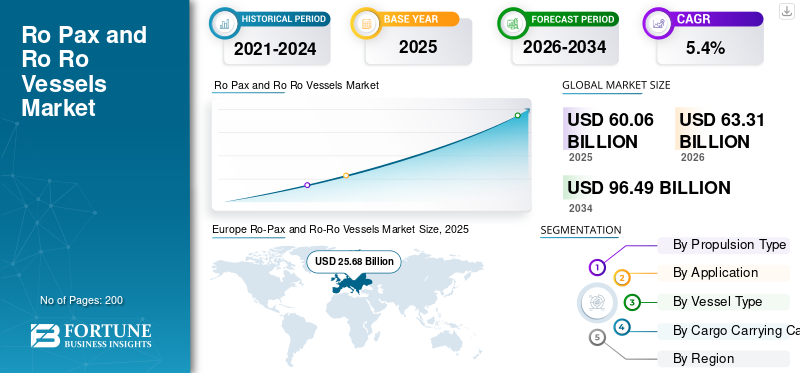
The global Ro-Pax and Ro-Ro vessels market size was valued at USD 60.06 billion in 2025. The market is projected to grow from USD 63.31 billion in 2026 to USD 96.49 billion by 2034, with a CAGR of 5.4% over the forecast period.
Ro-Pax and Ro-Ro vessels are ships designed for transporting wheeled cargo through roll on roll /roll-off ramps. Ro-Ro vessels mainly carry cars, trucks, trailers, buses, and machinery, while Ro-Pax vessels combine vehicle decks with passenger facilities. They support ferry services, automotive logistics, short-sea freight movement, island connectivity, and military mobility. Rising vehicle exports, short-sea freight movement, passenger ferry recovery, island connectivity needs, and fleet modernization support the growth of the market. Demand is especially strong on Europe’s ferry routes and Asia’s automotive export routes. In addition, decarbonization rules are also pushing LNG, hybrid-electric, methanol-ready, and ammonia-ready vessels into newbuild programs, improving efficiency and lowering emissions.
Major players include Wallenius Wilhelmsen ASA, Hoegh Autoliners ASA, Grimaldi Group, DFDS A/S, Stena Line AB, and Finnlines Plc. These companies are focusing on larger PCTCs, greener Ro-Pax vessels, LNG-hybrid propulsion, methanol readiness, battery-electric ferries, and integrated logistics networks.
Download Free sample to learn more about this report.
RO-PAX and RO-RO VESSELS MARKET TRENDS
Adoption of Larger and Low-Emission Vessels to Reshape Market Trend
Fleet renewal is shifting toward larger, fuel-flexible Ro-Pax and Ro-Ro vessels as operators seek lower unit costs, higher cargo capacity, and compliance with tightening emissions expectations. PCTC operators are adopting vessels with capacity exceeding 9,000+ CEUs, while ferry operators are adding hybrid, LNG, and shore-power-ready ship designs for dense routes. This trend is strongest among global automotive logistics and European ferry players as vessel age, fuel consumption efficiency, and emissions compliance increasingly influence charter preference and route economics. For instance, in April 2025, Grimaldi Group signed an order for nine new Ro-Pax ships for deployment in the Mediterranean and Baltic. Moreover, in 2024, Wallenius Wilhelmsen confirmed its methanol dual-fuel Shaper Class PCTCs with alternative-fuel capability.
MARKET DYNAMICS
MARKET DRIVERS
Download Free sample to learn more about this report.
Expanding Vehicle Trade and Short-Sea Freight Supports Market Growth
Automotive logistics and trailer freight are expanding the market for Ro-Pax and Ro-Ro services. Vehicle export routes require high-capacity PCTCs, while short-sea corridors use Ro-Ro and Ro-pax vessels to reduce road congestion, simplify cross-border freight movement, and improve port-to-port logistics efficiency. EV exports, industrial machinery movement, defense logistics, and passenger-plus-vehicle demand across island and coastal regions are reinforcing market growth. The market also benefits when Ro-Ro shipping lines combine passenger, freight, and vehicle revenue streams within the same network. For instance, in 2024, Hoegh Autoliners highlighted its 12 Aurora Class vessels on order, each with a capacity of up to 9,100-car capacity. Moreover, in 2025, K Line listed contracts for four LNG-fueled car carriers for the European short-sea operations.
MARKET RESTRAINTS
High Capital Investment and Uncertainty Surrounding Alternative Fuel to Restrict Industry Expansion
New Ro-Pax and Ro-Ro vessels require high upfront capital, long construction timelines, port compatibility planning, and certainty regarding fuel infrastructure. Operators must decide between LNG, methanol, batteries, ammonia readiness, or conventional fuel, but future fuel availability and regulation remain uneven across regions. Battery-electric vessels are well-suited for short routes, while deep-sea PCTCs need scalable low-carbon fuels that are not yet widely available. This slows fleet replacement decisions among smaller operators and ferry companies in emerging markets. For instance, in 2023, DFDS stated that alternative fuel choices remain complex while outlining its ‘‘2+2+2’‘ plan for electric, methanol, and ammonia vessels. Moreover, in 2024, Hoegh Autoliners noted that its Aurora-class vessels are ammonia-ready but depend on future fuel availability.
MARKET OPPORTUNITIES
Expansion of Decarbonized Ferry Corridors to Create New Market Growth Opportunities
Decarbonized ferry corridors, port shore-power projects, and alternative-fuel bunkering create opportunities for shipowners, shipyards, battery suppliers, engine makers, and port authorities. Ro-Pax routes are especially suitable for electrification as vessels operate on predictable schedules, fixed distances, and repeated port calls. PCTC operators also benefit from green vehicle logistics contracts as automakers seek lower-emission export chains. Investment opportunities are strongest in Europe, China, Japan, South Korea, Australia, and North America, where policy support and port modernization are progressing. For instance, in 2023, DFDS announced plans to invest up to around USD 1 billion in battery-electric Channel ships. In 2025, Incat secured a deal to build battery-electric ferries for Denmark’s Molslinjen.
MARKET CHALLENGES
Port Readiness and Infrastructure Gaps Challenge Scalable Deployment
Ro-Pax and Ro-Ro vessel modernization depends on ship design and on port readiness, including ramp system capacity, shore power, charging infrastructure, LNG or methanol bunkering, berth availability, and customs processing efficiency. Large PCTCs and next-generation Ro-Pax ships need deeper coordination among operators, ports, energy suppliers, and regulators. Smaller ports may struggle to support larger vessels or alternative-fuel systems, limiting route deployment even when vessel demand exists. This creates uneven adoption between mature ferry corridors and developing coastal markets.
For instance, in October 2025, TT-Line’s new Ro-Pax order included LNG-hybrid propulsion and battery systems designed for shore-power charging, showing how vessel deployment increasingly depends on compatible port infrastructure.
Segmentation Analysis
By Propulsion Type
Operational Reliability for Long-Haul Transport Strengthens Conventional Fuel-Powered Vessel Segment Growth
Based on propulsion type, the market is segmented into conventional fuel-powered, LNG-powered, hybrid-electric, fully electric, and alternative fuel-powered (methanol/hydrogen).
The conventional fuel-powered segment dominates the global market due to its extensive installed fleet base, established bunkering infrastructure, lower capital requirements, and suitability for long-haul operations. Most existing Ro-Ro freight carriers, vehicle carriers, and Ro-Pax ferries continue to rely on conventional marine fuels, particularly across Asia Pacific, Europe, and North America. Fleet operators prioritize operational reliability and global fuel availability while gradually transitioning to alternative propulsion systems. The segment remains essential for automotive logistics, freight transportation, and passenger ferry networks despite increasing environmental regulations.
The fully electric segment is projected to grow at a CAGR of 11.3% over the forecast period.
For instance, in March 2025, Wallenius Wilhelmsen renewed a long-term vehicle shipping contract valued at approximately USD 380 million, reinforcing continued demand for its conventional and mixed-fleet Ro-Ro operations.
By Application
Rising Global Vehicle Exports Boost Automotive Logistics Segment Growth
Based on application, the market is segmented into passenger transportation, automotive logistics, freight & trailer transportation, heavy equipment & industrial machinery transport, and military & defense logistics.
Automotive logistics dominates the market, owing to rising global vehicle exports, increasing cross-border automotive trade, and growing reliance on specialized vehicle carriers. Ro-Ro and PCTC vessels provide efficient transportation for passenger vehicles, commercial vehicles, and electric vehicles while minimizing cargo handling risks. Major automotive manufacturing hubs in China, Japan, South Korea, Europe, and North America continue to drive demand for maritime vehicle logistics services. The increasing internationalization of automotive supply chains further strengthens this segment’s growth.
The automotive logistics segment is projected to grow at a CAGR of 6.3% over the forecast period.
For instance, in January 2025, MOL’s LNG-fueled Ro-Pax ferry Sunflower Kamuy entered service supporting passenger and trailer logistics routes in Japan, reflecting continued investment in vehicle and freight transportation infrastructure.
The military & defense logistics segment is projected to grow at the highest CAGR of 5.6% over the forecast period, driven by increasing defense mobility requirements, rapid deployment capabilities, NATO and Indo-Pacific security initiatives, and rising investments in military sealift fleets for transporting armored vehicles, equipment, and tactical support cargo.
By Vessel Type
Efficient Transportation of Rolling Cargo Propel Pure Ro-Ro Vessel Segment Growth
Based on vessel type, the market is segmented into Ro-Pax vessels, pure Ro-Ro vessels, Pure Car and Truck Carriers (PCTC), and ConRovessels.
Pure Ro-Ro Vessels dominate the market due to their ability to transport trucks, trailers, buses, heavy machinery, and rolling cargo with rapid loading and unloading efficiency. These vessels play a crucial role in short-sea shipping, regional freight movement, and intermodal transportation networks, particularly across Europe and Asia. Their flexibility and lower cargo handling requirements help reduce transit times and logistics costs, making them highly attractive for freight operators. Growing demand for trailer transportation and regional trade connectivity continues to support segment expansion.
The pure Ro-Ro vessels segment is projected to grow at a CAGR of 7.4% over the forecast period.
For instance, in June 2025, Wallenius Lines acquired the Ro-Ro vessel Don Juan to strengthen freight transportation capacity and support expanding regional cargo services.
The Pure Car and Truck Carriers (PCTC) segment is projected to grow at the highest CAGR of 5.3% during the forecast period, driven by expanding global vehicle exports, EV trade growth, larger carrier deployments, and rising demand from automotive OEMs for safer, high-capacity, and efficient seaborne vehicle logistics.
To know how our report can help streamline your business, Speak to Analyst
By Cargo Carrying Capacity
Optimal Balance of Capacity and Operational Efficiency Drives Growth of 4,000–6,000 Lane Meter Segment
Based on cargo carrying capacity, the market is segmented into below 2,000 lane meters, 2,000-4,000 lane meters, 4,000-6,000 lane meters, and above 6,000 lane meters.
The 4,000-6,000 lane meters segment dominates the market, as it offers an optimal balance between cargo capacity, vessel economics, port accessibility, and operational flexibility. These vessels are widely utilized on high-frequency freight and passenger routes, allowing operators to maximize utilization while maintaining compatibility with existing port infrastructure. Their versatility supports the transportation of vehicles, trailers, machinery, and mixed cargo across regional and international routes. Demand remains strong among ferry operators and freight logistics providers seeking efficient fleet deployment.
The above 6,000 lane meters segment is projected to grow at a CAGR of 6.7% over the forecast period.
For instance, in January 2024, Wallenius Wilhelmsen expanded its Shaper Class order book, increasing its pipeline of large-capacity vehicle carriers designed to transport significantly higher cargo volumes.
RO-PAX AND RO-RO VESSELS MARKET REGIONAL OUTLOOK
By geography, the market is categorized into Europe, North America, Asia Pacific, South America,
and the Middle East & Africa.
NORTH AMERICA
Europe Ro-Pax and Ro-Ro Vessels Market Size, 2025 (USD Billion)
To get more information on the regional analysis of this market, Download Free sample
North America is projected to maintain a significant position in the global market, supported by strong automotive trade flows, integrated U.S.-Mexico supply chains, and established coastal freight networks. Growing demand for vehicle transportation, trailer freight services, and defense logistics continues to support fleet utilization across the region. Investments in port modernization, LNG bunkering infrastructure, and sustainable maritime transportation further contribute to market expansion. The region also benefits from increasing cross-border trade activity and rising demand for efficient short-sea shipping alternatives, supporting steady growth throughout the forecast period.
U.S. RO-PAX AND RO-RO VESSELS MARKET
The U.S. market is estimated to reach USD 5.72 billion in 2026, supported by extensive automotive imports and exports, large-scale port infrastructure, military logistics requirements, and coastal freight transportation activities. Growing vehicle carrier deployments, expansion of Gulf Coast and East Coast vehicle-handling terminals, and increasing demand for efficient freight mobility solutions continue to strengthen the country's position within the North American market.
EUROPE
Europe holds the largest Ro-Pax and Ro-Ro vessels market share globally, due to its extensive ferry networks, dense short-sea shipping corridors, and strong passenger transportation demand across the Baltic Sea, North Sea, English Channel, and Mediterranean regions. The presence of major operators such as DFDS, Stena Line, Finnlines, Grimaldi Group, and Brittany Ferries strengthens regional dominance. Ongoing investments in LNG-powered, hybrid-electric, and fully electric vessels support fleet modernization and compliance with environmental regulations. Strong intra-European freight movement and intermodal transportation integration continue to support long-term Ro-Pax and Ro-Ro vessels market growth.
U.K. RO-PAX AND RO-RO VESSELS MARKET
The U.K. market is projected to reach USD 4.16 billion in 2026, supported by intensive Ro-Pax operations across the English Channel, Irish Sea, and North Sea routes. Strong passenger traffic, freight trailer transportation, and trade connectivity with continental Europe continue to drive vessel demand. Investments in ferry fleet renewal, decarbonization initiatives, and next-generation vessel deployment further support long-term market expansion.
GERMANY RO-PAX AND RO-RO VESSELS MARKET
Germany is projected to account for approximately 18.3% of the European market in 2026. The country benefits from its strategic position in automotive exports, Baltic Sea freight transportation, and vehicle logistics operations through major ports such as Hamburg and Bremerhaven. Strong industrial production, extensive export activity, and increasing short-sea freight services continue to reinforce Germany's importance within the European maritime transportation ecosystem.
ASIA PACIFIC
Asia Pacific is expected to be the fastest-growing regional market, driven by growing automotive exports, increasing island connectivity requirements, and substantial investments in maritime infrastructure. China, Japan, South Korea, and India collectively account for a significant portion of regional vessel deployments. Rising vehicle exports, expanding ferry networks, and strong shipbuilding capabilities support long-term market growth. Increasing adoption of LNG-powered and alternative-fuel vessels, combined with growing regional trade activity, continues to strengthen the region's market outlook during the forecast period.
CHINA RO-PAX AND RO-RO VESSELS MARKET
China is estimated to account for approximately 31.3% of the Asia Pacific market in 2026. Strong vehicle export growth, expanding Ro-Ro port infrastructure, and increasing deployment of PCTC vessels support market expansion. Major ports, including Shanghai, Guangzhou, and Ningbo, continue to strengthen China's position as a global automotive export hub, generating substantial demand for vehicle transportation and Ro-Ro logistics services.
INDIA RO-PAX AND RO-RO VESSELS MARKET
India is expected to register a CAGR of 9.8% during the forecast period, supported by government initiatives promoting coastal shipping, increasing automotive production, and expanding port infrastructure. Growing demand for passenger and freight transportation services, combined with rising investments in maritime logistics and domestic ferry connectivity, continues to enhance the country's growth prospects within the regional market.
JAPAN RO-PAX AND RO-RO VESSELS MARKET
Japan is estimated to reach approximately USD 4.65 billion in 2026, supported by its mature ferry network, globally competitive automotive export industry, and strong presence of leading shipping operators. Established Ro-Pax routes, significant vehicle transportation demand, and continued investments in LNG-powered and next-generation vessels contribute substantially to market development across the country.
SOUTH AMERICA
South America is witnessing gradual market expansion, supported by growing automotive trade, increasing agricultural machinery transportation, and ongoing port infrastructure improvements. Rising demand for vehicle imports and exports, particularly in Brazil and Argentina, continues to support Ro-Ro vessel deployment. The region also benefits from growing industrial equipment transportation and increasing adoption of maritime logistics solutions to improve supply chain efficiency. Although smaller than Europe and the Asia Pacific, South America presents attractive long-term growth opportunities.
BRAZIL RO-PAX AND RO-RO VESSELS MARKET
Brazil is estimated to account for approximately 46.9% of the South American market in 2026. Strong automotive manufacturing activity, increasing vehicle exports, and major port infrastructure investments support market expansion. The country's position as the region's largest economy and automotive production hub continues to drive demand for PCTC vessels, Ro-Ro freight services, and industrial machinery transportation solutions.
MIDDLE EAST & AFRICA
The Middle East & Africa market is supported by rising vehicle imports, logistics hub development, and growing investments in maritime infrastructure. Strategic shipping routes through the Red Sea, Arabian Gulf, and Mediterranean corridors contribute to increasing Ro-Ro vessel utilization. The expansion of port facilities, industrial diversification initiatives, and growing trade connectivity continue to strengthen market prospects. The region also benefits from increasing automotive demand and efforts to establish advanced logistics ecosystems that support regional and international freight movement.
UAE RO-PAX AND RO-RO VESSELS MARKET
The UAE is projected to expand at a CAGR of 6.0% during the forecast period, supported by world-class ports, strategic geographic positioning, and increasing vehicle import and re-export activities. Investments in logistics infrastructure, free trade zones, multimodal transportation networks, and port expansion projects continue to strengthen the UAE's role as a major Ro-Ro and automotive logistics hub within the Middle East & Africa region.
COMPETITIVE LANDSCAPE
Key Industry Players
Industry Participants are Investing in LNG-powered Vessels to Strengthen Their Market Position
The global Ro-Pax and Ro-Ro vessels market is led by major operators, including Wallenius Wilhelmsen, Hoegh Autoliners, Grimaldi Group, and, Mitsui O.S.K. Lines. Companies compete through fleet capacity expansion, route optimization, automotive logistics integration, fuel-efficient vessel deployment, and long-term transportation contracts with vehicle manufacturers and freight customers. Market participants are investing in LNG-powered, hybrid-electric, methanol-ready, and ammonia-ready vessels while expanding digital fleet management and cargo tracking capabilities to strengthen their market position. Strategic vessel orders, terminal investments, logistics partnerships, and network expansion across Europe, Asia-Pacific, and North America are helping operators improve operational efficiency and cargo utilization.
For instance, in January 2024, Wallenius Wilhelmsen expanded its Shaper Class vessel program by exercising options for additional large-capacity vehicle carriers, strengthening its ability to serve growing global automotive logistics demand while improving fleet efficiency and sustainability performance.
LIST OF KEY RO-PAX AND RO-RO VESSELS COMPANIES PROFILED
- Wallenius Wilhelmsen ASA (Norway)
- Hoegh Autoliners ASA (Norway)
- Mitsui O.S.K. Lines (MOL) (Japan)
- Nippon Yusen Kabushiki Kaisha (NYK Line) (Japan)
- Kawasaki Kisen Kaisha (K Line) (Japan)
- Grimaldi Group (Italy)
- DFDS A/S (Denmark)
- Stena Line AB (Sweden)
- Finnlines Plc (Finland)
- Color Line AS (Norway)
- Tallink Grupp AS (Estonia)
- Brittany Ferries (France)
- P&O Ferries (U.K.)
- Irish Continental Group plc (Ireland)
- Attica Group (Greece)
KEY INDUSTRY DEVELOPMENTS
- March 2026: Stena RoRo took delivery of the 13th E-Flexer RoPax ferry from China Merchants Industry Weihai. The vessel, Capu Rossu, was handed to Corsica Linea and was designed with multi-fuel engines, battery-powered notation, 1,000-passenger capacity, and 2,500 lane meters.
- February 2026: TT-Line signed a contract with China Merchants Shipbuilding Industry Nanjing Jinling for an LNG-hybrid RoPax vessel. RINA would classify the ship, carry around 1,000 passengers, and include shore-power charging battery solutions.
- January 2026: OSK Design developed the contract design for TT-Line’s Green Ship 2.0 RoPax vessel. The 240-meter vessel would feature LNG-hybrid propulsion, battery systems supported by shore power, a passenger capacity of 1,000, and would be constructed at China Merchants Jinling Shipyard.
- January 2026: Stena RoRo ordered two firm next-generation C-Flexer RoRo vessels, with options for four more, from China Merchants Industry Weihai. Developed with NAOS Ship and Boat Design, the vessels feature multi-fuel engines, scalable battery-hybrid systems, and up to 4,750 lane meters.
- December 2025: Auramarine was selected to deliver methanol, biofuel, and HFO fuel supply systems for three Finnlines Hansa Superstar RoPax vessels.
REPORT COVERAGE
The global Ro-Pax and Ro-Ro vessels market analysis provides an in-depth study of the market size & forecast across all market segments included in the report. It contains details on market research dynamics and trends expected to drive the market during the forecast period. It offers information on rapid technological advancements, new product launches, key industry developments, strategic partnerships, mergers & acquisitions. The market forecast provides a comprehensive competitive landscape, including the most significant global market shares, emerging opportunities, and profiles of key players.
Request for Customization to gain extensive market insights.
Report Scope & Segmentation
| ATTRIBUTE | DETAILS |
| Study Period | 2021-2034 |
| Base Year | 2025 |
| Estimated Year | 2026 |
| Forecast Period | 2026-2034 |
| Historical Period | 2021-2024 |
| Growth Rate | CAGR of 5.4% from 2026 to 2034 |
| Unit | Value (USD Billion) |
| Segmentation | By Propulsion Type, By Application, By Vessel Type, By Cargo Carrying Capacity, and By Region |
| By Propulsion Type |
|
| By Application |
|
| By Vessel Type |
|
| By Cargo Carrying Capacity |
|
| By Geography |
|
Frequently Asked Questions
Fortune Business Insights says that the global market value stood at USD 60.06 billion in 2025 and is projected to reach USD 96.49 billion by 2034.
In 2025, the market value stood at USD 25.68 billion.
The market is expected to grow at a CAGR of 5.4% from 2026 to 2034.
The conventional fuel-powered segment leads the market by propulsion type.
Rising vehicle exports, short-sea freight movement, passenger ferry recovery, island connectivity needs, and fleet modernization are the key factors driving the market.
Key market players include Wallenius Wilhelmsen, Hoegh Autoliners, Grimaldi Group, DFDS, and Stena Line.
Europe holds the largest share of the market.
North America, Europe, Asia Pacific, South America, and the Middle East & Africa are considered in the market.



- 2021-2034
- 2025
- 2021-2024
- 200
Get 30-60 hrs Free Customization
Expand Regional and Country Coverage, Segments Analysis, Company Profiles, Competitive Benchmarking, and End-user Insights.




















-
US +1 833 909 2966 ( Toll Free )
-
Get In Touch With Us