Robotic Non-Destructive Testing (NDT) Systems Market Size, Share & Industry Analysis, By Robotic Platform (Crawler Robots, In-Pipe Robotic Systems, Robotic Arms & Gantry Systems, Subsea Robotic Systems, and Others), By NDT Technique (Ultrasonic Testing (UT), Eddy Current Testing (ECT), Radiographic Testing (RT), Visual Testing (VT), and Others), By End User (Oil & Gas, Power Generation, Aerospace & Defense, Manufacturing & Automotive, and Others), and Regional Forecast, 2026-2034
 Download Free Sample
Robotic Non-Destructive Testing (NDT) Systems Market Size and Future Outlook
 Listen to Audio Version
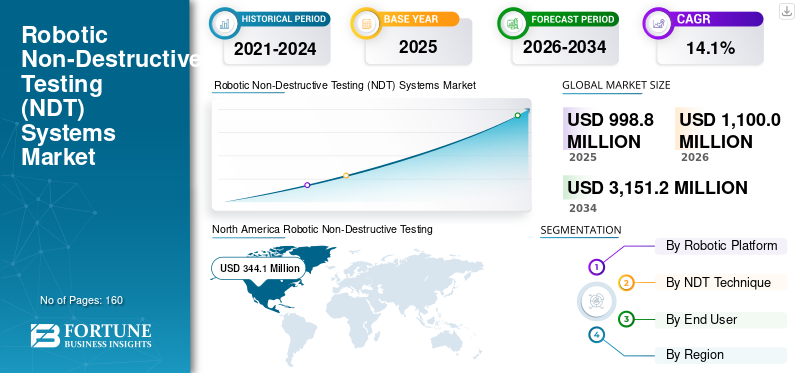
The global robotic Non-Destructive Testing (NDT) systems market size was valued at USD 998.8 million in 2025. The market is projected to grow from USD 1,100.0 million in 2026 to USD 3,151.2 million by 2034, exhibiting a CAGR of 14.1% during the forecast period. North America dominated the robotic non-destructive testing (NDT) systems market with a market share of 34.45% in 2025.
The global robotic Non-Destructive Testing (NDT) systems market comprises automated inspection solutions used to assess the structural integrity of critical industrial assets without causing damage. The global market is experiencing steady growth as industries increasingly adopt automated inspection technologies to enhance safety, reliability, and operational efficiency. Robotic NDT systems integrate advanced inspection techniques such as ultrasonic testing, radiographic testing, and acoustic emission testing with mobile and articulated robotic platforms to inspect critical industrial assets. Growing investments in infrastructure, including bridges, pipelines, refineries, and transportation networks, are driving demand for reliable and repeatable inspection solutions. In addition, the expansion of renewable energy assets such as wind turbines and large-scale infrastructure projects is further supporting adoption of robotic inspection systems to ensure structural integrity and compliance with safety standards.
Key industry players such as Baker Hughes (Waygate Technologies), Eddyfi Technologies, and Zetec continue to expand robotic inspection platforms and advanced ultrasonic solutions to strengthen their market presence across energy, aerospace, and manufacturing sectors.
Download Free sample to learn more about this report.
ROBOTIC NON-DESTRUCTIVE TESTING (NDT) SYSTEMS MARKET KEY TAKEAWAYS
 Market Size & Forecast
- 2025 Market Size: USD 998.8 Million
- 2026 Market Size: USD 1,100.0 Million
- 2034 Forecast Market Size: USD 3,151.2 Million
- CAGR: 14.1% from 2026–2034
 Market Share
- North America dominated the market with a 34.45% share in 2025.
- The crawler robots segment held the largest share by robotic platform.
- The Ultrasonic Testing (UT) segment dominated the market by NDT technique.
 Key Regional Highlights
North America
North America reached USD 344.1 million in 2025, accounting for 34.45% of the global market.
Europe
Europe is projected to reach USD 317.8 million in 2026, driven by industrial manufacturing and renewable energy expansion.
Asia Pacific
Asia Pacific is projected to reach USD 283.2 million in 2026 and is expected to record the fastest regional growth.
U.S.
The market is estimated to reach USD 311.9 million in 2026, supported by aerospace, defense, and industrial automation investments.
Japan
The market is estimated to reach USD 61.0 million in 2026, accounting for approximately 5.5% of global revenue.
Read More

ROBOTIC NON-DESTRUCTIVE TESTING (NDT) SYSTEMS MARKET TRENDS
Increasing Adoption of Automated Inspection Systems to Enhance Safety and Repeatability is a Key Market Trend
The market is witnessing a growing shift toward automated inspection platforms that reduce human exposure to hazardous environments while improving inspection consistency and repeatability. Industries such as oil and gas, aerospace, and manufacturing are increasingly deploying crawler robots, robotic arms, and in-pipe systems equipped with ultrasonic and visual inspection tools to enhance operational reliability. The trend is closely linked to digital transformation initiatives, where inspection data is integrated with asset management platforms and predictive maintenance systems. Robotic inspection enables real-time data capture, reduced inspection downtime, and improved compliance with safety standards.
- For example, companies such as Waygate Technologies and Eddyfi Technologies continue to expand robotic inspection platforms integrated with advanced ultrasonic and digital inspection technologies for industrial assets.
Download Free sample to learn more about this report.
MARKET DYNAMICS
MARKET DRIVERS
Rising Focus on Worker Safety and Infrastructure Integrity is Driving Market Growth
A major driver for the market is the increasing emphasis on worker safety, regulatory compliance, and aging infrastructure management. Traditional manual inspection methods often require confined space entry, elevated work, or exposure to radiation, making robotic inspection a safer alternative. Additionally, aging pipelines, power plants, bridges, and industrial assets require frequent and accurate inspection to prevent catastrophic failures. Robotic systems enable continuous, high-precision inspection while minimizing operational disruptions. As industries move toward predictive maintenance and asset lifecycle optimization, robotic NDT solutions are becoming a critical component of modern inspection strategies.
- Aerospace manufacturers and energy companies increasingly rely on automated ultrasonic and robotic inspection solutions to meet strict quality and safety standards.
MARKET RESTRAINTS
High Initial Investment and Certification Complexity May Limit Adoption
Despite promising growth potential, the adoption of robotic NDT systems may be limited by their high initial system costs and technical difficulties in integrating them into existing systems. In many cases, robotic inspection systems must be tailored or require extensive software integration and operator training and some industries will not allow the implementation of robotic systems until they have certified and validated the inspection procedures, which slows implementation. Finally, smaller inspection service providers may not have sufficient financial capacity to make large capital investments in robotic platforms, which may limit adoption rates in cost sensitive markets.
- Industry participants often express the need to have standardized validation procedures to facilitate rapid adoption of robotic inspection systems among regulated industries.
MARKET OPPORTUNITIES
Expansion of Smart Infrastructure and Industry 4.0 Integration Creates Long-Term Opportunities
The growing adoption of Industry 4.0 technologies and smart infrastructure initiatives presents significant opportunities for robotic NDT systems. Integration of robotic inspection with digital twins, cloud-based asset management platforms, and AI-driven analytics enables enhanced defect detection and predictive maintenance capabilities. As manufacturing and energy sectors invest in automation and data-driven operations, robotic NDT systems are expected to evolve from standalone inspection tools into integrated asset intelligence platforms. Emerging markets investing in large-scale infrastructure projects also present untapped growth potential for automated inspection technologies.
- Industrial automation providers are increasingly promoting robotic inspection systems as part of connected and data-enabled maintenance ecosystems.
Segmentation Analysis
By Robotic Platform
Crawler Robots Hold Largest Share Due to Versatility across Industrial Inspection Applications
Based on robotic platform, the market is divided into crawler robots, in-pipe robotic systems, robotic arms & gantry systems, subsea robotic systems, and others.
In 2025, the crawler robots segment accounted for the highest robotic Non-Destructive Testing (NDT) systems market share. Crawler robots are widely adopted across oil and gas facilities, storage tanks, pipelines, power plants, and structural inspection applications due to their mobility and adaptability to vertical and horizontal surfaces. These systems support ultrasonic and visual inspection tools, making them highly versatile for both corrosion detection and structural integrity assessments. Their ability to operate in hazardous environments without requiring scaffolding or confined space entry significantly enhances safety and cost efficiency.
- Leading inspection technology providers continue to enhance crawler-based platforms with advanced ultrasonic payloads and digital data acquisition systems.
The in-pipe robotic systems segment is anticipated to rise with a CAGR of 14.7% over the forecast period.
To know how our report can help streamline your business, Speak to Analyst
By NDT Technique
Ultrasonic Testing Leads Adoption Due to Precision and Automation Compatibility
Based on NDT technique, the market is segmented into Ultrasonic Testing (UT), Eddy Current Testing (ECT), Radiographic Testing (RT), Visual Testing (VT), and others.
In 2025, Ultrasonic Testing (UT) held the highest share within robotic NDT systems. Ultrasonic testing is highly compatible with robotic automation and provides accurate defect detection in welds, pipelines, pressure vessels, and aerospace components. Phased array ultrasonic testing in particular enables detailed imaging and faster scanning speeds, making it ideal for integration with robotic platforms. As industries prioritize precision and repeatability, ultrasonic-based robotic inspection systems continue to see strong adoption.
- Industrial inspection companies increasingly deploy robotic ultrasonic systems to enhance inspection speed and data reliability.
The Visual Testing (VT) segment is expected to grow at a CAGR of 14.2% over the forecast period.
By End User
Manufacturing and Automotive Dominate Due to Automated Production and Quality Requirements
Based on end user, the market is segmented into oil & gas, power generation, aerospace & defense, manufacturing & automotive, and others.
In 2025, the manufacturing & automotive segment accounted for the highest share of the market. High-volume production environments require consistent quality inspection of components such as welds, castings, and machined parts. Robotic NDT systems enable automated inline or near-line inspection with minimal production interruption. The push toward smart factories and automated production lines further supports the integration of robotic inspection systems into manufacturing workflows.
- Automotive and industrial equipment manufacturers increasingly integrate robotic inspection cells to maintain high production throughput and quality consistency.
The aerospace & defense segment is expected to grow at a CAGR of 14.3% over the forecast period.
Robotic Non-Destructive Testing (NDT) Systems Market Regional Outlook
By geography, the market is categorized into Europe, North America, Asia Pacific, South America, and the Middle East & Africa.
North America
North America Robotic Non-Destructive Testing (NDT) Systems Market Size, 2025 (USD Million)
To get more information on the regional analysis of this market, Download Free sample
North America held a dominant position in the market in 2024 and continued to maintain its leading share in 2025, with a market valuation of USD 344.1 million. The region holds a leading position in the robotic NDT systems market due to strong adoption across aerospace, oil and gas, and advanced manufacturing industries. The presence of major aircraft manufacturers, aging energy infrastructure, and strict regulatory standards for asset integrity management are key factors supporting robotic Non-Destructive testing (NDT) systems market growth.
U.S. Robotic Non-Destructive Testing (NDT) Systems Market
The U.S. market is estimated at around USD 311.9 million in 2026. The U.S. represents the dominant contributor within North America, supported by extensive aerospace production, defense programs, and pipeline inspection requirements. Industrial automation adoption and strong R&D investments in robotics continue to accelerate deployment of robotic NDT systems across manufacturing and energy sectors.
Europe
Europe to record a market valuation of USD 317.8 million in 2026. The region’s growth is driven by strong industrial manufacturing, rail infrastructure, renewable energy expansion, and stringent safety compliance requirements. Additionally, offshore wind infrastructure and industrial plant modernization initiatives support demand for automated ultrasonic and crawler-based inspection systems.
U.K. Robotic Non-Destructive Testing (NDT) Systems Market
The U.K. market is estimated at around USD 58.7 million in 2026, representing roughly 5.3% of global revenues.
Germany Robotic Non-Destructive Testing (NDT) Systems Market
Germany’s market is projected to reach USD 81.3 million in 2026, equivalent to around 7.4% of global sales.
Asia Pacific
Asia Pacific to record a market valuation of USD 283.2 million in 2026. The region is expected to witness the fastest growth over the forecast period, driven by expanding manufacturing output, infrastructure development, and rising automation adoption. Rapid industrialization and increasing investments in power generation and transportation infrastructure are supporting demand for robotic inspection solutions. Manufacturing and automotive production hubs are integrating robotic ultrasonic and visual testing systems to enhance production efficiency and quality control.
Japan Robotic Non-Destructive Testing (NDT) Systems Market
The Japan market is estimated at around USD 61.0 million in 2026, accounting for roughly 5.5% of global revenue.
China Robotic Non-Destructive Testing (NDT) Systems Market
The China market is estimated at around USD 98.2 million in 2026, accounting for roughly 8.9% of global revenue.
India Robotic Non-Destructive Testing (NDT) Systems Market
The Indian market is estimated at around USD 35.3 million in 2026, accounting for roughly 3.2% of global market.
South America and Middle East & Africa
The South America and Middle East & Africa regions are expected to witness moderate growth in this market during the forecast period. South America is projected to reach a market valuation of USD 42.6 million in 2026. The region’s growth is supported by oil and gas production activities, mining operations, and gradual modernization of industrial facilities. The Middle East & Africa market is expected to reach a valuation of USD 76.8 million in 2026. Market growth in this region is primarily supported by oil and gas infrastructure inspection requirements and pipeline monitoring activities.
GCC Robotic Non-Destructive Testing (NDT) Systems Market
The GCC market is projected to reach around USD 35.2 million in 2026, representing roughly 3.2% of global market.
COMPETITIVE LANDSCAPE
Key Industry Players
Focus on Integrated Robotic Inspection Platforms and Advanced Ultrasonic Solutions to Strengthen Market Position
Robotic systems for nondestructive testing feature both traditional ND testing method developers, as well as specialists in robotics and integrated inspection. The leading organizations are focusing their efforts on providing end-to-end robotic inspection solutions that use crawler robots, remote in-pipe NDT techniques, robotic arms, and advanced ultrasonic / visual inspection techniques. Some of the leading organizations: Baker Hughes (Waygate Technologies), Eddyfi Technologies, Wabtec Corporation, Zetec Inc. and MISTRAS Group, are innovative leaders because of their expertise in ultrasonic NDT, phased array NDT systems and digital NDT software. In addition to their expertise, these vendors continue to invest in expanding their portfolios of robotic inspection offerings and upgrades to existing robotic inspection offerings. For example, vendors will be able to expand their robotic inspection product lines with upgrades to existing robotic inspection technologies or through partnerships with industrial automation products and technologies providers that utilize Artificial Intelligence for the purpose of identifying defects in materials. Robotic inspection modules put emphasis on the ability to demonstrate accurate and repeatable results and on the ability to integrate with digital asset management systems that continue to impact vendor and product competitive strategy. Finally, vendors have appropriate funds to develop modular robotic systems capable of supporting a variety of NDT process operations within the same modular system across oil & gas, aerospace, power generation and manufacturing industries.
LIST OF KEY ROBOTIC NON-DESTRUCTIVE TESTING (NDT) SYSTEMS COMPANIES PROFILED IN REPORT:
- Baker Hughes (Waygate Technologies) (U.S.)
- Eddyfi Technologies (Canada)
- Wabtec Corporation (U.S.)
- Zetec Inc. (U.S.)
- MISTRAS Group, Inc. (U.S.)
- Flyability SA (Switzerland)
- Gecko Robotics, Inc. (U.S.)
- Blueye Robotics AS (Norway)
- SGS SA (Switzerland)
- Intertek Group plc (U.K.)
KEY INDUSTRY DEVELOPMENTS
- October 2025: Microwatt and Nexxis formed a partnership to deliver modular robotic and NDT inspection solutions targeting confined spaces and submerged industrial assets, aiming to bring advanced robotic NDT technology to operators facing hazardous conditions.
- July 2025: Waygate Technologies launched the Krautkrämer WheelStar RPS, a fully automated robotic ultrasonic NDT system that automates inspection of dismantled railway wheelsets, reducing manual intervention and inspection time using advanced phased array and robotics technology.
- July 2025: Wabtec Corporation finalized the acquisition of Evident’s Inspection Technologies division, expanding its non-destructive testing and remote inspection capabilities.
- January 2025: MISTRAS Group reported its financial results for 2024 with continued focus on growth and development of advanced NDT technologies including automated and robotics-enhanced inspection solutions.
- April 2024: Mistras Group announced the acquisition of Zetec, expanding its automated NDT services and robotics-related portfolio, strengthening its position in advanced inspection technologies including robotics-enabled systems.
- March 2024: Olympus Corporation and Yaskawa Electric announced a collaboration to integrate Olympus’ NDT sensors with Yaskawa’s robotic platforms for automated pipeline and weld inspection solutions.
REPORT COVERAGE
The global robotic Non-Destructive Testing (NDT) systems market analysis includes a comprehensive study of the market size & forecast by all the market segments included in the report. It includes details on the market dynamics and market trends expected to drive the market over the forecast period. It provides information on key aspects, including an overview of technological advancements, pipeline candidates, the regulatory environment, and product launches. Additionally, it details strategic partnerships, mergers & acquisitions, as well as key industry developments and prevalence by key regions. The global market research report also provides a depth competitive landscape with information on the market share and profiles of key players.
Request for Customization to gain extensive market insights.
Report Scope & Segmentation
| ATTRIBUTE | DETAILS |
| Study Period | 2021-2034 |
| Base Year | 2025 |
| Estimated Year | 2026 |
| Forecast Period | 2026-2034 |
| Historical Period | 2021-2024 |
| Growth Rate | CAGR of 14.1% from 2026-2034 |
| Unit | Value (USD Million) |
| Segmentation | By Robotic Platform, NDT Technique, End User, and Region |
| By Robotic Platform |
|
| By NDT Technique |
|
| By End User |
|
| By Region |
|
Frequently Asked Questions
According to Fortune Business Insights, the global market value stood at USD 998.8 million in 2025 and is projected to reach USD 3,151.2 million by 2034.
In 2025, North Americas market value stood at USD 344.1 million.
The market is expected to exhibit a CAGR of 14.1% during the forecast period of 2026-2034.
By end user, the manufacturing & automotive segment is expected to lead the market.
Growing focus on worker safety, regulatory compliance, and aging infrastructure is accelerating adoption of robotic NDT systems across aerospace and energy industries.
Baker Hughes (Waygate Technologies), Eddyfi Technologies, Wabtec Corporation, Zetec Inc., and MISTRAS Group are the major players in the global market.
North America held the largest market share in 2025.


- 2021-2034
- 2025
- 2021-2024
- 160
Get 30-60 hrs Free Customization
Expand Regional and Country Coverage, Segments Analysis, Company Profiles, Competitive Benchmarking, and End-user Insights.













Related Reports
-
US +1 833 909 2966 ( Toll Free )
-
Get In Touch With Us