Robotic Process Automation Market Size, Share & Industry Analysis, By Component (Software and Services), By Operation (Rule-Based and Knowledge-Based), By Application (Administration and Reporting, Customer Support, Data Migration & Capture Extraction, Analysis, and Others), By Industry (Retail, Manufacturing & Logistics Industry, BFSI, Healthcare, IT and Telecom, Hospitality, and Others), and Regional Forecast, 2026-2034
 Download Free Sample
KEY MARKET INSIGHTS
 Listen to Audio Version
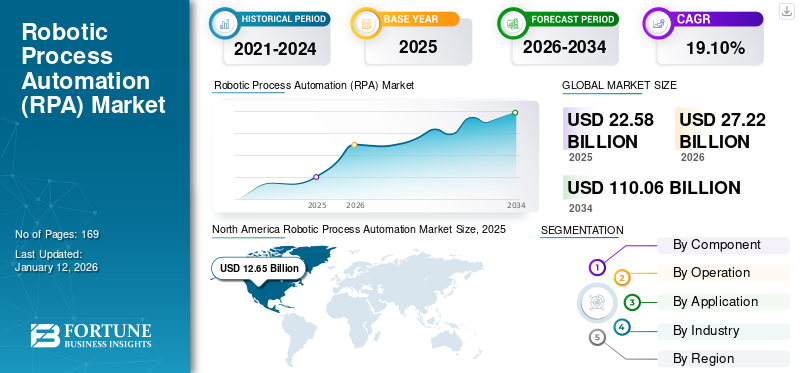
The global robotic process automation market size was valued at USD 22.58 billion in 2025 and is projected to grow from USD 27.22 billion in 2026 to USD 110.06 billion by 2034, exhibiting a CAGR of 19.10% during the forecast period. North America dominated the robotic process automation market, accounting for 56.00% market share in 2025. Additionally, the U.S. robotic process automation market is predicted to grow significantly, reaching an estimated value of USD 22.32 billion by 2032.
The scope of the report covers the software and solutions offered by key players, including Automation Anywhere Inc., Blue Prism PLC, Kofax, Inc., and Nice Systems Ltd. Among these, Automation Anywhere Inc. offers several Robotic Process Automation solutions and software, including Automation 360, IQ bots, bot insights, and the digital workplace. Robotic process automation (RPA) bots can also automate tasks across multiple systems to provide detailed insights into data from multiple digital platforms. Similarly, Blue Prism PLC offers several intelligent RPA platforms, including robotic operating models, Blue Prism Cloud, and RPA-based lifecycle management software.
The rising adoption of these solutions to optimize operations, improve productivity, and generate high returns on investment is aiding the growth of the robotic process automation market. Several key players in the market are adopting advanced technologies, such as AI, machine learning, and cloud, to automate business processes across enterprises. For instance,
- In May 2021, UiPath Inc. launched artificial intelligence-powered UiPath Platform 21.4, which eliminates manual business processes of the enterprises. The platform provides security controls and automates business processes related to the data.
Further, several players are receiving funding for the development of RPA platforms and gaining higher returns on investment in the ongoing digital transformation era. Various businesses are implementing RPA to increase business productivity, optimize the organization's performance, integrate new technologies to get higher returns, and relocate business processes across different enterprises.
The COVID-19 pandemic is expected to positively impact the market due to a significant uptick in the adoption of RPA software and solutions to support COVID-19 patients visiting physicians. For many healthcare providers, the COVID-19 pandemic has boosted the demand for contact center tasks by two to three times. As a result, several of these centers are resorting to automation to speed up the onboarding of remote contact center staff.
Vaccine manufacturers have also used RPA to accelerate the development of pharmaceutical products. The result has piqued the pharmaceutical sector's interest in novel development models based on AI and increased automation. RPA might also play a significant role in pharmacovigilance, collecting data on the side effects and difficulties in the field after a medicine has been introduced. Post-pandemic, the demand for RPA solutions has remained stable. This is primarily due to the surge in market players' adoption of strategies such as partnerships, mergers, and acquisitions.
Download Free sample to learn more about this report.
Robotic Process Automation Market Key Takeaways
 Global Market Size & Forecast
- 2025 Market Size: USD 22.58 billion
- 2026 Market Size: USD 27.22 billion
- 2034 Forecast Market Size: USD 110.06 billion
- CAGR: 19.10% from 2026–2034
 Market Share
- North America dominated the robotic process automation market with a 56.00% share in 2025.
- Services accounted for the largest component share at 79.35% in 2026.
- BFSI held an 18.92% industry share in 2026.
 Key Regional Highlights
North America
North America generated USD 12.65 billion in 2025, representing 56.00% of the global market.
Europe
Europe accounted for 23.40% of the market in 2025, valued at USD 5.28 billion.
Asia Pacific
Asia Pacific held a 16.30% share in 2025, with revenue of USD 3.67 billion.
U.S.
The U.S. market is projected to reach USD 13.07 billion in 2026.
Japan
The Japan market is projected to reach USD 0.58 billion in 2026.
Read More

Robotic Process Automation Market Trends
Rising Adoption and Development of RPA-Enabled Self-Learning Conversational Chatbots Aids the Market Growth
Intelligent bots are becoming increasingly prevalent across the data ecosystem, whether through RPA, chatbots, or other digital assistants. The variety of tasks that these bots can perform is expanding.
With the rise of digital assistants such as Siri and Alexa in both personal and professional settings, many knowledge workers view chatbots as a dated, template-based version of what bots can do. However, the range of applications for these linguistically adept bots is expanding to include both internal and external use cases.
Several leading players are developing chatbots using AI and RPA technologies. For instance,
- In June 2021, RPA Labs launched a new virtual chatbot assistant, RPA Engage. The chatbot assistant is an AI-based logistics platform that enhances the customer experience by automating interactions with vendors, customers, and internal teams. This platform combines conversational machine learning, AI, and Natural Language Processing (NLP) to provide logical answers.
Also, several government organizations and private companies are investing in developing conversational RPA chatbots to automate their processes. For instance, the National Science Foundation (NSF) has created an RPA bot that automates message delivery and reminds people about upcoming public meetings. Since the NSF organization holds several thousand meetings annually, the RPA bot helps save over 25,000 hours of administrative staff time.
Download Free sample to learn more about this report.
Robotic Process Automation Market Growth Drivers
Increasing Adoption of Advanced Technologies such as AI, Cloud, and Machine Learning Boosts RPA Capabilities
The demand for these solutions across organizations is increasing to handle complex data and information and automate business processes. Key players in the market are combining advanced technologies such as cloud, artificial intelligence, machine learning, and cognitive technologies to automate their business processes. These AI- and cloud-based solutions detect work activities, automatically identify optimal workflows, and suggest self-regulatory paths for businesses. Companies are developing AI and cloud-based RPA software and solutions. For instance,
- In May 2021, Automation Anywhere Inc. launched a cloud-based RPA solution to boost industrial bots. The application can be scaled, deployed, and managed on the server.
In addition, end-to-end automation is achieved by combining artificial intelligence and machine learning technologies. This automation helps analyze data, make predictions, handle unstructured information, and assess robot credibility by leveraging the process's decision-making capabilities. Furthermore, increasing adoption of Platform as a Service (PaaS), Infrastructure as a Service (IaaS), and Software as a Service (SaaS) offerings for cloud computing is expected to drive the global robotic process automation market growth.
Market Restraints
Infrastructure and Customization Issues Associated with RPA to Impede Market Growth
Companies need to invest in dependable infrastructure and a skilled staff to oversee all operations when using robotic process automation technology. It's complex and expensive to set up RPA infrastructure, hire professionals, or educate current personnel, and deploy thousands of bots.
In addition, the platforms for automation bots change frequently, and essential adaptability isn't always built into bots. Many companies are hesitant to use this technology in their operations. It's also a tool that needs a distinct identity and cutting-edge technology. As a result, upgrading the platform to meet the company's continuously changing needs is difficult.
Market Segmentation Analysis
By Component Analysis
By component, the robotic process automation market is bifurcated into software and services.
Among these, the services segment will hold the largest share, owing to the surge in enterprises worldwide adopting RPA-as-a-Service, with a share of 79.35% in 2026. Also, leading players in the market are expanding and developing advanced technologies, such as AI and cloud-native RPA, as services. For instance,
- In October 2020, Automation Anywhere Inc. launched AI-based robotic automation as a services platform that accelerated RPA adoption globally.
On the other hand, the software segment is expected to grow at a moderate CAGR during 2025-2032, driven by the surge in adoption of RPA software across the manufacturing sector to automate repetitive robotic tasks.
By Operation Analysis
Ability to Perform Repetitive tasks without Human Intervention to drive the Rule-based Segment
Based on operation, the robotic process automation market is bifurcated into rule-based and knowledge-based.
The rule-based segment is expected to capture the largest share of the robotic process automation market, as it performs repetitive tasks across industries and automates workflows. Several leading players are deploying rule-based RPA platforms for automating business workflows. For instance, as of 2021, UiPath had automated 65% of the Fortune 500's repetitive tasks.
The knowledge-based segment is expected to account for 56.58% of the market in 2026. Currently, the adoption of knowledge-based systems is lower than that of rule-based systems. However, it is likely to experience a rapid adoption after the integration of automation with cognitive technologies such as AI and machine learning. Several companies are adopting cloud-based and AI-driven solutions for scaling up business operations. For instance,
- In May 2020, Automation Anywhere Inc. launched SaaS-based RPA products for its cloud-based and web-based workforce platforms. This platform offers flexibility for both office and remote workers.
By Application Analysis
Administration and Reporting Applications to Generate Monumental Demand for RPA through 2032
In terms of application, the robotic process automation market is segmented into analysis, data migration & capture extraction, administration and reporting, customer support, and others.
Among these, the administration and reporting segment held the largest share in 2026, owing to the rapid and efficient adoption of automation across most finance- and administration-related processes.
The analysis segment will be driven by rising demand from the banking, finance, and insurance sector for report and invoice generation and other day-to-day tasks, accounting for a 26.05% market share in 2026.
To know how our report can help streamline your business, Speak to Analyst
By Industry Analysis
BFSI to Witness Rising Use of RPA for Regulatory Reporting and Balance Sheet Reconciliation
The market is segmented into retail, manufacturing & logistics, IT and telecom, BFSI, healthcare, hospitality, and others (travel & transportation, education, government).
The BFSI segment will account for the largest share of the robotic process automation market in 2026, at 18.92%, primarily owing to rising demand for automating banking processes such as KYC, customer handling, and compliance management. The rising cost of banks' compliance management operations has created ample opportunity for the growth of RPA software and platforms across the BFSI landscape. For instance, according to the World Bank Organization Report, in 2020, banks spent around USD 270 billion yearly on compliance management operations. To reduce the high cost of compliance management, the demand for RPA software has increased substantially.
The healthcare segment is anticipated to grow with the highest CAGR during the forecast period. This is primarily due to factors such as the rising use of RPA tools across healthcare processes, including admissions and discharge, and clinical data interoperability, as well as health plans.
Similarly, the rising digital transformation in the IT and telecom industry is likely to surge the demand for software during the forecast period. Also, the manufacturing and logistics industries are set to grow in the near future owing to the rising data complexity. Implementing robotic process automation (RPA) across industries enhances return on investment and reduces labor costs, thereby improving operational efficiency.
Regional Insights
Geographically, the robotic process automation market is fragmented across five major regions: North America, Europe, Asia Pacific, the Middle East & Africa, and South America. They are further categorized into countries.
North America
North America Robotic Process Automation Market Size, 2025 (USD Billion)
To get more information on the regional analysis of this market, Download Free sample
The North America market accounted for USD 12.65 billion in 2025, representing 56.00% of the global industry, and is expected to reach USD 14.68 billion in 2026. Moreover, the United States government is providing funding and running programs to encourage private companies to deploy automated solutions to improve the smooth flow of their workflows. For instance, the U.S. federal government introduced new RPA programs, creating around 1,000 robotic automation solutions that freed around 1.5 million hours of capacity. The rising adoption of automation software, solutions, and processes by enterprises and government agencies in this region is driving market growth. Also, in March 2019, the U.S. Federal government allocated funding to encourage RPA and AI adoption to serve U.S. citizens better. The U.S. market is projected to reach USD 13.07 billion by 2026.
To know how our report can help streamline your business, Speak to Analyst
Asia Pacific
In 2025, Asia Pacific represented USD 3.67 billion, accounting for 16.30% of the worldwide market, and is projected to grow to USD 4.94 billion in 2026. This is primarily due to the rising adoption of these solutions across the automotive manufacturing industry. Furthermore, the rising Industry 4.0 evolution with increasing investment in industrial plants is anticipated to aid the robotic process automation market growth. China, India, and Japan are expected to have the maximum share in the coming years. The increasing digital transformation across industries in India is driving the demand for RPA software solutions. For instance, India’s banks, such as ICICI, are leading adopters of these solutions to automate customer email responses, IT support, and account portability. Several leading players are expanding their RPA product offerings in the Asia Pacific. The Japan market is projected to reach USD 0.58 billion by 2026, the China market is projected to reach USD 1.54 billion by 2026, and the India market is projected to reach USD 1.18 billion by 2026. For instance,
- In December 2020, Japan-based Sumitomo Mitsui Banking Corporation (SMBC) and Sumitomo Mitsui Financial Group (SMFG) collaboratively implemented UiPath, Inc.’s RPPA solutions. It helped maintain high volumes in financial services operations and meet cost-reduction demands in banking. They implemented RPA solutions across their platform to improve operational efficiency, increase productivity, and reduce operational costs.
Europe
Europe recorded a market size of USD 5.28 billion in 2025, capturing 23.40% of the global market share, and is projected to reach USD 6.33 billion in 2026. Demand for RPA tools in European countries such as Germany, the U.K., and Italy is high. Manufacturing companies across these countries are adopting these solutions to automate small-scale projects and to scale up their operations. The increasing adoption of RPA in small- and medium-sized business is expected to improve business functions, such as data entry, procurement, and accounting/finance, and drive market expansion during the forecast period. The UK market is projected to reach USD 1.17 billion by 2026, while the German market is projected to reach USD 1.62 billion by 2026.
- According to IBA Group, RPA implementation in European countries helped to save around 50% or more of the cost for small-sized companies and 30% for large-scale enterprises.
Similarly, the increasing adoption of advanced technologies such as cloud computing and AI in South America is driving market growth.
Middle East & Africa and South America
Middle East & Africa contributed 2.70% to the global market in 2025, with a valuation of USD 0.63 billion, and is projected to reach USD 0.81 billion in 2026. The Middle East & Africa and South American countries have shown slower RPA adoption than other regions, mainly owing to a lack of industrial investment. However, according to the Middle Eastern and Automation Forum, several industry players in this region plan to invest in RPA technologies to reduce costs and enhance business process efficiency. Companies are entering the Middle East & Africa (MEA) to expand their robotic process automation industry product portfolio. For instance,
- In May 2019, UiPath, Inc. partnered with Mannai Trading Co., a Qatar-based trader, to drive the adoption of these solutions.
Latin America
The Latin America market was valued at USD 0.36 billion in 2025, capturing 1.60% of global revenue, and is estimated to reach USD 0.46 billion in 2026.
KEY INDUSTRY PLAYERS
Key Players are Focused on Strengthening their Market Position with Continuous Developments
The global market is consolidated by leading players such as Automation Anywhere, Inc., UiPath, Inc., and Blue Prism Group Plc. These key players are expanding their operations through mergers, acquisitions, collaborations, and partnerships. These companies are focused on adopting cognitive technologies, such as AI and machine learning, to better serve their customers. For instance,
- In March 2022, SS&C Technologies Holdings, Inc. acquired Blue Prism Group Plc for around USD 1.6 billion. With this acquisition, the company expanded its automation services and software capabilities across the healthcare and financial services sectors. This acquisition helped the company create deep expertise across the robotic process automation and intelligent automation product offerings.
- In March 2021, Microsoft Corporation launched robotic process automation for its Windows 10 users. The company offered its RPA Power Platform, which automates repetitive, monotonous tasks.
- January 2021 – Nice System Ltd. introduced an AI-based RPA solution to fast-track automation opportunities. This solution enabled businesses to strengthen organizational efficiency and expand existing business processes, even during unpredictable market conditions.
- November 2020 – Pegasystems, Inc. launched Pega Auto-balancing RPA digital transformation solution. The solution is driven by advanced artificial intelligence to optimize workload management without human intervention.
List of Top Robotic Process Automation Companies:
- Automation Anywhere (U.S.)
- Blue Prism Group PLC (U.K.)
- UiPath Inc. (U.S.)
- Microsoft Corporation (U.S.)
- Nice Systems Ltd. (Israel)
- WorkFusion, Inc. (U.S.)
- Pegasystems, Inc. (U.S.)
- OnviSource, Inc. (U.S.)
- Salesforce (Servicetrace GmbH/Mulesoft, Inc.) (Germany)
- Kryon Systems (U.S.)
KEY INDUSTRY DEVELOPMENTS
- May 2021- Automation Anywhere Inc. launched a cloud-based robotic process automation solution to boost industrial bots. Automation Anywhere Inc.’s applications can be scaled, deployed, and managed on a server.
- July 2020 — Nice Systems Ltd. partnered with Minit to accelerate the return on investment by automating discovery accuracy. The combination of both companies accelerated automation and interactive processes for boosting operational efficiency.
REPORT COVERAGE
The report offers qualitative and quantitative insights into the market and a detailed analysis of the robotic process automation market, including size & growth rate across all segments. Additionally, it provides an in-depth analysis of market dynamics, emerging trends, and the competitive landscape. Key insights offered in the report include the adoption of automation across individual segments, recent industry developments such as partnerships and mergers & acquisitions, a consolidated SWOT analysis of key players, Porter’s Five Forces analysis, business strategies of leading market players, macro- and microeconomic indicators, and key robotic process automation market trends.
Request for Customization to gain extensive market insights.
REPORT SCOPE & SEGMENTATION
|
ATTRIBUTE |
DETAILS |
|
Study Period |
2021-2034 |
|
Base Year |
2025 |
|
Estimated Year |
2026 |
|
Forecast Period |
2026-2034 |
|
Historical Period |
2021-2024 |
|
Growth Rate |
CAGR of 19.10% from 2026 to 2034 |
|
Unit |
Value (USD billion) |
|
Segmentation |
By Component
By Operation
By Application
By Industry
By Region
|
Frequently Asked Questions
According to Fortune Business Insights, the global market is predicted to reach USD 110.06 billion by 2034.
In 2025, the market value stood at USD 22.58 billion.
The market is projected to grow at a CAGR of 19.10% during the forecast period (2026-2034).
The analysis segment is expected to show the highest CAGR during the forecast period.
North America dominated the robotic process automation market with a share of 56.00% in 2025.
By industry, the BFSI segment leads the market owing to the rising use of RPA for regulatory reporting and balance sheet reconciliation.
Infrastructure and customization issue associated with RPA is restraining the growth of the market.
Increasing adoption of advanced technologies is the key factor driving the growth of the market.
Some of the top players in the market are Uipath, Inc., Blue Prism PLC, Automation Anywhere, Inc., Nice Systems Ltd., and Microsoft Corporation.


- 2021-2034
- 2025
- 2021-2024
- 169
Get 30-60 hrs Free Customization
Expand Regional and Country Coverage, Segments Analysis, Company Profiles, Competitive Benchmarking, and End-user Insights.













Related Reports
-
US +1 833 909 2966 ( Toll Free )
-
Get In Touch With Us