Robotic Prosthetics Market Size, Share & Industry Analysis, By Product Type (Lower Body Prosthetics {Prosthetic Knee, Prosthetic Ankle/Foot, and Others} and Upper Body Prosthetics {Prosthetic Arm, Prosthetic Hand, and Others), By Technology (Myoelectric-Controlled Prosthetics, Microprocessor-Controlled Prosthetics, and Others), By Patient Group (Adult and Pediatric), By End-user (Hospitals, Prosthetic & Orthotic Clinics, and Others), and Regional Forecast, 2026-2034
 Download Free Sample
Robotic Prosthetics Market Size & Future Outlook
 Listen to Audio Version
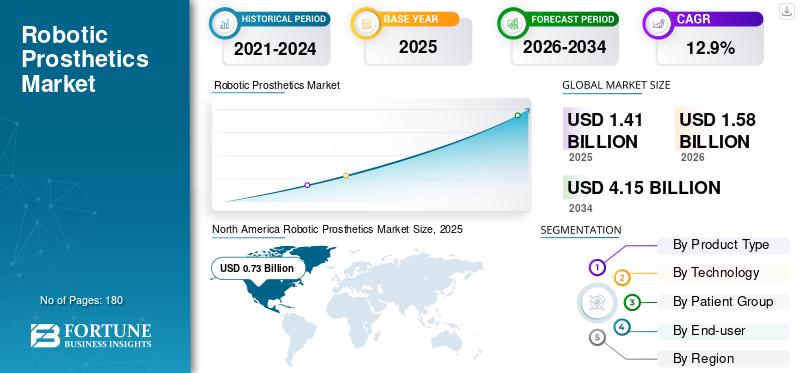
The global robotic prosthetics market size was valued at USD 1.41 billion in 2025 and is projected to grow from USD 1.58 billion in 2026 to USD 4.15 billion by 2034, exhibiting a CAGR of 12.9% during the forecast period. North America dominated the robotic prosthetics market with a market share of 51.77% in 2025.
The robotic prosthetics market includes advanced artificial limbs integrated with sensors, microprocessors, motors, batteries, embedded software, AI-based control systems, and myoelectric or biomechanical interfaces to restore mobility, grip, balance, and functional independence for amputees. The market’s growth is attributed to the rising burden of limb loss, diabetes-related amputations, trauma injuries, and other conditions, which are driving the adoption of technologically advanced prosthetic knees, ankles, and hands.
Ottobock, Össur, and Open Bionics are key companies operating in the market and held the highest share in 2025 with significant market reach, strong brand reputations, and diversified portfolios.
Download Free sample to learn more about this report.
Robotic Prosthetics Market KEY TAKEAWAYS
 Global Market Size & Forecast
- 2025 Market Size: USD 1.41 billion
- 2026 Market Size: USD 1.58 billion
- 2034 Forecast Market Size: USD 4.15 billion
- CAGR: 12.9% from 2026–2034
 Market Share
- North America dominated the robotic prosthetics market with a 51.77% share in 2025.
- Lower body prosthetics accounted for the largest segment share in 2025.
- Microprocessor-controlled prosthetics held the largest share, estimated at 68.1% in 2026.
 Key Regional Highlights
North America
North America led the market, supported by strong reimbursement access and advanced rehabilitation infrastructure.
Europe
Europe is projected to grow at a CAGR of 11.6%, driven by advanced prosthetic technologies.
Asia Pacific
Asia Pacific is expected to reach approximately USD 0.31 billion in 2026, making it the third-largest market.
U.S.
U.S. The market is anticipated to reach USD 0.76 billion in 2026, representing approximately 48.4% of the global market.
Japan
Japan The market is projected to reach approximately USD 0.21 billion in 2026, accounting for nearly 13.3% of the global market.
Read More

ROBOTIC PROSTHETICS MARKET TRENDS
Shift Toward AI-Enabled, Sensor-Rich, and Microprocessor-Controlled Prosthetics Emerges as a Key Trend
Currently, there has been a shift toward AI-enabled, sensor-rich, and microprocessor-controlled devices that adjust to the user’s gait, speed, cadence, terrain, and daily activity patterns. Microprocessor knees and feet use embedded sensors and software to monitor movement and change resistance in real time, improving stability and confidence during walking, climbing stairs, and uneven surfaces.
- For instance, as recorded in July 2025, Ottobock’s C-Leg remains a significant product, with more than 100,000 fittings globally.
Moreover, upper limb prosthetic companies are also focused on advancing touch-sensitive, multi-grip, and remote-updateable bionic hands, contributing to newer innovations in robotic prosthetics.
MARKET DYNAMICS
MARKET DRIVERS
Download Free sample to learn more about this report.
Rising Limb Loss Burden and Demand for Natural Mobility to Fuel Market Expansion
In recent years, there has been an increasing amputee population and growing demand for prostheses that provide more natural movement than conventional mechanical limbs. For instance, in February 2024, the Amputee Coalition reported that more than 5.6 million people live with limb loss or limb difference in the U.S.
Moreover, the growth in lower-limb amputations is attributed to diabetes-related complications, which is expected to create strong demand for robotic knees, ankles, and feet to improve walking efficiency, stumble recovery, stair navigation, and balance.
|
Rank |
Market Driver |
Overall Impact Rank |
CAGR Contribution (2026-2034) |
Impact: 2026-2028 |
Impact: 2029-2031 |
Impact: 2032-2034 |
|
1 |
Rising Limb Loss Burden and Demand for Natural Mobility |
High |
+4.35% |
High |
High |
High |
|
2 |
Technological Advancements in Myoelectric, Microprocessor-controlled, AI-enabled, and Sensor-based Prosthetics |
High |
+3.82% |
High |
High |
Medium |
|
3 |
Increasing Adoption of Microprocessor-controlled Lower Body Prosthetics |
Medium-High |
+3.21% |
Medium |
High |
High |
|
4 |
Improving Reimbursement, Insurance Coverage, and Clinical Acceptance in Developed Markets |
Medium-High |
+2.94% |
Medium |
High |
High |
|
5 |
Expansion of Specialized Prosthetic & Orthotic Clinics and Emerging Market Access |
Medium |
+2.38% |
Medium |
Medium |
Medium |
|
6 |
Others |
Low |
+1.98% |
Low |
Low |
Low |
|
Total Positive Growth Contribution |
+18.68% |
MARKET RESTRAINTS
High Device Cost, Reimbursement Barriers, and Complex Fitting Requirements to Hamper Market Growth
Although demand for robotic prosthetics has been increasing, powered knees, the higher cost of bionic hands, and integrated lower-limb systems that use motors, batteries, sensors, and software remain key constraints. Moreover, advanced prosthetic limbs often require custom sockets, training, periodic software adjustments, repeated fitting visits, gait maintenance, and component replacement, increasing total ownership cost. Furthermore, reimbursement limitations restrict adoption, especially in emerging markets and for patients who do not qualify for advanced mobility categories.
- For instance, in September 2025, Orthotics Ltd stated that a prosthetic arm ranges from USD 5,000 for basic body-powered models to USD 50,000 or more for myoelectric or specialized arms.
|
Rank |
Market Restraint |
Overall Impact Rank |
Negative CAGR Contribution (2026-2034) |
Impact: 2026-2028 |
Impact: 2029-2031 |
Impact: 2032-2034 |
|
1 |
High Device Cost, Reimbursement Barriers, and Complex Fitting Requirements |
High |
-2.34% |
High |
High |
High |
|
2 |
Limited Availability of Skilled Prosthetists, Rehabilitation Infrastructure, and Fitting Expertise |
Medium-High |
-1.56% |
High |
High |
Medium |
|
3 |
Device Maintenance, Battery Dependence, User Adaptation, and Long-term Usability Challenges |
Medium-Low |
-1.18% |
Medium |
Medium |
Low |
|
4 |
Others |
Low |
-0.70% |
Low |
Low |
Low |
|
Total Negative Growth Impact |
-5.78% |
MARKET OPPORTUNITIES
Expansion of Clinic-Ready Powered and Connected Prosthetic Solutions to Offer Lucrative Growth Opportunities
In recent years, demand has increased for clinic-ready robotic prosthetics that combine advanced performance with easier prescription, fitting, programming, and reimbursement pathways. The robotic prosthetics market growth is projected to increase as healthcare systems focus on functional independence, post-trauma rehabilitation, aging populations, and improved quality of life for amputees. For instance, according to the January 2024 data from the World Health Organization, over 2.5 billion people need one or more assistive products globally.
Moreover, companies are moving toward commercialization-focused strategies rather than only R&D pilots and integrating advanced control technologies into prosthetic care delivery. These developments are expected to create opportunities for scalable adoption through prosthetic and orthotic clinic networks.
MARKET CHALLENGES
Balancing Performance, Comfort, Reliability, and Patient Training to Challenge Market Expansion
Balancing robotic performance with comfort, durability, battery life, water resistance, usability, and long-term patient compliance is a major market challenge. A robotic limb may offer strong technological capability; however, its adoption depends on the patient’s comfort. Moreover, socket discomfort, charging needs, maintenance, device weight, and control accuracy also affect patient satisfaction.
Furthermore, upper limb robotic prosthetics face additional challenges as fine motor control, sensory feedback, grip strength, and intuitive hand movement are difficult to replicate. This is expected to pose a major challenge for market expansion.
Segmentation Analysis
By Product Type
High Prevalence of Lower-Limb Amputations Compared With Upper-Limb Amputations to Boost the Segment Growth
Based on product type, the market is segmented into lower body prosthetics and upper body prosthetics. The lower body prosthetics are sub-segmented into prosthetic knee, prosthetic ankle/foot, and others. On the other hand, the upper body prosthetics are sub-classified into prosthetic arm, prosthetic hand, and others.
To know how our report can help streamline your business, Speak to Analyst
The lower body prosthetics segment accounted for the largest robotic prosthetics market share in 2025. The segment’s growth is attributed to the high prevalence of lower-limb amputations compared with upper-limb amputations. For instance, in December 2024, ScienceDirect reported that among the number of people living with limb loss in the U.S., nearly 91.0% of individuals underwent lower extremity amputation, while only 9.2% underwent upper extremity amputations.
The upper body prosthetics segment is projected to grow at a CAGR of 14.0% during the forecast period.
By Technology
Microprocessor-Controlled Prosthetics are Highly Preferred Due to Key Advantages
By technology, the market is segmented into myoelectric-controlled prosthetics, microprocessor-controlled prosthetics, and others.
The microprocessor-controlled prosthetics segment accounted for the largest market share in 2025. Microprocessor knees have stronger adoption than fully powered or neural-interface prosthetics as they offer proven clinical utility, broader reimbursement acceptance, and established product portfolios from major companies. This is anticipated to drive the segment’s growth during the forecast period and is estimated to hold a 68.1% share in 2026.
The myoelectric-controlled prosthetics segment is anticipated to grow at a CAGR of 14.9% over the forecast period.
By Patient Group
Increasing Number of Old Individuals Globally to Boost the Segment’s Growth
By patient group, the market is classified into adult and pediatric.
The adult segment accounted for the largest market share in 2025 and is projected to hold a 98.0% share in 2026. The segment’s growth is attributed to the growing global elderly population, as most amputations occur in this age group due to diabetes, peripheral vascular disease, trauma, cancer, and age-related complications.
- For instance, in October 2025, the World Health Organization in October 2025 stated that the global population of those 60 and older will double to 2.1 billion by 2050.
The pediatric segment is expected to grow at a CAGR of 15.1% during the forecast period.
By End-user
Specialized Capabilities of Prosthetic & Orthotic Clinics Propel the Segment’s Growth
On the basis of end-user, the market is segmented into hospitals, prosthetic & orthotic clinics, and others.
In 2025, prosthetic & orthotic clinics dominated the market by end-users as robotic prosthetics require specialized prescription, socket fitting, gait assessment, alignment, calibration, software programming, training, and follow-up adjustment, which these settings offer. Furthermore, the segment is set to hold a 69.8% share in 2026.
The hospitals segment is projected to grow at a CAGR of 12.0% during the forecast period.
Robotic Prosthetics Market Regional Outlook
Based on geography, the market is classified into North America, Europe, Asia Pacific, Latin America, and the Middle East & Africa.
North America
North America Robotic Prosthetics Market Size, 2025 (USD Billion)
To get more information on the regional analysis of this market, Download Free sample
North America accounted for the largest share of revenues in 2024, valued at USD 0.66 billion, and USD 0.73 billion in 2025. The growth is attributed to strong reimbursement access, high prosthetic care awareness, advanced rehabilitation infrastructure, and the presence of leading prosthetic clinics in the region.
U.S. Robotic Prosthetics Market
In 2026, the U.S. is anticipated to reach USD 0.76 billion, accounting for approximately 48.4% of the global market.
Europe
Europe is projected to record a CAGR of 11.6% during the forecast period, the second-highest globally, reaching USD 0.43 billion by 2026. The U.K., Germany, France, Italy, and Spain are key contributors due to the strong presence of established prosthetic manufacturers, advanced rehabilitation systems, and favorable adoption of microprocessor-controlled lower-limb technologies in the region.
U.K. Robotic Prosthetics Market
The U.K. is projected to reach USD 0.07 billion in 2026, representing approximately 4.2% of global revenues.
Germany Robotic Prosthetics Market
Germany's market is expected to reach around USD 0.11 billion by 2026, accounting for approximately 7.1% of global revenue.
Asia Pacific
In 2026, the Asia Pacific robotic prosthetics market is projected to reach approximately USD 0.31 billion, making it the third-largest market globally. The region’s growth is driven by a large patient pool with diabetes and other conditions requiring further foot amputation, increasing robotic prosthetics adoption.
- For instance, according to the data from the Ministry of Health & Family Welfare, India is projected to be the diabetes capital of the world with 109.0 million individuals with diabetes by 2035.
Japan Robotic Prosthetics Market
Japan is projected to generate approximately USD 0.21 billion in 2026, representing nearly 13.3% of the global market.
China Robotic Prosthetics Market
China is anticipated to reach around USD 0.07 billion in 2026, accounting for nearly 4.3% of global revenues.
Australia Robotic Prosthetics Market
Australia is expected to reach approximately USD 0.03 billion in 2026, accounting for around 1.9% of global market revenue.
Latin America and Middle East & Africa
Both Latin America and the Middle East & Africa are anticipated to witness moderate growth, with Latin America’s market estimated at USD 0.01 billion for 2026. The growth is attributed to increasing healthcare spending and the partnership among key players to expand in the underserved areas of these regions.
GCC Robotic Prosthetics Market
In 2026, the GCC market is estimated to reach approximately USD 0.01 billion, representing around 0.5% of global revenues.
COMPETITIVE LANDSCAPE
Key Industry Players
Partnerships, Acquisitions, and Collaborations to Strengthen Market Position of Key Players
The global market is moderately consolidated, with a few established prosthetics companies accounting for a significant share of the market. In 2025, Ottobock, Össur, and Open Bionics held the largest global robotic prosthetics market share due to their broad robotic prosthetics portfolio and clinical acceptance worldwide.
Moreover, other major players are focusing on acquisitions, partnerships, collaborations, and new product launches to strengthen their market presence worldwide in the forthcoming years.
LIST OF KEY ROBOTIC PROSTHETICS MARKET COMPANIES PROFILED
- Ottobock (Germany)
- Össur (Iceland)
- Blatchford Limited (U.K.)
- PROTEOR (France)
- Open Bionics (U.K.)
- Mobius Bionics (U.S.)
- TASKA Prosthetics (New Zealand)
- PSYONIC (U.S.)
- BrainRobotics (U.S.)
- Vincent Systems GmbH (Germany)
KEY INDUSTRY DEVELOPMENTS
- February 2025: Hanger, Inc. agreed to acquire Coapt to add advanced myoelectric control technology to its orthotics and prosthetics care network.
- January 2025: BionicM launched its U.S. subsidiary, BionicM USA, and highlighted Bio Leg after receiving CES 2025 Best of Innovation recognition.
- September 2024: BionicM reported U.S. sales progress for Bio Leg and secured USD 3 million in first-close funding to support commercialization.
- June 2024: Eqwal completed the acquisition of TASKA Prosthetics, strengthening its position in multi-articulated myoelectric prosthetic hands.
- June 2024: Ottobock unveiled Genium X4, the next generation of its Genium family of microprocessor knees.
- March 2024: PROTEOR launched SYNSYS in the U.S., a PDAC-verified microprocessor full-leg system with integrated hip-knee-ankle functionality.
- August 2023: BionicM received U.S. FDA registration for Bio Leg, its robotic prosthetic knee, supporting planned U.S. commercialization.
- February 2022: Össur launched the POWER KNEE, an actively powered microprocessor prosthetic knee for above-knee amputees and people with limb difference.
REPORT COVERAGE
The report provides an in-depth assessment of all market segments, highlighting the key growth drivers, opportunities, emerging trends, major restraints, and challenges shaping the market. It further includes technological advancements, volume of amputations, key industry developments, new product launches, company market share analysis, and profiles of prominent market players.
Request for Customization to gain extensive market insights.
Report Scope & Segmentation
| ATTRIBUTE | DETAILS |
| Study Period | 2021-2034 |
| Base Year | 2025 |
| Estimated Year | 2026 |
| Forecast Period | 2026-2034 |
| Historical Period | 2021-2024 |
| Growth Rate | CAGR of 12.9% from 2026-2034 |
| Unit | Value (USD Billion) |
| Segmentation | By Product Type, Technology, Patient Group, End-user, and Region |
| By Product Type |
|
| By Technology |
|
| By Patient Group |
|
| By End-user |
|
| By Geography |
|
Frequently Asked Questions
Fortune Business Insights says that the global market value stood at USD 1.41 billion in 2025 and is projected to reach USD 4.15 billion by 2034.
In 2025, North America’s market value stood at USD 0.73 billion.
The market is expected to exhibit a CAGR of 12.9% during the forecast period of 2026-2034.
The lower body prosthetics segment led the market by product type.
The key factor driving the market is the rising limb loss burden and demand for natural mobility.
Ottobock, Össur, and Open Bionics are among the prominent players in the market.
North America dominated the market in 2025.



- 2021-2034
- 2025
- 2021-2024
- 180
Get 30-60 hrs Free Customization
Expand Regional and Country Coverage, Segments Analysis, Company Profiles, Competitive Benchmarking, and End-user Insights.













.webp)






Related Reports
-
US +1 833 909 2966 ( Toll Free )
-
Get In Touch With Us