Saccharin Market Size, Share & Industry Analysis, By Product Type (Sodium Saccharin, Calcium Saccharin, and Insoluble Saccharin), By Form (Dry and Liquid), By Application (Food & Beverages {Bakery, Confectionery, Beverages, and Others}, Pharmaceuticals, Personal Care & Cosmetics, Animal Feed, and Others), and Regional Forecast, 2026 - 2034
 Download Free Sample
(Offer valid till 30th Sep 2026)

Saccharin Market Size and Industry overview
 Listen to Audio Version
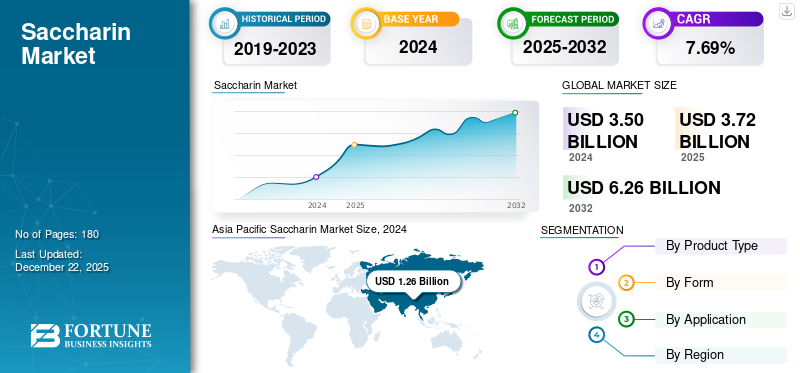
The global saccharin market size was valued at USD 3.72 billion in 2025 and is projected to grow from USD 3.98 billion in 2026 to USD 7.28 billion by 2034, exhibiting a growth at a CAGR of 7.84% during the forecast period. Asia Pacific dominated the saccharin market with a market share of 47.19% in 2025.
A few of the key players in the industry include Merck KGaA, Kyung-In Synthetic Corporation, and PRODUCTOS ADITIVOS, S.A., among others.
Saccharin, also known as benzosulfimide/E954, is a white-colored artificial or zero-calorie sweetener produced through chemical synthesis. This sugar alternative was discovered in 1879, its popularity has grown in recent years due to the surging awareness of low-calorie sweeteners and their versatility. Some of the common forms include calcium, acid, and sodium saccharin. Moreover, this artificial sweetener can be consumed within the range of 5 to 9 mg/kg of body weight, which is considered safe for human intake. With respect to utilization, this low-calorie sugar alternative can be used in several industries, ranging from food and beverages to cosmetics and pharmaceutical sectors.
Download Free sample to learn more about this report.
Saccharin Market Takeaways
 Global Market Size & Forecast
- 2025 Market Size: USD 3.72 billion
- 2026 Market Size: USD 3.98 billion
- 2034 Forecast Market Size: USD 7.28 billion
- CAGR: 7.84% from 2026–2034
 Market Share
- Asia Pacific dominated the saccharin market with a 47.19% share in 2025.
- The Sodium product type segment led the global market in 2025.
- The Food & Beverages application segment accounted for the largest market share in 2025.
 Key Regional Highlights
North America
North America contributed USD 1.05 billion in 2025 and is expected to reach USD 1.10 billion in 2026, driven by growing adoption of sugar substitutes in processed foods.
Europe
Europe recorded USD 0.78 billion in 2025 and is projected to reach USD 0.83 billion in 2026, supported by increasing demand for healthier food ingredients.
Asia Pacific
Asia Pacific generated USD 1.36 billion in 2025 and is projected to reach USD 1.48 billion in 2026, supported by rising demand for low-calorie food and beverages.
U.S.
The U.S. market is witnessing strong demand for saccharin due to the rising consumption of sugar-free foods, beverages, and pharmaceutical formulations.
Japan
Japan's saccharin market is supported by increasing consumer preference for low-calorie sweeteners and the growing demand for functional food and beverage products.
Read More

MARKET DYNAMICS
Market Drivers
Increasing Prevalence of Diabetes Encourages Product Demand
The surging diabetes population is the primary driver behind the growing use of saccharin. Diabetes is recognized as one of the most common Non-Communicable Diseases (NCDs), affecting the lives of billions of people worldwide. This condition mainly arises when the body cannot produce enough insulin or cannot effectively use the insulin the pancreas produces, resulting in high glucose levels. Thus, in order to restrict sugar intake, global consumers are switching toward artificial sweeteners, as it is known to provide fewer calories and do not raise glucose levels. Moreover, few studies suggest that sugar alternatives may help enhance glycemic control in diabetic patients, further contributing to their rising consumption.
Market Restraints
Rising Competition from Substitute Sweeteners Could Hamper Market Growth
One of the key challenges faced by producers is the tough competition from alternative substitutes. The sugar substitute industry is facing stiff competition from various artificial sweeteners such as stevia, aspartame, and sucralose. These substitutes are attaining huge popularity owing to their low-calorie content and natural origin. By seeing such advantages, the majority of global consumers are switching toward more plant-sourced natural ingredients, which can be used as additives. This inclination in consumer behavior poses serious hurdles for the saccharin market growth, further impeding its acceptability worldwide.
Market Opportunities
Growing Use of Products in the Personal Care Industry to Present Significant Growth Opportunities
Saccharin, particularly in its sodium form, plays a significant role in the self-care and cosmetics sector, creating several growth opportunities. Sodium saccharin is primarily used as a flavoring agent and sweetener in oral care items, such as mouthwash and toothpaste, helping these products preserve their sweetness during production processes and storage. Moreover, this substitute can be utilized in skincare cosmetics products, which include hand cream, lip gloss, face cream, lipstick, and others. Additionally, it acts as an odor-masking agent and helps eliminate unwanted odors in finished cosmetic products.
Saccharin Market Trends
Rising Focus on Health-Consciousness is the Current Trend
Surging health-consciousness is a pivotal trend that boosts the intake of sugar alternatives. In this modern era, most consumers are actively searching for ways to maintain a healthy lifestyle. In order to adhere to their goals, individuals are reducing their intake of sugar as high consumption can lead to numerous health ailments. This awareness of the adverse effects of synthetic sugar necessitates consumers to turn toward zero-calorie sweeteners.
Segmentation Analysis
By Product Type
Sodium Segment Led the Market Due to its Numerous Advantages
Depending on product type, the market is segmented into sodium, calcium, and insoluble saccharin. The sodium product type segment led the global market and held a sizable share. This substitute is one of the well-known and common sweeteners in the food industry and is being utilized in the preparation of sugar-free candies, drinks, and others. Additionally, it is considered tooth-friendly owing to its non-fermentable nature, which reduces the risk of tooth decay. Along with this, it is economical and highly stable, further making it a suitable alternative for food applications.
Calcium emerged as the fastest-growing segment. The shelf-life extending property of calcium and weight reduction benefits are the critical factors driving the segment’s growth.
By Form
Dry Form is Majorly Preferred and is Dominant Owing to its Ease of Handling
On the basis of form, the global market is bifurcated into dry and liquid. The dry segment led the market and is anticipated to maintain its leading position in the near term. Compared to liquid forms, dry product has a prolonged shelf life, which minimizes the risk of rancidity and spoilage. Moreover, it is also easy to transport, store, and handle, making it more convenient for manufacturers. Additionally, it can be customized easily compared to liquid forms, in order to cater to particular nutritional needs.
Liquid is the fastest-growing segment in the global market and holds the highest CAGR. Dry-form liquids also offer several advantages, ranging from ease of administration to flexibility in dosing and ease of production.
By Application
Food & Beverages Segment Led the Market Due to Product’s High Usage in Diet Sodas
On the basis of application, the market is divided into food & beverages, pharmaceuticals, personal care & cosmetics, animal feed, and others. The food & beverages sector secured the foremost position and generated the maximum market share. Saccharin is used as an artificial sweetener in a variety of processed food items such as baked snacks, candies, jellies, and others. Additionally, when combined with aspartame, this ingredient is utilized in diet sodas and various low-calorie beverages.
Pharmaceuticals is considered the fastest-growing segment and is likely to expand at a rapid pace in the upcoming years. This alternative is used as a sweetening agent, mainly in tablets and liquid formulations for taste masking.
Saccharin Market Regional Outlook
On the basis of region, the market is segmented into North America, Europe, Asia Pacific, South America, and the Middle East & Africa.
Asia Pacific
Asia Pacific Saccharin Market Size, 2025 (USD Billion)
To get more information on the regional analysis of this market, Download Free sample
Asia Pacific emerged as the fastest-growing region in the global marketplace. The Asia Pacific market was valued at USD 1.36 billion in 2025, capturing 47.19% of global revenue, and is estimated to reach USD 1.48 billion in 2026. In this region, most individuals are becoming health-conscious and are proactively seeking conventional sugar alternatives. This trend is expected to bolster the growth possibilities of artificial sugar in the coming years. Along with this, the desire for weight management and the increased use of sodium saccharine in the flourishing personal care industry also add up to the growth. Within the region, Japan is considered the prominent consumer of sugar alternatives, owing to the rising investments and surge in the geriatric population in comparison to other countries.
Amongst all Asian countries, Japan leads and is expected to maintain the same pace of growth. The increasing health consciousness and improved launches boost the market’s potential.
Download Free sample to learn more about this report.
North America
North America contributed 31.52% to the global market in 2025, with a valuation of USD 1.05 billion, and is projected to reach USD 1.1 billion in 2026. North America is considered one of the leading regions in the global saccharine industry. This growth is attributed to the augmented awareness of low-calorie and sugar-free products and surging health consciousness. Compared to other regions, North American individuals are highly dependent on packaged convenience edibles, which comprise high sugar and fat content. Such excessive consumption increases the risk of contracting chronic health ailments. As a result, mass consumers are shifting to low-sugar enriched products which propels the demand for saccharine-based items.
Amongst other countries, the U.S. dominated the North American region and held an accountable share. The increasing incidences of diabetes and obesity and the rising Gen Z population are the prime factors boosting the nation’s growth. Moreover, the surging innovation in accordance with sugar alternatives and the expanding food & beverage sector further escalates the sales of zero-calorie sweetener-based items.
Europe
Europe accounted for USD 0.78 billion in 2025, representing 38.20% of the global market share, and is projected to reach USD 0.83 billion in 2026. Europe is considered the third biggest region, accounting for a considerable market share. The pivotal driver supporting the region’s growth is the government approval of saccharine in the food industry and burgeoning pharmaceuticals sector. In the past few years, the pharmaceutical industry in Europe has advanced rapidly, which paves the way for the use of sugar alternatives. Similarly, in the food processing industry, artificial sugar can be utilized in medicinal formulations (cough syrups and tablets), where it is used to mask undesirable taste. Moreover, it is used for improving the flavor of chewable mineral and vitamin tablets. Thus, such usage of saccharine is predicted to fuel the region’s momentum.
South America
South America is still at its developing stage and is predicted to grow at a higher pace in the future. The rising number of local sugar alternative manufacturers and surging awareness of the negative impact of traditional sugar intake will drive the sales of low-calorie sweeteners.
Middle East & Africa
The market in Middle East & Africa reached USD 0.21 billion in 2025, representing 54.55% of total market revenue, and is projected to reach USD 0.23 billion in 2026. South America and the Middle East & Africa are also at their developing stage and are anticipated to maintain the same pace in the global saccharin market over the forecast period. The growing internet penetration and increasing incidences of diabetic patients are expected to strengthen the intake of zero-calorie sugar.
Latin America
In 2025, the Latin America market stood at USD 0.32 billion, representing 37.47% of global demand, and is projected to grow to USD 0.34 billion in 2026.
COMPETITIVE LANDSCAPE
Key Industry Players
Active Players Are Focusing on Participating in Events to Improve Brand Awareness
The dominating players in the global industry are Merck KGaA, Kyung-In Synthetic Corporation, and PRODUCTOS ADITIVOS, S.A. All these prominent enterprises are actively working on enhancing their product visibility by participating in trade events/shows. Such participation helps in strengthening their global presence and also contributes to revenue growth. Along with corporate efforts, government bodies are promoting the use of artificial sugar through promotional campaigns or guidelines, which bolsters the global saccharin market share.
List of Key Saccharin Companies Profiled
- Kyung-In Synthetic Corporation (South Korea)
- Tianjin Changjie Chemical Co., Ltd. (China)
- PRODUCTOS ADITIVOS, S.A. (Spain)
- Salvi Chemical Industries Ltd. (India)
- Shanghai Fortune Chemical Co., Ltd. (China)
- Merck KGaA (Germany)
- Foodchem International Corporation (China)
- MUBY CHEMICALS (India)
- Kaifeng Xinghua Fine Chemical LTD (China)
- Batang Alum Industrie (Indonesia)
KEY INDUSTRY DEVELOPMENTS
- April 2025: A recent study published by Embo Molecular Medicine, a peer-reviewed medical journal, stated that saccharin showcases antimicrobial potential, such as triggering bacterial lysis, disrupting biofilms, and minimizing the growth of multidrug-resistant pathogens on consumption.
- August 2024: Foodchem International Corporation, a Chinese food ingredients producer, participated in Food Ingredients South America, a trade fair held in Brazil. During this event, the company showcased a range of products, such as sugar substitutes, konjac gum, gelatin, and others, to the visitors.
- July 2024: Foodchem International Corporation, a prominent food ingredients firm in China, released the news of participating in IFT First, a U.S.-based event organized by the Institute of Food Technologists (IFT), a nonprofit society of professionals in the U.S. With the help of this event, the enterprise displayed its extensive range of zero-calorie sweeteners, collagen peptides, and others.
- May 2023: The World Health Organization, a government agency, unveiled the new guidelines on the use of Non-Sugar Sweeteners (NSS), which claims that the intake of artificial sweeteners does not benefit weight control in children or adults.
- August 2020: JMC, a Korea-based manufacturer, announced it had obtained a patent for functionalized derivatives of sodium saccharin. This patent was filed via a joint study with Professors Un chul Shin and Suhng Wook Kim of Korea University’s School of Health and Environmental Science.
REPORT COVERAGE
The market research report includes quantitative and qualitative insights of the market. It offers a detailed analysis of the market sizing and growth rate for all possible segments. Key insights presented in the global saccharin market research report include an overview of related markets, a competitive landscape, recent industry developments such as mergers & acquisitions, the regulatory environment in critical countries, and current market trends.
Request for Customization to gain extensive market insights.
Report Scope & Segmentation
|
ATTRIBUTE |
DETAILS |
|
Study Period |
2021-2034 |
|
Base Year |
2025 |
|
Estimated Year |
2026 |
|
Forecast Period |
2026-2034 |
|
Historical Period |
2021-2024 |
|
Unit |
Value (USD Billion) |
|
Growth Rate |
CAGR of 7.84% from 2026 to 2034 |
|
Segmentation |
By Product Type
|
|
By Form
|
|
|
By Application
|
|
|
By Region
|
Frequently Asked Questions
Fortune Business Insights says that the global market size was valued at USD 3.72 billion in 2025.
The market is expected to grow at a CAGR of 7.84% during the forecast period (2026-2034).
By type, the sodium segment led the market.
Increasing prevalence of diabetes encourages product adoption, driving market growth.
Merck KGaA, Kyung-In Synthetic Corporation, and PRODUCTOS ADITIVOS, S.A. are a few of the top players in the market.
Asia Pacific held the highest share of the market.
Emerging use of alternative sugar in personal care industry builds growth opportunities.



- 2021-2034
- 2025
- 2021-2024
- 180
-
(Offer valid till 30th Sep 2026)
Get 30-60 hrs Free Customization
Expand Regional and Country Coverage, Segments Analysis, Company Profiles, Competitive Benchmarking, and End-user Insights.




















-
US +1 833 909 2966 ( Toll Free )
-
Get In Touch With Us