Sacroiliac Joint Fusion Market Size, Share & Industry Analysis, By Indication (Degenerative Sacroiliitis, Sacral Disruption), By Treatment Type (Surgery, Injections), By End-user, and Regional Forecast, 2026-2034
 Download Free Sample
Sacroiliac Joint Fusion Market Overview
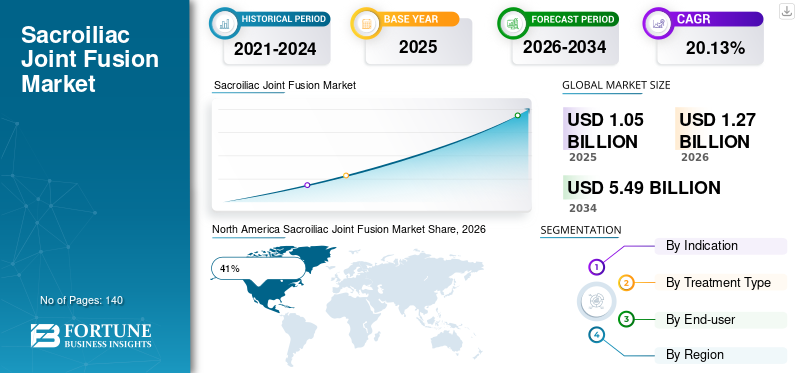
The global sacroiliac joint fusion market size was valued at USD 1.05 billion in 2025. The market is projected to grow from USD 1.27 billion in 2026 to USD 5.49 billion by 2034, exhibiting a CAGR of 20.13% during the forecast period.

The sacroiliac joint fusion market is experiencing significant expansion due to the increasing prevalence of chronic lower back pain and sacroiliac joint dysfunction among aging populations. Rising adoption of minimally invasive spine procedures and advanced implant systems is supporting strong market penetration across orthopedic and neurosurgical centers. sacroiliac joint fusion market trends indicate growing preference for image-guided navigation systems and titanium implant technologies that improve procedural accuracy and recovery outcomes. Healthcare providers are increasingly diagnosing sacroiliac joint disorders through advanced imaging techniques, resulting in higher treatment volumes. Expanding awareness regarding minimally invasive sacroiliac stabilization procedures continues to strengthen overall market demand globally.
The USA sacroiliac joint fusion market is witnessing strong growth due to rising incidences of degenerative spine disorders, obesity-related joint complications, and sports injuries. Hospitals and ambulatory surgical centers are increasingly performing minimally invasive sacroiliac fusion procedures to reduce hospitalization time and improve patient mobility. sacroiliac joint fusion market analysis in the United States highlights rising demand for robotic-assisted surgical systems and advanced implant technologies. Favorable reimbursement policies and strong healthcare infrastructure are supporting rapid adoption of innovative sacroiliac joint treatment procedures. Increasing awareness among orthopedic surgeons regarding long-term pain management solutions further accelerates market development across the country.
Download Free sample to learn more about this report.
Sacroiliac Joint Fusion Market Key Takeaways
 Global Market Size & Forecast
- 2025 Market Size: USD 1.05 Billion
- 2026 Market Size: USD 1.27 Billion
- 2034 Forecast Market Size: USD 5.49 Billion
- CAGR: 20.13% from 2026-2034
 market share
- North America dominated with a regional market share of 41% in 2025.
- Degenerative sacroiliitis led by indication with approximately 63% market share.
- Surgery led by treatment type with approximately 72% market share.
 Key Regional Highlights
North America
North America held the largest regional share at 41% of the global market.
Europe
Europe accounted for 28% of the global market, supported by advanced orthopedic care infrastructure.
Asia-Pacific
Asia-Pacific represented 24% of the global market, driven by rising demand for minimally invasive procedures.
U.S
The U.S. remains a major market, supported by advanced spine care facilities and adoption of minimally invasive fusion procedures.
Japan
Japan accounted for 26% of the Asia-Pacific market, supported by advanced orthopedic technologies and an aging population.
Read More

sacroiliac joint fusion market Latest Trends
The sacroiliac joint fusion market is evolving rapidly with continuous innovation in minimally invasive surgical techniques and implant materials. One of the major sacroiliac joint fusion market trends is the increasing adoption of triangular titanium implants designed to improve stability and promote long-term fusion outcomes. Surgeons are increasingly utilizing navigation-assisted systems and robotic guidance technologies to enhance procedural precision and reduce tissue trauma during surgery.
Download Free sample to learn more about this report.
Another important trend in the sacroiliac joint fusion market research report is the growing preference for outpatient and ambulatory surgical procedures. Minimally invasive techniques reduce recovery periods, postoperative pain, and hospital stays, improving patient satisfaction and operational efficiency. sacroiliac joint fusion market Insights also indicate increasing investment in biologics and bone graft substitutes that accelerate healing and bone integration. Manufacturers are focusing on low-profile implant systems and advanced fixation devices that improve mobility and reduce procedural complications. Growing clinical evidence supporting minimally invasive sacroiliac fusion efficacy is further driving adoption among orthopedic specialists and spine surgeons worldwide.
sacroiliac joint fusion market Dynamics
DRIVER
Rising prevalence of chronic lower back pain and sacroiliac joint disorders
The increasing prevalence of chronic lower back pain and sacroiliac joint dysfunction is a major factor driving sacroiliac joint fusion market growth. Sedentary lifestyles, aging populations, obesity, and spinal degeneration are contributing to higher diagnosis rates of sacroiliac joint instability. sacroiliac joint fusion market report findings indicate rising demand for minimally invasive procedures capable of delivering long-term pain relief and improved mobility.
Healthcare providers are increasingly recognizing sacroiliac joint dysfunction as a significant contributor to chronic lower back pain, resulting in greater treatment awareness and patient referrals. Technological advancements in imaging diagnostics and navigation-assisted surgery are also supporting improved surgical outcomes. sacroiliac joint fusion market forecast studies highlight increasing use of minimally invasive implant systems that reduce blood loss, shorten recovery periods, and improve patient satisfaction. Rising adoption of outpatient surgical settings and improved reimbursement support continue to strengthen market expansion globally.
RESTRAINT
High procedural costs and limited awareness in emerging regions
The sacroiliac joint fusion market faces restraints related to high treatment costs and limited awareness regarding sacroiliac joint dysfunction in developing healthcare systems. Advanced implants, navigation technologies, and minimally invasive surgical equipment involve substantial costs that may limit accessibility for certain patient populations. Sacroiliac joint fusion industry analysis indicates reimbursement limitations and healthcare affordability concerns continue to affect market penetration in several regions.
Another major restraint involves diagnostic complexity. Sacroiliac joint pain is often misdiagnosed as lumbar spine disorders or hip-related conditions, delaying appropriate treatment. Limited availability of specialized orthopedic surgeons and advanced surgical facilities in emerging economies further restricts procedural adoption. Concerns regarding postoperative complications and long-term implant durability may also discourage some healthcare providers from recommending fusion procedures. These factors collectively create operational and commercial challenges for manufacturers and healthcare institutions.
OPPORTUNITY
Expansion of minimally invasive spine surgery technologies
The rapid expansion of minimally invasive spine surgery technologies presents substantial opportunities for the sacroiliac joint fusion market outlook. Healthcare systems are increasingly prioritizing procedures that reduce hospital stays, postoperative pain, and recovery periods. sacroiliac joint fusion market opportunities are growing as robotic-assisted surgery and navigation systems improve procedural precision and surgeon confidence.
Manufacturers are investing heavily in advanced implant materials, biologics, and low-profile fixation systems that enhance patient outcomes. The growing popularity of ambulatory surgical centers is creating additional opportunities for minimally invasive sacroiliac procedures. sacroiliac joint fusion market Insights indicate increasing collaboration between medical device companies and orthopedic research institutions to develop innovative fusion technologies. Emerging healthcare markets with expanding orthopedic infrastructure are also expected to create long-term commercial opportunities for implant manufacturers and surgical technology providers.
CHALLENGE
Clinical variability and long-term outcome assessment
One of the major challenges in the sacroiliac joint fusion market is ensuring consistent clinical outcomes across diverse patient populations. Variations in patient anatomy, disease severity, and surgical techniques can influence procedural success rates. sacroiliac joint fusion market research report findings emphasize the importance of long-term clinical studies to evaluate implant performance and fusion durability.
Healthcare providers also face challenges related to accurate diagnosis and patient selection for sacroiliac fusion procedures. Misidentification of pain sources can affect treatment effectiveness and patient satisfaction. Regulatory requirements for implant safety and surgical efficacy further increase product development complexity. Competition among implant manufacturers is intensifying pressure to demonstrate superior clinical performance and cost-effectiveness. These challenges require continuous innovation, surgeon training, and evidence-based clinical validation to maintain market competitiveness.
sacroiliac joint fusion market Segmentation
By Indication
Degenerative sacroiliitis accounts for approximately 63% of the sacroiliac joint fusion market share due to the increasing prevalence of age-related joint degeneration and chronic inflammatory disorders. Patients suffering from degenerative sacroiliitis frequently experience persistent lower back pain and mobility limitations, increasing demand for long-term stabilization procedures. sacroiliac joint fusion market trends indicate growing use of minimally invasive fusion implants for degenerative joint conditions. Healthcare providers are increasingly recommending sacroiliac fusion surgery after conservative treatments such as physical therapy and pain injections fail to provide relief. Advanced titanium implants and image-guided navigation systems are improving procedural outcomes for degenerative sacroiliitis patients.
Sacral disruption represents nearly 37% of the sacroiliac joint fusion market Size due to increasing incidences of traumatic pelvic injuries, sports-related fractures, and accident-related sacral instability. Surgical stabilization procedures are commonly performed to restore structural integrity and improve patient mobility following severe sacral injuries. Sacroiliac joint fusion industry report findings indicate rising use of fixation devices and fusion implants in trauma care centers. Technological advancements in minimally invasive stabilization procedures are improving treatment outcomes for patients with sacral disruptions. Orthopedic surgeons are increasingly adopting navigation-assisted surgical techniques that reduce procedural complications and improve implant positioning accuracy. Rising participation in high-impact sports activities and increasing road accident cases continue to support growth in this segment.
To know how our report can help streamline your business, Speak to Analyst
By Treatment Type
Surgery accounts for approximately 72% of the sacroiliac joint fusion market share because minimally invasive surgical fusion remains the primary treatment option for severe sacroiliac joint dysfunction. Surgical intervention provides long-term stabilization and pain relief for patients unresponsive to conservative therapies. sacroiliac joint fusion market report findings indicate strong adoption of minimally invasive implant systems that reduce tissue damage and accelerate patient recovery. Hospitals and ambulatory surgical centers are increasingly performing outpatient sacroiliac fusion procedures using advanced navigation systems and robotic assistance technologies. Surgeons prefer minimally invasive techniques because they improve procedural efficiency and reduce hospitalization durations.
Injections represent nearly 28% of the sacroiliac joint fusion market Size because diagnostic and therapeutic injections remain important components of sacroiliac joint disorder management. Corticosteroid injections and image-guided pain management procedures are frequently used before surgical intervention is considered. sacroiliac joint fusion market Insights highlight growing demand for fluoroscopy-guided and ultrasound-guided injection procedures to improve diagnostic accuracy and pain relief. Pain management clinics and orthopedic specialists increasingly utilize injection therapies to reduce inflammation and confirm sacroiliac joint dysfunction diagnosis. Although injections provide temporary symptom relief, they are widely adopted due to lower procedural risks and shorter recovery times compared to surgery.
By End-user
Hospitals hold the largest share in the sacroiliac joint fusion market due to the increasing number of minimally invasive spine procedures performed in advanced surgical settings. Large hospitals are equipped with robotic-assisted surgical systems, navigation technologies, and specialized orthopedic departments that improve procedural precision and patient outcomes. sacroiliac joint fusion market trends indicate rising preference for hospital-based procedures because hospitals provide comprehensive postoperative care, rehabilitation support, and multidisciplinary pain management services. Increasing admissions related to chronic lower back pain, degenerative sacroiliitis, and trauma-related pelvic injuries are further strengthening segment growth. Hospitals also benefit from strong reimbursement frameworks and access to skilled spine surgeons capable of handling complex sacroiliac joint fusion procedures.
sacroiliac joint fusion market Regional Outlook
North America
North America Sacroiliac Joint Fusion Market Share, 2025 (%)
To get more information on the regional analysis of this market, Download Free sample
North America accounts for approximately 41% of the sacroiliac joint fusion market share due to advanced healthcare infrastructure, strong reimbursement support, and widespread adoption of minimally invasive spine procedures. The region benefits from high awareness regarding sacroiliac joint dysfunction diagnosis and treatment. sacroiliac joint fusion market research report findings indicate strong demand for robotic-assisted surgery systems and advanced implant technologies across hospitals and specialty clinics. The United States remains the dominant contributor within the region because of increasing incidences of chronic lower back pain, obesity-related spinal disorders, and age-associated degenerative conditions. Canada is also witnessing rising adoption of minimally invasive orthopedic procedures supported by expanding healthcare investments and improved diagnostic capabilities.
Healthcare providers in North America are increasingly performing outpatient sacroiliac fusion procedures to reduce operational costs and improve patient convenience. Strong investment in orthopedic innovation and clinical research continues to support market growth. Increasing prevalence of obesity-related spinal disorders and aging populations further contributes to rising procedural volumes throughout the region. In addition, favorable reimbursement frameworks and growing surgeon expertise in navigation-assisted procedures are accelerating adoption of advanced fusion technologies.
Europe
Europe holds nearly 28% of the sacroiliac joint fusion market share supported by increasing adoption of minimally invasive orthopedic procedures and expanding aging populations. European healthcare systems are emphasizing advanced spinal care solutions and improved mobility restoration for chronic pain patients. sacroiliac joint fusion market analysis highlights rising demand for image-guided navigation systems and biologic-assisted fusion procedures. Countries such as Germany, France, Italy, and the United Kingdom are investing heavily in orthopedic innovation and surgical infrastructure modernization. Rising awareness regarding sacroiliac joint dysfunction among healthcare professionals is improving diagnosis rates and increasing procedural adoption across the region.
Manufacturers in Europe are investing in advanced implant technologies and low-profile fixation systems designed to improve patient recovery outcomes. The region also benefits from growing awareness regarding sacroiliac joint dysfunction among orthopedic specialists. Expansion of ambulatory surgical centers and minimally invasive spine surgery training programs continues to strengthen market growth across Europe. Government healthcare initiatives supporting chronic pain management and rehabilitation services are further contributing to market expansion. In addition, increasing collaboration between medical device companies and research institutions is encouraging development of innovative fusion implants and robotic-assisted surgical technologies.
Germany Sacroiliac Joint Fusion Market
Germany contributes approximately 6% of the European sacroiliac joint fusion market due to its advanced orthopedic healthcare infrastructure and strong adoption of innovative surgical technologies. sacroiliac joint fusion market trends in Germany indicate increasing demand for minimally invasive spine procedures among aging populations and chronic pain patients. Hospitals are increasingly integrating navigation-assisted surgical systems and robotic technologies into orthopedic treatment programs. The country’s strong healthcare reimbursement framework and emphasis on technological advancement are supporting rapid adoption of advanced sacroiliac fusion implants and biologic-enhanced fixation systems.
German medical device manufacturers are investing heavily in implant innovation and biologic-enhanced fusion technologies. Rising awareness regarding sacroiliac joint dysfunction and improved diagnostic capabilities are supporting procedural adoption nationwide. The country’s strong focus on healthcare technology advancement and clinical research continues to strengthen market competitiveness within Europe. Academic medical centers and orthopedic research institutions are actively conducting clinical studies to improve surgical outcomes and long-term implant performance. Increasing prevalence of degenerative spinal disorders and sports-related injuries is also contributing to procedural demand.
United Kingdom Sacroiliac Joint Fusion Market
The United Kingdom accounts for approximately 12% of the European sacroiliac joint fusion market driven by increasing demand for minimally invasive orthopedic procedures and chronic pain management solutions. sacroiliac joint fusion market Insights indicate growing use of outpatient surgical procedures and image-guided interventions across hospitals and spine centers. Rising incidences of lower back pain, obesity-related spinal complications, and age-associated degenerative disorders are contributing to increasing procedural volumes throughout the country. Healthcare providers are emphasizing early diagnosis and personalized treatment approaches to improve patient mobility and reduce long-term disability.
Healthcare providers in the United Kingdom are emphasizing early diagnosis and minimally invasive treatment approaches to reduce recovery periods and improve patient outcomes. Technological advancements in surgical instrumentation and implant design continue to accelerate procedural adoption. Rising prevalence of spinal degeneration and expanding orthopedic healthcare services are expected to support continued market growth throughout the country. Government initiatives aimed at reducing surgical waiting times and improving access to advanced orthopedic care are also strengthening market expansion. In addition, increasing collaboration between hospitals and medical technology companies is encouraging adoption of robotic-assisted surgery systems and navigation-guided fusion procedures.
Asia-Pacific
Asia-Pacific represents approximately 24% of the sacroiliac joint fusion market share due to increasing healthcare modernization and growing awareness regarding advanced orthopedic procedures. Rising incidences of lower back disorders, sports injuries, and age-related spinal degeneration are supporting procedural demand throughout the region. sacroiliac joint fusion market outlook assessments indicate strong growth potential in countries investing heavily in healthcare infrastructure development. Rapid urbanization, sedentary lifestyles, and expanding elderly populations are contributing to increasing prevalence of chronic spinal disorders across major economies including China, Japan, India, and South Korea.
Manufacturers are expanding orthopedic device distribution networks and surgical training programs across Asia-Pacific healthcare markets. Increasing adoption of minimally invasive surgery and robotic-assisted orthopedic procedures continues to strengthen regional market penetration. Government initiatives focused on healthcare accessibility and chronic pain management further contribute to market development. Hospitals and specialty orthopedic centers are increasingly integrating advanced imaging systems and navigation-assisted technologies to improve surgical precision and patient recovery outcomes. International medical device companies are also forming strategic partnerships with regional healthcare providers to strengthen market presence and improve access to innovative fusion implants.
Japan Sacroiliac Joint Fusion Market
Japan contributes approximately 26% of the Asia-Pacific sacroiliac joint fusion market because of its aging population and advanced orthopedic surgical capabilities. sacroiliac joint fusion market forecast studies indicate increasing demand for minimally invasive fusion procedures among elderly patients experiencing degenerative joint disorders and chronic back pain. The country’s sophisticated healthcare infrastructure and strong focus on technological innovation are supporting widespread adoption of robotic-assisted surgery systems and advanced navigation technologies in orthopedic procedures.
Japanese healthcare providers are investing in robotic-assisted surgery systems and advanced navigation technologies to improve surgical precision and recovery outcomes. Rising focus on mobility preservation and long-term pain management is accelerating procedural adoption. The country’s strong medical technology innovation ecosystem continues to support development of advanced implant materials and minimally invasive orthopedic devices. Academic institutions and medical device manufacturers are collaborating on research initiatives aimed at improving implant durability and fusion success rates. Increasing awareness regarding sacroiliac joint dysfunction among healthcare professionals is also contributing to higher diagnosis and treatment rates.
China Sacroiliac Joint Fusion Market
China accounts for approximately 39% of the Asia-Pacific sacroiliac joint fusion market due to expanding healthcare infrastructure and increasing demand for advanced orthopedic treatments. sacroiliac joint fusion market growth in China is supported by rising incidences of spinal disorders, aging populations, and greater access to specialized surgical care. Rapid urbanization, changing lifestyles, and increasing participation in physically demanding activities are contributing to higher prevalence of chronic lower back pain and sacroiliac joint dysfunction across the country.
Domestic and international manufacturers are increasing investment in orthopedic implant production and minimally invasive surgical technologies. Hospitals are rapidly adopting navigation-assisted procedures and advanced fixation systems to improve patient outcomes. Government healthcare modernization initiatives and rising awareness regarding chronic pain treatment options continue to strengthen market expansion across the country. China’s growing network of specialty orthopedic hospitals and ambulatory surgical centers is improving accessibility to advanced fusion procedures in both urban and semi-urban regions. In addition, increasing collaboration between healthcare providers and medical technology companies is accelerating adoption of robotic-assisted surgery systems and innovative implant materials.
Rest of World
The Rest of World region accounts for approximately 7% of the sacroiliac joint fusion market share supported by gradual improvements in orthopedic healthcare infrastructure and growing awareness regarding minimally invasive spine surgery. Increasing prevalence of lower back pain and traumatic pelvic injuries is creating demand for sacroiliac stabilization procedures in Latin America, the Middle East, and Africa. Expanding healthcare investments and rising access to specialized orthopedic services are contributing to gradual market development across these regions. Countries such as Brazil, Saudi Arabia, South Africa, and the United Arab Emirates are witnessing increasing adoption of advanced spinal treatment technologies and minimally invasive surgical procedures.
International medical device companies are expanding partnerships with regional healthcare providers to improve access to advanced orthopedic implants and surgical technologies. Although affordability challenges and limited specialist availability remain concerns, rising investment in healthcare modernization and chronic pain management programs is expected to support future market growth. Governments and private healthcare organizations are increasingly focusing on improving orthopedic care infrastructure and expanding surgeon training initiatives to enhance procedural capabilities.
List of Top Sacroiliac Joint Fusion Companies
- SI-BONE, Inc.
- PainTEQ
- CornerLoc
- SIGNUS Medizintechnik GmbH
- Globus Medical
- Orthofix Medical
- Life Spine, Inc.
- Camber Spine Technologies, LLC
- CoreLink Surgical
- Xtant Medical
- Surgalign Spine Technologies, Inc.
- Medtronic
Top Two Companies by market share
- SI-BONE, Inc. – 24%
- Medtronic – 16%
Investment Analysis and Opportunities
The sacroiliac joint fusion market is attracting substantial investment from orthopedic device manufacturers, surgical robotics companies, and healthcare technology providers. Rising demand for minimally invasive spine procedures and chronic pain management solutions is encouraging expansion of implant manufacturing capabilities and surgical training programs. sacroiliac joint fusion market opportunities are particularly strong in robotic-assisted surgery, navigation technologies, and biologic-enhanced fusion systems.
Medical device companies are investing heavily in advanced implant materials, image-guided surgical platforms, and outpatient procedure technologies designed to improve clinical outcomes. Emerging healthcare markets are also witnessing rising investment in orthopedic infrastructure and minimally invasive surgery adoption. sacroiliac joint fusion market Insights indicate growing merger and acquisition activity among spine technology companies seeking to strengthen product portfolios and geographic presence. Expansion of ambulatory surgical centers and outpatient orthopedic care models is expected to create additional long-term commercial opportunities.
New Product Development
New product development in the sacroiliac joint fusion market is focused on improving implant stability, procedural precision, and postoperative recovery outcomes. Manufacturers are introducing low-profile titanium implants, porous fixation systems, and biologic-enhanced fusion devices designed to accelerate bone integration and long-term stabilization. sacroiliac joint fusion market trends indicate increasing demand for minimally invasive implant systems compatible with robotic-assisted surgical procedures.
Companies are also investing in navigation-guided instrumentation and advanced imaging technologies that improve implant placement accuracy and reduce procedural complications. Innovations in bone graft substitutes and regenerative biologics are further enhancing surgical outcomes. sacroiliac joint fusion market research report findings indicate rising development of outpatient-friendly implant systems that support faster recovery and shorter hospitalization periods. The market continues to witness strong innovation in customized fixation solutions and advanced spinal stabilization technologies.
Five Recent Developments (2023-2025)
- SI-BONE, Inc. expanded its minimally invasive sacroiliac implant portfolio with advanced titanium fixation systems.
- Medtronic increased investment in navigation-assisted spine surgery technologies for sacroiliac fusion procedures.
- PainTEQ introduced enhanced minimally invasive access systems for outpatient sacroiliac stabilization treatments.
- Globus Medical expanded robotic-assisted orthopedic surgery capabilities for spinal fusion applications.
- Orthofix Medical strengthened biologic fusion technology research focused on accelerated bone healing and integration.
Report Coverage
The sacroiliac joint fusion market report provides comprehensive analysis of market dynamics, technological advancements, competitive landscape, and orthopedic treatment developments across global healthcare industries. The report evaluates major procedure categories including degenerative sacroiliitis and sacral disruption treatments along with detailed application analysis covering surgery and injection therapies. Sacroiliac joint fusion industry report findings include assessment of minimally invasive surgical technologies, implant innovation, and navigation-assisted procedures influencing market expansion.
Request for Customization to gain extensive market insights.
The study also covers regional healthcare infrastructure trends, orthopedic surgery adoption patterns, and investment activities shaping competitive dynamics. sacroiliac joint fusion market analysis includes evaluation of robotic-assisted surgical systems, biologics, outpatient procedure models, and advanced fixation technologies. Country-level insights provide detailed understanding of procedural demand, reimbursement environments, and clinical adoption trends. The report further examines product development pipelines, regulatory frameworks, and strategic initiatives impacting the future evolution of the sacroiliac joint fusion industry.
Frequently Asked Questions
Fortune Business Insights says that the global market value stood at USD 1.05 billion in 2025 and is projected to reach USD 5.49 billion by 2034.
The market is expected to exhibit a CAGR of 20.13% during the forecast period of 2026-2034.
Surgery was the leading treatment type segment, accounting for approximately 72% of the market, as minimally invasive surgical fusion remains the primary treatment for severe sacroiliac joint dysfunction.
Key players include SI-BONE, Inc., PainTEQ, CornerLoc, SIGNUS Medizintechnik GmbH, Globus Medical, and Medtronic.
Major trends include increasing adoption of minimally invasive techniques, triangular titanium implants, and navigation/robotic guidance, alongside growing preference for outpatient procedures and biologic fusion technologies. North America leads with approximately 41% market share.



- 2021-2034
- 2025
- 2021-2024
- 140
-

(Offer valid till 30th Sep 2026)
Get 30-60 hrs Free Customization
Expand Regional and Country Coverage, Segments Analysis, Company Profiles, Competitive Benchmarking, and End-user Insights.













.webp)






-
US +1 833 909 2966 ( Toll Free )
-
Get In Touch With Us