Satellite Propellant Tanks Market Size, Share & Industry Analysis, By Tank Architecture (Diaphragm Tanks, Bladder Tanks, PMD Tanks, and Pressure Vessel Tanks), By Propulsion Type (Electric, Chemical, Green Propellant, and Cold-Gas), By Tank Capacity (Below 100 L, 100–500 L, 500–1,000 L, and Above 1,000 L), By Propellant (Xenon/Krypton, Hydrazine, Bipropellants, and Green Propellants), By Satellite Class (CubeSats & Nanosatellites, Small Satellites, Medium Satellites, and Large/GEO Satellites), By End User (Commercial Manufacturers and Defense Agencies), and Regional Forecast, 2026–2034
 Download Free Sample
Satellite Propellant Tanks Market Size and Future Outlook
 Listen to Audio Version
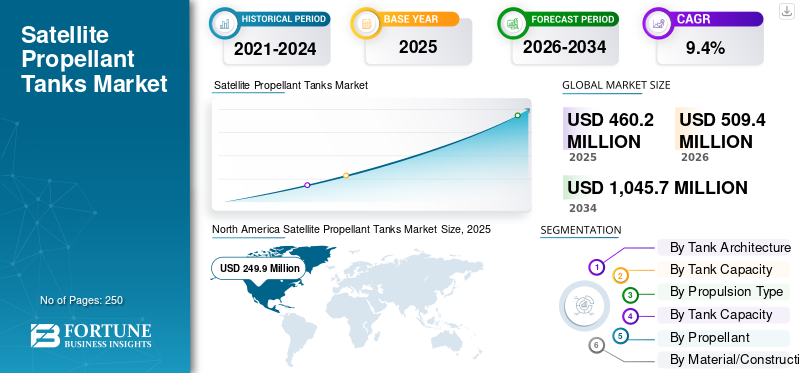
The global satellite propellant tanks market size was valued at USD 460.2 million in 2025. The market is projected to grow from USD 509.4 million in 2026 to USD 1,045.7 million by 2034, exhibiting a CAGR of 9.4% during the forecast period.
Satellite propellant tanks are critical spacecraft components that store and manage the chemical or cryogenic propellants required for orbit insertion, attitude control, station-keeping, deorbiting, and in-space maneuvering. The global demand for advanced propellant tank solutions is rising rapidly as satellite missions diversify covering smallSats and large GEO comsats, LEO constellations, on-orbit servicing, refueling, and deep-space exploration driven by the need for higher performance, greater reliability, reduced mass, and long-duration propellant storage under challenging thermal and micro-gravity conditions.
Industry leaders and specialized suppliers including Moog, Northrop Grumman Corporation, ArianeGroup, MT Aerospace AG, and new-space engineering firms are developing integrated propellant-storage suites that combine lightweight composite and metallic tank structures, advanced bladder and monopropellant management systems, and thermal control solutions for cryogens. Key technical advances shaping the market include adoption of Composite Overwrapped Pressure Vessels (COPVs) and isogrid/metallurgical optimizations for reduced mass.
Download Free sample to learn more about this report.
Satellite Propellant Tanks Market Key Takeaways
 Global Market Size & Forecast
- 2025 Market Size: USD 460.2 million
- 2026 Market Size: USD 509.4 million
- 2034 Forecast Market Size: USD 1,045.7 million
- CAGR: 9.4% (2026–2034)
 Market Share
- North America dominated the global market in 2025.
- The conventional chemical propulsion tanks segment is projected to grow at a 7.5% CAGR during the forecast period.
- The COPVs segment is expected to register the fastest growth at an 11.1% CAGR during the forecast period.
 Key Regional Highlights
Asia Pacific
Asia Pacific is expected to register the fastest growth during the forecast period.
North America
North America generated USD 249.9 million in 2025 and is projected to reach USD 275.7 million in 2026.
Europe
Europe is projected to grow at a 8.0% CAGR during the forecast period.
U.S.
U.S. market reached USD 245.7 million in 2025.
Japan
Japan market reached USD 13.1 million in 2025.
Read More

SATELLITE PROPELLANT TANKS MARKET TRENDS
Shift Toward Compact, High-Pressure, and Integrated Propellant Tank Architectures is Emerging as a Defining Market Trend
The market is witnessing a clear transition toward compact, high-pressure, lightweight, and mission-integrated tank architectures as satellite platforms become increasingly maneuverable, propulsion-dependent, and constrained by mass and volume limitations. Satellite manufacturers are placing greater emphasis on usable propellant efficiency, pressure capability, mass optimization, propellant compatibility, gas-free delivery, slosh control, manufacturability, and integration with complete propulsion modules. As a result, demand is increasing for xenon/krypton high-pressure storage tanks, compact chemical propulsion tanks, PMD and surface-tension tanks, rolling metal diaphragm tanks, composite pressure vessels, and additively manufactured tank designs that can be integrated within constrained spacecraft envelopes.
- For instance, in March 2025, Liftero’s RED5 mission was launched aboard SpaceX’s Transporter-13 rideshare mission to validate its BOOSTER green chemical propulsion system on an OrbAstro 6U satellite platform. The compact propulsion package included propellant tanks, an electronic control unit, and health monitoring capability.
This trend is expected to increase demand for lightweight diaphragm tanks, high-pressure xenon and krypton tanks, compact green-propellant tanks, integrated tank-and-feed assemblies, PMD-equipped tanks, and additively manufactured storage designs. As satellite operators pursue higher maneuverability, particularly across LEO and smallsat missions, tank suppliers are expected to focus on designs that reduce spacecraft mass, improve propellant utilization, shorten qualification and integration timelines, and support standardized satellite bus and propulsion-module architectures
MARKET DYNAMICS
MARKET DRIVERS
Download Free sample to learn more about this report.
Rising Deployment of Propulsion-Enabled LEO Satellites is Propelling Market Growth
The satellite propellant tanks market growth is being driven by the growing deployment of propulsion-enabled satellites across LEO, MEO, GEO, and deep-space missions. Modern satellite platforms increasingly require onboard propulsion for orbit raising, station keeping, collision avoidance, constellation phasing, drag compensation, and end-of-life disposal. Growing number of satellites in orbit is also increasing the need for maneuverability, as operators must manage orbital congestion, debris risk, and regulatory requirements for post-mission disposal.
- For instance, in May 2026, the Satellite Industry Association reported that 4,434 commercially manufactured satellites were launched in 2025, representing a 65% increase from 2024. The association also reported that satellite manufacturing revenue reached USD 20.4 billion in 2025, reflecting continued expansion in satellite production and deployment activity.
This driver is expected to sustain demand for high-pressure xenon and krypton tanks, diaphragm tanks, PMD tanks, compact cold-gas tanks, green-propellant tanks, and tank assemblies integrated into complete spacecraft propulsion modules. The strongest adoption is expected across North America, Europe, and Asia Pacific, where commercial constellation deployment, defense space modernization, civil space programs, and satellite manufacturing activity are concentrated.
MARKET RESTRAINTS
Complex Qualification, Propellant Compatibility, and Specialized Manufacturing Requirements to Limit Market Expansion
A key restraint for the market is the complex qualification and manufacturing burden associated with flight-grade tank systems. Satellite propellant tanks must operate reliably under launch vibration, thermal cycling, pressure loading, long-duration storage, microgravity fluid behavior, and strict cleanliness requirements. The tank design also depends heavily on propellant compatibility, as hydrazine, MMH, NTO/MON, xenon, krypton, green propellants, helium, nitrogen, and other stored media impose different requirements on materials, liners, diaphragms, bladders, welds, seals, and internal propellant management devices.
For instance, in April 2024, NASA Goddard Space Flight Center’s green propulsion assessment stated that remaining technical, cost, and schedule risks continue to affect the broader adoption of ASCENT and LMP-103S for high-value scientific spacecraft propulsion applications.
This restraint is likely to affect both established satellite manufacturers and emerging spacecraft developers. While demand for advanced propulsion tanks is increasing, suppliers must still address compatibility testing, proof-pressure testing, burst testing, leakage control, propellant management performance, flight heritage requirements, and mission-specific integration.
MARKET OPPORTUNITIES
Green Propulsion, Demisable Tanks, and Additive Manufacturing Presents Growth Opportunities for the Market
A major opportunity for the market lies in the transition toward green propulsion, demisable tank structures, and additive-manufactured tank designs. Traditional hydrazine-based systems remain important due to their flight heritage, but handling complexity, toxicity concerns, and sustainability requirements are encouraging satellite manufacturers to evaluate safer and more flexible propulsion architectures. This is creating opportunities for tanks compatible with green propellants, high-test peroxide, ADN/HAN-based propellants, and compact chemical propulsion systems for small and medium satellites.
- For instance, in March 2025, Liftero’s RED5 mission was launched aboard SpaceX’s Transporter-13 rideshare mission to validate its BOOSTER green chemical propulsion system on an OrbAstro 6U satellite platform. The compact propulsion package included propellant tanks, an electronic control unit, and health monitoring capability.
This opportunity is expected to increase demand for green-propellant-compatible tanks, compact diaphragm tanks, additively manufactured tanks, demisable aluminum tanks, integrated tank-and-feed assemblies, and high-efficiency propellant management systems.
MARKET CHALLENGES
Concerns Related to the Integration of Advanced Tank Designs with Electric, Green, and Multi-Mission Propulsion Systems to Challenge Product Adoption
A major challenge for the market is integrating advanced tank designs into increasingly diverse propulsion architectures. Satellite platforms are shifting toward electric propulsion, green chemical propulsion, hybrid propulsion concepts, and compact modular propulsion systems, each of which requires different storage pressure, thermal control, feed-system design, propellant compatibility, and safety validation. This challenge can slow adoption as tank suppliers and spacecraft integrators must validate storage systems alongside thrusters, valves, regulators, feed lines, power systems, thermal controls, and spacecraft structures.
High-pressure xenon and krypton tanks must support electric propulsion requirements, while green chemical systems require verified material compatibility and stable storage behavior.
For instance, in March 2025, ISRO successfully completed a 1,000-hour life test of its 300 mN Stationary Plasma Thruster for spacecraft electric propulsion. ISRO stated that the electric propulsion system is proposed to replace chemical propulsion in future satellites and support communication satellites using all-electric propulsion for orbit raising and station keeping.
Segmentation Analysis
By Tank Architecture
Adoption of High-Pressure Electric Propulsion Storage to Support Segment Dominance of High-Pressure Gas Storage Tanks / Pressure Vessels
Based on tank architecture, the market is divided into flexible diaphragm tanks, bladder tanks, surface-tension / PMD (propellant management device) tanks, rolling metal diaphragm tanks, and high-pressure gas storage tanks / pressure vessels.
The high-pressure gas storage tanks / pressure vessels segment is expected to hold a leading share in the market as electric propulsion adoption increases across LEO constellations, GEO satellites, satellite servicing platforms, and long-life commercial spacecraft. High-pressure tanks are essential for storing xenon, krypton, helium, nitrogen, and other gases used in electric propulsion, cold-gas propulsion, pressurization, and in-orbit servicing architectures. Demand is further supported by the need for compact, lightweight, and pressure-qualified storage systems that can fit within constrained satellite bus designs while supporting extended maneuvering, orbit raising, station keeping, and end-of-life operations.
- For instance, in July 2025, Orbit Fab won approximately USD 0.87 million in ESA ARTES funding through the UK Space Agency to work with commercial satellite operators on in-orbit refueling for GEO communication satellites. The company also unveiled the “Shilling” demonstration mission to showcase a new high-pressure variant of its RAFTI refueling interface, supporting pressurized fuel containment and transfer for satellite refueling applications.
The surface-tension / PMD tanks segment is anticipated to rise with a steady growth of 7.8% over the forecast period.
To know how our report can help streamline your business, Speak to Analyst
By Propulsion Type
Rise in the Electric Propulsion Adoption and Mass Optimization Needs to Drive Leadership of the Segment
By propulsion type, the market is segmented into electric propulsion tanks, conventional chemical propulsion tanks, green chemical propulsion tanks, and cold-gas propulsion tanks.
The electric propulsion tanks segment is expected to dominate the market as satellite manufacturers increasingly use electric propulsion for orbit raising, station keeping, drag compensation, and long-duration mission control. Electric propulsion systems require specialized storage tanks for xenon, krypton, or other propellants, often at high pressure, enabling satellites to reduce propellant mass while extending operational life. The segment benefits from rising deployment of all-electric and hybrid-electric satellites, particularly in communication, Earth observation, defense, and constellation applications where mass savings and mission flexibility are major procurement considerations.
- For instance, in March 2025, ISRO successfully completed a 1,000-hour life test of its 300 mN Stationary Plasma Thruster for spacecraft electric propulsion. ISRO stated that the system is proposed to replace chemical propulsion in future satellites and support all-electric communication satellites for orbit raising and station keeping, with xenon used as the propellant.
The conventional chemical propulsion tanks segment to register steady CAGR of 7.5% over the forecast period.
By Tank Capacity
Requirement for Onboard Propulsion for Small-Capacity Tanks (Below 100 L) to Propel the Leading Position of the Segment
On basis of tank capacity, the market is segmented into small-capacity tanks (below 100 L), medium-capacity tanks (100 L to <500 L), large-capacity tanks (500 L to <1,000 L), and very-large-capacity tanks (above 1,000 L).
The small-capacity tanks (below 100 L) segment is expected to hold a leading share in the market as small satellites, microsatellites, CubeSats, and compact LEO platforms increasingly require onboard propulsion. These tanks are used in compact chemical, green-propellant, cold-gas, and electric propulsion systems where spacecraft volume, mass, and integration space are highly constrained.
- For instance, in August 2024, Space Dynamics Laboratory and Velo3D presented the qualification of 3D printed aerospace tanks, a 3D-printed titanium volume-optimized propulsion tanks for small satellites, including an 11 L propellant-volume half-ESPA tank with an integral propellant management device and a scalable approach for spacecraft ranging from 1U to full ESPA class.
The medium-capacity tanks (100 L to <500 L) segment is projected to grow steadily with a CAGR of 8.8% over the forecast period.
By Propellant
Xenon/Krypton Use in Electric Propulsion to Strengthen Tactical Connectivity Makes it the Dominant Propellant
By propellant, the market is segmented into xenon / krypton, hydrazine, MMH / NTO / MON and other bipropellants, green propellants (AHR-3, LMP-103S, ionic liquids, hydroxylammonium nitrate blends), nitrogen / helium / cold gases, and other emerging propellants (cryogenic oxygen / hydrogen, methane, ammonia).
The xenon / krypton segment is expected to dominate the propellant type category as these gases remain fundamental to electric propulsion systems used for satellite orbit raising, station keeping, and long-duration maneuvering. Xenon offers strong performance and flight heritage, while krypton is gaining attention as a lower-cost and more available alternative space propellants for constellation-scale electric propulsion. The segment is supported by the growing number of satellites using Hall-effect and ion propulsion systems, particularly across commercial LEO constellations, high-throughput communication satellites, and future refuelable spacecraft platforms.
- For instance, ESA’s ARTES AT Kr project with Safran Spacecraft Propulsion advanced krypton-based electric propulsion by completing the technical basis for TRL 6 maturity of PPS X00 cathode operation with krypton and identifying lifetime testing and component-level testing.
The green propellants segment is projected to be the fastest growing with 11.3% growth rate over the forecast period.
By Material/Construction
Titanium Alloy Tanks Are The Most Preferred Material/Construction Due To Their High Strength, Corrosion Resistance, and Pressure Capability
By material/construction, the market is segmented into titanium alloy tanks, aluminum alloy tanks, stainless steel / nickel alloy tanks, composite overwrapped pressure vessels (COPVS), and polymer-lined / hybrid tanks.
The titanium alloy tanks segment is expected to hold a leading share in the market due to titanium’s strong combination of low mass, high strength, corrosion resistance, pressure capability, and compatibility with several spacecraft propellants. Titanium tanks are widely used in chemical propulsion and bipropellant spacecraft applications where long mission life, structural reliability, and proven qualification history are critical. The segment is propelled by the demand for high-performance tanks across GEO satellites, exploration spacecraft, defense satellites, and high-reliability commercial platforms.
- For instance, ArianeGroup’s spacecraft propellant tank portfolio identifies space-qualified titanium bipropellant tanks for satellite and spacecraft propulsion systems, with capacities ranging from 198 L to 2,100 L and materials including Ti6Al4V for pressure vessels, ports, and propellant management structures.
The COPVs segment is to grow with the fastest CAGR of 11.1% over the forecast period.
By Satellite Class
CubeSat Mobility and Miniaturized Propulsion Needs to Sustain Cubesats and Nanosatellites’ Leadership
On the basis of satellite class, the market is divided into cubesats & nanosatellites, microsatellites & small satellites, medium satellites, large GEO / high-capacity satellites, and deep-space & exploration spacecraft.
The cubesats and nanosatellites segment is expected to dominate satellite-class growth as small spacecraft increasingly move from passive payload platforms to maneuverable mission assets. CubeSats and nanosatellites are being equipped with satellite attitude control systems, orbit correction, formation flying, drag compensation, collision avoidance, technology demonstration, and end-of-life disposal. This trend is increasing demand for miniaturized propellant tanks, micro-propulsion modules, compact green-propellant tanks, and integrated storage-feed-thruster assemblies designed for very limited spacecraft volume.
- For instance, in June 2025, the UAE Space Agency and Khalifa University commissioned the region’s first locally developed sustainable micro-propulsion system for a 6U CubeSat. The system uses high-test peroxide, includes a compact 2U propulsion module with five thrusters.
Microsatellites and small satellites are expected to register a steady growth with CAGR of 8.9% over the forecast period.
By End User
Commercial Satellite Manufacturers to Dominate Owing to Expansion Of Commercial Satellite Production and High Strength-To-Weight Requirements
By end user, the market is segmented into commercial satellite manufacturers, defense & intelligence space agencies, civil space agencies, propulsion subsystem integrators, and research & academic spacecraft developers.
The commercial satellite manufacturers segment is expected to hold a leading share in the market as commercial satellite production continues to expand across broadband constellations, Earth observation networks, direct-to-device connectivity, IoT satellites, and high-throughput communication platforms. Commercial manufacturers require large volumes of standardized, reliable, and cost-efficient tank assemblies to support high-rate production, spacecraft maneuverability, orbital sustainability, and longer mission life.
The defense and intelligence space agencies segment is set to register moderate growth with a CAGR of 8.9% over the forecast period.
Satellite Propellant Tanks Market Regional Outlook
By geography, the market is segmented into North America, Europe, Asia Pacific, Middle East, and Rest of the World.
North America
North America Satellite Propellant Tanks Market Size, 2025 (USD Million)
To get more information on the regional analysis of this market, Download Free sample
North America dominated the satellite propellant tanks market share in 2025 with a valuation of USD 249.9 million, growing to USD 275.7 million in 2026. The region is expected to remain the largest market, primarily driven by the U.S. satellite manufacturing base, high-volume LEO constellation production, defense space modernization, electric propulsion adoption, and strong domestic availability of tank and pressure-vessel suppliers. Demand is supported by propulsion-enabled commercial satellites, high-pressure xenon and krypton storage systems, PMD tanks, compact smallsat tanks, and spacecraft propulsion components used across broadband, Earth observation, defense, and civil space missions. North America also benefits from the presence of key tank and propulsion suppliers such as Northrop Grumman, Moog, L3Harris/ARDE, Eaton, and Vivace.
U.S Satellite Propellant Tanks Market
Based on North America’s strong contribution and the U.S. dominance within the region, the U.S. market was valued at around USD 245.7 million in 2025. The U.S. is expected to remain the largest country-level market due to its concentration of commercial satellite manufacturers, defense and intelligence spacecraft programs, in-space servicing activity, and established spacecraft tank suppliers. Growth is supported by continued deployment of propulsion-enabled LEO constellations, increasing use of high-pressure xenon/krypton storage for electric propulsion.
- For instance, in August 2024, Space Dynamics Laboratory and Velo3D presented the qualification of additively manufactured titanium propulsion tanks for small satellites, including an 11 L propellant-volume half-ESPA tank with an integral propellant management device and scalability from 1U spacecraft to full ESPA-class platforms.
Europe
Europe is projected to record a significant growth rate of 8.0% during 2026 to 2034. The region is expected to maintain a strong position in the market, supported by established spacecraft manufacturing, ESA-linked programs, sovereign secure-connectivity initiatives, and direct tank manufacturing capability in countries such as Germany and France. European demand is supported by ArianeGroup’s spacecraft propellant tank portfolio, MT Aerospace’s diaphragm, PMD, xenon, and high-pressure vessel tank families, and broader satellite manufacturing activity across Airbus, Thales Alenia Space, OHB, and other regional primes.
- For instance, in December 2024, the European Commission signed the concession contract for IRIS² with the SpaceRISE consortium. The program is designed as a multi-orbital constellation of 290 satellites to provide secure governmental and commercial satellite communication services by 2030.
U.K Satellite Propellant Tanks Market
The U.K. market in 2025 was valued around USD 14.5 million, representing roughly 3.2% of global market revenues.
Germany Satellite Propellant Tanks Market
Germany market is reached approximately USD 21.7 million in 2025, equivalent to around 5.2% of global market sales.
Asia Pacific
Asia Pacific is projected to witness the fastest growth in the the global market. The region’s growth is driven by China’s satellite constellation activity, India’s electric propulsion development, Japan’s established spacecraft propulsion and tank manufacturing base, South Korea’s space-sector expansion, and rising commercial and government satellite deployment across the overall region. The demand for the product is supported by communication satellites, Earth observation platforms, navigation satellites, defense spacecraft, smallsat programs, and growing adoption of electric propulsion systems that require high-pressure xenon and krypton tanks.
- For instance, in March 2025, ISRO successfully completed a 1,000-hour life test of its 300 mN Stationary Plasma Thruster for spacecraft electric propulsion.
Japan Satellite Propellant Tanks Market
The Japan market in 2025 touched around USD 13.1 million valuation, accounting for roughly 2.9% of global market revenues.
China Satellite Propellant Tanks Market
China’s market is projected to be one of the largest globally, with 2025 revenues estimated at around USD 70.0 million representing roughly 15.2% of global market sales.
India Satellite Propellant Tanks Market
The India market in 2025 was valued around USD 10.8 million, accounting for roughly 2.3% of global market revenues.
Middle East
Middle East remains smaller than North America, Europe, and Asia Pacific in absolute value, but is expected to show strong percentage growth due to expanding sovereign satellite programs, defense-space investments, CubeSat development, and local propulsion capability building. Israel remains the strongest regional base for satellite propulsion and tank-related capability, while the UAE is investing in indigenous micro-propulsion systems and smallsat technology. Turkey also supports regional demand through GEO communication satellite programs and growing domestic satellite capability
- For instance, in June 2025, Khalifa University and the UAE Space Agency commissioned the region’s first locally developed CubeSat propulsion tanks, a sustainable micro-propulsion system for a 6U CubeSat.
Turkey Satellite Propellant Tanks Market
Turkey market in 2025 was at USD 3.45 million, accounting for roughly 0.7% of global market revenues.
Rest of the World
Rest of the World covering Latin America and Africa, is expected to remain a smaller market due to limited domestic satellite manufacturing and lower availability of specialized spacecraft propulsion and tank suppliers. However, selective growth is expected as Brazil, Argentina, South Africa, Egypt, Nigeria, Kenya, and other emerging space countries expand CubeSat, Earth observation, and academic satellite programs.
Latin America Satellite Propellant Tanks Market
Latin America market in 2025 was at around USD 4.39 million, accounting for roughly 1.0% of global market revenues.
COMPETITIVE LANDSCAPE
Key Industry Players
Space-Qualified Reliability, Propellant Compatibility, and High-Pressure Tank Engineering Are Driving Competitive Leadership
The global satellite propellant tanks market is characterized by competition among spacecraft tank manufacturers, pressure-vessel suppliers, propulsion subsystem integrators, composite tank specialists, and space-qualified materials and manufacturing providers. Competitive leadership is increasingly shaped by companies that can deliver qualified tank assemblies across chemical propulsion, electric propulsion, cold-gas propulsion, and emerging green propulsion applications. Suppliers get differentiated by their ability to provide PMD and surface-tension tanks, diaphragm and bladder tanks, xenon/krypton high-pressure tanks, COPVs, titanium and aluminum alloy tanks, demisable tank structures, and mission-specific tank configurations.
Market leaders are strengthening their positions through proven in-orbit performance, high-pressure storage capability, lightweight material selection, propellant compatibility testing, integrated tank-and-feed designs, shortened lead times, and qualification support for smallsat, GEO, defense, civil, and exploration spacecraft.
LIST OF KEY SATELLITE PROPELLANT TANKS COMPANIES PROFILED
- Northrop Grumman Corporation (U.S.)
- ArianeGroup (France)
- MT Aerospace AG (Germany)
- L3Harris Technologies, Inc. (U.S.)
- Moog Inc. (U.S.)
- IHI Aerospace Co., Ltd. (Japan)
- Rafael Advanced Defense Systems Ltd. (Israel)
- Nammo AS (Norway)
- Eaton Corporation plc (Ireland)
- Vivace International Corporation (U.S.)
KEY INDUSTRY DEVELOPMENTS
The global satellite propellant tanks market analysis provides an in-depth study of market size & forecast by all the market segmentation included in the report. It includes details on the market dynamics, and market trends, and regional analysis expected to drive the market in the forecast period. The market report includes porter s five forces analysis which illustrates the potency of buyers and suppliers in the market. The market forecast offers information on the technological advancements, new product launches, key trends, major industry developments, and details on partnerships, mergers & acquisitions. The market analysis also encompasses detailed competitive landscape with information on the market share and profiles of key players.
Request for Customization to gain extensive market insights.
Report Scope & Segmentation
| ATTRIBUTE | DETAILS |
| Study Period | 2021-2034 |
| Base Year | 2025 |
| Estimated Year | 2026 |
| Forecast Period | 2026-2034 |
| Historical Period | 2021-2024 |
| Growth Rate | CAGR of 9.4% from 2026-2034 |
| Unit | Value (USD Million) |
| Segmentation | By Tank Architecture, By Propulsion Type, By Tank Capacity, By Propellant, By Material/Construction, By Satellite Class, By End User, and Region |
| By Tank Architecture |
|
| By Propulsion Type |
|
| By Tank Capacity |
|
| By Propellant |
|
| By Material/Construction |
|
| By Satellite Class |
|
| By End User |
|
| By Region |
|
Frequently Asked Questions
According to Fortune Business Insights, the global market value stood at USD 460.2 million in 2025 and is projected to reach USD 1,045.7 million by 2034.
In 2025, the market value stood at USD 249.9 million.
The market is expected to exhibit a CAGR of 9.4% during the forecast period of 2026-2034.
By tank architecture, the high-pressure gas storage tanks / pressure vessels segment is expected to lead the market.
Rising deployment of propulsion-enabled LEO satellites is driving market expansion.
Northrop Grumman Corporation, ArianeGroup, MT Aerospace AG, and L3Harris Technologies, Inc. are some of the major players in the global market.
North America dominated the market in 2025.



- 2021-2034
- 2025
- 2021-2024
- 250
Get 30-60 hrs Free Customization
Expand Regional and Country Coverage, Segments Analysis, Company Profiles, Competitive Benchmarking, and End-user Insights.




















Related Reports
-
US +1 833 909 2966 ( Toll Free )
-
Get In Touch With Us