Scented Candles Market Size, Share & Industry Analysis, By Type (Container-based, Pillar, and Tea Light and Others), By Category (Mass and Premium), By Wax Type (Paraffin Wax, Bees Wax, Soy Wax, and Others), By Distribution Channel (Supermarkets & Hypermarkets, Specialty Stores, Online Retail, and Others), and Regional Forecast, 2026-2034
 Download Free Sample
(Offer valid till 30th Sep 2026)

Scented Candles Market Size and Future Outlook
 Listen to Audio Version
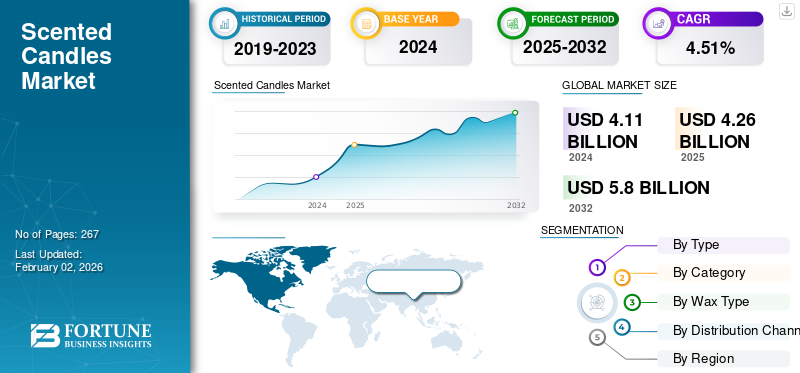
The global scented candles market size was valued at USD 4.26 billion in 2025 and is projected to grow from USD 4.42 billion in 2026 to USD 6.64 billion by 2034, exhibiting a CAGR of 5.22% during the forecast period. Europe dominated the global scented candles market with a market share of 45.89% in 2025.
Candles infused with essential oils are wax-based products used to create fragrance, ambience, and a sensory atmosphere in the surrounding environment. While paraffin remains the most widely used wax, natural alternatives such as soy, bees, and rapeseed wax are increasingly being adopted for their sustainability appeal. These candles are used for home décor, mood-setting, and relaxation. According to the National Candle Association’s (NCA) Facts and Figures, nine out of ten candle users say they use candles to make a room feel comfortable or cozy. Candle users report that they most frequently burn candles in the living room (42%), followed by the kitchen (18%) and the bedroom (13%). Growth of the market is primarily driven by shifting consumer preferences and an increasing focus on wellness and ambience. This demand is consolidated by premiumisation and a growing gifting culture, as consumers increasingly value design-led jars, artisanal craftsmanship, and seasonal collections. Candles rank among the most commonly gifted home items across holidays and special occasions, according to NCA gifting data. Sustainability is another important driver, with rising interest in natural waxes over paraffin.
Major players, including Yankee Candle, Bath & Body Works, Diptyque, Jo Malone London, NEST New York, and Voluspa, are some of the well-established brands in the market. Players are modernizing their brand with updated formulations, refreshed packaging, and broader seasonal fragrance lines to attract younger consumers. Additionally, brands are emphasizing stronger digital engagement and exclusive scent drops.
Download Free sample to learn more about this report.
Scented Candles Market Key Takeaways
 Market Size & Forecast
- 2025 Market Size: USD 4.26 Billion
- 2026 Market Size: USD 4.42 Billion
- 2034 Forecast Market Size: USD 6.64 Billion
- CAGR: 5.22% from 2026–2034
 Market Share
- Europe dominated the scented candles market with a 45.89% share in 2025.
- The container-based segment is projected to hold a 57.47% market share in 2026.
- The mass category segment is projected to account for a 64.71% market share in 2026.
 Key Regional Highlights
Europe
Europe generated USD 1.96 billion in revenue and accounted for 45.89% of the global market in 2025.
North America
North America contributed USD 1.24 billion and held a 29.12% share of the global market in 2025.
Asia Pacific
Asia Pacific captured 16.52% of the global market and generated USD 0.70 billion in revenue in 2025.
U.S.
The U.S. scented candles market is valued at USD 1.12 billion in 2026.
Japan
The Japan scented candles market is valued at USD 0.061 billion in 2026.
Read More

MARKET DYNAMICS
MARKET DRIVERS:
Rising Emphasis on Home Ambience & Wellness Transition to Drive Market Growth
The rise of home-centered lifestyles has turned the living environment into a focal point for self-care and comfort, and scented candles have become a key element in this shift. As per the National Candle Association, around 90% of candle users stated they burn candles to make a room feel “comfortable or cozy,” demonstrating the strong link between candles and home ambience. Simultaneously, industry commentary highlights the growing role of fragrance in supporting emotional well-being and relaxation at home, positioning scented candles as wellness tools rather than just decorative items. Greater time spent at home, the desire for sensory ritual, and increased focus on mental health have all contributed to the rising demand for fragrance products that create atmosphere and mood, propelling growth in the scented products category.
MARKET RESTRAINTS:
Shift Toward Eco-Friendly Candle Formulations to Restrict Market Expansion
The shift toward eco-friendly, natural, and luxury candle formulations is raising manufacturing costs and creating pricing pressure, which hampers market growth. Premium ingredients such as soy wax, beeswax, rapeseed wax, and essential-oil-based fragrances are significantly more expensive than conventional synthetic and paraffin aroma compounds. For instance, beeswax is one of the highest-priced natural waxes since its production depends on limited beekeeping output, while vegetable waxes face cost fluctuations tied to agricultural yields and global commodity markets. Moreover, sustainable packaging such as FSC-certified paper, recycled glass, and low-impact dyes also adds to manufacturing costs.
MARKET OPPORTUNITIES:
Rising Demand for Natural and Eco-Friendly Scented Candles to Create Lucrative Growth Opportunities
The accelerating global shift toward sustainable, natural, and non-toxic home-fragrance products is significantly shaping market demand. Consumers are increasingly looking for candles made from plant-based waxes such as coconut, soy, rapeseed, and beeswax, which are perceived as cleaner, safer, and renewable for indoor environments. Industry bodies note that natural waxes are experiencing increased demand as environmentally friendly alternatives to paraffin, creating strong momentum for brands that emphasize sustainability. Simultaneously, rising demand for scented candles, essential-oil blends, phthalate-free fragrances, lead-free wicks, and recyclable or refillable containers is pushing players to differentiate through eco-design and transparency. Younger consumers, especially Gen Z and Millennials, show a strong preference for purpose-driven brands and ethical sourcing, generating growth avenues for premium pricing and brand loyalty.
SCENTED CANDLES MARKET TRENDS:
Integration of Wellness and Aromatherapy in Home Fragrances Boosts Market Growth
One of the major influential trends shaping the market is the blending of home fragrance with wellness and aromatherapy, transforming candles from decorative objects into a tool for sensory and emotional well-being. Consumers are increasingly selecting fragrances associated with focus, sleep enhancements, stress relief, and mood elevation, reflecting a broader cultural shift toward mindfulness and the self-care at home trend. Chamomile, lavender, eucalyptus, sandalwood, and citrus blends are being positioned for specific benefits, and several brands now market candles as part of holistic wellness routines. This trend is strengthened by growing interest in essential-oil-based fragrances, natural ingredients, and clean-burning waxes, strengthening the perception of candles as healthier, supportive lifestyle products. As people spend more time creating calming home environments, wellness-driven fragrance candles continue to gain relevance and drive premium product innovation.
Download Free sample to learn more about this report.
Market Segmentation Analysis
By Type
Container-Based Segment to Lead due to Its Several Advantages
On the basis of type, the market is segmented into container-based, pillar, tea light, and others.
To know how our report can help streamline your business, Speak to Analyst
Container-based segment is projected to dominate the market with a share of 57.47% in 2026, driven by several advantages such as safe, contained burning that allows stronger fragrance diffusion as the wax pool forms evenly. These types of candles also offer a wide scope for aesthetic designs that fit modern home décor trends. Additionally, they remain the preferred choice for seasonal collections, gifting, and premium packaging, which further boosts their market share.
The pillar segment is projected to expand at the fastest CAGR of 5.23% over the projected years. These candles combine long burn times with strong decorative appeal, making them ideal for consumers seeking both value and ambiance. Unlike jar candles, pillars can be displayed as standalone sculptural pieces, fitting into minimalistic, rustic, or luxury décor themes that have grown in popularity. Their ability to burn for longer, extended hours without a container also appeals to users looking for consistent, slow fragrance release during rituals, gatherings, or wellness routines.
By Category
Broad Distribution Network, Consistent Seasonal Demand, and Strong Gifting Cycles Drive Mass Category Dominance
By category, the market is bifurcated into mass and premium.
The mass segment is projected to dominate the market with a share of 64.71% in 2026. This segment is strongly supported by high-volume retail channels, including supermarkets & hypermarkets, drugstores, and discount stores as identified by the NCA. Mass-market candles benefit from easy accessibility, affordable pricing, wide fragrance variety, encouraging frequent, impulse-driven purchases. As candles are often perceived as an everyday ambience product, many consumers prefer budget-friendly options for daily use, contributing a large share of total sales to the mass segment.
The premium category is expected to grow at a CAGR of 5.18% over the forecast period. Growing consumer interest in luxury home décor, wellness retreats, and artisanal fragrances is driving the sales of premium scented candles. These are often made using essential-oil-based fragrances, natural waxes, and aesthetically designed higher-quality vessels appealing to consumers seeking superior performance, cleaner ingredients, and décor-driven products. Additionally, the growing shift toward clean-label and sustainable formulations, coupled with the rising trend of wellness-centric living, fuels growth in this segment.
By Wax Type
Wide Availability and Excellent Product Characteristics Lead Paraffin Wax Segment Growth
Based on wax type, the market is segmented into paraffin wax, beeswax, soy wax, and others.
The paraffin wax segment is projected to dominate the market with a share of 56.33% in 2026, as noted by the European candle industry bodies and NCA. Paraffin wax is highly favored by manufacturers due to its wide availability, low cost, excellent performance, and ability to hold complex fragrances and vibrant colors. Moreover, paraffin’s consistent melting behavior makes it ideal for producing large batches with uniform quality, enabling mass-market scalability.
The soy wax segment is projected to grow the fastest CAGR followed by beeswax and other natural waxes. The growth of the segment is driven by growing consumer awareness regarding the harmful impact of synthetic waxes and preference for renewable, eco-friendly, and clean-burning products. The growing popularity of “clean fragrance” and wellness-associated movements, along with the demand for plant-based ingredients, has led to the rapid adoption of soy wax in both premium and artisanal candles.
By Distribution Channel
Wide Product Assortments Boosted the Growth of Supermarkets & Hypermarkets
Based on distribution channel, the market is segmented into supermarkets & hypermarkets, specialty stores, online retail, and others.
Supermarkets & hypermarkets segment is projected to dominate the market with a share of 35.97% in 2026. These mass-merchandiser formats are identified by the NCA as one of the primary outlets where the majority of consumers purchase candles. High product visibility, larger product assortments, easy accessibility, and competitive pricing lead to large-volume, impulse-driven sales contributing to the segmental growth. Their strong seasonal merchandising, particularly during holidays and nationwide footprint, ensures consistent demand across income groups.
Online retail is the fastest-growing channel and is projected to grow at a CAGR of 5.36% during the study period. Rapid shift toward direct-to-consumer (D2C) brands, e-commerce, and personalized fragrance experiences is expected to boost market growth. Digital platforms allow consumers to explore natural-wax formulations, niche scents, and artisanal brands that are not found in mass stores. Subscription boxes, influencer-led brand marketing, and premium lifestyle positioning have made a highly online-friendly category, which is further likely to supplement its market share.
Scented Candles Market Regional Outlook
By geography, the market is categorized into Europe, North America, Asia Pacific, South America, and the Middle East & Africa.
Europe Scented Candles Market Size, 2025 (USD Billion)
To get more information on the regional analysis of this market, Download Free sample
Europe
In 2025, the Europe market stood at USD 1.96 Billion, representing 45.89% of global demand, and is projected to grow to USD 2.02 Billion in 2026. Growth of the market in Europe is supported by the trends of wellness and retreating to the comfort and security of one's home, where candles are used for ambience, relaxation, and stress relief. Moreover, growing consumer preference for sustainable and eco-friendly candles is encouraging new product and brand development in the region. In the region, The U.K. market is valued at USD 0.26 billion by 2026, while the Germany market is valued at USD 0.37 billion by 2026.
Asia Pacific
The Asia Pacific region captured 16.52% of the global market in 2025, generating USD 0.7 Billion in revenue, and is projected to reach USD 0.74 Billion in 2026. Region’s growth is fueled by rising urbanization, increasing disposable incomes, and the growing influence of Western home-fragrance and lifestyle trends across major economies such as China, India, Japan, South Korea, and Australia. The Japan market is valued at USD 0.061 billion by 2026, the China market is valued at USD 0.25 billion by 2026, and the India market is valued at USD 0.23 billion by 2026.
North America
North America contributed approximately USD 1.24 Billion to the global market in 2025, accounting for 29.12% share, and is expected to reach USD 1.29 Billion in 2026 and secure the position of the second-largest region in the market. High household penetration, strong home-fragrance culture, and consumers’ long-standing use of candles for ambience and décor drive the growth of the market. The region’s emphasis on wellness, relaxation, and self-care has accelerated demand for aromatherapy-inspired fragrances and clean-label formulations, while strong gifting traditions, especially during holidays, consistently boost seasonal sales. The U.S. market is valued at USD 1.12 billion by 2026.
South America and the Middle East & Africa
In 2025, Middle East & Africa generated USD 0.1 Billion, contributing 2.56% to global market revenue, and is projected to grow to USD 0.11 Billion in 2026. South America and the Middle East & Africa regions would witness a considerable growth in this market. South America contributed 5.91% to the global market in 2025, with a valuation of USD 0.25 Billion, and is projected to reach USD 0.26 Billion in 2026. Growing urban lifestyles, rising interest in home décor and wellness, and increasing availability of affordable and premium fragrance products through expanding retail and e-commerce channels drive South America’s scented candle market growth. In the Middle East & Africa, the UAE is set to attain the value of USD 0.01 billion in 2025.
COMPETITIVE LANDSCAPE
Key Industry Players:
Intensifying Competition Drives Innovation and Strategic Partnerships in the Market
Major players include Bath & Body Works, Yankee Candle, Diptyque, Jo Malone London, NEST New York, and Voluspa. Key players in the industry mainly differentiate themselves by bringing fragrance innovation, launching seasonal, occasional, and mood-based signature scent collections to set apart their product portfolio and gain a competitive advantage in the market. Many companies are also investing in natural and sustainable formulations, including eco-friendly vessels and plant-based waxes to target health and environment-conscious consumers. Additionally, premium brands emphasize distinctive, luxury, and premium packaging and personalization while investing heavily in branded e-commerce and omnichannel distribution to grow their businesses.
LIST OF KEY SCENTED CANDLES COMPANIES PROFILED:
- Yankee Candle (U.S.)
- Jo Malone London (U.K.)
- Chesapeake Bay Candle (U.S.)
- Diptyque (France)
- Bath & Body Works (U.S.)
- Liljeholmens (Sweden)
- Ormonde Jayne (U.K.)
- Mayfield Consumer Products (U.S.)
- A Candle Co (U.S.)
- Terenzi Candle (Italy)
KEY INDUSTRY DEVELOPMENTS:
- September 2025: Scentsy, Idaho, U.S.-based scented product company, launched a new collection of soy-wax hand-poured candles emphasizing clean-burn performance, longer burn time, and premium presentation, a clear indication of innovation in wax quality and positioning.
- September 2025: Tekla, established in Copenhagen, U.S., and engaged in the homeware category, created a new candle collection featuring sculptural ceramic candle vessels in collaboration with Irish ceramicist Sara Flynn. This newly launched refill model offers a new luxury expression in the category, emphasising sustainability and eco-friendly products and design-forward vessels.
- October 2025: Yankee Candle, a well-known brand in the home fragrance industry, introduced the YC Collection, a premium line designed to redefine the candle category through elevated design and fine-fragrance craftsmanship. The collection features seven bespoke scents crafted by world-renowned perfumers, presented in minimalist glass vessels with gold-tone accents and a proprietary dye-free wax blend fashioned for optimal burn performance.
- June 2023: Otherland, a digitally-native candle brand known for its graphic design aesthetic and strong Gen Z/millennial following, has been acquired by Curio Brands. The deal reflects Curio’s intent to enhance its home-fragrance portfolio, leveraging Otherland’s robust direct-to-consumer e-commerce presence and social-media traction.
- September 2023: Bath & Body Works unveiled a limited-edition collaboration with Disney, themed around iconic characters from the brand’s legacy. The special collection features three-wick candles and wall-plug fragrance diffusers inspired by the Evil Queen and Maleficent, with scent profiles such as dark red apple & wicked pear and sinister plum & midnight berries. The themed packaging and distinctive fragrance blends are designed to appeal to both home-fragrance enthusiasts and Disney collectors.
REPORT COVERAGE
The global scented candles industry analysis provides an in-depth study of market size & forecast by all segments included in the report. It includes details on the market dynamics and market trends expected to drive the market in the forecast period. It offers information on the technological advancements, new product launches, key market developments, and details on partnerships, mergers & acquisitions. The market research report also encompasses Porter’s five forces analysis, a detailed competitive landscape with information on the market share and profiles of key operating players.
Request for Customization to gain extensive market insights.
Report Scope & Segmentation
| ATTRIBUTE | DETAILS |
| Study Period | 2021-2034 |
| Base Year | 2025 |
| Forecast Period | 2026-2034 |
| Historical Period | 2021-2024 |
| Growth Rate | CAGR of 5.22% from 2026-2034 |
| Unit | Value (USD Billion) |
| Segmentation | By Type, Category, Wax Type, Distribution Channel, and Region |
| By Type |
|
| By Category |
|
| By Wax Type |
|
| By Distribution Channel |
|
| By Geography |
|
Frequently Asked Questions
Fortune Business Insights says that the global market value stood at USD 4.42 billion in 2026 and is projected to reach USD 6.64 billion by 2034.
In 2025, the market value stood at USD 1.96 billion.
The market is expected to exhibit a CAGR of 5.22% during the forecast period (2026-2034).
The container-based segment led the market by type.
The key factors driving the market are shifting consumer preferences and an increasing focus on wellness and ambience, along with premiumisation and gifting culture, as consumers increasingly value design-led jars, artisanal craftsmanship, and seasonal collections.
Yankee Candle, Bath & Body Works, Diptyque, Jo Malone London, NEST New York, and Volusp are some of the prominent players in the market.
Europe dominated the market in 2025.
Accelerating the global shift toward sustainable, natural, and non-toxic home-fragrance products is expected to favor product adoption.



- 2021-2034
- 2025
- 2021-2024
- 267
-
(Offer valid till 30th Sep 2026)
Get 30-60 hrs Free Customization
Expand Regional and Country Coverage, Segments Analysis, Company Profiles, Competitive Benchmarking, and End-user Insights.



















-
US +1 833 909 2966 ( Toll Free )
-
Get In Touch With Us