Securities Exchange Market Size, Share & Industry Analysis, By Market Structure (Primary Market and Secondary Market), By Security Type (Equity Securities, Debt Securities, Derivatives, Hybrid Securities, and Exchange-Traded Funds (ETFs)), By Participant Type (Retail Investors, Institutional Investors, Intermediaries, and Issuers), and Regional Forecast, 2026-2034
 Download Free Sample
Securities Exchange Market Size and Future Outlook
 Listen to Audio Version
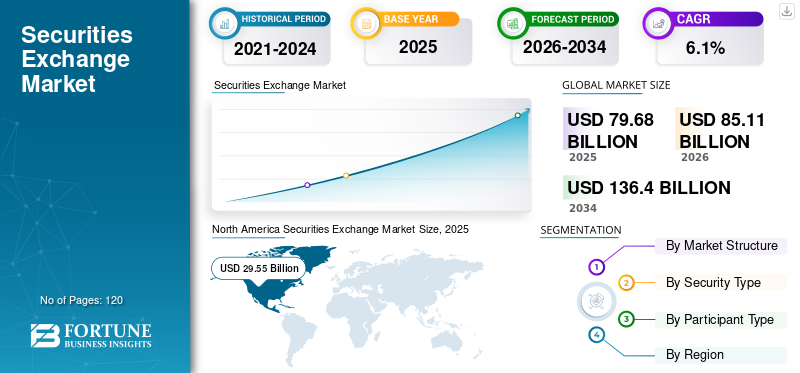
The global securities exchange market size was valued at USD 79.68 billion in 2025 and is projected to grow from USD 85.11 billion in 2026 to USD 136.40 billion by 2034, exhibiting a CAGR of 6.1% during the forecast period. North America dominated the securities exchange market with a market share of 37.08% in 2025.
The securities exchange market comprises organized platforms where financial instruments such as equities, bonds, derivatives, exchange-traded funds (ETFs), and hybrid securities are issued and traded. These exchanges facilitate capital formation, liquidity generation, price discovery, and risk management across global financial systems.
The market continues to expand due to rising cross-border investments, upgrades to digital trading infrastructure, and increased retail participation in capital markets. The growing adoption of algorithmic trading, electronic platforms, and derivatives for hedging and speculative purposes is further strengthening global exchange volumes. Additionally, regulatory reforms and exchange consolidation are reshaping competitive dynamics across developed and emerging markets.
Major exchange operators such as Intercontinental Exchange (ICE), Nasdaq Inc., London Stock Exchange Group (LSEG), CME Group, Deutsche Börse AG, and Hong Kong Exchanges and Clearing (HKEX) continue to expand trading platforms, clearing services, and derivatives offerings to capture higher transaction volumes.
- For instance, in May 2024, Nasdaq completed its acquisition of Adenza for USD 10.5 billion, strengthening its capital markets technology and risk management solutions portfolio for global exchanges and financial institutions.
Download Free sample to learn more about this report.
SECURITIES EXCHANGE MARKET KEY TAKEAWAYS
 Market Size & Forecast
- 2025 Market Size: USD 79.68 Billion
- 2026 Market Size: USD 85.11 Billion
- 2034 Forecast Market Size: USD 136.40 Billion
- CAGR: 6.1% from 2026–2034
 Market Share
- North America dominated the securities exchange market with a market share of 37.08% in 2025.
- The derivatives segment is projected to grow at the highest CAGR of 6.6% over the forecast period.
- The retail investors segment is expected to register the highest CAGR of 7.5% over the forecast period.
 Key Regional Highlights
North America
North America holds the largest market share in the global securities exchange trading market, driven by deep capital market liquidity, strong institutional investor presence, and advanced trading infrastructure.
Europe
Europe represents a significant and well-regulated market, supported by integrated multi-country exchange networks and strong clearing capabilities.
Asia Pacific
Asia Pacific is expected to register the highest CAGR of 7.6% during the forecast period, driven by rapid economic expansion, growing IPO pipelines, and increasing retail investor participation.
U.S.
The market is estimated to reach USD 26.77 billion in 2026, supported by high equity market capitalization, strong derivatives trading activity, and advanced clearing systems.
Japan
The market is estimated to reach USD 5.07 billion in 2026, driven by advanced trading technologies, institutional investor participation, and expanding derivatives markets.
Read More

SECURITIES EXCHANGE MARKET TRENDS
Digitalization and Derivatives Expansion are Key Market Trends
A major trend driving the securities exchange market growth is the rapid digitalization of trading infrastructure and the expansion of derivatives. Exchanges are investing heavily in low-latency systems, cloud migration, and AI-driven surveillance tools to enhance operational resilience and trading efficiency.
Simultaneously, derivatives products, including futures, options, and structured contracts, are witnessing accelerated growth amid rising demand for hedging amid market volatility. This has increased exchange revenues from clearing and risk management services.
- For instance, in 2024, CME Group reported record derivatives trading volumes, driven by heightened demand for interest rate and equity index futures contracts.
Download Free sample to learn more about this report.
MARKET DYNAMICS
MARKET DRIVERS
Rising Capital Market Participation and Cross-Border Investment to Boost Industry Growth
The securities trading platforms market is primarily driven by growing global participation in capital markets. Increased financial literacy, greater access to digital brokerage services, and lower trading costs have encouraged both institutional and retail investors to participate actively in equities and derivatives markets. Exchanges benefit directly from higher trading volumes and listing activities.
Furthermore, the globalization of investment portfolios has increased cross-border trading flows. Companies increasingly seek international listings, while investors diversify geographically, expanding transaction volumes and liquidity across major exchanges.
- For instance, in 2024, the New York Stock Exchange (NYSE) recorded strong IPO activity in the technology and energy sectors, reinforcing the role of exchanges in capital formation.
MARKET RESTRAINTS
Regulatory Complexity and Market Volatility Restrict Expansion
Despite strong growth, regulatory complexities across jurisdictions pose operational challenges for exchange operators. Stringent compliance requirements related to market transparency, clearing obligations, and investor protection increase administrative burdens and costs. Extreme market volatility or geopolitical disruptions can temporarily suppress IPO pipelines and trading volumes, impacting exchange revenues dependent on transaction-based income.
- For instance, in 2024, global IPO volumes declined in certain regions due to macroeconomic uncertainty, affecting primary market activity across exchanges.
MARKET OPPORTUNITIES
Growth in Emerging Markets and ESG Listings Creating Opportunities
Emerging markets present significant opportunities for exchange expansion, particularly in Asia Pacific and the Middle East regions, where capital market participation is rising. Exchanges are increasingly launching sustainability-linked bonds, green equities indices, and ESG-focused investment products to attract global investors. Moreover, the expansion of carbon trading platforms and ESG reporting frameworks is generating new revenue streams for securities exchanges.
- For instance, in 2024, London Stock Exchange Group expanded its sustainable bond market platform to support ESG-linked capital-raising initiatives.
Segmentation Analysis
By Market Structure
Secondary Market Dominates Due to Continuous Trading Activities
Based on market structure, the market is segmented into primary market and secondary market.
The secondary market holds the highest market share, as it facilitates ongoing trading of listed securities, generating continuous transaction volumes and liquidity. Daily trading activities across equities, derivatives, and ETFs drive consistent revenue streams for exchange operators. Additionally, secondary markets benefit from algorithmic trading and institutional participation, reinforcing their dominance.
The secondary market segment is also expected to register the highest CAGR of 6.3% over the forecast period, supported by rising derivatives volumes and increasing retail trading participation.
To know how our report can help streamline your business, Speak to Analyst
By Security Type
Equity Securities Lead Due to Strong IPO and Listing Activity
Based on security type, the market is segmented into equity securities, debt securities, derivatives, hybrid securities, and exchange-traded funds (ETFs).
The equity securities segment holds the highest market share, driven by IPO listings, corporate fundraising, and high daily trading activity across global exchanges. Equities remain the primary instrument for capital formation and investor participation.
- For instance, in 2024, the NYSE and Nasdaq hosted multiple high-profile IPOs across technology and energy sectors, reinforcing equity dominance.
The derivatives segment is projected to grow at the highest CAGR of 6.6% over the forecast period, driven by rising demand for hedging and speculative trading instruments.
By Participant Type
Institutional Investors Dominate Due to High Trading Volumes
Based on participant type, the market is segmented into retail investors, institutional investors, intermediaries, and issuers.
The institutional investors segment holds the highest securities exchange market share, as asset managers, hedge funds, pension funds, and sovereign wealth funds execute high-value transactions across equities, bonds, and derivatives markets. Institutional trading contributes significantly to exchange liquidity and revenue generation.
The retail investors segment is expected to register the highest CAGR of 7.5% over the forecast period, supported by app-based trading platforms and increased individual participation in global capital markets.
Securities Exchange Market Regional Outlook
By geography, the market is categorized into North America, Europe, Asia Pacific, South America, and the Middle East & Africa.
North America
North America Securities Exchange Market Size, 2025 (USD Billion)
To get more information on the regional analysis of this market, Download Free sample
North America holds the largest market share in the global securities exchange trading market, driven by deep capital market liquidity, strong institutional investor presence, and advanced trading infrastructure. The region benefits from a mature financial ecosystem supported by large pension funds, asset managers, hedge funds, and retail brokerage platforms. Continuous IPO activity, derivatives trading expansion, and strong ETF adoption further reinforce revenue generation for exchange operators.
Leading exchanges such as NYSE, Nasdaq, and CME Group maintain global competitiveness through technology upgrades, cross-border listings, and diversified clearing operations, strengthening North America’s dominant position.
U.S. Securities Exchange Market
The U.S. market in 2026 is estimated at around USD 26.77 billion, representing approximately 31.5% of global revenues. High equity market capitalization and derivatives trading volumes drive market strength. Robust institutional trading participation, high-frequency trading infrastructure, and advanced clearing systems further support consistent transaction-based revenue growth.
Europe
Europe represents a significant and well-regulated market, supported by integrated multi-country exchange networks and strong clearing capabilities. Exchanges such as LSEG, Deutsche Börse, and Euronext play key roles in global equity, derivatives, and bond markets. Regulatory harmonization across the EU supports cross-border trading and capital raising.
The region also benefits from growing sustainable finance listings and green bond issuance, strengthening trading activity and investor engagement.
U.K. Securities Exchange Market
The U.K. market in 2026 is estimated at around USD 4.36 billion, representing approximately 5.1% of global revenues. London remains a major international listing and clearing hub. Strong derivatives clearing through LCH and sustained cross-border equity listings reinforce market depth and liquidity.
Germany Securities Exchange Market
Germany’s market in 2026 is estimated at around USD 3.45 billion, representing approximately 4.1% of global revenues. Deutsche Börse’s dominance in derivatives and clearing services drives revenue stability. The country’s strong industrial base and institutional investor participation contribute to high transaction volumes.
Asia Pacific
Asia Pacific is expected to register the highest CAGR of 7.6% during the forecast period, driven by rapid economic expansion, growing IPO pipelines, and increasing retail investor participation. Expanding derivatives markets and financial reforms across emerging economies are strengthening trading volumes and liquidity. Technological modernization and regulatory reforms across major Asian exchanges are enhancing competitiveness and cross-border investor participation.
Japan Securities Exchange Market
Japan’s market in 2026 is estimated at around USD 5.07 billion, representing approximately 6.0% of global revenues. Advanced trading systems and strong institutional investor presence support stable market activity. Derivatives expansion and corporate governance reforms contribute to sustained exchange revenues.
China Securities Exchange Market
China’s market in 2026 is estimated at around USD 8.84 billion, representing approximately 10.4% of global revenues. Strong domestic IPO activity and government-backed capital market reforms drive sustained trading growth. The expansion of derivatives products and increased foreign investor access through connect programs further strengthen market expansion.
India Securities Exchange Market
India’s market in 2026 is estimated at around USD 4.34 billion, representing approximately 5.1% of global revenues. Rapid growth in retail participation and digital brokerage adoption drives strong equity trading volumes. Increasing IPO activity and the expansion of derivatives trading further support market acceleration.
South America and Middle East & Africa
The Middle East & Africa and South America collectively represent emerging but steadily growing markets. Financial market modernization, regulatory reforms, and increasing IPO activity in energy, infrastructure, and commodity-linked sectors support growth in these regions. Governments are actively promoting capital market development to diversify economic growth and attract foreign investment. Expanding derivatives offerings and improved trading infrastructure are gradually strengthening liquidity and cross-border participation across these regions.
GCC Securities Exchange Market
The GCC market in 2026 is estimated at around USD 3.46 billion, representing approximately 4.1% of global revenues. Strong IPO activity in the energy and infrastructure sectors supports transaction growth. Government-led diversification strategies and increasing foreign investor access continue to enhance market depth and listing activity.
COMPETITIVE LANDSCAPE
Key Industry Players
Expansion of Derivatives and Technology Platforms Strengthens Market Positioning
The securities exchange market is moderately consolidated, with leading global operators focusing on acquisitions, derivatives expansion, and digital infrastructure modernization. Exchange operators are investing in trading platforms, clearing services, and market data solutions to diversify revenue streams.
- For instance, in May 2024, Nasdaq completed its USD 10.5 billion acquisition of Adenza, enhancing its capital markets software and risk management technology portfolio.
LIST OF KEY SECURITIES EXCHANGE COMPANIES PROFILED
- Intercontinental Exchange (ICE) (U.S.)
- Nasdaq Inc. (U.S.)
- CME Group Inc. (U.S.)
- London Stock Exchange Group (U.K.)
- Deutsche Börse AG (Germany)
- Hong Kong Exchanges and Clearing (Hong Kong)
- Japan Exchange Group (Japan)
- Euronext N.V. (Netherlands)
- B3 S.A. (Brazil)
- Singapore Exchange (Singapore)
KEY INDUSTRY DEVELOPMENTS
- February 2024: Intercontinental Exchange (ICE) announced plans to launch NYSE Texas, a fully electronic equities exchange headquartered in Dallas. The initiative aims to expand U.S. equity trading infrastructure and strengthen regional market participation under the NYSE brand.
- January 2024: CME Group entered into an agreement to acquire a majority stake in GFO-X, a London-based digital asset derivatives exchange. The transaction is intended to expand CME’s presence in regulated digital asset derivatives markets and enhance its global derivatives portfolio.
- November 2023: Nasdaq Inc. completed its USD 10.5 billion acquisition of Adenza, a provider of capital markets and risk management software. The acquisition significantly expanded Nasdaq’s financial technology and regulatory solutions capabilities for exchanges and financial institutions globally.
- October 2023: Japan Exchange Group (JPX) officially launched its Carbon Credit Market, enabling the trading of government-certified carbon credits on the Tokyo Stock Exchange platform. The initiative marked Japan’s entry into exchange-based carbon trading to support national decarbonization
- September 2023: Deutsche Börse AG completed its acquisition of SimCorp A/S in a transaction valued at approximately USD 4.12 billion. The acquisition strengthened Deutsche Börse’s investment management technology and data services capabilities, diversifying its revenue streams beyond traditional exchange trading.
REPORT COVERAGE
The global securities exchange market analysis includes a comprehensive study of market size & forecast across all key segments included in the report. It provides insights into market trends, drivers, restraints, opportunities, and challenges expected to influence the global market growth over the forecast period. The report also covers technological advancements in digital identity and verification platforms, compliance considerations, and key strategic developments, including partnerships and M&A activity, alongside regional insights and competitive landscape analysis. Additionally, it includes regional insights and competitive landscape analysis, highlighting the market positioning and strategic initiatives of leading companies.
Request for Customization to gain extensive market insights.
Report Scope & Segmentation
| ATTRIBUTE | DETAILS |
| Study Period | 2021-2034 |
| Base Year | 2025 |
| Estimated Year | 2026 |
| Forecast Period | 2026-2034 |
| Historical Period | 2021-2024 |
| Growth Rate | CAGR of 9.5% from 2026 to 2034 |
| Unit | Value (USD Billion) |
| Segmentation | By Market Structure, Security Type, Participant Type, and Region |
| By Market Structure |
|
| By Security Type |
|
| By Participant Type |
|
| By Region |
|
Frequently Asked Questions
According to Fortune Business Insights, the global market value stood at USD 79.68 billion in 2025 and is projected to reach USD 136.40 billion by 2034.
In 2025, the market value in North America stood at USD 29.55 billion.
The market is expected to exhibit a CAGR of 6.1% during the forecast period of 2026-2034.
By participant type, the institutional investors segment leads the market.
Rising capital market participation and cross-border investment are driving market growth.
Intercontinental Exchange (ICE), Nasdaq Inc., CME Group Inc., London Stock Exchange Group, and Deutsche Börse AG are among the major players in the global market.
North America dominated the market in 2025.



- 2021-2034
- 2025
- 2021-2024
- 120
Get 30-60 hrs Free Customization
Expand Regional and Country Coverage, Segments Analysis, Company Profiles, Competitive Benchmarking, and End-user Insights.












Related Reports
-
US +1 833 909 2966 ( Toll Free )
-
Get In Touch With Us