Self-Cleaning Bottles Market Size, Share & Industry Analysis, By Material (Stainless Steel, Plastic, and Others), By Capacity (500 ml & Below, 500 ml to 750 ml, and 750 ml & Above), By Sales Channel (D2C and Retailers), and Regional Forecast, 2026-2034
 Download Free Sample
(Offer valid till 30th Sep 2026)

KEY MARKET INSIGHTS
 Listen to Audio Version
The global self-cleaning bottles market size was valued at USD 170 million in 2025 and is projected to grow from USD 190 million in 2026 to USD 350 million by 2034, exhibiting a compound annual growth rate (CAGR) of 8.36% over the forecast period. Europe dominated the self-cleaning bottles market with a market share of 40.33% in 2025.
Self-cleaning bottles can filter water content and fulfill individuals' hydration needs while traveling. The majority of these products are equipped with UV (ultraviolet) technology that aids in the destruction of the molecular bonds of the viruses & bacteria contained in the water. The growing trend of using diverse reusable bottles with built-in carbon filters, digital UV filters, and other self-purification technologies drives product demand globally.
The BRITA Group, Auron Bottle, and Sapience Group LLC are leading players in the self-cleaning water bottle market. OHOM Inc. and Nuvoe focus on broadening their portfolio of upcycled material-based self-cleaning and purification products and sustainably building their presence in the industry. For instance, from 2019 to 2024, Nuvoe produced more than 500,000 refillable in-bottle water purifiers that have contributed to the decrease in the usage of 78 million single-use plastic water bottles.
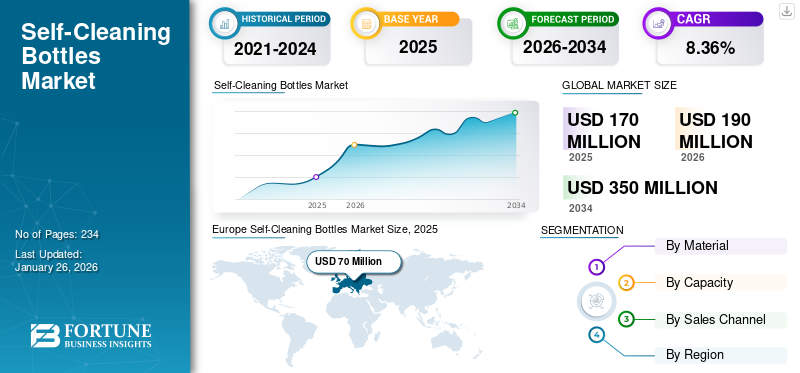
Download Free sample to learn more about this report.
Self-Cleaning Bottles Market Key Takeaways
 Global Market Size & Forecast
- 2025 Market Size: USD 170 million
- 2026 Market Size: USD 190 million
- 2034 Forecast Market Size: USD 350 million
- CAGR: 8.36% from 2026–2034
 Market Share
- Europe dominated the market with a 40.33% share in 2025.
- Stainless steel is projected to lead with a 73.68% share in 2026.
- D2C is expected to dominate with a 63.16% share in 2026.
 Key Regional Highlights
North America
Reached USD 51 million in 2025, supported by eco-conscious consumers and UV bottle innovations.
Asia Pacific
Stood at USD 46 million in 2025, fueled by rising demand for sustainable hydration products.
Europe
Valued at USD 70 million in 2025, driven by strong demand for travel and reusable bottles.
U.S.
The market is projected to reach USD 55 million by 2026.
Japan
The market is projected to reach USD 80 million by 2026.
Read More

Self-Cleaning Bottles Market Trends
Rising Trend of Outdoor Travelling to Favor Market Growth
The rising trend of outdoor recreation and increasing travelers' spending on camping goods, such as self-purifying water bottles, mugs, coffee makers, tents, and others, favor product revenues across many countries. In addition, the growing trend of backpacking and river camping will increase the demand for products among youngsters globally.
- Europe witnessed self-cleaning bottles market growth from USD 61.32 Million in 2023 to USD 65.40 Million in 2024.
MARKET DYNAMICS
Market Drivers
Advancements in Water Self-Purification Technologies to Drive Market Growth
Hydration bottle manufacturers continuously design innovative self-purification and filtration technology-based products, including pitchers, cups, mugs, and water bottles. This uplifts the product supply rate in the bottle market and supports the product revenue growth globally. For instance, LARQ, a Brita Group-owned water filter products maker, consistently designs PureVis technology-based self-cleaning water bottles that clean water every 2 hours. Users can effectively monitor the product's water filtration activity status via the LARQ mobile application.
Rising Concerns of Waterborne Diseases to Augment Product Demand
Concerns about waterborne diseases, including diarrhea, typhoid, and others, and increasing awareness of water intake benefits with self-purifying bottles & pitchers drive the self-cleaning bottles market growth. According to the United Nations International Children's Emergency Fund (UNICEF), 9% of all the worldwide deaths among children aged under 5 years were associated with diarrhea disease in 2021. Besides, the instances of limited accessibility to drinking water increase the travelers' need to utilize self-purifying water bottles, supporting product sales growth globally.
Download Free sample to learn more about this report.
Market Restraints
Higher Number of Households Installing In-house Water Purifiers to Limit Market Growth
More households are installing in-house water purifiers to fulfill their needs for clean water consumption, which limits the demand for self-cleaning water bottles across many countries. In addition, an increasing number of commercial facilities, including hospitality settings, restaurants, resorts, and spa clinics, installing water purifiers to serve purified water to their clients lowers the consumers' necessity of purchasing self-cleaning water bottles, restraining the global self-cleaning bottle market growth.
Market Opportunities
Rising Demand for Sustainably-made Reusable Bottles to Fuel Market Growth
Shifting eco-consumers' preference toward sustainably made reusable water bottles to avoid the single-use plastic generation from disposable products creates newer opportunities for the manufacturers to expand their business in the self-purification product category. In addition, manufacturers' adoption of sustainability measures in their manufacturing practices, including producing water tumblers sourced from eco-friendly materials, including glass, stainless steel, upcycled/recycled plastic, bamboo, and others, create newer market growth avenues.
Market Challenges
Higher R&D Investment Requirements to Limit Industry Players in Business Expansion Activities
The higher necessity of R&D investments to design and produce self-cleaning water bottles poses challenges to the industry manufacturers, thus limiting the global market growth. For instance, in September 2020, LARQ, a Brita Group-owned product maker, conducted a Series A round of USD 10 million in funding led by the Seventure investor to develop newer products and build manufacturing capacity across Europe.
Impact of COVID-19
During the initial waves of the coronavirus infection threat, restrictive governmental policies on outdoor travel significantly lowered the travel-friendly self-cleaning bottle sales across many countries. In addition, reduced consumer spending on non-essential goods hampered product sales worldwide. However, the increased importance of personal hygiene and clean water drinking elevated the product demand during multiple waves of the COVID-19 pandemic.
SEGMENTATION ANALYSIS
By Material
Higher Preference for Durable and Reusable Bottles Boosted the Stainless Steel Segment Growth
The global market is segmented into stainless steel, plastic, and others based on the material used.
The stainless steel material segment is projected to account for 73.68% of the market due to consumers' preference for durable stainless steel-based water tumblers over their counterparts. In addition, increasing consumers' accessibility to steel bottles of different colors and styles supports segmental revenue growth at the fastest rate during the forecast period of 2025-2032. The stainless stell segment captured a share of 77.17% in 2024.
Moreover, plastic is expected to be the second fastest-growing segment during 2025-2032, mainly due to the increasing middle-income and household preference for affordable and innovative self-care products, including plastic bottles for office usage. Others segment covers the analysis of various product materials such as glass, bamboo, material blends, and others, broadening consumers' necessities of utilizing hydration bottles of different materials.
To know how our report can help streamline your business, Speak to Analyst
By Capacity
Higher Demand for Mid-Capacity Bottles Resulted in the Dominance of 500 ml to 750 ml Segment
Based on capacity, the global market is segmented into 500 ml & below, 500 ml to 750 ml, and 750 ml & above.
The 500 ml to 750 ml capacity segment is expected to contribute 57.89% of the market and is predicted to grow at a second faster-growing rate during 2025-2032. This is mainly due to the higher demand for mid-capacity (up to 20 oz) reusable water bottles that fulfill the users' complete day body hydration needs. The segment is estimated to capture a share of 60.36% in 2025.
Additionally, the 750 ml & above segment is predicted to grow fastest with a CAGR of 8.28% during the forecast period of 2025-2032 due to the rising number of outdoor camping groups preferring reusable bottles of large water storage capacity sizes.
The increasing number of students preferring water filtration system-based bottles of capacity 15 oz. or below for their hydration needs at the school facilities favor 500 ml & below segmental revenue growth during 2025-2032.
By Sales Channel
A Higher Number of Brands Selling Products through Stores Resulted in D2C Segment's Dominance
Based on sales channel, the market is bifurcated into D2C and retailers.
The D2C sales channel segment dominated the global market with a market share of 63.16% in 2026 and is slated to grow rapidly during the forecast period of 2025-2032. This is due to more self-cleaning bottle brands selling products through direct-to-consumer (D2C) channels to build their brand image globally. The segment is expected to gain 66.11% of the market share in 2025.
A rising number of international self-cleaning bottle retailers, including Nordstrom, Revolve, and MONA, selling reusable bottles at discounted prices support the retailer's segmental growth, which is expected to rise at the second fastest-growing rate during 2025-2032. The segment is predicted to grow with a CAGR of 7.51% during the forecast period (2025-2032).
Global Self-Cleaning Bottles Market Regional Outlook
Geographically, the global market is segmented into North America, Europe, Asia Pacific, South America, and the Middle East & Africa.
Europe
Europe Self-Cleaning Bottles Market Size, 2025 (USD Million)
To get more information on the regional analysis of this market, Download Free sample
The European market dominated, and its size reached USD 61.32 million in 2023 and USD 65.40 million in 2024. The European market is projected to grow rapidly during the forecast period of 2025-2032. Major markets in the European region are Germany, the U.K., and France. The U.K. market is predicted to reach a value of USD 14.84 million in 2025.Higher consumer spending on travel-essential goods, including water bottles, backpacks, and others, generated higher product revenue in the U.K., Germany, and France. According to the World Travel & Tourism Council (WTTC), from 2019 to 2023, domestic visitor spending in Germany increased by USD 3.02 billion. The UK market is projected to reach USD 15 billion by 2026, while the Germany market is projected to reach USD 22 billion by 2026.
- In Germany, the stainless steel segment is estimated to hold a 77.86% market share in 2024.
To know how our report can help streamline your business, Speak to Analyst
In addition, consistent key manufacturers' business expansion projects in the European countries, including Switzerland, Poland, and Russia, positively contribute toward the future development of the European market.
North America
North America is the second leading region, expected to reach a valuation of USD 51.67 million in 2025, exhibiting a CAGR of 7.63% during the forecast period (2025-2032). The North American market is estimated to grow at the third fastest rate during 2025-2032. This is mainly driven by increasing eco-conscious consumers' preference for reusable water bottles to avoid single-use plastic generation in the U.S. and Canada. In addition, continual manufacturers' efforts to launch innovative water filtration bottles support the future market development in the U.S. From March 2022, Sidhesh Wilson started offering a smart water bottle 'Halo' in the U.S. market. The product consists of a UV scanner, which effectively kills germs and bacteria present in the water of the bottle. The U.S. market is projected to reach USD 40 billion by 2026. North America recorded a market size of USD 51 million in 2025, capturing 29.75% of the global market share, and is projected to reach USD 55 million in 2026.
Asia Pacific
Asia Pacific is the third largest market expected to gain USD 46.56 million in 2025. Consistent efforts by manufacturers, including KingStar Industries Co., Ltd., Zojirushi America Corporation, and others, to broaden their reusable water bottle product portfolio in the self-cleaning category favor market growth across the Asia Pacific region. China is set to be valued at USD 20.88 million in 2025. In addition, growing awareness about sustainable water drinking product availability among higher-income consumer groups in China, Japan, and Australia accelerates market growth in these countries.The Japan market is projected to reach USD 80 billion by 2026, the China market is projected to reach USD 22 billion by 2026, and the India market is projected to reach USD 60 billion by 2026. The Asia Pacific market generated USD 46 million in 2025, representing 26.81% of the global market landscape, and is expected to reach USD 49 million in 2026.
Europe
In 2025, Europe represented USD 70 million, accounting for 40.33% of the worldwide market, and is projected to grow to USD 75 million in 2026.
South America
South America is the fourth leading region, anticipated to reach a market value of USD 3.40 million in 2025. Self-purification bottles essentially fulfill the hydration needs of individuals while traveling. The emerging trends of hiking and outdoor recreation are expected to increase the consumer demand for such products, driving the market growth in Brazil, Chile, and other South American countries. In addition, growing awareness regarding environmental degradation due to the usage of single-use plastic-based food and beverage containers increases the consumer demand for reusable products, creating newer market growth opportunities in South America. In 2025, the South America market stood at USD 30 million, representing 1.15% of global demand, and is projected to grow to USD 30 million in 2026.
Middle East & Africa
Growing awareness regarding the availability of self-filtration water bottles and the increasing number of youngsters opting for water-drinking products of stylish designs support product sales across Saudi Arabia, UAE, and South Africa. In addition, rising consumer adoption of smart gym accessories, including smart water bottles and fitness trackers at public gym facilities and fitness centers, is driving product sales across the region. The UAE is anticipated to acquire USD 0.44 million in 2025. Middle East & Africa accounted for USD 20 million in 2025, representing 1.96% of the global market share, and is projected to reach USD 20 million in 2026.
COMPETITIVE LANDSCAPE
Key Industry Players
Consistent Brand Building Efforts by Prominent Players Strengthen Their Market Positions
The BRITA Group, Auron Bottle, and Sapience Group LLC are key players. OHOM Inc. and Nuvoe focus on building brand image to strengthen their position in the worldwide markets. For instance, LARQ, a Brita Group-owned business, unveiled its USD 118-priced self-cleaning smart water bottles at Shark Season 12 to build its brand image.
Major Players in the Self-Cleaning Bottles Market
To know how our report can help streamline your business, Speak to Analyst
The BRITA Group, Auron Bottle, Sapience Group LLC. OHOM Inc. and Nuvoe are a few of the leading players in the global market. The global market is competitive, with the top 5 players accounting for 81.9% of the global market share.
List of Key Self-Cleaning Bottle Companies Profiled:
- The BRITA Group (Germany)
- Auron Bottle (Germany)
- Sapience Group LLC. (U.K.)
- OHOM Inc. (U.S.)
- Nuvoe (Australia)
- GRAYL/ SEATTLE USA (U.S.)
- Koninklijke Philips NV (Netherlands)
- Smart Flask (Australia)
- Luma Hydration, Inc. (U.S.)
- Nutrality.co.uk (U.K.)
KEY INDUSTRY DEVELOPMENTS
- February 2024: Brita SE, a global drinking product provider, acquired LARQ, Inc., a healthy hydration product innovator, to expand its presence in the North American region.
- May 2022: WAATR, a technology startup, was awarded a business innovation award in the category' Business to Consumer: Travel, Sports & Outdoor Goods,' with the launch of water bottle caps equipped with Integrated Deep UV LEDs at the GIA 2022 event.
- May 2022: Luma Hydration, Inc. launched its upgraded products, Luma 2.0, an innovative self-cleaning bottle with multiple quality improvements & newer color options, and Luma Carbon, a next-generation water filtration system for killing contaminants.
- November 2021: GRAYL/ SEATTLE USA, an American hydration products maker, unveiled the New Travel-Ready UltraPress Water Filter & Purifier Bottle product at AdventureELEVATE in Sedona, Arizona.
- July 2020: WAKEcup, a germ-bursting bottle manufacturer, launched an innovative self-cleaning UV technology-based light water bottle in the U.K. market. The product functions as a water cleaner with a single click of a button, and it can be powered with a USB rechargeable lithium battery and a waterproof MicroUSB connector.
REPORT COVERAGE
The market report analysis includes in-depth market-related information, highlighting crucial aspects such as prominent companies, product types, product model types, product capacities, end-users, and distribution channels. Besides this, the research report on the outlook provides insights into the market trends for self-cleaning products and highlights significant product developments in the industry.
Request for Customization to gain extensive market insights.
Report Scope & Segmentation
|
ATTRIBUTE |
DETAILS |
|
Study Period |
2021–2034 |
|
Base Year |
2025 |
|
Estimated Year |
2026 |
|
Forecast Period |
2026-2034 |
|
Historical Period |
2021–2024 |
|
Growth Rate |
|
|
Unit |
Value (USD million) |
|
Segmentation |
By Material
|
|
By Capacity
|
|
|
By Sales Channel
|
|
|
By Region
|
Frequently Asked Questions
According to Fortune Business Insights, the global self-cleaning bottles market size was valued at USD 170 million in 2025. It is projected to grow from USD 190 million in 2026 to USD 350 million by 2034.
The global market forecasted to grow at a CAGR of 8.36% during 2026-2034.
The market is driven by advancements in water self-purification technologies, increased awareness of waterborne diseases, and the rising demand for reusable, eco-friendly hydration products.
Europe dominates the global market with a 40.16% share in 2025, valued at USD 65.40 million. Countries like the U.K., Germany, and France lead due to higher consumer spending on travel and hydration essentials.
The main challenge is the high R&D investment required for developing innovative self-cleaning and water purification technologies. This can limit smaller players’ ability to scale and compete with larger brands.
Popular materials include stainless steel (due to durability and insulation), plastic (for affordability), and eco-friendly materials such as glass, bamboo, and recycled plastics, aligning with sustainability trends.
The 500 ml to 750 ml segment holds the largest share in 2025, driven by consumer preference for mid-capacity bottles that fulfill daily hydration needs while being portable and lightweight.
Key companies include The BRITA Group, Auron Bottle, Sapience Group LLC, OHOM Inc., Nuvoe, GRAYL, Koninklijke Philips NV, Smart Flask, and Luma Hydration, Inc. BRITA’s acquisition of LARQ highlights active expansion strategies among top players.



- 2021-2034
- 2025
- 2021-2024
- 234
-
(Offer valid till 30th Sep 2026)
Get 30-60 hrs Free Customization
Expand Regional and Country Coverage, Segments Analysis, Company Profiles, Competitive Benchmarking, and End-user Insights.



















Related Reports
-
US +1 833 909 2966 ( Toll Free )
-
Get In Touch With Us