Sleep Disorder Devices Market Size, Share & Industry Analysis, By Product Type (Diagnostic [Polysomnography Devices, Pulse Oximeters, Actigraphy Systems & Others] & Therapeutic [Positive Airway Pressure Devices {Continuous Positive Airway Pressure (CPAP) Devices, Bilevel Positive Airway Pressure Devices (BiPAP) Devices, & Others}, Masks & Accessories, & Others]), By Age Group (Adults and Pediatrics), By Disorder Type (Sleep Apnea, Insomnia, Restless Leg Syndrome (RLS), & Others), By End User (Sleep Laboratories & Clinics, Homecare Settings, & Others), and Regional Forecast, 2026-2034
 Download Free Sample
Sleep Disorder Devices Market Size and Future Outlook
 Listen to Audio Version
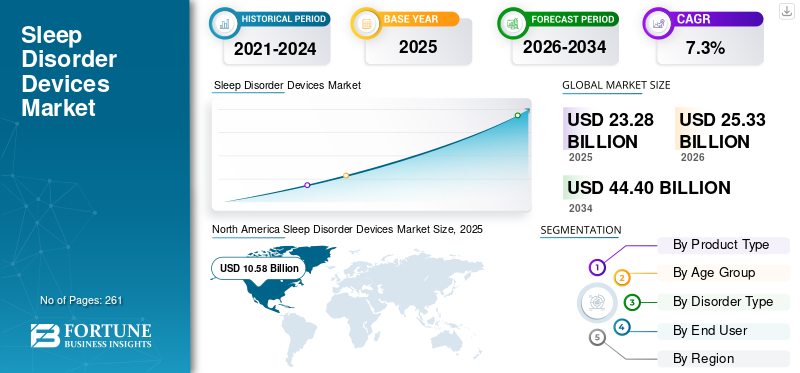
The global sleep disorder devices market size was valued at USD 23.28 billion in 2025 and is projected to grow from USD 25.33 billion in 2026 to USD 44.40 billion by 2034, exhibiting a CAGR of 7.3% during the forecast period. North America dominated the sleep disorder devices market with a market share of 45.44% in 2025.
Sleep disorder devices refers to medical devices used for sleep apnea, including CPAP/BiPAP, oral appliances, and at-home diagnostic trackers. The increasing prevalence of sleep diseases, rising awareness of sleep health, rising number of sleep studies, and development of the healthcare system are resulting in the growing adoption rate of sleep disorder devices. Increasing aging population is further boosting the demand for diagnostic and treatment procedures among patients, thereby fueling the demand for these devices in the market.
- For instance, according to the 2021 data published by The National Medical Journal of India (NMJI), an estimated 25%-30% of adults suffer from at least one of the sleep disorders globally.
Furthermore, rising incorporation of technological advancements in these devices by the major companies, including Resmed and Fisher & Paykel Healthcare Limited, among others, is further contributing to the demand for these devices.
Download Free sample to learn more about this report.
Sleep Disorder Devices Market KEY TAKEAWAYS
 Global Market Size & Forecast
- 2025 Market Size: USD 23.28 billion
- 2026 Market Size: USD 25.33 billion
- 2034 Forecast Market Size: USD 44.40 billion
- CAGR: 7.3% from 2026–2034
 Market Share
- North America dominated the sleep disorder devices market with a 45.44% share in 2025.
- The diagnostic segment is projected to grow at the fastest CAGR of 8.1% during the forecast period.
- The pediatrics segment is projected to grow at the fastest CAGR of 8.8% during the forecast period.
 Key Regional Highlights
Asia Pacific
Asia Pacific reached USD 5.00 billion in 2026, driven by healthcare infrastructure development and rising expenditure.
North America
North America reached USD 10.58 billion in 2025, supported by high sleep disorder prevalence and advanced healthcare systems.
Europe
Europe reached USD 6.73 billion in 2026, driven by rising sleep conditions and product launches.
U.S.
U.S. reached USD 10.52 billion in 2026, fueled by strong demand for diagnostic and therapeutic devices.
Japan
Japan reached USD 1.08 billion in 2026, driven by growing awareness of sleep health and disorder management.
Read More

Sleep Disorder Devices Market Trends
Increasing Adoption of Wearable Products to Fuel the Demand
There is a strong shift towards the adoption of wearable and digital health devices for sleep screening and monitoring. Wearable devices, including smartwatches, fitness bands, smart rings, and other connected wearables, are increasingly being used by consumers to monitor sleep stages, track sleep duration, heart rate, blood oxygen levels, respiratory patterns, and nighttime movement. These devices enable users to identify abnormal sleep patterns, further boosting the medical consultations for sleep apnea, circadian rhythm disorders, and insomnia.
Additionally, growing interest in preventive health among the population, rising availability of affordable smart wearables and telehealth-based sleep management solutions, enhanced sensor accuracy, and incorporation of sleep data into mobile health applications are also boosting the market growth. Wearables also help in long-term data collection and remote monitoring, contributing in the adoption of therapy adherence tracking, patient engagement, and population-level sleep research.
- According to 2024 data published by Nature, the All of Us Research Program analyzed sleep patterns and chronic disease risk using long-term monitoring with commercial wearable devices.
Market Dynamics
Market Drivers
Download Free sample to learn more about this report.
Increasing Prevalence of Sleep Disorders to Drive Market Growth
The growing prevalence of chronic diseases, including sleep apnea, insomnia, and others, is resulting in the rising number of diagnostic and treatment rates among the patient population, consequently driving the demand for sleep disorder devices in the market.
- For instance, according to 2025 data published by Science Direct, it was reported that more than 16% people were estimated to have insomnia.
This, along with an expansion of healthcare infrastructure, rising awareness about sleep health, and growing adoption of digital health technologies, is further augmenting the market progress. Therefore, the factors mentioned above, along with growing focus of key players on introducing research and development activities to launch novel devices, are anticipated to fuel the market gowth.
Market Restraints
High Cost of Diagnosis and Treatment to Hinder the Market Growth
The high cost associated with sleep disorder diagnosis and treatment remains a key restraint for the market. There is an increasing demand for sleep specialist consultation, in-lab polysomnography, home sleep apnea testing, follow-up assessments, and long-term monitoring, which increases the cost for patients. Additionally, treatment requires CPAP or BiPAP devices, masks and accessories, humidifiers, replacement supplies, oral appliances, and other devices, which further adds to the treatment cost.
Additionally, limited reimbursement policies in emerging countries, including Brazil, India, and others, is resulting in reduced diagnosis and treatment rates for sleep disorders among patients, thereby hindering the market growth.
- For instance, according to 2025 data published by the American Academy of Sleep Medicine, people with sleep apnea pay an average of USD 2,105.0 per year for testing, medical appointments, treatment devices, and surgery if necessary.
Market Opportunities
Expansion of Sleep Disorder Centers and Treatment Volumes to Create Market Growth Opportunities
The increasing diagnosis and treatment volumes, expansion of healthcare infrastructure, and growing number of sleep disorder centers are consequently boosting the adoption of sleep disorder devices in these settings. Additionally, the incorporation of sleep centers with telemedicine, home sleep testing, remote monitoring, and digital platforms enables healthcare professionals to cater to a larger patient base.
- According to 2022 data published by the American Academy of Sleep Medicine (AASM), there are more than 2,500 sleep centers in the U.S.
Market Challenges
Restricted Healthcare Access in Developing Countries to Limit the Market Growth
There is an increasing demand for innovative solutions for sleep disorder diagnosis and treatment among the patient population. However, limited penetration of technologically advanced devices, healthcare expenditure, and awareness about sleep health, along with stringent regulatory requirements, particularly in developing nations, are resulting in inadequate access to sleep facilities among the patient population.
Moreover, a lack in number of sleep laboratories and trained professionals, among others, are also some of the crucial factors, hindering the adoption of these devices among the patient population, especially in emerging countries, including China, Brazil, among others. Additionally, ensuring long-term patient adherence to sleep therapies and device usage remains a key challenge to sleep disorders devices market growth.
- For instance, according to 2023 data published by The World Bank Group (WBG), about 4.5 billion people lack full access to essential health services all over the globe.
SEGMENTATION ANALYSIS
By Product Type
Increasing Cases of Sleep Disorders Led to the Segment Dominance of Therapeutics
Based on the product type, the market is classified into diagnostic and therapeutic. Diagnostic is further classified into polysomnography devices, pulse oximeters, actigraphy systems, and others. Therapeutic is further segmented into positive airway pressure devices, masks & accessories, and others. Positive airway pressure devices are classified into Continuous Positive Airway Pressure (CPAP) devices, Bilevel Positive Airway Pressure (BiPAP) devices, and others.
The therapeutic segment held the largest revenue share in 2025. The growth is due to the increasing prevalence of sleep disorders among patients, resulting in a growing demand for therapeutic devices. This, coupled with the growing focus of key companies on launching CPAP devices, is further anticipated to contribute to the overall market growth.
- For instance, in January 2026, Inogen, Inc., a medical technology company specializing in innovative respiratory products for homecare use, launched Aurora CPAP masks, a new product within the expanding Inogen portfolio.
The diagnostic segment is expected to grow at a CAGR of 8.1% over the forecast period.
To know how our report can help streamline your business, Speak to Analyst
By Age Group
Increasing Prevalence of Sleep Disorders Among Adults Led to Segment’s Leadership
Based on age group, the market is segmented into adults and pediatrics.
The adults segment dominated the global market in 2025 due to the rising prevalence of sleep disorders among the adult population, resulting in a growing demand for diagnostic and therapeutic products.
- For instance, according to 2025 data published by the National Center for Biotechnology Information (NCBI), it was reported that about 425 million adults aged 30 to 69 are affected by moderate-to-severe obstructive sleep apnea globally.
The pediatrics segment is set to flourish with a growth rate of 8.8% across the forecast period.
By Disorder Type
Growing Occurrence of Chronic Conditions Bolstered the Governance of Sleep Apnea
Based on disorder type, the market is segmented into sleep apnea, insomnia, Restless Leg Syndrome (RLS), and others.
The sleep apnea segment dominated the global market in 2025 due to the growing prevalence of chronic conditions, including sleep apnea, among others, resulting in an increasing number of patient admissions globally, further boosting the demand for sleep disorder devices.
- For instance, according to the 2025 statistics published by the National Center for Biotechnology Information (NCBI), it was reported that approximately 1 billion people are affected by obstructive sleep apnea globally.
The insomnia segment is set to flourish with a growth rate of 5.4% across the forecast period.
By End user
Increasing Preference for Homecare Settings Led to the Segmental Dominance
Based on end user, the market is segmented into sleep laboratories & clinics, homecare settings, and others.
The homecare settings segment dominated the market in 2025. Increasing prevalence of sleep conditions, preference for treatment in home care settings, among others, are some of the crucial factors contributing to the growth of the segment. Furthermore, the segment is set to hold 70.6% share in 2026.
- For instance, according to 2021 statistics published by the Homecare Association, more than a third (35%) of people surveyed said they were now more likely to choose care in their own home, with 38% of over 65-year-olds preferring to opt for home care.
In addition, sleep laboratories & clinics are projected to grow at a 6.8% CAGR during the forecast period.
Sleep Disorder Devices Market Regional Outlook
Based on region, the market has been studied across North America, Europe, Asia Pacific, Latin America, and the Middle East & Africa.
North America
North America Sleep Disorder Devices Market Size, 2025 (USD Billion)
To get more information on the regional analysis of this market, Download Free sample
The North America market held the dominant share in 2024, valued at USD 9.61 billion, and also took the leading share in 2025 with USD 10.58 billion. Growing prevalence of sleep disorders, high demand for diagnostic and therapeutic devices for long term treatment, advanced hospital infrastructure, among others, are some of the factors supporting the growth regional market.
- For instance, according to 2024 statistics published by the American Academy of Sleep Medicine (AASM), about 13% of Americans were diagnosed with RLS in the U.S.
U.S. Sleep Disorder Devices Market
Based on North America’s strong contribution and the U.S.’s dominance within the region, the U.S. market can be analytically approximated at around USD 10.52 billion in 2026, accounting for roughly 41.5% of global market sales.
Europe
Europe is projected to record a growth rate of 6.3% in the coming years, which is the second highest among all regions, and reach a valuation of USD 6.73 billion by 2026. Growing prevalence of sleep conditions and rising number of product launches are likely to support the regional market growth.
U.K Sleep Disorder Devices Market
The U.K. market in 2026 is estimated at around USD 1.30 billion, representing roughly 5.1% of global market revenues.
Germany Sleep Disorder Devices Market
Germany’s market is projected to reach approximately USD 1.47 billion in 2026, equivalent to around 5.8% of global market sales.
Asia Pacific
Asia Pacific is estimated to reach USD 5.00 billion in 2026 and secure the position of the third-largest region in the market. Development of healthcare infrastructure and rising healthcare expenditure are likely to support the regional market.
Japan Sleep Disorder Devices Market
The Japan market in 2026 is estimated at around USD 1.08 billion, accounting for roughly 4.3% of global revenues. Japan has historically reported a relatively high prevalence of sleep disorders with growing awareness regarding sleep health.
China Sleep Disorder Devices Market
China’s market is projected to be one of the largest globally, with 2026 revenues estimated at around USD 1.47 billion, representing roughly 5.8% of global sales.
India Sleep Disorder Devices Market
The India market size in 2026 is estimated at around USD 0.74 billion, accounting for roughly 2.9% of global revenues.
Latin America and Middle East & Africa
The Latin America and Middle East & Africa regions are expected to witness moderate growth in this market space during the forecast period. The Latin America market is set to reach a valuation of USD 1.17 billion in 2026. The growth is due to the increasing public healthcare investment and expansion of healthcare infrastructure in the region. The Middle East & Africa is also expected to grow due to rising acquisitions and mergers among other companies to strengthen their presence in the market. In the Middle East & Africa, the GCC is set to reach a value of USD 0.43 billion in 2026.
South Africa Sleep Disorder Devices Market
The South Africa market is projected to reach around USD 0.03 billion in 2026, representing roughly 0.6% of global market revenues.
Competitive Landscape
Key Industry Players
Increasing Number of Product Launches By Prominent Players to Support Their Dominance
Robust and diversified product portfolio, along with a strong emphasis on strategic initiatives, is one of the key factors supporting the dominance of these companies in the market. Resmed and Fisher & Paykel Healthcare Limited are major companies in the market in 2025. Moreover, the growing focus of key companies on research and development activities to launch novel devices is likely to strengthen their presence and support the global sleep disorder devices market share.
- For instance, in January 2026, Fisher & Paykel Healthcare Limited launched its nasal PAP mask for treating obstructive sleep apnea, the F&P Nova Nasal mask.
Other key players, including Koninklijke Philips N.V. are also growing, primarily due to their increasing focus on partnerships with other companies to strengthen their presence in the market.
List of Key Sleep Disorder Devices Companies Profiled
- Resmed (U.S.)
- Fisher & Paykel Healthcare Limited (New Zealand)
- Koninklijke Philips N.V. (Netherlands)
- Inspire Medical Systems, Inc. (U.S.)
- ZOLL Medical Corporation (U.S.)
- Compumedics Limited (Australia)
- Cadwell Industries Inc. (U.S.)
- React Health (U.S.)
- Löwenstein Medical SE & Co. KG (Germany)
- SomnoMed (Australia)
KEY INDUSTRY DEVELOPMENTS
- May 2026: Resmed acquired Noctrix Health, manufacturer of the Nidra device, for a purchase price of USD 340 million with an aim to strengthen its product channel.
- September 2025: Compumedics Limited received the U.S. Food & Drug Administration (FDA) approval for the Somfit D device (K252383), authorising its sale in the U.S.
- June 2025: ProSomnus Sleep Technologies, the non-CPAP Obstructive Sleep Apnea (OSA) therapy, launched EVO Guided. EVO Guided is a new precision, custom oral device for the treatment of Obstructive Sleep Apnea.
- May 2025: Resmed, the health technology company focused on sleep, breathing, and care delivered in the home, acquired VirtuOx, a leading independent diagnostic testing facility (IDTF) for sleep, respiratory, and cardiac conditions.
- August 2024: React Health launched the Rio II full face mask, an ultra-compact CPAP mask designed to enhance patient comfort and compliance.
- August 2024: Inspire Medical Systems, Inc., a medical technology company focused on the development and commercialization of innovative, minimally invasive solutions for patients with obstructive sleep apnea (OSA), received FDA approval of the Inspire V therapy system which includes the next generation neurostimulator and the associated Bluetooth patient remote and physician programmer.
- April 2024: Fisher & Paykel Healthcare Corporation Limited launched the F&P Solo Nasal mask for the treatment of obstructive sleep apnea (OSA) in the U.S.
REPORT COVERAGE
The report provides a detailed global sleep disorder devices market analysis and focuses on key aspects such as leading companies and market segmentation, including product type, age group, disorder type, and end user. Besides this, the global report offers insights into the market growth trends and highlights key industry developments. In addition to the aforementioned factors, the report encompasses several factors that have contributed to the growth and advancement of the market over recent years.
Request for Customization to gain extensive market insights.
Report Scope & Segmentation
| ATTRIBUTE | DETAILS |
| Study Period | 2021-2034 |
| Base Year | 2025 |
| Estimated Year | 2026 |
| Forecast Period | 2026-2034 |
| Historical Period | 2021-2024 |
| Growth Rate | CAGR of 7.3% from 2026-2034 |
| Unit | Value (USD Billion) |
| Segmentation | By Product Type, Age Group, Disorder Type, End User, and Region |
| By Product Type |
|
| By Age Group |
|
| By Disorder Type |
|
| By End User |
|
| By Region |
|
Frequently Asked Questions
Fortune Business Insights says that the global market size was USD 23.28 billion in 2025 and is projected to reach USD 44.40 billion by 2034.
In 2025, the North America regional market value stood at USD 10.58 billion.
Growing at a CAGR of 7.3%, the market will exhibit steady growth over the forecast period.
By product type, the therapeutic segment is the leading segment in this market.
Introduction of novel sleep disorder devices is one of the major factors driving the market growth.
Resmed and Fisher & Paykel Healthcare Limited are the major players in the global market.
North America dominated the market share in 2025.
Growing prevalence of sleep disorders, increasing demand for diagnostic and therapeutic devices, among others, are some of the crucial factors anticipated to boost the adoption of these devices.



- 2021-2034
- 2025
- 2021-2024
- 261
Get 30-60 hrs Free Customization
Expand Regional and Country Coverage, Segments Analysis, Company Profiles, Competitive Benchmarking, and End-user Insights.













.webp)






Related Reports
-
US +1 833 909 2966 ( Toll Free )
-
Get In Touch With Us