Sludge Dewatering Equipment Market Size, Share & Industry Analysis, By Technology (Filter Press, Screw Press, Belt Filter Press, Centrifuges, and Others), By End User (Municipal, Pulp & Paper, Textile, Food & Beverage, Oil & Gas, and Others), and Regional Forecast, 2025-2032
 Download Free Sample
SLUDGE DEWATERING EQUIPMENT MARKET SIZE AND FUTURE OUTLOOK
 Listen to Audio Version
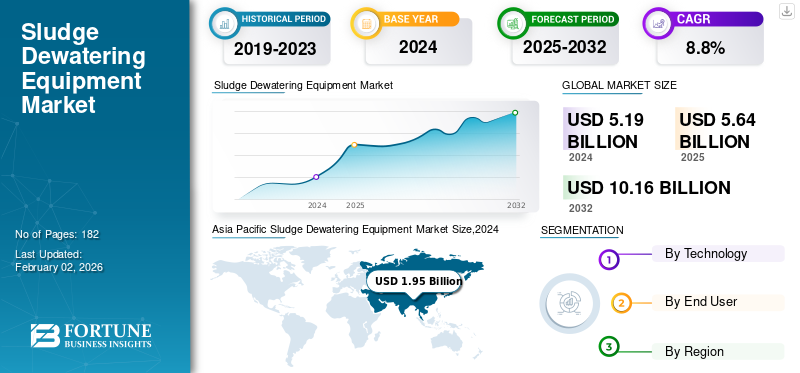
The global sludge dewatering equipment market size was valued at USD 5.19 billion in 2024 and is projected to grow from USD 5.64 billion in 2025 to USD 10.16 billion by 2032, exhibiting a CAGR of 8.8% during the forecast period. Asia Pacific dominated the global sludge dewatering equipment market with a market share of 37.57% in 2024.
Sludge dewatering equipment is industrial machinery used for the separation of water from sludge, which is a semi-solid waste product generated from wastewater treatment. This process decreases volume and weight significantly to lower transportation and disposal costs, and the solids are then easier to store, dry, or dispose off.
The market growth is being driven by increased environmental regulations, urbanization, and industrial growth, as well as demand for sustainable and energy-efficient solutions for wastewater treatment applications.
The top firms in the industry are ALFA LAVAL, AMCON Europe s.r.o., ANDRITZ, Benenv Co. Ltd., Evoqua Water Technologies, and Flottweg SE.
Download Free sample to learn more about this report.
Sludge Dewatering Equipment Market KEY TAKEAWAYS
 Market Size & Forecast
- 2024 Market Size: USD 5.19 billion
- 2025 Market Size: USD 5.64 billion
- 2032 Forecast Market Size: USD 10.16 billion
- CAGR: 8.8% from 2025–2032
 Market Share
- Asia Pacific dominated the sludge dewatering equipment market with a 37.57% share in 2024.
- The screw press segment is expected to grow at the highest CAGR of 9.4% during the forecast period.
- The food & beverage industry segment is expected to grow at the highest CAGR of 9.5% during the forecast period.
 Key Regional Highlights
Asia Pacific
Valued at USD 2.14 billion in 2025, driven by rapid industrialization, wastewater infrastructure expansion, and government initiatives.
Europe
Projected to reach USD 1.18 billion by 2025, driven by circular economy initiatives and advanced sludge treatment technologies.
North America
Valued at USD 1.46 billion in 2024, supported by stringent environmental regulations and wastewater treatment infrastructure upgrades.
U.S.
Projected to reach USD 1.18 billion by 2025, supported by stricter environmental regulations and ongoing infrastructure investments.
Japan
Expected to witness steady growth, driven by increasing adoption of advanced wastewater treatment and dewatering technologies.
Read More

MARKET DYNAMICS
Market Drivers
Growing Wastewater Treatment Needs Drives Market Growth
The rapid surge in urbanization and industrialization in both developing and developed areas has led to a considerable increase in the amount of wastewater produced. In order to meet rigorous environmental standards, governments and private sectors are placing a priority on investments in state-of-the-art wastewater treatment plants. Sludge dewatering machines are extremely important in the process of decreasing sludge material, thereby facilitating the management of the remaining waste and lessening the possibility of danger to the environment. The increase in public awareness of water conservation and waste management is also a great promoter of the market. Besides that, the imposition of stringent discharged regulations by environmental agencies is a continuous impetus for global demand for high-tech solutions in sludge treatment and dewatering.
Market Restraints
High Installation and Maintenance Costs Hinder Growth
Sludge dewatering systems, while offering great operational benefits, need a significant amount of money to be procured, installed, and set up. Such high upfront expenses may become a heavy load on small municipalities and industrial units that run on limited budgets. Moreover, the complex machine structures require regular maintenance, skilled labor, and timely replacement of mechanical parts, thus, operational costs become even higher. Many developing areas, due to financial constraints, cannot adopt sludge treatment technologies, which thus slows their overall market penetration. The cost-intensive nature of sludge dewatering devices is a major factor that hinders the adoption of such technologies, which, in turn, limits the market growth in price-sensitive economies and small wastewater treatment plants.
Market Opportunities
Rising Demand in Emerging Economies Drive Growth, Creating Opportunities
Developing countries mainly those in the Asia Pacific region, Africa and Latin America, are rapidly improving their infrastructures with a particular focus on sanitation and water resource management. Governments are initiating extensive projects to update sewage and industrial wastewater treatment systems. As a result, this movement is presenting a profitable opportunity for sludge dewatering equipment producers to introduce advanced and affordable models. Additionally, the rise in public-private partnerships, foreign investments, and the implementation of regulations related to environmental sustainability are among the factors contributing to the market’s positive outlook. Manufacturers that provide energy-efficient, scalable, and automated devices will be in a very favorable position to receive the maximum benefits, as these areas have become committed to solving wastewater treatment problems in a sustainable manner and for the long term.
SLUDGE DEWATERING EQUIPMENT MARKET TRENDS
Adoption of Energy-Efficient Technologies Emerges as a Market Trend
The sludge dewatering equipment market is progressively adopting energy-efficient and environmentally friendly technologies that lower both operational costs and the environmental impact. Manufacturers are spending on research and development to come up with units that consume less energy yet still deliver high output and are durable. Automation, IoT-based monitoring, and advanced filtration materials are increasingly being utilized to improve process control and minimize the need for manual operations. This change aligns with the global sustainability objectives that promote green technologies and circular economy practices. When industries seek ways to reduce their carbon footprint, energy-efficient sludge dewatering systems prove to be the most popular choice in various parts of the world.
Download Free sample to learn more about this report.
SEGMENTATION ANALYSIS
By Technology
Reliability and Automation of Centrifuges Drives the Segment Growth
Based on thetechnology, the market is segmented into filter press, screw press, belt filter press, centrifuges, and others.
The centrifuges segment held the largest revenue share of USD 1.81 billion in the overall global market in the year 2024. The increase in revenue is because dewatering centrigues efficiently separate solids from liquids and are well-suited for large-scale municipal and industrial operations. Their reliability and automation make them a preferred choice for consistent sludge treatment.
Of all the segments, screw press holds the highest CAGR of 9.4% in the global market. The segment’s growth is attributable to its energy-efficient design and low maintenance needs. Its increasingly popular for small and medium facilities seeking cost-effective wastewater management solutions.
To know how our report can help streamline your business, Speak to Analyst
Municipal Segment Leads Market Owing to Need for Effective Wastewater Treatment
Based onend user, the market is divided into municipal, pulp & paper, textile, food & beverage, oil & gas, and others.
Municipal applications segment dominates with a sludge dewatering equipment market share of USD 2.93 billion. The segment continues to generate the major revenue due to growing urban populations and the need for effective wastewater treatment. Investments in modern sewage treatment equipment is further supporting this demand.
The food & beverage industry holds the highest CAGR of 9.5% in the global market. The segment’s growth is attributable to its rapid adoption of sludge dewatering systems to manage high wastewater volumes. The focus on sustainability and resource recovery is boosting its growth.
SLUDGE DEWATERING EQUIPMENT MARKET REGIONAL OUTLOOK
Geographically the market is segmented into North America, Europe, Asia Pacific, South America and Middle East & Africa.
North America
The North America market is rapidly expanding. The market size was valued at USD 1.34 billion USD 1.46 billion in 2023 and 2024 respectively. The region’s growth is attributable to stringent environmental regulations and the need to upgrade aging wastewater treatment infrastructure. The primary technologies used are belt filter presses, centrifuges, and screw presses, with a growing emphasis on automation and energy efficiency.
The U.S. is at the forefront of the North American market, with expected revenue of USD 1.18 billion in 2025. The growth is attributable to increasingly stringent environmental regulations, rapid urbanization and industrial expansion, and ongoing technological advancements.
Europe
The European market is substantially growing and is likely to contribute to a revenue share of USD 1.18 billion in 2025. This growth is due to stringent environmental regulations, the increasing focus on a circular economy and resource recovery, a rising volume of sludge production due to urbanization and industrialization, and continuous technological advancements in dewatering equipment.
The U.K., Germany and Italy are some of the leading contributors to the growth in the market, with the required revenue stake of USD 0.18 billion, USD 0.29 billion and USD 0.11 billion respectively by 2025.
Asia Pacific
Asia Pacific is currently leading the global market. The market size was valued at USD 1.95 Billion and USD 2.14 billion in 2024 and 2025 respectively. The region’s growth is attributable to rapid industrialization and government initiatives for improved wastewater management. Expanding urban areas and stricter environmental standards are key drivers.
At the same time, Asia Pacific is also expected to have the highest CAGR of 9.4%, further solidifying the market as the fastest growing. The region’s growth is attributable to increasing infrastructure projects and adoption of advanced dewatering technologies to support environmental goals.
Asia Pacific Sludge Dewatering Equipment Market Size,2024 (USD Billion)
To get more information on the regional analysis of this market, Download Free sample
India and China are major contributors to the sludge dewatering equipment market growth with an expected revenue share of USD 0.45 billion, and USD 0.87 billion respectively by 2025.
South America and Middle East & Africa
The markets of South America and Middle East & Africa are growing with an expected share of USD 0.42 billion and USD 0.31 billion respectively in 2025 due to rapid urbanization, increasing industrialization, stringent environmental regulations, and a rising focus on water scarcity and resource recovery.
GCC countries are predicted to have a market share of USD 0.14 billion by 2025.
COMPETITIVE LANDSCAPE
Key Industry Players
Key Players Focus On Developing Innovative Technologies to Lead the Industry
The key players in the industry include ALFA LAVAL, AMCON Europe s.r.o., ANDRITZ, Benenv Co. Ltd., Evoqua Water Technologies, and Flottweg SE. The players are focusing on developing innovative technologies, expanding through mergers and acquisitions, and integrating smart solutions. Growth in the market is driven by increasing environmental regulations, rising wastewater volumes, and a greater emphasis on resource efficiency.
LIST OF KEY SLUDGE DEWATERING EQUIPMENT COMPANIES PROFILED
- ALFA LAVAL (Sweden)
- AMCON Europe s.r.o. (Czech Republic)
- ANDRITZ (Austria)
- Benenv Co. Ltd. (South Korea)
- Evoqua Water Technologies (U.S.)
- Flottweg SE (Germany)
- Groupe Industries Fournier Inc. (Canada)
- Hitachi Zosen Corporation (Japan)
- HUBER SE (Germany)
- Komline (U.S.)
- Kontek Ecology Systems (U.S.)
- Kurita Water Industries Ltd. (Japan)
- Phoenix Process Equipment (U.S.)
KEY INDUSTRY DEVELOPMENTS
- October 2025- 374Water Inc. announced a partnership with the City of Olathe, Kansas, to deploy an AirSCWO 6 system alongside a full-scale pre-treatment and dewatering system, valued at approximately USD 4 million over two years. This collaboration aims to evaluate the Supercritical Water Oxidation (SCWO) process at Olathe's wastewater treatment facility, exploring its viability as a sustainable alternative to traditional sludge management methods.
- May 2025- Fjord Solutions strengthens Pelagia's focus on sustainable sludge solutions, which already combines Pelagia's expertise in logistics and processes with Blue Ocean's technology for dewatering, storage and value creation of sludge. At the core of the acquisition is Fjord Solutions' BioCollector, a robust collection system that efficiently captures and gently transports feed waste and sludge from open and semi-closed cages.
- July 2024- International technology group ANDRITZ received an order from the German waste management service provider MVA Bielefeld-Herford GmbH to supply an EcoFluid bubbling fluidized bed (BFB) boiler system for a new sewage sludge mono-incineration plant.
- March 2023- Atlas Copco developed a new versatile range of electric surface self-priming dewatering pumps for a wide variety of applications. The E-Pump range consists of different models with a canopy and open set configuration. This flexible solution is ideally suited for many applications like sewage bypass, in the municipality sector and construction projects with access to a power source.
- November 2022- Andritz expanded its C-press screw presses product range to meet the dewatering needs of wastewater and industrial treatment plants. The Andritz C-Press offers simplified operation and processes free from contact with dewatered sludge, combined with low maintenance and energy consumption costs.
REPORT COVERAGE
The global report provides a detailed analysis of the market and focuses on key aspects such as prominent companies, deployment modes, types, and end users of the product. Besides this, it offers insights into the sludge dewatering equipment market trends and highlights key industry developments and market share analysis for key companies. In addition to the aforementioned factors, the report encompasses several factors that have contributed to the growth of the market over recent years.
Request for Customization to gain extensive market insights.
Report Scope & Segmentation
| Attribute | Details |
| Study Period | 2019-2032 |
| Base Year | 2024 |
| Forecast Period | 2025-2032 |
| Growth Rate | CAGR of 8.8% from 2025-2032 |
| Historical Period | 2019-2023 |
| Unit | Value (USD Billion) |
| Segmentation | By Technology, End User, and Region |
| By Technology |
|
| By End User |
|
| By Region |
|
Frequently Asked Questions
Fortune Business Insights says that the global market stood at USD 5.19 billion in 2024 and is projected to reach USD 10.16 billion by 2032.
The market is expected to exhibit steady growth at a CAGR of 8.8% during the forecast period.
Growing wastewater treatment needs is speeding up the market growth.
ALFA LAVAL, AMCON Europe s.r.o., ANDRITZ, Benenv Co. Ltd., Evoqua Water Technologies, and Flottweg SE are some of the top players in the market.
The Asia Pacific region held the largest market share.
Asia Pacific was valued at USD 1.95 billion in 2024.


- 2019-2032
- 2024
- 2019-2023
- 182
Get 30-60 hrs Free Customization
Expand Regional and Country Coverage, Segments Analysis, Company Profiles, Competitive Benchmarking, and End-user Insights.






Related Reports
-
US +1 833 909 2966 ( Toll Free )
-
Get In Touch With Us