Smart Furniture Market Size, Share & Industry Analysis, By Product (Tables & Desks, Stools & Benches, Beds, Chairs & Sofas, and Others), By Material (Wood, Metal, and Others), By End-User (Residential, Office, Hotel, and Others), By Distribution Channel (Specialty Stores, Online Channels, and Others), and Regional Forecast, 2026-2034
 Download Free Sample
(Offer valid till 15th Oct 2026)

KEY MARKET INSIGHTS
 Listen to Audio Version
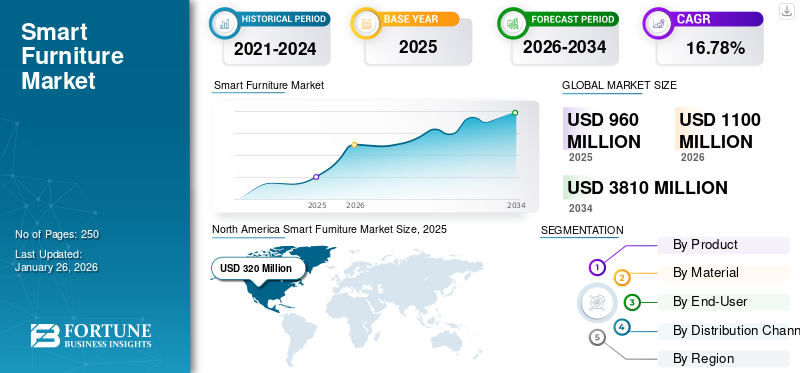
The global smart furniture market size was valued at USD 960.00 million in 2025 and is projected to grow from USD 1,100.00 million in 2026 to USD 3,810.00 million by 2034, exhibiting a compound annual growth rate (CAGR) of 16.78% during the forecast period (2026-2034). North America dominated the smart furniture market with a market share of 33.44% in 2025.
Intelligent technology-based furniture enhances seating convenience, improves aesthetics, and optimizes living room areas. These products promote energy-saving when integrated with smart home ecosystems for a connected living experience. The connected technologies of the furniture of smart functions include IoT-enabled automation, touch-screen control, Bluetooth connectivity, and adjustable settings. The increasing number of smart home & corporate infrastructural facilities and the growing adoption of digital solutions among them favor the demand for smart furniture products. As per the survey conducted by Samsung Electronics Co. Ltd., a global electronic goods manufacturer, Britain's population spent 7.7% more on a fully-equipped smart home in 2024, compared to 6.5% more in 2023.
The global market competitiveness can be characterized by the leading players, including HNI Corporation, Sleep Number Corporation, Inter IKEA Systems B.V., Ashley Furniture Industries, Inc., and Desktronic. These smart furniture companies launch brand stores to expand their retail presence across emerging markets, including Asia, Europe, and the Middle East. For instance, in February 2024, HNI Corporation unveiled a state-of-the-art experience center in Hyderabad, India. The center has been installed to display the latest modular office furniture products that significantly enhance digital connectivity within the workplace.
Download Free sample to learn more about this report.
Smart Furniture Market Key Takeaways
 Global Market Size & Forecast
- 2025 Market Size: USD 960.00 million
- 2026 Market Size: USD 1,100.00 million
- 2034 Forecast Market Size: USD 3,810.00 million
- CAGR: 16.78% from 2026–2034
 Market Share
- North America dominated the smart furniture market with a 33.44% share in 2025.
- The tables & desks segment accounted for the largest market share of 35.45% in 2026.
- The wood segment is projected to dominate the market with a 71.82% share in 2026.
 Key Regional Highlights
North America
North America was valued at USD 320 million in 2025 and is projected to reach USD 370 million in 2026.
Asia Pacific
Asia Pacific reached USD 300 million in 2025 and is expected to grow to USD 340 million in 2026.
Europe
Europe generated USD 290 million in 2025 and is projected to reach USD 340 million in 2026.
U.S.
The U.S. market is projected to reach USD 320 million in 2026.
Japan
The Japan market is projected to reach USD 50.58 million in 2026.
Read More

MARKET DYNAMICS
Market Drivers
Advancements in Development of Connected Technology-based Products to Drive Product Sales
Advancements in the development of IoT-based home utilities, including furniture equipped with advanced technologies such as sensors, voice-control features, and WiFi connectivity, positively contribute to the future development of the market. In addition, growing consumer accessibility to such innovative products at specialty furniture shops and branded upholstery outlets drives product revenues worldwide. Furthermore, the rising demand for personalized feature items equipped with individual preferences regarding functionality, design, and technology favors global smart furniture market growth.
- In May 2025, JIECANG Group, in collaboration with its subsidiary groups DREAMOTION and LOGICDATA, unveiled a Smart Standing Desk Solution for commercial environments and home office settings. The desk delivers a high load capacity of 120kg and an increased speed of 80mm/s while enabling OTA updated from the user's smart home. For home-office settings, the desk delivers an inline foldable standing feature, reducing its packaging volume by 50% for space optimization.
Rising Demand for Desks and Chairs Promoting User Posture Correction to Skyrocket Market Growth
Rising demand for health monitoring devices, including smart chairs and desks promoting posture correction & activity tracking features, accelerates the growth of the market across many countries. In addition, a rising number of home-office facilities, co-working spaces, and offices preferring seating furniture equipped with heart rate and stress level monitoring features for holistic wellness favor product revenues worldwide. Furthermore, the number of hotels and spa clinics investing in smart chairs and sofas to enhance user experience and operational efficiency has skyrocketed market growth.
Download Free sample to learn more about this report.
Market Restraints
Private Data Theft and Power Dependency Issues to Hinder Product Demand
Increasing incidences of data theft, including potential hacking and data privacy concerns when using connected technology-based furniture items, negatively impact smart furniture demand across many countries. In addition, a diverse range of seating items requiring frequent charging from power sources poses challenges in their usage in home settings, restraining the market growth.
Market Opportunities
Manufacturers Combining Eco-friendly Materials with Smart Home Furniture to Favor Market Growth
The growing number of smart furniture manufacturers producing seating and bedroom furniture items equipped with eco-friendly materials, including recycled plastic, plant products, reclaimed wood, and used papers to meet environmental sustainability standards, favors the market growth. In addition, a rising number of eco-conscious consumers preferring smart home solutions, aligning with the environmental product usage benefits, creates newer market growth opportunities.
Market Challenges
Higher Product Costs to Challenge Key Players in Business Expansion Activities
High costs of smart home furniture items and easy consumers’ accessibility to the traditional seating products of minimalistic space-saving designs pose challenges to key market players in increasing their retail sales from the smart category of products. Furthermore, the high costs involved in R&D activities of smart home utilities and shorter product life cycles obsolete the product demand, posing challenges to the global market growth.
Smart Furniture Market Trends
Increasing Demand for Foldable Furniture Equipped with Wireless Charging Feature to Accelerate Market Development
The growing number of offices investing in fordable furniture items equipped with features such as wireless charging & adaptable furniture layouts for enhanced space optimization and convenience at workplaces accelerates the future development of the global market. Furthermore, the emergence of desks and chairs featuring integration features with voice assistance devices, including Google Assistant, Alexa, and related applications, favors product demand globally.
Impact of COVID-19
Trade restrictions and the closure of specialty home utility shops due to the lockdown restrictions imposed by the government during the COVID-19 pandemic severely lowered product sales across many countries. In addition, lower sales of smart office solutions due to the closure of office and hospitality settings negatively impacted product revenues globally. However, the demand for smart home furniture items featuring health monitoring features, including heart rate, sleep tracking patterns, and seating posture, increased due to higher health consciousness among household consumers during the pandemic.
SEGMENTATION ANALYSIS
By Product
Rising Focus on Creating Digital Workplace Environment Boosted Tables & Desks Segment Expansion
By product, the global market is segmented into tables & desks, stools & benches, beds, chairs & sofas, and others. The tables & desks segment exhibited a leading global smart furniture market share of 35.45% in 2026. The higher number of corporate settings preferring ergonomic and connected technology-based desks to have a digital workplace environment resulted in the tables & desk segment leading the global market. In addition, a rising number of coffee shops preferring coffee tables equipped with charging plugs has skyrocketed the demand for tables & desks.
The chairs & sofas segment is projected to grow at the fastest rate during the forecast period of 2025-2032. Advancements in developing ergonomic chairs equipped with AI features, motors, sensors for automated reclining, and massage functions drive segmental revenue growth. Furthermore, the rising adoption of automated reclining chairs in commercial settings, including spas, salons, and hotels, favors segmental growth worldwide.
The stools & benches segment is projected to dominate the market with a share of 2025-2032. The rising number of educational institutes and conference facilities preferring smart stools & benches for a convenient seating environment accelerates stools & benches segment growth. In addition, increasing consumers' accessibility to smart benches equipped with solar panels for wired or wirelessly charging tablets and smartphones accelerates segmental revenue growth.
The beds segment is projected to grow at the fourth fastest rate during the forecast period of 2025-2032. Rising population aging and increasing prevalence of mobility issues & sleep disorders drive the demand for smart beds featuring remote control & adjustable positioning. Furthermore, the rising adoption of smart beds among hospital settings and wellness centers for remote monitoring & personalized care favors bed segmental revenue growth globally.
The others segment is projected to grow at the fifth fastest rate during the forecast period of 2025-2032. The others segment covers the analysis of various products such as cabinets, drawers, shelves, smart furnishings, etc. Broadening consumers’ necessities of using a diverse range of smart home furniture products, including kitchen furniture, dining furniture, living room furniture, and bedroom & bathroom furniture, mainly drives others segmental growth worldwide.
To know how our report can help streamline your business, Speak to Analyst
By Material
Significant Households’ Demand for Premium Pine & Eucalyptus Furniture Resulted in Wood Segment’s Dominance
By material, the global market is segmented into wood, metal, and others. The wood segment is projected to dominate the market with a share of 71.82% in 2026 due to the significant consumption of ergonomically designed, smart wood furniture among households and public settings worldwide. In addition, growing households’ demand for premium pine & eucalyptus furniture and indigenous hardwoods is accelerating the wood segmental growth.
The metal segment is slated to grow at the third fastest growing rate due to the increasing consumers’ preference for robust, highly durable, metal-based chairs & tables in their bedroom, office, and kitchen spaces.
The others segment covers the market analysis of various materials such as glass, leather, fabrics, etc. It is slated to grow at the fastest rate during the forecast period of 2025-2032. Rising demand for synthetically produced leather furniture equipped with self-cleaning properties, USB ports, and temperature control for thermal regulation accelerates the demand for leather-based products. Increasing adoption of 3D-printed technology-based glass tables and desks supports the others segmental revenue growth.
By End-User
Higher Product Demand among Single-person Smart Homes Results in Residential Segment to Lead Market
Based on end-user, the global market is segmented into residential, office, hotel, and others. The residential segment is projected to dominate the market with a share of 69.09% in 2026 due to the significant households’ demand for smart home utilities for their daily needs. In addition, the rising number of single-person households preferring innovative work tables and ergonomic chairs for an enhanced connected home experience will skyrocket residential segmental growth at the fastest rate during 2025-2032.
The hotel segment is slated to grow at the second fastest rate during the forecast period of 2025-2032. Growing hospitality infrastructural facilities and governmental assistance in hotel development, including approving grants, interest subsidies, and tax exemptions, support product demand in hotel settings. Furthermore, a rising number of luxury hotels preferring desks with charging ports, adjustable beds, and mirrors with integrated lights favors product sales in these settings worldwide.
The office segment is slated to grow at the third fastest rate during the forecast period of 2025-2032. Significant office facilities’ demand for stackable & foldable tables and multipurpose desks equipped with wired or wireless charging ports and the function of adjustable heights resulted in considerable product revenue generation from the office segment. Furthermore, the rising adoption of smart storage drawers equipped with IoT, AI, and other automation features among offices for data privacy purposes drives the office segment’s growth globally.
The others segment covers the market analysis on various end-user areas such as salons & wellness centers, pubs & bars, educational institutions, hospitals, public transport terminals, etc., broadening the necessity of utilizing innovative seating and convenience products among public settings to drive the others segment growth.
By Distribution Channel
Constant Top Brands’ Retail Base Expansion Activities Fostered Specialty Stores Segment Expansion
Based on distribution channel, the global market is divided into market segments, including specialty stores, online channels, and others. The specialty stores segment is projected to dominate the market with a share of 64.55% in 2026. Consistent leading brands’ retail base expansion activities and the rising number of specialty store firms expanding their presence in the international markets accelerate the product sales from these settings and drive the specialty stores segmental growth. Furthermore, consistent specialty furniture retailers’ partnerships with commercial settings, including spa & salon clinics, wellness centers, and hospitals, to receive bulk orders of health-monitoring feature-based products drive the segment’s revenue growth globally.
The online channels segment is slated to grow at the fastest rate during the forecast period of 2025-2032. Rising adoption of online shopping of branded home utilities and consistent online retailers’ provision of discounted products to at-home consumers drive the online channels segment’s growth globally.
The others segment covers the market analysis on various distribution channels such as wholesale shops, offline direct selling channels, discount stores, etc. Broadening manufacturers’ efforts to sell goods from a diverse range of sales channels drives the others segment’s growth.
Smart Furniture Market Regional Outlook
Regionally, the global market is segmented into North America, Europe, Asia Pacific, South America, and the Middle East & Africa.
North America
North America Smart Furniture Market Size, 2025 (USD Million)
To get more information on the regional analysis of this market, Download Free sample
In 2025, the North America market stood at USD 320 million, representing 33.44% of global demand, and is projected to grow to USD 370 million in 2026. The North American market is projected to grow at the third fastest rate during the forecast period (2026-2034). Significant adoption of smart homes and increasing consumer demand for aesthetic and innovative home furniture items resulted in higher product revenue generation in the U.S. and Canada. In addition, considerable smart tables and chairs’ demand among home-office settings resulted in significant generation of product sales across the U.S. Furthermore, rising hospitality infrastructural facilities preferring luxury beds and chairs drive the product sales in Canada and Mexico. The U.S. market is projected to reach USD 320 million by 2026.
- According to the National Institute of Statistics and Geography (INEGI), in March 2024, the hotel occupancy rate in Mexico reached 63.9%, a 1.4%-point increase from the previous month.
To know how our report can help streamline your business, Speak to Analyst
Asia Pacific
Asia Pacific maintained a strong presence in the global market, reaching USD 300 million in 2025, accounting for 30.91% share, and is expected to reach USD 340 million in 2026. In the region, the product demand is significant in China, followed by Japan and Southeast Asia. The higher number of the aged household population preferring health-monitoring home products resulted in a significant demand for smart seating and bed products in China, South Korea, and Japan. In addition, growing residential and hospitality infrastructural facilities in India and Southeast Asia favor product revenues across these geographies. The Japan market is projected to reach USD 50.58 million by 2026, the China market is projected to reach USD 150 million by 2026, and the India market is projected to reach USD 14.09 million by 2026.
Europe
The Europe region captured 30.44% of the global market in 2025, generating USD 290 million in revenue, and is projected to reach USD 340 million in 2026. Higher demand for energy-efficient home solutions, including the usage of space-saving, energy-efficient, and connected technology-based products among households in the U.K., Germany, and Italy, resulted in considerable product revenue generation from these countries. Rising hotel room occupancy rates and the increasing number of international travelers preferring luxury seating arrangements in their hotel rooms mainly drive product revenues across Spain and France. The growing housing and corporate construction rate supports the product demand across Russia and the Eastern European region. The UK market is projected to reach USD 70.36 million by 2026, while the Germany market is projected to reach USD 84.9 million by 2026.
South America
The rising adoption of online shopping for home utilities to get products in the comfort of their homes drives product revenues across Brazil and Colombia. In addition, growing awareness regarding using sustainable and space-saving home goods among upper-income households favors product sales across the region.
Middle East & Africa
The Middle East & Africa market accounted for USD 23.32 million in 2025, representing 2.43% of the global industry, and is expected to reach USD 25.66 million in 2026. Growing infrastructural facilities related to shopping centers, malls, and other retail infrastructural facilities are expected to increase the demand for auto-door shelves, innovative tables, and coffee tables across UAE and Saudi Arabia. Furthermore, a rising number of international brands opening new furniture shops supports product sales across South Africa and Nigeria.
COMPETITIVE LANDSCAPE
Key Industry Players
Consistent Provision of Space-Saving Smart Products Enables Key Players to Maintain Market Positions
HNI Corporation, Sleep Number Corporation, Inter IKEA Systems B.V., Ashley Furniture Industries, Inc., Desktronic, and other players are focused on offering products with adjustable features and custom designs to enable consumers to use furniture items as per their seating needs. For instance, Desktronic provides adjustable desks with a dual-motor system, enabling users to adjust desktops at their seating and standing heights.
Major Players in the Smart Furniture Market
To know how our report can help streamline your business, Speak to Analyst
HNI Corporation, Sleep Number Corporation, Inter IKEA Systems B.V., Ashley Furniture Industries, Inc., and Desktronic are a few of the leading players in the global market. The global market is slightly competitive compared with the furniture industry, with the top 5 players accounting for 29.37% of the global market share in 2024.
List of Key Smart Furniture Companies Profiled
- HNI Corporation (U.S.)
- La-Z-Boy Incorporated (U.S.)
- Ashley Furniture Industries, Inc. (S.)
- IOF srl (Italy)
- Desktronic (Lithuania)
- Sleep Number Corporation (U.S.)
- StoreBound LLC (U.S.)
- Steelcase, Inc. (U.S.)
- Inter IKEA Systems B.V. (Netherlands)
- Herman Miller, Inc. (U.S.)
KEY INDUSTRY DEVELOPMENTS
- October 2024: Ashley Furniture Industries, Inc. partnered with Samsung Electronics Co., Ltd. to produce connected living room seating products powered by Samsung Smart Things. These furnishing products include Samsung Galaxy Tab FE+ connectivity with smart plugs, locks, light bulbs, and digital displays.
- October 2024: Godrej Interio, a Godrej & Boyce-owned furniture brand, launched a festive season campaign, ‘Dream Home Fiesta,’ catering to the smart home furniture needs of Indian households.
- March 2024: King Koil, a luxury mattress manufacturer, launched SmartLife Mattress by King Koil, a next-generation bedding system equipped with four new smart technology-based beds.
- November 2023: Living Spaces, a luxury furniture retailer, in collaboration with Diamond Mattress, launched an Adaptive Sleep smart bed equipped with advanced sleep technology.
- March 2023: Godrej Interio launched a smart office furniture range of products in the Indian market. These products include contemporary sofa sets, an intriguing pendant light collection, modular hangers & hooks, and others.
REPORT COVERAGE
The market report analysis includes in-depth market-related information, highlighting crucial aspects such as prominent companies, product types, materials, distribution channels, and end-users. In addition, the global report on the market outlooks, competitive analysis, and strategic recommendation-related information to support informed decision-making. Besides this, the smart furniture market research report delivers insights into market trends for intelligent furniture items and highlights significant product developments in the industry.
Request for Customization to gain extensive market insights.
Report Scope & Segmentation
|
ATTRIBUTE |
DETAILS |
|
Study Period |
2021-2034 |
|
Base Year |
2025 |
|
Estimated Year |
2026 |
|
Forecast Period |
2026-2034 |
|
Historical Period |
2021-2024 |
|
Growth Rate |
CAGR of 16.78% from 2026 to 2034 |
|
Unit |
Value (USD Million) |
|
Segmentation |
By Product
|
|
By Material
|
|
|
By End-User
|
|
|
By Distribution Channel
|
|
|
By Region
|
Frequently Asked Questions
Fortune Business Insights says the global market was USD 1,100 million in 2026 and is anticipated to reach USD 3,810 million by 2034.
In 2025, the market value stood at USD 960 million.
The global market is projected to grow at a CAGR of 16.78% from 2026-2034.
By material, the wood segment dominated the market.
Advancements in the development of connected technology-based home products are a crucial factor driving global market growth.
HNI Corporation, Sleep Number Corporation, Inter IKEA Systems B.V., Ashley Furniture Industries, Inc., and Desktronic are the leading companies operating in the global market.
North America dominated the global market in 2025.
The growing number of manufacturers combining eco-friendly materials with smart home furniture will create new market growth opportunities.



- 2021-2034
- 2025
- 2021-2024
- 250
-
(Offer valid till 15th Oct 2026)
Get 30-60 hrs Free Customization
Expand Regional and Country Coverage, Segments Analysis, Company Profiles, Competitive Benchmarking, and End-user Insights.



















-
US +1 833 909 2966 ( Toll Free )
-
Get In Touch With Us