Smart Toilet Market Size, Share Industry Report Size, Share & Industry Analysis, By Product (Integrated Smart Toilet and Smart Bidet Seat), By Bowl Type (Wall-Hung and Floor-Mounted), By Feature Tier (Entry, Mid, and Premium), By Connectivity (Standalone, Bluetooth, and Wi-Fi/Cloud), By Application (Residential, Hospitality, Healthcare, Commercial Buildings, and Others), and Regional Forecast, 2026-2034
 Download Free Sample
(Offer valid till 15th Oct 2026)

Smart Toilet Market Size and Future Outlook
 Listen to Audio Version
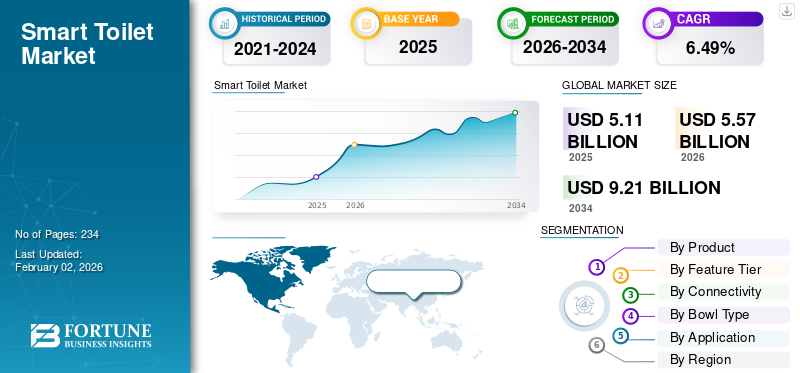
The global smart toilet market size was valued at USD 5.11 billion in 2025 and is projected to grow from USD 5.57 billion in 2026 to USD 9.21 billion by 2034, exhibiting a CAGR of 6.49% during the forecast period. Asia Pacific dominated the smart toilet market with a market share of 74.19% in 2025.
The adoption of the demand for smart toilets is increasing rapidly as consumers prioritize hygiene, water efficiency, and integrated smart-home features in modern bathrooms. Growing urbanization, higher disposable incomes, and increasing focus on smart home integration are further supporting market expansion. Overall, the market reflects a clear shift toward modern and sustainable bathroom solutions.
Advancements in automated flushing, bidet functions, heated seats, and self-cleaning technologies are enhancing the user experience and further fueling adoption. In September 2024, Bemis launched the Bio Bidet BB-1200, an app-controlled bidet toilet seat (Bluetooth + Wi-Fi) which allows users to set personalized settings for water pressure, seat temperature, and more. Such app integration offers smarter, user-centric control over basic features like warm water and heated seating.
Key players, including TOTO Ltd., LIXIL Corporation, Kohler Co., Roca Sanitario, S.A., and Duravit AG, moderately consolidate the global market through strong brand presence, technological innovation, and broad distribution networks.
Download Free sample to learn more about this report.
Smart Toilet Market Key Takeaways
 Market Size & Forecast
- 2025 Market Size: USD 5.11 billion
- 2026 Market Size: USD 5.57 billion
- 2034 Forecast Market Size: USD 9.21 billion
- CAGR: 6.49% from 2026–2034
 Market Share
- Asia Pacific dominated the smart toilet market with a 74.19% share in 2025.
- The smart bidet seat segment accounted for a 63.64% market share in 2026.
- The residential segment is projected to hold a 63.16% share in 2026.
 Key Regional Highlights
North America
North America accounted for an 11.81% share in 2025, valued at USD 0.60 billion.
Asia Pacific
Asia Pacific held a 74.19% share in 2025, valued at USD 3.79 billion.
Europe
Europe held an 8.90% share in 2025, valued at USD 0.46 billion.
U.S.
Market projected to reach USD 0.55 billion by 2026.
Japan
The market projected to reach USD 1.26 billion by 2026.
Read More

MARKET DYNAMICS
MARKET DRIVERS:
Growing Expansion of Smart Home Systems to Drive Market Growth
The expansion of smart home ecosystems is a major driver for the market growth, as consumers increasingly seek integrated, connected living environments. Intelligent bathroom systems are now compatible with voice assistants, mobile apps, and home automation systems, allowing users to control temperature, lighting, and hygiene settings remotely. This seamless connectivity enhances convenience and personalization, positioning automated toilets as an essential component of modern, tech-enabled homes. Increasing consumer preferences for the broader range of automated bathroom products is driving the global market growth.
MARKET RESTRAINTS:
High Initial Cost and Installation Complexity to Restrain Market Growth
The high cost and complex installation of intelligent toilets are major barriers to smart toilet market growth. Automated bathroom systems are priced much higher than traditional models due to their advanced features, limiting affordability for many consumers. Installation requires professional expertise and often involves electrical and plumbing work, adding to the initial expense. Moreover, ongoing maintenance, including software updates and sensor calibrations, requires specialized service, which can be costly and inconvenient. These factors create a perception of intelligent toilets as luxury items, which holds back wider adoption despite their technological benefits and growing demand.
MARKET OPPORTUNITIES:
Advancements in Self-Cleaning Mechanisms and Sensor-based Technology in Toilets to Favor Market Growth
Technological advancements in automated toilets have transformed them into highly sophisticated bathroom fixtures. Innovations include bidet systems with adjustable water pressure and temperature, self-cleaning mechanisms using UV and electrolyzed water, and heated seats for enhanced comfort. Many models now integrate AI and health monitoring sensors to track user health metrics, such as hydration and glucose levels, providing early disease detection. Additionally, features like automatic flushing, touchless lid operation, and compatibility with home automation systems improve hygiene and convenience while reducing water consumption, making such toilets a blend of luxury, technology, and sustainability.
SMART TOILET MARKET TRENDS:
Integration of Smart Devices with Intelligent Toilets to Augment Product Demand
Integration with smart home ecosystems allows intelligent toilets to connect seamlessly with other smart devices in a home, providing enhanced convenience and control. Users can operate their toilets remotely via mobile apps or voice commands through virtual assistants like Alexa or Google Home. This connectivity enables personalized settings, usage tracking, and remote diagnostics, improving user experience and maintenance efficiency. Additionally, automated toilets integrated into home automation systems can coordinate with lighting, heating, and water management for an optimized, eco-friendly bathroom environment, driving the demand for smart toilets globally.
MARKET CHALLENGES:
Data Privacy Concerns of Intelligent Toilets to Challenge Key Players’ Brand Loyalty and Impact Product Demand
Data privacy concerns revolve around the sensitive health information these devices collect, such as images or analyses of stool and urine, vital signs, and other biometric data. Users worry about unauthorized access, data breaches, or the sharing of this personal information with third parties, raising fears about misuse or exploitation. The intimate nature of the data, including potentially identifiable images from cameras or sensors, intensifies privacy anxieties. Additionally, the risk of hacking is real since these devices transmit data over networks. Ensuring strong encryption, regulatory compliance (like HIPAA), and transparent data handling policies are critical in gaining user trust and safeguarding privacy. Data theft risks challenge the key players' product sales growth.
Download Free sample to learn more about this report.
Segmentation Analysis
By Product
Cost-effectiveness Leads to the Smart Bidet Seat Segment’s Leading Market Share
By product, the market is bifurcated into integrated smart toilet and smart bidet seat.
The smart bidet seat segment expected leading global smart toilet market share of 63.64% in 2026. The dominance of the segment in the market is driven primarily by its cost-effectiveness and ease of installation, as it can be retrofitted onto existing toilets without expensive replacements or complex plumbing work. Consumers appreciate the advanced comfort and hygiene features bidet seats offer, such as heated seats, adjustable water temperature and pressure, self-cleaning nozzles, and remote controls, which meet growing personal and health-conscious demands.
The integrated segment is growing at a CAGR of 8.37% during the forecast period. The integrated segment is experiencing rapid growth, driven by rising disposable incomes, increasing demand for hygiene and comfort, and continuous technological advancements such as automated flushing, heated seats, and health monitoring. This segment benefits from integration with smart home ecosystems and water-saving features, appealing to both luxury residential users and commercial sectors like hotels and hospitals.
To know how our report can help streamline your business, Speak to Analyst
By Application
Significant Households’ Consciousness of Toilet Block Hygiene and Modernization Results in Dominance of Residential Segment
Based on application, the market is categorized into residential, hospitality, healthcare, commercial buildings, and others.
The residential segment exhibited a leading global market share expected to 63.16% globally in 2026. The residential segment dominates the market due to the rising adoption of smart home technologies and increasing consumer demand for enhanced hygiene, comfort, and luxury in private living spaces. Growth in disposable incomes and urbanization further propel residential installations, making this segment the largest user base of such products globally.
The healthcare segment is projected to grow at a fastest rate of 8.97% during the forecast period as these toilets offer advanced features for health monitoring and hygiene, supporting early disease detection and personalized care. Hospitals and eldercare facilities increasingly adopt such products to improve patient comfort, facilitate contactless diagnostics, and manage chronic conditions efficiently.
By Feature Tier
High Demand for Entry-level Products Delivering Essential Smart Features at Affordable Prices Led to the Dominance of the Entry Segment
Based on feature tier, the market is divided into entry, mid, and premium.
The entry segment held the leading global market share expected for 43.21% in 2026. The segment is also projected to capture the largest share of the global market because it delivers essential smart features at a price point accessible to most consumers, especially in price-sensitive and developing regions. Affordable pricing, combined with upfront installation and significant upgrades over traditional toilets, makes entry-tier products particularly appealing for mass adoption, as more households seek hygienic and convenient solutions without premium costs.
The premium segment is slated to grow at the fastest rate of 10.05% during the forecast period. The premium segment of the market is rapidly expanding, fueled by increasing consumer interest in luxury, convenience, and advanced hygiene features. High-income consumers and luxury residential markets prioritize premium offerings that integrate state-of-the-art technologies such as AI personalization, health monitoring, heated seats, and self-cleaning capabilities.
By Connectivity
Better Connectivity of Bluetooth Connectivity Featured Toilets Over Counterparts Led the Dominance of the Bluetooth Segment
Based on connectivity, the market is segmented into standalone, Bluetooth, and Wi-Fi/cloud.
The Bluetooth segment is anticipated to hold a dominant market share of 38.27% in 2026. The Bluetooth segment leads the market because it offers reliable and user-friendly connectivity without requiring complicated network setups. Bluetooth-enabled products provide easy, immediate control via remote devices or smartphones, appealing to a wide audience seeking convenience without technical barriers. This straightforward operation and broad compatibility make Bluetooth the preferred choice, especially in residential settings where simple and direct control is valued.
The Wi-Fi/cloud segment is slated to grow at a fastest CAGR of 8.38% during the forecast period. The Wi-Fi/cloud segment is the fastest-growing in the market due to its advanced connectivity that enables seamless integration with smart home ecosystems and remote control via mobile apps. This connectivity allows users to customize settings, receive software updates, and monitor usage and maintenance needs from anywhere, enhancing convenience and user experience. Additionally, Wi-Fi-enabled products support data-driven health monitoring and automation, appealing to tech-savvy consumers and commercial sectors seeking high-end, interconnected sanitation solutions.
By Bowl Type
Widespread Adoption of Floor-Mounted Commodes due to their Easy Installation Led the Dominance of Floor Floor-Mounted Segment
Based on bowl type, the market is segmented into wall-hung and floor-mounted.
The floor-mounted segment dominates the market due to its widespread familiarity, robust design, and easier installation compared to wall-hung toilets. These toilets are commonly preferred in both residential and commercial settings because they fit seamlessly into existing bathroom layouts without requiring extensive modifications, making them a cost-effective and practical choice for consumers prioritizing simplicity and reliability.
The wall-hung segment is slated to grow at a fastest rate of 8.04% during the forecast period. The wall-hung segment is the fastest-growing bowl type in the market due to its modern, space-saving design that is ideal for smaller bathrooms and contemporary interiors. These toilets free up floor space, making cleaning easier and enhancing bathroom aesthetics. Additionally, their adjustable height options improve comfort and accessibility, while integration with smart home technologies and advanced hygiene features further attract urban consumers and premium residential and commercial spaces.
Smart Toilet Market Regional Outlook
By geography, the market is categorized into North America, Europe, Asia Pacific, South America, and Middle East & Africa.
Asia Pacific
Asia Pacific Smart Toilet Market Size, 2025 (USD billion)
To get more information on the regional analysis of this market, Download Free sample
The market in Asia Pacific reached USD 3.79 billion in 2025, representing 74.19% of total market revenue, and is projected to reach USD 4.15 billion in 2026. The region is witnessing strong growth in the global market, fueled by rapid urbanization, increasing disposable incomes, and expanding smart city initiatives in India, Japan, South Korea, and Australia. Government investments in sanitation infrastructure and environmental regulations promoting water conservation further support market expansion. Rising awareness of hygiene and technological adoption in residential and commercial sectors, along with growing demand for automated and resource-efficient sanitation solutions, are key qualitative drivers bolstering the Asia Pacific market. The Japan market is estimated to reach USD 1.26 billion by 2026, the China market is estimated to reach USD 1.73 billion by 2026, and the India market is estimated to reach USD 0.23 billion by 2026.
The Chinese market size reached USD 1.42 billion in 2024. The market is characterized by rapid growth thanks to innovation and affordability. Advanced functionalities such as self-cleaning, touchless flushing, and health monitoring are widely integrated, enhancing hygiene and wellness. The market emphasizes water conservation with efficient designs like dual-flush systems, while brands like Xiaomi offer cost-effective yet feature-rich options catering to diverse consumer needs.
North America
The North America market was valued at USD 0.6 billion in 2025, capturing 11.81% of global revenue, and is estimated to reach USD 0.65 billion in 2026. Other regions, such as North America and Europe, are anticipated to witness a notable growth in the coming years. The North American market is robust, driven by growing consumer interest in smart home technologies and heightened hygiene awareness. Rising smart home penetration and increasing household spending on bathroom renovation projects are accelerating the product demand in the region. The U.S. market is estimated to reach USD 0.55 billion by 2026.
The U.S. market is changing from luxury to practical utility, owing to aging populations and the demand for assisted living. Retrofit smart bidet seats are increasingly preferred by consumers over full systems due to their reduced cost and ease of installation. Manufacturers are integrating health-monitoring sensors, touchless features, water efficiency, and antimicrobial surfaces into smart toilets, portraying them as future wellness devices rather than simply hygiene fixtures, creating newer market growth opportunities across U.S.
Europe
In 2025, Europe held 8.90% of the global market, reaching a valuation of USD 0.46 billion, and is projected to grow to USD 0.49 billion in 2026. The European market is experiencing steady growth, driven by increased adoption of smart home technologies and rising disposable incomes. Government initiatives promoting water efficiency and sustainable sanitation practices, alongside heightened hygiene awareness, contribute to expanding demand. The commercial sector takes the lead in the demand fueled by investments in modernizing public and hospitality facilities. Meanwhile, single floor-standing toilets currently dominate, though wall-hung models are gaining popularity due to their sleek design and space efficiency. The UK market is estimated to reach USD 0.09 billion by 2026, while the Germany market is estimated to reach USD 0.11 billion by 2026.
South America
South America recorded a market size of USD 0.15 billion in 2025, capturing 2.99% of the global market share, and is projected to reach USD 0.17 billion in 2026. Over the forecast period, market in the South America and Middle East & Africa regions would witness a moderate growth rate during 2026-2034. The South American market is growing steadily, driven by increasing urbanization and rising consumer awareness about hygiene and sanitation. Growth is supported by improving infrastructure and rising disposable incomes, with major demand coming from residential and commercial sectors.
Middle East & Africa
In 2025, the Middle East & Africa market stood at USD 0.11 billion, representing 2.12% of global demand, and is projected to grow to USD 0.12 billion in 2026. The Middle East & Africa market is growing steadily, driven by increasing urbanization, broadening product distribution channels, technological advancements, and government initiatives promoting smart and sustainable infrastructure. Countries like the UAE, Saudi Arabia, and South Africa are leading in adoption with a focus on luxury real estate and energy-efficient sanitation solutions, supporting robust market expansion. Growing awareness about hygiene and water conservation further propels demand across residential and commercial sectors. In the Middle East & African market, the UAE is set to attain the market value of USD 0.032 billion in 2025.
COMPETITIVE LANDSCAPE
Key Industry Players:
Portfolio Expansion and Distribution Network Building to Help Key Players Maintain Market Positions
The leading players operating in the market include TOTO Ltd., LIXIL Corporation, Kohler Co., Roca Sanitario, S.A., and Duravit AG. TOTO remains a pioneer, setting industry benchmarks with its advanced Washlet series. LIXIL leverages its extensive plumbing portfolio and global reach to scale adoption, while Kohler focuses on premium smart home integration and design. Roca emphasizes water-efficient and cost-effective solutions to target wider consumer segments, and Duravit builds its product portfolio on European design heritage to serve upscale markets. Collectively, these companies drive product innovation, enhance user experience, and shape market trends through sustained R&D investments and strategic expansion.
LIST OF KEY SMART TOILET COMPANIES PROFILED:
- TOTO Ltd. (Japan)
- LIXIL Corporation (Japan)
- Kohler Co. (U.S.)
- Roca Sanitario, S.A. (Spain)
- Duravit AG (Germany)
- GROHE AG (Germany)
- Villeroy & Boch AG (Germany)
- JOMOO Group Co., Ltd. (China)
- HEGII (China)
- Coway Co., Ltd. (South Korea)
KEY INDUSTRY DEVELOPMENTS:
- October 2025: Jomoo, in partnership with Sanitec, unveiled ‘JOMOO: The Eos of Smart Living,’ a themed portfolio of world-class bathroom solutions for Filipino homes and developments. This portfolio includes intelligent toilets, cabinets, faucets, and other bathroom products.
- September 2024: Hindware’s Italian Collection launched an automated Imperial Smart Toilet equipped with other smart home devices’ advanced technologies that eliminate the need for bulky tanks in the bathroom.
- July 2024: Brondell launched the Sutro Integrated Smart Bidet Toilet, a flagship product integrated with the features of automated flushing and opening & closing the seat and lid.
- August 2023: SYNSOL launched a second-generation smart toilet lineup, integrated with medical-grade health monitoring features, including electrolyte detection and 6-lead ECG monitoring.
- January 2023: Kohler launched new smart toilets, faucets, and water monitoring systems at CES 2023. These products are equipped with seven different kinds of systems of immersive spray experiences.
REPORT COVERAGE
Request for Customization to gain extensive market insights.
Report Scope & Segmentation
| ATTRIBUTE | DETAILS |
| Study Period | 2021-2034 |
| Base Year | 2025 |
| Estimated Year | 2026 |
| Forecast Period | 2026-2034 |
| Historical Period | 2021-2024 |
| Growth Rate | CAGR of 6.49% from 2026-2034 |
| Unit | Value (USD Billion) |
| Segmentation |
By Product
By Feature Tier
By Connectivity
By Bowl Type
By Application
By Region
|
Frequently Asked Questions
Fortune Business Insights says that the global market value stood at USD 5.57 billion in 2026 and is projected to reach USD 9.21 billion by 2034.
In 2025, the market value stood at USD 3.79 billion.
The market is expected to exhibit a CAGR of 6.49% during the forecast period.
The smart bidet seat segment led the market by product.
Growing expansion of smart home systems is driving the market growth.
TOTO Ltd., LIXIL Corporation, Kohler Co., Roca Sanitario, S.A., and Duravit AG are some of the prominent players in the market.
Asia Pacific dominated the market in 2025.
The advancements in self-cleaning mechanisms and sensor-based technology in toilets are expected to favor the product adoption rate.



- 2021-2034
- 2025
- 2021-2024
- 234
-
(Offer valid till 15th Oct 2026)
Get 30-60 hrs Free Customization
Expand Regional and Country Coverage, Segments Analysis, Company Profiles, Competitive Benchmarking, and End-user Insights.












Related Reports
-
US +1 833 909 2966 ( Toll Free )
-
Get In Touch With Us