Smart Warehousing Market Size, Share & Industry Analysis, By Component (Hardware, Software, and Services), By Application (Inventory Management, Order Management, Smart Warehouse Maintenance, Asset Tracking, and Others), By End-user (Retail & E-commerce, Transportation & Logistics, Manufacturing, Healthcare & Pharmaceuticals, Automotive, Food & Beverages, and Others), and Regional Forecast, 2026–2034
 Download Free Sample
KEY MARKET INSIGHTS
 Listen to Audio Version
The global smart warehousing market size was valued at USD 28.68 billion in 2025 and is projected to grow from USD 32.68 billion in 2026 to USD 99.71 billion by 2034, exhibiting a CAGR of 14.96% during the forecast period. North America dominated the global market with a share of 37.04% in 2025.
Smart warehousing refers to the usage of digital technologies and automated systems to simplify operations and functionalities within a warehouse. It comprises advanced software, services, and physical warehouse automation tools such as conveyors, robotics, and autonomous vehicles. Several smart warehousing technologies include autonomous mobile robots, Internet of Things (IoT), artificial intelligence, and other automation-based technologies. For instance,
- As per Industry Insights 2025, over 70% of enterprises and leaders across supply chain and logistics plan to invest approximately USD 100 million in automation over the next five years.
Various market players, such as Körber AG, Honeywell International Inc., and Manhattan Associates, are developing new solutions and advancements to deliver automation capabilities to warehouse owners.
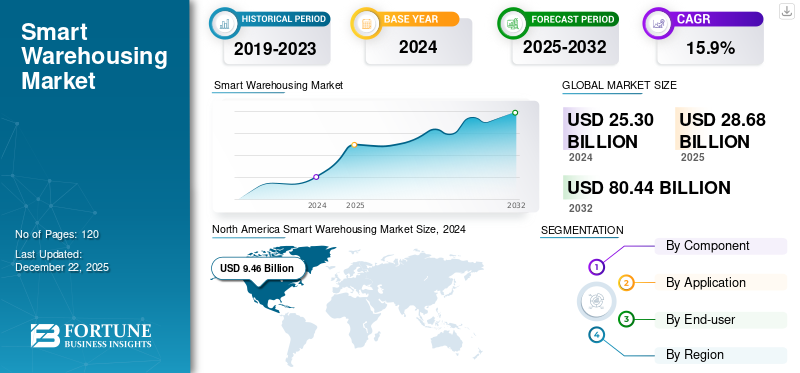
Download Free sample to learn more about this report.
Smart Warehousing Market Key Takeaways
 Market Size & Forecast
- 2025 Market Size: USD 28.68 billion
- 2026 Market Size: USD 32.68 billion
- 2034 Forecast Market Size: USD 99.71 billion
- CAGR: 14.96% from 2026–2034
 Market Share
- North America dominated the smart warehousing market with a 37.04% share in 2025.
- The hardware segment held the largest market share of 44.61% in 2026.
- The order management segment accounted for the highest share of 32.58% in 2026.
 Key Regional Highlights
North America
North America led the global market, generating USD 10.62 billion in revenue in 2025 and maintaining its position through strong warehouse automation adoption.
Europe
Europe accounted for 26.45% of the global market in 2025, supported by increasing investments in smart logistics and supply chain modernization.
Asia Pacific
Asia Pacific contributed 20.73% of global revenue in 2025 and is expected to witness strong growth driven by expanding e-commerce and industrial automation.
U.S.
The market is projected to reach USD 5.8 billion by 2026, supported by widespread deployment of automated warehousing technologies and advanced logistics infrastructure.
Japan
The market is projected to reach USD 1.67 billion by 2026, driven by rising demand for robotics, IoT-enabled warehouses, and labor-efficient logistics solutions.
Read More

IMPACT OF GENERATIVE AI
Growing Implementation of GenAI to Streamline Warehouse Operations Propels Market Growth
Implementing Generative AI in warehouse operations helps bring in a smart mechanism that can help carry out tasks faster and better. Generative AI helps manage supplier selection, inventory optimization, return management, demand forecasting, and planning. Leveraging generative AI offers several benefits, such as seamless human-robot collaboration, energy and resource optimization, advanced inventory management, and many other benefits. Hence, several large enterprises are utilizing the power of generative AI in their warehouse automation operations to enhance performance. For instance,
- In March 2025, FORTNA and sSy.AI collaborated to use generative AI for data insights within warehouse environments. This partnership aims to streamline multifaceted data analytics for system design and customer enquiries, empowering smarter decision-making and enhancing fulfillment center operations.
Some real-life use cases of the implementation of generative AI include Automated systems of Walmart for resupply, Amazon's AI-driven demand forecasting, GE's predictive maintenance for equipment, and supply chain management of P&G.
Such advancements and implementations of GenAI across warehousing operations propel the smart warehousing market growth.
Impact of Reciprocal Tariffs
Reciprocal Tariffs Can Affect Overall Supply Chains, Thereby Hampering Market Progress
The reciprocal tariffs enforced by the U.S. government on more than 60 countries globally can affect the overall trade agreements around the globe. Various impacts on the market include interruption in the supply chain, reduced market penetration, and augmented operational costs.
Tariffs make imported products and materials more expensive for enterprises and factory owners, impacting production costs for several industries reliant on international sourcing. These increased prices often result in job losses in sectors hit hardest by tariffs. Enterprises need to either pay these prices themselves or burden customers more, making it challenging to stay competitive in the global market.
In the coming days, tariffs will change consumers' shopping patterns. Higher prices and fewer options push several consumers to buy local or low-priced items. These shifts can affect the overall retail and wholesale supply chain across warehouses, driving changes in demand and altering supply operations across warehouses.
Thus, the imposition of reciprocal tariffs can considerably impact the overall market development.
SMART WAREHOUSING MARKET TRENDS
Rising Adoption of Robotics Across Warehouse Operations to Fuel Market Progress
Robotics technology can progressively handle more multifaceted and diverse operations within the warehouse ecosystem. Modern robots, particularly Cobots (Collaborative Robotics), are being developed to function alongside human workers, learning from their activities and functioning collaboratively to improve productivity. These technologies have cut manual error rates by approximately 60% and reduced workplace injuries by 25%.
These robots can acclimate to varied tasks, minimizing the requirement for dedicated machinery and lowering operational expenses. The safety of warehouse processes is also significantly increased by robotics and automation, as they take on dangerous tasks and decrease workplace injuries. Hence, enterprises across industries are implementing robotics across warehouse operations to leverage these operational benefits. For instance,
- In March 2025, Hai Robotics formed an alliance with Bowoo System to enhance automation for a fashion brand. The companies implemented the advanced HaiPick System 3 at their delivery center in Pyeongtaek, South Korea.
Such growing adoption of robotics within warehouses is expected to boost the growth of the market.
MARKET DYNAMICS
Market Drivers
Rising Adoption of 5G Technology to Drive Market Growth
The adoption of 5G technology enables ultra-fast internet speeds and high reliable connections to handle real-time operations and data. It enhances connectivity and supports a wider density of IoT devices per square meter. It also allows the warehouse managers to have more extensive management and monitoring capabilities. Lower latency and faster data transfer facilitate responsive automation and predictive analytics.
With the help of 5G networks, warehouses can accomplish near-instantaneous communication among devices, easing more adaptive and responsive logistics operations. The technology also aids virtual reality (VR) and augmented reality (AR) applications for employee training. It simulates warehouse tasks and layouts for optimization without distracting from the current procedures. For instance,
- In March 2024, Huawei and Telkomsel inaugurated the 5G smart warehouse and innovation center in Indonesia. The state-of-the-art facility determines the transformative potential of 5G in warehouse management, improving operational productivity and creating new prospects for the logistics sector to aid the digital growth toward the Golden Indonesia Vision 2045.
Thus, the 5G technology empowers the usage of various network-driven technologies in warehousing, thereby driving market growth.
Market Restraints
Seamless Integrations within Different Systems Can Hamper Market Progress
As warehouses implement a wide range of new advanced technologies, incorporating these systems into a unified operational structure presents a substantial challenge. Integrating smart systems with legacy infrastructure poses operational difficulties. The intricacy of assimilating modernized technologies such as IoT devices, AI (artificial intelligence), and robotics with present warehouse management systems can cause significant interference if not managed appropriately. This integration needs to be seamless to ensure that data flows proficiently between systems, allowing real-time decision-making and functions.
The continuous maintenance of combined systems needs consistent upgrades and checks. Although this adds to operating costs, it is necessary for long-term efficiency and resilience. Warehouses would require careful planning and the implementation of incorporation strategies, possibly connecting specialist IT support to ensure compatibility and reduce downtime.
Market Opportunities
Rising Efforts toward Sustainable Warehousing Practices to Create Numerous Market Opportunities
Many companies are shifting their behaviors to embrace supply chain sustainability, and researchers are reviewing the subsequent impacts. In the U.S. and globally, companies are actively tracking ways to reduce carbon emissions and waste while enhancing labor conditions. At the same time, consumers are leaning toward the purchase of sustainable products, especially those that come with green packaging. For instance,
- As per IBM research, around 6 in 10 customers are ready to change their shopping behaviors to minimize environmental impact. Approximately 8 in 10 customers specify that sustainability is essential for them. Around 70% are willing to pay a premium, averaging 35%, for environmentally responsible and sustainable brands.
Sustainable warehousing incorporates eco-friendly technologies and practices into logistics and warehousing operations to considerably decrease environmental impact. It represents a transformation toward more accountable energy and resource management across the supply chain, aiming to develop a greener future.
Sustainable warehouse solutions incorporate energy-efficient systems and renewable energy sources to restrain high energy usage typical of customary operations. By deploying LED lighting and solar panels, warehouses minimize energy intake and reduce environmental impact. Smart HVAC systems and solar integration have shown energy savings of approximately 18%.
The prospect of the warehousing mechanism incorporates various innovations to aid sustainability. Key trends include renewable energy integrations, green packaging automation, and AI-based predictive analytics. Some use cases include blockchain for a sustainable and transparent supply chain, a carbon-unbiased warehouse with AI-based optimization, and decentralized micro-warehousing.
These growing implementations and consumer preference toward sustainability open up various market opportunities.
SEGMENTATION ANALYSIS
By Component
Hardware Segment Dominated Due to Growing Preference for Drones and Robots
Based on component, the market is categorized as hardware (automated storage & retrieval system (ASRS), RFID & barcode scanner, IoT sensors & controllers, drones & robots (AGVs, AMRs), conveyor & sortation systems, smart shelving and racks), software (warehouse management system, inventory management software, transportation management system, labor management software, and analytics & dashboard platform), and services (system integration, consulting & design services, and maintenance & support).
Hardware accounted for the highest market share 44.61% in 2026, owing to wider usage of automated storage & retrieval systems and sensor-based devices. Additionally, the rising preference for drones and robots, and smart shelving systems across warehouses aids the segment's progress.
Drones and robots are anticipated to progress with the highest CAGR in the market. Using robotics delivers various benefits such as increased productivity, enhanced inventory management, improved safety, and minimized labor costs. For instance,
- In January 2025, Freespace Robotics announced an alliance and investment from Matthews Automation. This alliance combines Freespace Robotics' dynamic and high-density storage cube with Matthews' software. According to enterprises, the aim is to unlock transformative competencies for last-mile operations and warehouse automation.
Software is projected to grow with the highest CAGR during the forecast period. Higher implementation of software solutions, such as warehouse and inventory management, is contributing to market progress. These tasks help maintain real-time inventory levels and track inventory and stock levels, thereby accomplishing precision in overall warehouse management.
By Application
Inventory Management Segment to Showcase Highest CAGR due to New Developments and Innovations
By application, the market is divided into inventory management, order management, smart warehouse maintenance, asset tracking, and others.
The inventory management segment is estimated to grow with the highest CAGR during the study period. Effective inventory management is vital for any enterprise's effective operation, saving energy, time, and money. New developments and innovations in inventory management through smart warehousing technologies fuel market development. Hence, a larger number of warehouse owners are implementing or planning to implement smart inventory management solutions. For instance,
- As per ValuTrack Insights, around 73% of warehouses plan to adopt mobile inventory management solutions. It helps keep track of inventory, all from the ease of mobile devices.
The order management segment held the highest market share 32.58% in 2026. Order management is essential for effectively managing inventory and upholding orders. These solutions help boost efficiency, increase revenue, and lead to valuable developments across channels and processes.
By End-user
To know how our report can help streamline your business, Speak to Analyst
Retail & E-commerce Segment to Display Highest CAGR Owing to Faster Order Fulfilment
By end-user, the market is categorized as retail & e-commerce, transportation & logistics, manufacturing, healthcare & pharmaceuticals, automotive, food & beverages, and others (energy & utilities).
The retail & e-commerce segment is expected to witness the highest CAGR during the forecast period, owing to several benefits offered by smart warehousing across retail & e-commerce. It comprises faster order fulfilment, fewer returns, enhanced inventory management, and lower fulfillment costs. Various smart solutions being implemented across e-commerce include Warehouse Robots and Automated Guided Vehicles (AGVs), Cobots, robotic solutions, small batch order sorting, and many others. For instance,
- According to FM Logistics Insights 2023, automation investments within warehouses are rising, with around 80% of e-commerce and 84% of B2B warehouses having partly automated their activities.
The transportation and logistics segment held the highest market share 27.39% in 2026. Smart warehousing helps in quicker and more precise order processing, a unified last-mile incorporation for faster deliveries, enhanced warehouse layouts and picking routes, data-based performance tracking, and many other functions in transportation & logistics.
SMART WAREHOUSING MARKET REGIONAL OUTLOOK
By region, the market is divided into North America, Europe, Asia Pacific, South America, and the Middle East & Africa.
North America
North America Smart Warehousing Market Size, 2025 (USD Billion)
To get more information on the regional analysis of this market, Download Free sample
The North America region captured 37.04% of the global market in 2025, generating USD 10.62 billion in revenue, and is projected to reach USD 11.99 billion in 2026. holding the highest smart warehousing market share, driven by high investments from Amazon, Walmart, and FedEx. Robust tech adoption and regulatory support accelerate the growth of the market. The region also benefits from higher penetration of advanced technologies such as robotics, IoT, and sensor controllers.The U.S. market is projected to reach USD 5.8 billion by 2026.
The prominence of U.S.-manufactured products and their widespread distribution across several markets further underscores the country’s emphasis on expanding smart warehousing capabilities.
- In December 2024, Exotec and BlueStar collaborated to introduce a smarter warehouse system. BlueStar selected Exotec to offer a smarter warehouse automation system in its distribution centers in the U.S. and Europe.
Download Free sample to learn more about this report.
South America
South America is experiencing considerable progress in smart warehousing, owing to several factors, such as the e-commerce boom, labor shortages, and competitive pressure. Rising investments and funding for automation across warehouses drive the market expansion in the region. Investments across robotic automation, a surge in online shopping, the growth of small warehouses are some other factors contributing to the region's market expansion.
Europe
Europe maintained a strong presence in the global market, reaching USD 7.59 billion in 2025, accounting for 26.45% share, and is expected to reach USD 8.73 billion in 2026. The market in Europe is projected to grow with a significant CAGR during the study period. Smart warehousing is experiencing a rise in adoption in Europe, owing to the requirement for higher productivity, sustainability, and adaptation to the digital environment. Additionally, countries such as Germany, the U.K., Spain, France, and the Netherlands have greater adoption of IoT, automation, and AI.The UK market is projected to reach USD 1.78 billion by 2026, while the Germany market is projected to reach USD 2.07 billion by 2026.
For instance,
- In the Netherlands, DHL experienced a 25% rise in operational productivity by using an AR (Augmented Reality) technology for smart-assisted picking tasks.
Middle East & Africa
Middle East & Africa recorded a market size of USD 3.13 billion in 2025, capturing 10.91% of the global market share, and is projected to reach USD 3.5 billion in 2026. The Middle East & Africa region is anticipated to progress at a noteworthy rate during the study period. Market expansion in this region is fueled by emerging countries such as UAE, Turkey, and South Africa, which offer untapped potential, driven by industrial automation and infrastructure development. Additionally, various enterprises are working toward developing new warehouse automation solutions in the region, through different research & development activities for innovations. For instance,
- In December 2024, Unilever and Du collaborated to renovate supply chain and warehousing operations in UAE. With this alliance, Du and Unilever will work collaboratively on a feasibility study to develop inventive solutions for warehouse management in the manufacturing sector of UAE.
Asia Pacific
In 2025, Asia Pacific generated USD 5.95 billion, contributing 20.73% to global market revenue, and is projected to grow to USD 6.92 billion in 2026. The rise in penetration of e-commerce and 5G networks across countries such as Japan, India, China, and South Korea contributes to the market expansion in the region. Additionally, the rising adoption of software such as inventory management, warehouse management, and transportation management systems aids the market's progress.The Japan market is projected to reach USD 1.67 billion by 2026, the China market is projected to reach USD 2.13 billion by 2026, and the India market is projected to reach USD 1.34 billion by 2026.
- As per Filuet Insights 2025, India had 886 million internet users in 2024. A notable highlight is the surge in online shoppers, with over 500 million Indians expected to engage in e-commerce purchases by 2029.
Competitive Landscape
KEY INDUSTRY PLAYERS
Key Market Players Focus on Presenting New Product Offering to Expand Their Business Presence
Key players in the market, such as Körber AG, Manhattan Associates, Honeywell International Inc., Zebra Technologies Corp., and KION GROUP AG, are developing new software and solutions to enhance their market position. These players use advanced technological extensions to resolve changing consumer requirements and attain a competitive edge. Their strategic focus included expanding product portfolio and strategic alliances, mergers, and investments to fortify their portfolio. As the industry continues to evolve rapidly, such advancements will help these players maintain and grow their market share.
Major Players in the Smart Warehousing Market
Körber AG, Manhattan Associates, Honeywell International Inc., Zebra Technologies Corp., KION GROUP AG, Cognex Corporation, and Tecsys, among other players, are the largest players in the market.
Long List of Smart Warehousing Companies Studied
- Körber AG. (Germany)
- Manhattan Associates (U.S.)
- Honeywell International Inc. (U.S.)
- Zebra Technologies Corp. (U.S.)
- KION GROUP AG (Germany)
- Blue Yonder Group, Inc. (U.S.)
- Tecsys (Canada)
- Cognex Corporation (U.S.)
- Siemens (Germany)
- ABB (Switzerland)
- Reply (Italy)
- Dematic (U.S.)
- Geek+ (China)
- Daifuku Co., Ltd. (Japan)
- IBM Corporation (U.S.)
- Oracle Corporation (U.S.)
- GreyOrange (U.S.)
- Addverb Technologies (India)
- Infor (U.S.)
- PSI logistics (Germany)
and many others…
KEY INDUSTRY DEVELOPMENTS
- June 2025: Giant Eagle announced the implementation of Manhattan Associates' Active Warehouse Management (WM) at its biggest facility in Bedford Heights, Ohio. It is the fifth facility of Giant Eagle in their cloud relocation to Manhattan Active WM, with strategies to evolve its remaining two DCs by September 2025.
- May 2025: Manhattan Associates launched supply chain solutions on the cloud marketplace of Google. All Manhattan Active solutions are accessible on Google Cloud Marketplace, allowing customers to fast-track their digital transformation. The extended alliance allows customers to easily deploy, procure, and manage Manhattan's cloud-native supply chain implementation, development, and omnichannel commerce solutions.
- January 2025: Rhenus Warehousing Solutions and Blue Yonder expanded their partnership for worldwide standardization across warehouse operations. The expanded partnership is anticipated to see the execution of the Warehouse Management solution of Blue Yonder in Rhenus warehouses worldwide, developing a combined and more proficient IT landscape.
- December 2024: Körber Supply Chain Software formed a strategic alliance with Dexory, a data intelligence and robotics firm. By incorporating DexoryView's modernized visibility platform with Körber's Warehouse Management Systems (WMS), the alliance offers better accuracy, insights, and operational proficiency to customers across the globe.
- November 2024: Geek+ and Intel collaborated to introduce the Vision Only Robot Solution fortified with the Visual Navigation Modules of Intel. It drives the digital and intelligent alteration of the logistics sector with advanced technology.
INVESTMENT ANALYSIS AND OPPORTUNITIES
Key market players are continually investing in research and development to integrate new technologies such as IoT sensors, robotics, AR, VR implementations, machine vision, and many more. Worldwide spending on warehouse automation is expected to increase rapidly, owing to technological advances and surging labor costs. Additionally, numerous small businesses and start-ups are securing investments and funds to expand their business offerings with new technologies and customer base. For instance,
- In February 2025, Nomagic secured an investment of USD 44 million to enhance warehouse robotics and AI innovation. The funding will scale up utilizations across Europe in the next two years. Nomagic's Robotics and AI technology continues to be invested in, developing on recent innovations by its AI team.
REPORT COVERAGE
The report provides a detailed market analysis and focuses on key aspects such as leading companies, components, end-users, and leading applications of the solution and services. Besides, the report offers insights into the market trends and highlights key industry developments. In addition to the factors above, the report encompasses several factors that contributed to the market's growth in recent years.
Request for Customization to gain extensive market insights.
REPORT SCOPE & SEGMENTATION
|
ATTRIBUTE |
DETAILS |
|
Study Period |
2021-2034 |
|
Base Year |
2025 |
|
Estimated Year |
2026 |
|
Forecast Period |
2026-2034 |
|
Historical Period |
2021-2024 |
|
Growth Rate |
CAGR of 14.96% from 2026 to 2034 |
|
Unit |
Value (USD Billion) |
|
Segmentation |
By Component
By Application
By End-user
By Region
|
|
Companies Profiled in the Report |
|
Frequently Asked Questions
The market is projected to reach USD 99.71 billion by 2034.
In 2025, the market was valued at USD 28.68 billion.
The market is projected to grow at a CAGR of 14.96% during the forecast period.
By end-user, the transportation & logistics segment leads the market.
The growing adoption of 5G technology is a key driver of market growth.
Korber AG, Manhattan Associates, Honeywell International Inc., Zebra Technologies Corp., KION GROUP AG, Cognex Corporation, and Tecsys are the top players in the market.
North America led the market.
By application, the inventory management segment is expected to grow with the highest CAGR during the forecast period.



- 2021-2034
- 2025
- 2021-2024
- 120
Get 30-60 hrs Free Customization
Expand Regional and Country Coverage, Segments Analysis, Company Profiles, Competitive Benchmarking, and End-user Insights.




















-
US +1 833 909 2966 ( Toll Free )
-
Get In Touch With Us