Smartphone Music Production Software Market Size, Share & Industry Analysis, By Functionality Type (Synthesizer Apps, Sampler/Looper Apps, Full DAWs, Sequencers and Grooveboxes, and Audio Effects Processors), By Interface Type (Touch-native Apps and Traditional DAWs with Mobile Adaptations), By Deployment Platform (iOS-based, Android-based, and Web/browser-based), By User Type (Independent Musicians and Producers, Hobbyists/Amateurs, and Semi-professional Creators), and Regional Forecast, 2026–2034
 Download Free Sample
KEY MARKET INSIGHTS
 Listen to Audio Version
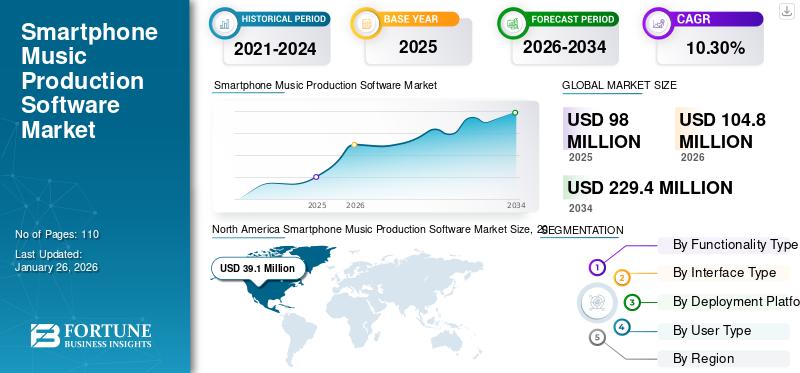
The global smartphone music production software market size was valued at USD 98 million in 2025. The market is projected to grow from USD 104.8 million in 2026 to USD 229.4 million by 2034, exhibiting a CAGR of 10.30% during the forecast period. North America dominated the global smartphone music production software market with a market share of 42.45% in 2025.
Smartphone music production software includes mobile applications that enable music creation, multitrack recording, sequencing, sound design, and real-time audio processing directly on smartphones. These solutions are developed for iOS, Android, and web/browser-based platforms, featuring touch-native interfaces or mobile-adapted versions of traditional DAWs. These applications support a wide user base, including independent musicians, hobbyists, and mobile-first content creators seeking accessible and portable production tools.
Furthermore, many key industry players, such as Apple Inc., Roland Corporation, BandLab Technologies, KORG Inc., and Image Line Software NV, operating in the market, are increasingly engaging in acquisition activities. The companies are keen to expand their sound libraries, integrate advanced synthesis and sampling technologies, and accelerate innovation in mobile-first DAW platforms through these activities. For instance,
- In February 2022, Apple acquired London-based startup AI Music, which builds AI-generated, adaptive soundtracks. The technology can be integrated into Apple Music and creation tools such as GarageBand to personalize and algorithmically generate music.
Download Free sample to learn more about this report.
Smartphone Music Production Software Market Key Takeaways
 Global Market Size & Forecast
- 2025 Market Size: USD 98 million
- 2026 Market Size: USD 104.8 million
- 2034 Forecast Market Size: USD 229.4 million
- CAGR: 10.30% from 2026–2034
 Market Share
- North America dominated the smartphone music production software market with a 42.45% share in 2025.
- Full DAWs are expected to account for 33.59% of the market in 2026.
- Touch-native apps are projected to hold 63.45% of the market in 2026.
 Key Regional Highlights
North America
North America generated USD 39.1 million in 2025 and is projected to reach USD 41.6 million in 2026.
Europe
Europe is projected to reach USD 27.3 million in 2025, supported by strong adoption of mobile music creation tools.
Asia Pacific
Asia Pacific accounted for USD 24.2 million in 2025 and is expected to reach USD 26.6 million in 2026.
U.S
The market is projected to reach USD 28.1 million by 2026.
Japan
The market is projected to reach USD 6.8 million by 2026.
Read More

IMPACT OF GENERATIVE AI
Lowering the Entry Barrier to Music Creation through Generative AI to Fuel Market Growth
Generative AI allows users with limited or no traditional music production experience to create structured compositions, including melodies, chord progressions, drum patterns, and full arrangements, using simple prompts or minimal inputs. This reduces the entry barrier and expands the creator base to beginners, hobbyists, and mobile content creators. For instance,
- In 2024, according to a survey by industry experts, an estimated 10% of consumers used generative AI for music creation and artificial intelligence (AI) powered music applications collectively attracted around 60 million users.
A notable case is Suno, which released its mobile application for iOS and Android in July 2024. By offering accessible music generation directly on smartphones, Suno significantly broadens participation beyond traditional musicians.
SMARTPHONE MUSIC PRODUCTION SOFTWARE MARKET TRENDS
Growing Integration of Mobile Apps with Desktop DAWs to Support Hybrid Production Workflows
One of the largest trends in smartphone music creation is the rising interconnectivity between mobile music applications and desktop digital audio workstations (DAWs). Mobile music apps are designed for creators to have access to their ideas at all times and be able to continue to develop them on any device. As hybrid workflows gain traction, mobile music applications are viewed as extensions of a creator's studio and enable creators to capture ideas quickly, easily arrange their music, and have editing capabilities with seamless integration into the creator's professional desktop DAW.
Consequently, the merging of mobile applications and desktop computers is redefining how music producers create their music today. Smart devices are becoming more widely accepted as valid tools for generating ideas, creating quick arrangements, and editing music on the go. However, desktops will continue to be the tools of choice for all aspects of finalizing and polishing music, including detailed mixing, sound design, and professional post-production, while mobile applications will act as extensions of this workflow in the hybrid, mobile environment. By creating this hybrid environment, producers can take advantage of key benefits. These comprise the convenience of being mobile, the ease of using mobile applications to create and edit music, and the precision and control offered by professional desktop DAWs.
Download Free sample to learn more about this report.
MARKET DYNAMICS
MARKET DRIVERS
Growing Creator Economy to Accelerate the Adoption of Mobile Music Production Tools
An increasing number of companies are producing and selling mobile digital audio workstation software. These products allow users to create music on their smartphones or tablets. Key companies are producing and selling software that allows for the creation of music without the need for a computer. However, mobile digital audio workstation software is being produced in increasingly larger numbers than in previous years. Consumers are purchasing software that can be used to create music from their mobile devices and using it in their daily lives. According to the Marker Group, there are currently approximately 207 million content creators in the world.
- According to Epidemic Sound’s 2025 global creator report, 94% of creators believe that music directly affects audience engagement, reinforcing the need for quick and reliable tools that allow creators to produce or adapt audio assets in real time. This shift is amplified by the dominance of short-form video platforms and social media channels, which require rapid turnaround and frequent posting.
As a result, creators are inclining toward mobile DAWs, synthesizer apps, sampler tools, and beatmaking software that make it possible to generate original soundtracks with minimal equipment and in significantly shorter time cycles. Therefore, the growing creator economy is expected to propel smartphone music production software market growth over the forecast period.
MARKET RESTRAINTS
Hardware and Latency Limitations to Restrict Complex or Professional-Grade Processing Tasks
Although mobile technology has advanced over the last several years, there are still many hardware limitations with smartphones as well as restrictions associated with audio latency. These prevent them from effectively managing complicated or professional-level audio production workflows. For instance, larger multi-track sessions, using CPU-intensive effect chains, rendering high resolution audio, or processing advanced, virtual instruments may bring out the limitations of numerous devices. This especially include those in the middle range of the price spectrum, which may not have enough performance potential to accomplish these tasks at an acceptable level. In addition, receptive, longer processing times, or instability may be the result of stresses placed on a device that may exceed its performance capabilities when working on a project that is demanding or highly intensive. As a result, many experienced creators continue to rely on desktop-based systems for final mixing, mastering, and other processing-heavy work, which limits the extent to which mobile tools can fully replace traditional production setups.
MARKET OPPORTUNITIES
Rapid Expansion of AI-Driven Creation Tools to Create New Demand for Intelligent Mobile Production Apps
The rapid evolution of musical AI in music creation and production is creating a lucrative opportunity for smartphone music production software vendors. Creators interested in using AI to speed up their processes or bridge their gaps in technical skills now have access to a plethora of available features that provide support for things such as automatic generation of beats and melodies, smart chord suggestions, assistance with mixing and mastering, separate stem generation of tracks, and the clean-up of audio tracks.
- Recent market assessments on generative AI in music indicate that software solutions for AI-assisted composition, mastering, and sound design are expected to expand quickly over the next decade. This is poised to be supported by strong double digit growth expectations for AI in the music segment and broader AI market adoption in creative industries.
Additionally, vendors who have incorporated intuitive AI tools within their mobile apps can attract both the novice user looking for assistance and experienced users looking for a way to expedite tedious tasks. This provides a larger target market for their application, creating longer user engagement in their ecosystem.
Segmentation Analysis
By Functionality Type
Increasing Demand for Comprehensive Capabilities to Drive the Dominance of Full DAWs
Based on functionality type, the market is divided into synthesizer apps, sampler/looper apps, full DAWs (digital audio workstations), sequencers and grooveboxes, and audio effects processors (real time).
The full DAWs (digital audio workstations) segment is projected to dominate the market with a share of 33.59% in 2026. This is due to their comprehensive feature sets that support end-to-end music production, including recording, sequencing, mixing, and mastering within a single platform. Their ability to meet the needs of both professional musicians and serious independent creators, combined with strong ecosystem integration and cross-device workflows, drive higher adoption compared to limited or task-specific tools.
The sampler/looper apps segment is anticipated to rise with a CAGR of 11.7% over the forecast period. This is owing to the rising demand for quick, intuitive music creation tools among mobile creators, live performers, and social media-focused users who prioritize speed and creative experimentation.
To know how our report can help streamline your business, Speak to Analyst
By Interface Type
Touch-Native Apps Segment Led with Gesture-Based Interfaces Enabling Wider Adoption of Music Production Apps
Based on interface type, the market is bifurcated into touch-native apps (gesture-based, modular-UI) and traditional DAWs with mobile adaptations.
In 2024, the touch-native apps segment is projected to dominate the market with a share of 63.45% in 2026 and it is expected to continue its dominance by growing at the highest CAGR of 10.7% during the forecast period. This is owing to their intuitive, gesture-driven controls that simplify complex production tasks on small screens. These interfaces cater effectively to hobbyists and creators who value accessibility, speed, and user-friendly design.
The traditional DAWs with mobile adaptations segment is projected to grow at a moderate CAGR of 8.8% during the forecast period. Professional users increasingly seek familiar desktop grade workflows on mobile devices, enabling seamless project continuity and flexible creation across environments, which is a key factor propelling segment growth.
By Deployment Platform
Apple’s Optimized Audio Ecosystem to Drive iOS-based Segment’s Leadership
Based on deployment platform, the market is classified into iOS-based, Android-based, and web/browser-based.
In 2024, the iOS-based segment dominated the global market. This is owing to Apple’s low-latency audio architecture, stable hardware and software integration, and strong support for professional-grade music applications. Additionally, the presence of a mature ecosystem of creators willing to pay for premium apps and in-app features further reinforced iOS’s dominance.
The Android-based deployment segment is projected to grow at a CAGR of 10.5% over the forecast period. This is due to rapid improvements in audio performance, wider device affordability, and expanding adoption among emerging market creators.
By User Type
Ease of Use and Casual Content Creation to Drive Hobbyist Dominance
Based on the user type, the market is categorized into independent musicians and producers, hobbyists/amateurs, and semi-professional creators.
The hobbyist/amateurs segment is projected to dominate the market with a share of 46.85% in 2026 over the forecast period as smartphone music production apps increasingly emphasize the ease of use and guided workflows that lower technical complexity. In addition, the rise of casual content creation for social media and personal entertainment expanded adoption beyond professional musicians.
The independent musicians and producers segment is projected to grow at a moderate CAGR of 9.9% over the forecast period. Mobile music production tools increasingly support professional-grade workflows, enabling cost-effective production, distribution, and creative flexibility without reliance on traditional studios, driving segment growth.
Smartphone Music Production Software Market Regional Outlook
By geography, the market is categorized into North America, South America, Europe, the Middle East & Africa, and Asia Pacific.
North America
North America Smartphone Music Production Software Market Size, 2025, (USD Million)
To get more information on the regional analysis of this market, Download Free sample
The North America market was valued at USD 39.1 million in 2025, capturing 40.00% of global revenue, and is estimated to reach USD 41.6 million in 2026. This is owing to an early adoption of new music creation technologies, high level of smartphone penetration, and a well-established community of independent artists/content creators in the region. Additionally, the region benefits from a well-developed digital music industry with widespread access to premium apps, subscription models, and distribution platforms. The U.S. market is projected to reach USD 28.1 million by 2026. For instance,
- In October 2024, Apple pushed the GarageBand 2.3.17 update for iPhone and iPad, improving stability and fixing issues around Drummer and Alchemy sound packs for mobile users.
These factors play a significant role in fueling the market growth.
U.S. Smartphone Music Production Software Market
Based on North America’s strong contribution and the U.S. dominance within the region, the U.S. market can be analytically approximated at around USD 26.4 million in 2025, accounting for roughly 28.5% of the global sales.
Europe
Europe is projected to record a growth rate of 10.2% over the forecast period, which is the second highest among all regions, and reach a valuation of USD 27.3 million by 2025. Europe demonstrates the consistent adoption of smartphone music production software, supported by a mature electronic music culture, strong DAW literacy, and growing interest in mobile-first creativity. Users in the region display heightened preference for synthesizers, grooveboxes, and advanced sound design tools, reflecting Europe’s strong roots in electronic and experimental music. The UK market is projected to reach USD 7.1 billion by 2026, while the Germany market is projected to reach USD 6.1 million by 2026.
U.K. Smartphone Music Production Software Market
In 2025, the U.K. smartphone music production software market is estimated at around USD 6.6 million, representing roughly 7.1% of global revenues.
Germany Smartphone Music Production Software Market
The Germany market is projected to reach approximately USD 5.7 million in 2025, equivalent to around 6.2% of global sales.
Asia Pacific
The market in Asia Pacific reached USD 24.2 million in 2025, representing 22.80% of total market revenue, and is projected to reach USD 26.6 million in 2026 and secure the position of the third-largest region in the market. Asia Pacific is the fastest-growing region for smartphone music production tools as rising smartphone penetration, expanding youth population, and growing engagement with creator economies boost adoption.
- In September 2024, Roland released Zenbeats 3.1.8, adding iOS 18 compatibility, improved import and export workflows, and performance fixes for iOS and Android users.
Japan Smartphone Music Production Software Market
The Japan market, in 2025, is estimated at around USD 6.3 million, accounting for roughly 6.8% of the global revenue. The high mobile technology adoption and a strong culture of digital music creation across gaming, anime, and independent artist communities play a vital role in driving market growth across the country. The Japan market is projected to reach USD 6.8 million by 2026
China Smartphone Music Production Software Market
The China market is projected to be one of the largest worldwide, with 2025 revenues estimated at around USD 4.9 million, representing roughly 5.3% of global sales. The China market is projected to reach USD 5.4 million by 2026
India Smartphone Music Production Software Market
The India market, in 2025, is estimated at around USD 3.2 million, accounting for roughly 3.5% of global revenues. The India market is projected to reach USD 3.5 million by 2026.
South America
South America is expected to witness moderate growth in this market during the forecast period. The South America market is set to reach a valuation of USD 6.1 million in 2025. The region shows steady progress in smartphone music production software adoption, underpinned by a vibrant music culture, active independent creator communities, and strong use of digital content platforms. Despite device and connectivity variations, enthusiasm for mobile-based creativity remains strong, fostering wider experimentation with music apps across the region. These factors drive the market growth across the region.
Latin America
Latin America maintained a strong presence in the global market, reaching USD 6.1 million in 2025, accounting for 6.20% share, and is expected to reach USD 6.6 million in 2026.
Middle East & Africa
In 2025, the Middle East & Africa market stood at USD 3.1 million, representing 3.10% of global demand, and is projected to grow to USD 3.3 million in 2026 and is expected to grow at a prominent growth rate in the coming years. The Middle East & Africa region is gradually expanding in smartphone music production adoption, driven by increasing smartphone accessibility and rising engagement with social platforms that encourage creative audio usage. As awareness of mobile creative tools increases, the region shows growing interest in versatile applications that enable quick, entry-level music creation. In the Middle East & Africa, the GCC is set to reach a value of USD 0.6 million in 2025.
COMPETITIVE LANDSCAPE
Key Industry Players
Focus on Expanding Product Portfolio by Key Players to Propel Market Progress
The global smartphone music production software market holds a semi-consolidated market structure, constituting prominent players such as Apple Inc., Roland Corporation, BandLab Technologies, KORG Inc., and Image Line Software NV. These key vendors are releasing upgraded smartphone music production apps that integrate advanced sequencing, sampling, and effects engines while maintaining low latency and high performance on mobile devices. For instance,
- In December 2024, Roland released a major update to Zenbeats, adding new sound packs, improved sampling features, and compatibility updates for the latest iOS and Android versions, thereby enhancing cross-platform beatmaking for smartphone creators.
Other notable players in the global market include Steinberg Media Technologies GmbH, Ableton, Soundtrap AB, Loudly GmbH, and elf audio. These companies are expected to prioritize new app launches and collaborations to increase their global market share during the forecast period.
LIST OF KEY SMARTPHONE MUSIC PRODUCTION SOFTWARE COMPANIES PROFILED
- Apple Inc. (U.S.)
- Roland Corporation (Japan)
- BandLab Technologies (Singapore)
- Steinberg Media Technologies GmbH (Germany)
- Image Line Software NV (Belgium)
- KORG Inc. (Japan)
- Ableton (Germany)
- Soundtrap AB (Sweden)
- Loudly GmbH(Germany)
- elf audio(U.K.)
KEY INDUSTRY DEVELOPMENTS
- August 2025: Image Line launched novel FL Studio Mobile build 4.8.10 for Android and iOS with additional bug fixes and stability improvements for mobile users.
- March 2025: KORG released version 5 of its KORG Module iOS app, introducing a new drum module recorded in a top-tier studio with up to eight velocity layers and round robin samples for natural, dynamic sound. The update, free for KORG Module and KORG Module Pro users, also expands polyphony to 256, optimizing performance for the latest iPads and iPhones.
- December 2024: Image Line released FL Studio Mobile 4.7.0 and then 4.7.1 for iOS, Android and other platforms, adding a new Tremolo effect, a revamped rack module picker and performance fixes such as faster startup and improved audio timing.
- December 2024: Elf audio released Koala Quokka, a built in polyphonic virtual analog synth inside Koala Sampler’s Samurai upgrade, adding full synth sound design to the existing SP 404 style mobile sampler on iOS and Android.
- May 2023: BandLab Technologies raised a further 25 million dollars in a Series B1 round led by Cercano Management, lifting its valuation to about 425 million dollars. The capital supports scaling its music creation platform across web, iOS, and Android.
REPORT COVERAGE
Request for Customization to gain extensive market insights.
Report Scope & Segmentation
|
ATTRIBUTE |
DETAILS |
|
Study Period |
2021-2034 |
|
Base Year |
2025 |
|
Estimated Year |
2026 |
|
Forecast Period |
2026-2034 |
|
Historical Period |
2021-2024 |
|
Growth Rate |
CAGR of 10.30% from 2026-2034 |
|
Unit |
Value (USD Million) |
|
Segmentation |
By Functionality Type, Interface Type, Deployment Platform, User Type, and Region |
|
By Functionality Type |
· Synthesizer Apps · Sampler/Looper Apps · Full DAWs (Digital Audio Workstations) · Sequencers and Grooveboxes · Audio Effects Processors (Real-time) |
|
By Interface Type |
· Touch-native Apps (Gesture-based, Modular UI) · Traditional DAWs with Mobile Adaptations |
|
By Deployment Platform |
· iOS-based · Android-based · Web/browser-based |
|
By User Type |
· Independent Musicians and Producers · Hobbyists/Amateurs · Semi-professional Creators |
|
By Region |
· North America (By Functionality Type, Interface Type, Deployment Platform, User Type, and Country) o U.S. o Canada o Mexico · South America (By Functionality Type, Interface Type, Deployment Platform, User Type, and Country) o Brazil o Argentina o Rest of South America · Europe (By Functionality Type, Interface Type, Deployment Platform, User Type, and Country) o U.K. o Germany o France o Italy o Spain o Russia o Benelux o Nordics o Rest of Europe · Middle East & Africa (By Functionality Type, Interface Type, Deployment Platform, User Type, and Country) o Turkey o Israel o GCC o North Africa o South Africa o Rest of the Middle East & Africa · Asia Pacific (By Functionality Type, Interface Type, Deployment Platform, User Type, and Country) o China o India o Japan o South Korea o ASEAN o Oceania o Rest of Asia Pacific |
Frequently Asked Questions
According to Fortune Business Insights, the global market value stood at USD 98 million in 2025 and is projected to reach USD 229.4 million by 2034.
In 2025, the North America market value stood at USD 39.1 million.
The market is expected to exhibit a CAGR of 10.30% during the forecast period of 2026-2034.
By use type, the hobbyist/amateurs segment is expected to lead the market.
Growing creator economy accelerating adoption of mobile music production tools is a key factor driving the market.
Apple Inc., Roland Corporation, BandLab Technologies, KORG Inc., and Image Line Software NV are the major players in the global market.
North America dominated the market in 2024.



- 2021-2034
- 2025
- 2021-2024
- 110
Get 30-60 hrs Free Customization
Expand Regional and Country Coverage, Segments Analysis, Company Profiles, Competitive Benchmarking, and End-user Insights.




















Related Reports
-
US +1 833 909 2966 ( Toll Free )
-
Get In Touch With Us