Smartwatch Battery Market Size, Share & Industry Analysis, By Rated Voltage (3.7V, 4.2V, and Others), By Application (iOS System Smartwatch and Android System Smartwatch), and Regional Forecasts, 2026-2034
 Download Free Sample
KEY MARKET INSIGHTS
 Listen to Audio Version
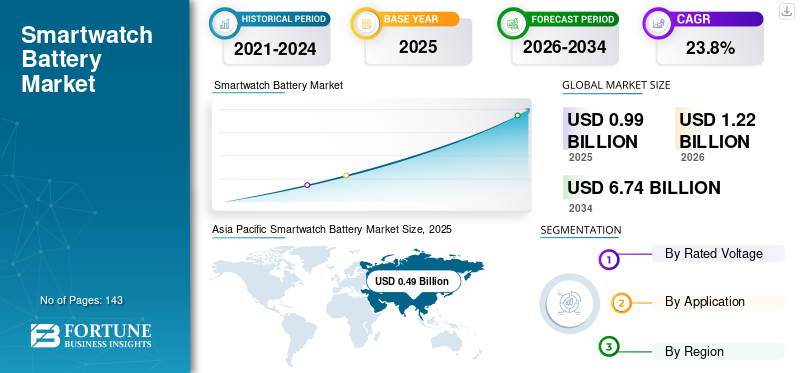
The global smartwatch battery market size was valued at USD 0.99 billion in 2025 and is estimated to increase from USD 1.22 billion in 2026 to USD 6.74 billion by 2034, demonstrating a CAGR of 23.80% between 2026-2034. Asia Pacific dominated the smartwatch battery market with a market share of 50.00% in 2025. The global COVID-19 pandemic has been unprecedented and staggering, with smartwatch battery experiencing higher-than-anticipated demand across all regions compared to pre-pandemic levels. Based on our analysis, the global market exhibited a growth of 18.6% in 2020 as compared to 2019.
A battery is a combination of electrochemical cells composed of three fundamental components: cathode, anode, and electrolyte. A chemical reaction occurs in a cell when the cathode and anode of the battery are connected to an external device, allowing electrons to flow via the circuit. A smartwatch is a touchscreen digital watch with several other functions besides timekeeping, as most manufacturers use lithium-ion (Li-Ion) batteries. Li-ion rechargeable batteries guarantee a long battery life as they enable many charge-discharge cycles without a memory effect.
Download Free sample to learn more about this report.
SMARTWATCH BATTERY MARKET Key Takeaways
 Global Market Size & Forecast
- 2025 Market Size: USD 0.99 billion
- 2026 Market Size: USD 1.22 billion
- 2034 Forecast Market Size: USD 6.74 billion
- CAGR: 23.80% from 2026–2034
 Market Share
- Asia Pacific dominated the smartwatch battery market with a market share of 50.00% in 2025.
- The 3.7V segment accounted for 67.7% of the global smartwatch battery market share in 2021.
- The Android system smartwatch segment is the fastest-growing segment during the forecast period.
 Key Regional Highlights
Asia Pacific
The region led the global market with a value of USD 0.49 billion in 2025, supported by expanding smartwatch manufacturing, strong consumer electronics demand, and increasing health awareness.
North America
North America is one of the leading regions in the global market, supported by high consumer spending on technology products and increasing adoption of wearable devices.
Europe
Europe is witnessing growth supported by investments in lithium-ion battery production facilities, including new manufacturing developments in Germany.
U.S.
The U.S. Smartwatch Battery Market is predicted to grow significantly, reaching an estimated value of USD 579.92 million by 2032.
Japan
Japan is expected to witness steady demand for smartwatch batteries, supported by the growing adoption of wearable technology.
Read More

SMARTWATCH BATTERY MARKET TRENDS
Download Free sample to learn more about this report.
Increasing Awareness Regarding Fitness to Boost Market Proliferation
The market is expected to see an increase in smartwatch adoption due to the rising propensity for fitness tracking and health monitoring capabilities. Companies have developed smartwatches with innovative health monitoring features such as SpO2 and blood oxygen sensors, electrocardiograms, a stress monitor, and calorie counter. Numerous companies, such as Noise, Fossil Group, Inc., Fitbit, and SAMSUNG, are bringing smartwatches with health checking feature. For example, in September 2021, Apple, Inc. launched the new Apple Series 7 smartwatch model, which has multiple health monitoring features such as natural sleep tracking, electrocardiogram (ECG) sensor, blood oxygen saturation, heart health monitoring, and improved fall detection.
The growing popularity of fitness among youth and the increasing acceptance of fitness tracking devices should help increase the consumption of such products. The International Health Racquet and Sportsclub Association stated in January 2020 that 33% of the millennial generation and 14% of Generation Z were classified as members of health clubs in the U.S. in 2018. The world is likely to experience increased demand for the product due to increasing awareness regarding smart devices. Unitednations.org noted in May 2018 that the global urban population had increased to 4.2 billion in 2018 from 751 million in 1950.
DRIVING FACTORS
Growing Demand for Portable Electronic Devices to Propel Market Growth
The income level of the world's population is rising, allowing them to spend more on housing and equip their homes with emerging technological products. Most electronic devices used in personal activities and households, such as tablets, smartphones, watches, laptops, and remote controls, are rechargeable and boast high battery life.
Demand for wireless electronics is increasing with the rapid rise in internet connectivity and digitization. Physical activity monitoring and measurement, environmental sensing, real-time data collection, and communication are some of the main applications which are essential features of smartwatch devices and are expected to meet customers' fundamental needs. In addition, increased fitness awareness has led to the integration of Artificial Intelligence (AI).
Furthermore, the growing demand for wearable electronic devices such as smartwatches has fueled the demand for smartwatch battery. Advances in battery technology and increasing consumer disposable income have fueled the growth of the global market. Benefits such as lightweight nature, long battery life, and fast charging capability are the factors that are expected to support the smartwatch battery market growth
Advanced Features of Smartwatches to Elevate Market Proliferation
Day-to-day fitness activities, such as steps taken, calories burned, distance covered, and others, can be easily monitored and tracked by smartwatches. Smartwatches can be easily connected to smartphones via wireless connectivity or the Bluetooth function. This also helps the athlete or any client to plan their daily tasks. In addition, smartwatches also have good verbal commands, play music, access notifications, call and mobile payments, etc. This multitasking feature also increases demand for smartwatch. This factor is consequently surging the demand for smartwatch battery.
In addition, the ongoing technological advances made by key players are also stimulating the demand for smartwatches as they are technical products that require constant research and development for various functions. In this context, Fossil launched its sports smartwatch in 2019. It is powered by the QUALCOMM snapdragon wear 3100 processor and runs Google's redesigned wear OS. This product is ideal for all health and activity enthusiasts.
RESTRAINING FACTORS
Availability of Smartwatch Alternatives to Hinder the Market Growth of Smartwatch Battery
The alternative to smartwatches is regular watches/traditional watches, which have a strong existence in the marketplace. A conventional watch is an analog dial with hour and minute hands. Regular or traditional watches can offer the advantage that smartwatch does not provide, i.e., longevity. In addition, traditional watches have excellent designs and look more aesthetic compared to smartwatches, which is also expected to hinder the adoption of smartwatches. Furthermore, low-income consumers prefer regular watches which will act as a challenge for businesses in this domain.
Moreover, technical glitches in smartwatches are challenging to fix. The battery life of traditional watches is way better than smartwatches. More importantly, some smartwatches come with faulty sensors. This might happen due to a lack of calibration or a low-end sensor. This results in failure of tracking fitness related data. Further, minor bugs that accumulate over time can mislead the user's interpretation. Therefore, digital watches are often aimed at a smaller group of buyers. This factor is consequently hindering market expansion of smartwatch battery.
SEGMENTATION ANALYSIS
By Rated Voltage Analysis
To know how our report can help streamline your business, Speak to Analyst
3.7V Segment Dominated the Market Owing to its Advanced Features
Based on rate voltage, the market is classified into 3.7V, 4.2V, and others. The 3.7V segment accounted for 67.7% of the global smartwatch battery market share in 2021. The 3.7V segment dominated the market owing its characteristics such as high energy density and voltage, lightweight nature, extremely safe, low self-discharge and long lifespan, wide operating temperature, and others. The 3.7V segment has a significantly higher energy density and capacity than other conventional batteries; it still has a relatively longer lifespan than these batteries. A 3.7V battery can last 800 cycles.
4.2V is also one of the significant segments. It boasts of a higher battery life due to less self-discharge. The shape is flexible so that it can be used for different applications. In addition, it also has a quick charging capacity.
By Application Analysis
Android System Smartwatch Drives the Smartwatch Battery Market Growth
Based on application, the market is divided into iOS system smartwatch and Android system smartwatch. The Android system smartwatch segment is the fastest-growing segment during the forecast period. Android smartwatch version is cheap compared to the iOS system smartwatch. It focuses on a broader range of consumers and manufacturing variants of products also available for people with lower purchasing power.
The iOS system smartwatch segment is likely to dominate the market. Since the high brand loyalty of iPhone users is one of Apple Watch's success factors, this popularity seems higher among the younger generation, making iOS watch an irreplaceable front-runner.
REGIONAL ANALYSIS
Asia Pacific Smartwatch Battery Market Size, 2025 (USD Billion)
To get more information on the regional analysis of this market, Download Free sample
Asia Pacific
Asia Pacific dominated the global market in 2025, with a market size of USD 0.49 billion. Significant growth in smartwatch manufacturing is expected in Asia Pacific, driven by the rising consumer electronics industry and rapid rise of smartwatch vendors in the region's emerging markets. The increasingly tech-savvy population, a rising prevalence of chronic diseases such as obesity and diabetes, and the growing popularity of health and fitness as a means of maintaining a healthy lifestyle are driving the market growth rate.
North America
North America is one of the leading regions in the global market. The people of this region spending massively on consumer units might play a crucial role in market development. In September 2021, the U.S. Bureau of Labor Statistics, the U.S. average annual spend for each consumer unit was USD 61,334. Likewise, the older population, who spend heavily on technology products, is expected to have a noticeable impact on the consumption rate. In January 2020, the American Association of Retired Persons claimed that 51% of older Americans had bought the technology in the past year. Additionally, the U.S. Smartwatch Battery Market is predicted to grow significantly, reaching an estimated value of USD 579.92 million by 2032.
Europe
In Europe, foreign investment has recently been seen with rising requirements to make the region self-dependent. Germany has been attracting funds from other countries worldwide to develop lithium-ion battery production facilities. For instance, in May 2019, a Chinese lithium battery producer, Farasis Energy, declared spending USD 674 million to construct a lithium-ion battery production site in Germany.
KEY INDUSTRY PLAYERS
Samsung SDI to Remain at the Forefront with its Wide Product Offerings and Established Brand Name
Samsung SDI’s strengths focus on the critical aspects of its business, giving it a competitive advantage in the marketplace of smartwatch battery. Some significant factors in its strengths are investments in R&D, experienced employees, geographical presence, and others. In addition, its product serves the Android system smartwatches. Samsung SDIs have generally proved sufficiently marketable by functioning after being bent within the curvature of the human wrist over 50,000 times. Samsung SDI also showed portable applications loaded with its Stripe and Band products. It's a step into the portable battery age, where a battery takes over the application.
LIST OF KEY COMPANIES PROFILED:
- Grepow Battery (China)
- EVE Energy Co., Ltd (China)
- SAMSUNG SDI CO., LTD. (South Korea)
- Renata Battery (Switzerland)
- Tianjin Lishen Battery Joint-Stock Co., Ltd. (China)
- BENZO Energy Technology Co., Ltd (China)
- Dongguan Perfect Amperex Technology (China)
- Enovix (U.S.)
- Guangzhou Fullriver Battery New Technology Co Ltd. (China)
- Shenzhen Topway New Energy Co., Ltd (China)
KEY INDUSTRY DEVELOPMENTS:
- May 2022: Enovix Corporation, one of the front-runners in designing and manufacturing next-generation 3D silicon lithium-ion batteries, declared that it had cleared a significant technology validation breakthrough. Also, it has consequently received the first order for its high-energy density smartwatch battery from one of the major consumer electronics companies of the world. This order marks the beginning of the next phase of the customer’s product development process.
- November 2021: Tianjin Lishen Battery Co. Ltd inked an industrial project. In Wuxi Xishan, it planned to develop the Lishen R&D center project and new energy industry base. This project investment is of around USD 1.75 billion, with an overall land area of nearby 800 million square meters, in Dongguan.
- September 2021: ABLIC Inc. released the S-82P1B/ S-82P1A series of one-cell battery protection ICs with the world's peak charge-discharge overcurrent detection voltage precision of ±0.75mV. A 1-cell lithium-ion battery is utilized in various uses, specifically in IT devices such as wearables or smartphones. The steadily increasing performance of smartphones has made a trend toward devices with powerful lithium-ion batteries. This factor has increased the need for large charging current to charge these high-capacity batteries quickly.
- April 2021: Samsung Electronics planned to use batteries from China's Amperex Technology Limited (ATL) and Samsung SDI for its new smartwatch, Galaxy Watch 4.
- September 2020: EVE signed the Annual Cooperation Agreement with Alibaba. This agreement was for e-commerce to enhance and consolidate EVE’s brand reputation and provide global customers with high-quality lithium battery products and services.
REPORT COVERAGE
The market report highlights leading regions worldwide to offer a better understanding of the user. Furthermore, the market research report provides insights into the latest industry trends and analyzes technologies that are being deployed at a rapid pace at a global level. It further highlights some of the growth-stimulating factors and restraints, helping the reader to gain in-depth knowledge about the industry.
Request for Customization to gain extensive market insights.
Report Scope & Segmentation
|
ATTRIBUTE |
DETAILS |
|
Study Period |
2021-2034 |
|
Base Year |
2025 |
|
Estimated Year |
2026 |
|
Forecast Period |
2021-2034 |
|
Historical Period |
2021-2024 |
|
Unit |
Value (USD Billion) |
|
Segmentation |
By Rated Voltage, Application, and Region |
|
By Rated Voltage |
|
|
By Application |
|
|
By Geography |
|
Frequently Asked Questions
Fortune Business Insights says that the global market size was USD 0.99 billion in 2025 and is projected to reach USD 6.74 billion by 2034.
In 2025, Asia Pacific stood at USD 0.49 billion.
The market will likely grow at a CAGR of 23.8%, exhibiting substantial growth during the forecast period (2026-2034).
Samsung SDI, Grepow Battery, and Dongguan Perfect Amperex Technology are some of the significant industrial participants in this market
Asia Pacific dominated the market in terms of share in 2025.
The 3.7V segment is anticipated to dominate the market during the forecast period.



- 2021-2034
- 2025
- 2021-2024
- 143
Get 30-60 hrs Free Customization
Expand Regional and Country Coverage, Segments Analysis, Company Profiles, Competitive Benchmarking, and End-user Insights.



















Related Reports
-
US +1 833 909 2966 ( Toll Free )
-
Get In Touch With Us