Sodium Borate Market Size, Share & Industry Analysis, By Type (Borax Pentahydrate, Borax Decahydrate, Anhydrous Borax, and Others), By Application (Glass & Fiberglass, Detergents & Cleaners, Agriculture, Ceramics & Enamels, and Others), and Regional Forecast, 2026-2034
 Download Free Sample
Sodium Borate Market Size & Future Outlook
 Listen to Audio Version
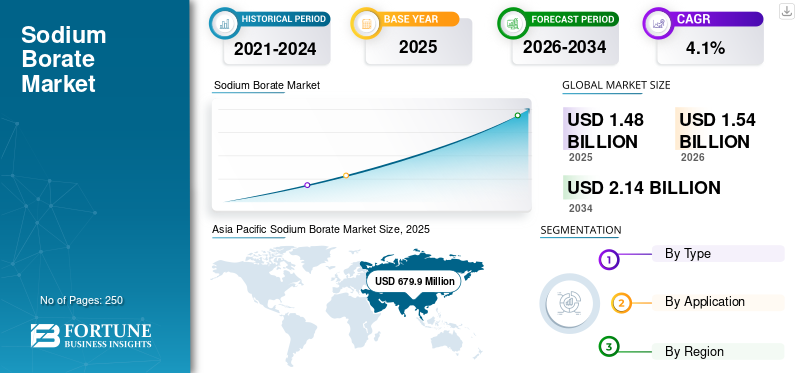
The global sodium borate market size was valued at USD 1,485.0 million in 2025. The market is projected to grow from USD 1,547.8 million in 2024 to USD 2,140.6 million by 2034, exhibiting a CAGR of 4.1% during the forecast period. Asia pacific dominated the sodium borate market with a market share of 45.78% in 2025.
Sodium borate, commonly referred to as borax, is an inorganic boron compound widely used as a fluxing agent, buffering material, cleaning agent, and glass-forming additive. It is available in various hydrated and anhydrous forms, including borax pentahydrate, borax decahydrate, and anhydrous borax. Sodium borate plays a critical role in glass manufacturing, detergents, ceramics, agriculture, and industrial processing. Its ability to improve thermal resistance, enhance chemical stability, and act as a cleaning booster makes it highly versatile across industries. Rising demand for fiberglass in the construction and renewable energy sectors significantly supports consumption.
Additionally, growth in detergents and specialty agricultural micronutrients supports steady demand growth. As boron-based compounds remain essential in industrial chemistry and materials engineering, sodium borate continues to demonstrate stable long-term demand, thus reinforcing its strategic position in the global specialty chemicals market. The key players operating in the market are Eti Maden İşletmeleri Genel Müdürlüğü, Rio Tinto Group, Boron Molecular Pty Ltd., American Borate Company, and 3M Company.
Download Free sample to learn more about this report.
Sodium Borate Market Key Takeaways
 Global Market Size & Forecast
- 2025 Market Size: USD 1,485.0 Million
- 2026 Market Size: USD 1,547.8 Million
- 2034 Forecast Market Size: USD 2,140.6 Million
- CAGR: 4.1% from 2026–2034
 Market Share
- Asia Pacific dominated the sodium borate market with a 45.78% share in 2025.
- The borax decahydrate segment is expected to grow at a CAGR of 3.2% during the forecast period.
- The ceramics & enamels segment is projected to grow at a CAGR of 5.1% during the forecast period.
 Key Regional Highlights
Asia Pacific
Asia Pacific led the global market with a valuation of USD 679.9 million in 2025, supported by strong demand from fiberglass and agriculture sectors.
North America
North America maintained a stable market position, driven by glass manufacturing, detergent production, and infrastructure upgrades.
Europe
Europe continues to benefit from demand in specialty glass, ceramics, and energy-efficient building applications.
U.S.
The sodium borate market reached USD 235.0 million in 2025, accounting for approximately 15.8% of regional revenue.
Japan
Demand is supported by advanced industrial applications and growing use of specialty glass and ceramics products.
Read More

Sodium Borate Market Trends
Glass Industry Expansion and Sustainable Formulations Reshaping Consumption Patterns
The market is evolving as glass and fiberglass production expands, particularly in the construction and renewable energy sectors. Increasing wind energy installations are driving demand for fiberglass, which relies on boron compounds to improve thermal and structural properties. Additionally, detergent manufacturers are shifting to efficient cleaning formulations that use borates as water-softening and buffering agents. Sustainability trends are encouraging optimized boron use and improved resource management, including the use of fertilizers containing borates. Technological improvements in borate refining and processing are enhancing product purity and performance. These structural, industrial, and sustainability shifts are reshaping demand patterns, thereby influencing long-term sodium borate market growth.
Market Dynamics
Market Drivers
Download Free sample to learn more about this report.
Fiberglass Demand and Cleaning Applications Sustaining Market Expansion
The primary driver of the market is the expanding glass and fiberglass industry. Borax improves thermal shock resistance and chemical durability in glass products, making it essential in construction and renewable energy applications. Rising detergent production also significantly supports consumption, as borates enhance cleaning performance and water softening. Agricultural demand for boron micronutrients further reinforces growth. Increasing infrastructure investment and industrial manufacturing expansion contribute to additional demand. These diversified industrial applications ensure steady consumption across sectors, thereby maintaining stable market expansion.
MARKET RESTRAINTS
Environmental Regulations and Raw Material Concentration Limiting Growth Flexibility
The market faces restraints due to environmental regulations governing the handling and use of boron compounds. Regulatory scrutiny concerning toxicity levels in detergents and agriculture may limit application flexibility in certain regions. Additionally, borate reserves are geographically concentrated, leading to supply dependency and potential pricing volatility. Transportation and handling requirements for bulk materials also increase logistical costs. Substitution risks in certain detergent formulations may further impact demand. These regulatory and supply-related constraints create operational challenges, hence moderating growth potential in specific markets.
MARKET OPPORTUNITIES
Renewable Energy Expansion and Agricultural Modernization Creating Growth Potential
Growing renewable energy installations, particularly wind power projects, create significant opportunities for sodium borate due to its use in fiberglass reinforcement. Infrastructure expansion and the adoption of energy-efficient building materials further strengthen demand for glass in manufacturing. Additionally, increasing focus on soil nutrient management in developing economies supports agricultural borate demand. Emerging economies investing in industrialization and detergent production present additional growth avenues. Specialty applications in ceramics, enamels, and flame-retardants also broaden the market scope. As governments prioritize infrastructure, clean energy, and agricultural productivity, sodium borate consumption is expected to rise steadily, therefore strengthening long-term growth prospects in the global market.
MARKET CHALLENGES
Resource Sustainability and Price Volatility Influencing Competitive Dynamics
A key challenge in the market is ensuring sustainable resource management, as boron reserves are finite and geographically limited. Producers must optimize extraction and processing efficiency to maintain long-term supply stability. Price volatility stemming from concentrated mining operations can affect downstream industries. Additionally, environmental compliance and waste management requirements add operational complexity. Balancing cost efficiency with sustainable production practices requires continuous investment in technology and logistics infrastructure. These structural challenges influence competitive positioning, therefore shaping long-term market stability.
Research and Development Trends
R&D efforts focus on improving borate purity, optimizing glass compositions, and enhancing agricultural micronutrient efficiency. Sustainable extraction and refining technologies are also gaining importance to reduce environmental impact and improve cost efficiency.
Segmentation Analysis
By Type
Balanced Solubility and Industrial Versatility Driving Borax Pentahydrate Segmental Dominance
Based on type, the market is segmented into borax pentahydrate, borax decahydrate, anhydrous borax, and others.
Borax pentahydrate holds the leading sodium borate market share due to its optimal balance between solubility, stability, and cost-effectiveness. It is widely used in glass manufacturing, detergents, and agricultural micronutrients. Its versatility across industrial and consumer applications supports strong and consistent demand. Growing fiberglass production and detergent formulation requirements further reinforce its dominant position, thus maintaining segment leadership.
Borax decahydrate is commonly used in detergents, cleaning products, and ceramics due to its water-softening and fluxing properties. Although slightly less concentrated than pentahydrate, it is still widely used in industrial cleaning formulations. Stable demand from household and industrial cleaners supports steady consumption, hence reinforcing its relevance. The segment is expected to hold a CAGR of 3.2% during the forecast period.
By Application
To know how our report can help streamline your business, Speak to Analyst
Infrastructure and Renewable Energy Demand Driving Glass & Fiberglass Segment’s Growth
In terms of application, the market is segmented into glass & fiberglass, detergents & cleaners, agriculture, ceramics & enamels, and others.
Glass and fiberglass represent the largest application segment, as sodium borate enhances thermal resistance, durability, and chemical stability in glass products. Expanding construction and wind energy installations significantly drive consumption. The increasing demand for energy-efficient materials further strengthens their use, thereby maintaining segment dominance.
Sodium borate acts as a water softener and cleaning booster in household and industrial detergents. Rising hygiene awareness and urbanization support stable consumption. Although regulatory considerations influence formulation trends, steady cleaning demand sustains growth, hence reinforcing this segment.
Sodium borate improves glaze properties and thermal resistance in ceramics and enamels. Construction and decorative product demand sustain stable consumption. Although smaller in volume, industrial applications continue to grow, thereby supporting segment stability.
The ceramics & enamels segment is set to flourish with a CAGR of 5.1% during the forecast period.
SODIUM BORATE MARKET REGIONAL OUTLOOK
By region, the market is segmented into North America, Europe, Asia Pacific, Latin America, and the Middle East & Africa.
Asia Pacific
Asia Pacific Sodium Borate Market Size, 2025 (USD Million)
To get more information on the regional analysis of this market, Download Free sample
The market size in Asia Pacific stood at USD 679.9 million in 2025. Asia Pacific holds the largest market share due to strong fiberglass production and expanding agricultural activities. China and India are major consumers, supported by large-scale glass manufacturing for construction and renewable energy. Rapid urbanization and infrastructure development are significantly increasing demand for boron-based glass additives to enhance thermal and chemical resistance. Additionally, agricultural modernization programs in India and Southeast Asia are boosting boron micronutrient consumption to improve crop yields. Expanding detergent manufacturing capacity across emerging economies further supports regional demand. Cost-competitive manufacturing and proximity to key end-use industries strengthen supply chain efficiency. Growing wind energy installations in China also drive demand for fiberglass. These growth drivers in the industrial and agricultural sectors collectively sustain high consumption levels, thereby reinforcing Asia Pacific’s leadership in the global market.
China Sodium Borate Market
Based on Asia Pacific’s strong contribution and China’s position as the leading country in the regional market, the China market was valued at USD 295.2 million in 2025, accounting for approximately 19.9% of regional revenues. Growth is driven by large-scale fiberglass production, expanding wind energy installations, and strong demand in the construction sector.
To know how our report can help streamline your business, Speak to Analyst
North America
North America represents a mature yet stable market for sodium borate, driven by strong glass manufacturing and detergent production. The U.S. benefits from well-established boron reserves and vertically integrated production capabilities, ensuring a steady supply. Growing renovation activities and infrastructure upgrades are supporting demand for fiberglass insulation materials.
U.S. Sodium Borate Market
The U.S. market in 2025 reached a valuation of USD 235.0 million, accounting for approximately 15.8% of regional revenues. Established boron reserves, stable demand for fiberglass insulation, and steady industrial detergent consumption drive growth.
Europe
Stringent environmental regulations and advanced industrial applications influence Europe’s market. Countries such as Germany, France, and Italy maintain strong demand from specialty glass, ceramics, and detergent manufacturing sectors. The region’s focus on energy-efficient buildings supports demand for fiberglass insulation. Additionally, growing emphasis on sustainable agricultural practices is encouraging optimized boron micronutrient application.
Germany Sodium Borate Market
Germany’s market reached a valuation of USD 66.3 million in 2025, accounting for approximately 4.5% of regional demand. Demand is driven by specialty glass manufacturing, renewable energy infrastructure, and energy-efficient building insulation requirements.
Latin America & Middle East & Africa
Latin America is experiencing moderate market growth, driven primarily by agricultural expansion and infrastructure development. Brazil and Argentina are key consumers due to large-scale farming activities requiring boron-based micronutrients to improve soil fertility and crop productivity. Growing construction projects are also increasing demand for fiberglass and glass materials. The Middle East & Africa region is experiencing steady growth supported by infrastructure investments and industrial diversification initiatives. GCC countries are investing in large-scale construction and renewable energy projects, increasing demand for fiberglass materials that utilize sodium borate. Expanding detergent and cleaning product consumption driven by urban population growth further supports regional demand.
Brazil Sodium Borate Market
The Brazilian market in 2025 was valued at USD 40.3 million, accounting for approximately 2.7% of Latin America revenues. Demand is driven by specialty glass manufacturing, renewable energy infrastructure, and energy-efficient building insulation requirements.
Competitive Landscape
Key Industry Players
Resource Concentration and Vertical Integration Strengthening Market Position
The global sodium borate market is moderately concentrated, with production heavily dependent on geographically limited boron reserves. Major players such as Eti Maden and Rio Tinto control significant portions of global borate supply, creating high entry barriers. Competitive advantage is largely determined by access to mineral reserves, integrated mining and refining operations, and established distribution networks. Companies focus on expanding downstream applications in fiberglass, agriculture, and specialty chemicals to enhance value addition. Environmental compliance and sustainable extraction practices increasingly influence strategic positioning. These structural supply dynamics and vertical integration strategies reinforce the dominance of established producers, therefore shaping a resource-driven competitive landscape.
LIST OF KEY SODIUM BORATE COMPANIES PROFILED
- Eti Maden İşletmeleri Genel Müdürlüğü (Turkey)
- Rio Tinto Group (U.S. Borax) (U.K.)
- Boron Molecular Pty Ltd. (Australia)
- American Borate Company (U.S.)
- 3M Company (U.S.)
- Searles Valley Minerals, Inc. (U.S.)
- Gujarat Boron Derivatives Pvt. Ltd. (India)
- YOGI CHEMICAL INDUSTRIES (India)
- Minera Santa Rita S.R.L. (Argentina)
- Orocobre Limited (Allkem Ltd.) (Australia)
REPORT COVERAGE
The global market research report provides a detailed analysis of the market and focuses on key aspects, including leading companies, types, and applications. Also, it offers insights into market trends and highlights vital industry developments. In addition to the factors mentioned above, the report encompasses various factors contributing to the market's growth in recent years. It further includes historical data & forecasts revenue growth at global, regional, and country levels and analyzes the industry's latest market dynamics and opportunities.
Request for Customization to gain extensive market insights.
Report Scope & Segmentation
| ATTRIBUTE | DETAILS |
| Study Period | 2021-2034 |
| Base Year | 2025 |
| Estimated Year | 2026 |
| Forecast Period | 2026-2034 |
| Historical Period | 2021-2024 |
| Unit | Value (USD Million) and Volume (Kiloton) |
| Growth Rate | CAGR of 4.1% from 2026 to 2034 |
| Segmentation | By Type, Application, and Region |
| By Type |
|
| By Application |
|
| By Region |
|
Frequently Asked Questions
Fortune Business Insights says that the global market size was USD 1,485.0 million in 2025 and is projected to reach USD 2,140.6 million by 2034.
In 2025, the Asia Pacific market size stood at USD 679.9 million.
Registering a CAGR of 4.1%, the market will exhibit steady growth during the forecast period.
The glass and fiberglass segment led the market in 2025.
Fiberglass demand and cleaning applications are sustaining market expansion.
Eti Maden İşletmeleri Genel Müdürlüğü, Rio Tinto Group, Boron Molecular Pty Ltd., American Borate Company, and 3M Company are the major players in the market.
Asia Pacific dominated the market in terms of share in 2025.



- 2021-2034
- 2025
- 2021-2024
- 250
Get 30-60 hrs Free Customization
Expand Regional and Country Coverage, Segments Analysis, Company Profiles, Competitive Benchmarking, and End-user Insights.


















Related Reports
-
US +1 833 909 2966 ( Toll Free )
-
Get In Touch With Us